Is there an information or data recession? Are you using less storage? (With Polls)

Is there an information or data recession? Are you using less storage? (With Polls)

StorageIO industry trends

Is there an information recession where you are creating, processing, moving or saving less data?

Are you using less data storage than in the past either locally online, offline or remote including via clouds?

IMHO there is no such thing as a data or information recession, granted storage is being used more effectively by some, while economic pressures or competition enables your budgets to be stretched further. Likewise people and data are living longer and getting larger.

In conversations with IT professionals particular the real customers (e.g. not vendors, VAR’s, analysts, blogalysts, consultants or media) I routinely hear from people that they continue to have the need to store more information, however they’re data storage usage and acquisition patterns are changing. For some this means using what they have more effectively leveraging data footprint reduction (DFR) which includes (archiving, compression, dedupe, thin provision, changing how and when data is protected). This also means using different types of storage from flash SSD to HDD to SSHD to tape summit resources as well as cloud in different ways spanning block, file and object storage local and remote.

A common question that comes up particular around vendor earnings announcement times is if the data storage industry is in decline with some vendors experience poor results?

Look beyond vendor revenue metrics

As a back ground reading, you might want to check out this post here (IT and storage economics 101, supply and demand) which candidly should be common sense.

If all you looked at were a vendors revenues or margin numbers as an indicator of how well such as the data storage industry (includes traditional, legacy as well as cloud) you would not be getting the picture.

What needs to be factored into the picture is how much storage is being shipped (from components such as drives to systems and appliances) as well as delivered by service providers.

Looking at storage systems vendors from a revenue earnings perspective you would get mixed indicators depending on who you include, not to mention on how those vendors report break of revenues by product, or amount units shipped. For example looking at public vendors EMC, HDS, HP, IBM, NetApp, Nimble and Oracle (among others) as well as the private ones (if you can see the data) such as Dell, Pure, Simplivity, Solidfire, Tintri results in different analysis. Some are doing better than others on revenues and margins, however try to get clarity on number of units or systems shipped (for actual revenue vs. loaners (planting seeds for future revenue or trials) or demos).

Then look at the service providers such as AWS, Centurlylink, Google, HP, IBM, Microsoft Rackspace or Verizon (among others) you should see growth, however clarity about how much they are actually generating on revenues plus margin for storage specific vs. broad general buckets can be tricky.

Now look at the component suppliers such as Seagate and Western Digital (WD) for HDDs and SSHDs who also provide flash SSD drives and other technology. Also look at the other flash component suppliers such as Avago/LSI whose flash business is being bought by Seagate, FusionIO, SANdisk, Samsung, Micron and Intel among others (this does not include the systems vendors who OEM those or other products to build systems or appliances). These and other component suppliers can give another indicator as to the health of the industry both from revenue and margin, as well as footprint (e.g. how many devices are being shipped). For example the legacy and startup storage systems and appliance vendors may have soft or lower revenue numbers, however are they shipping the same or less product? Likewise the cloud or service providers may be showing more revenues and product being acquired however at what margin?

What this all means?

Growing amounts of information?

Look at revenue numbers in the proper context as well as in the bigger picture.

If the same number of component devices (e.g. processors, HDD, SSD, SSHD, memory, etc) are being shipped or more, that is an indicator of continued or increased demand. Likewise if there is more competition and options for IT organizations there will be price competition between vendors as well as service providers.

All of this means that while IT organizations budgets stay stretched, their available dollars or euros should be able to buy (or rent) them more storage space capacity.

Likewise using various data and storage management techniques including DFR, the available space capacity can be stretched further.

So this then begs the question of if the management of storage is important, why are we not hearing vendors talking about software defined storage management vs. chasing each other to out software define storage each other?

Ah, that’s for a different post ;).

So what say you?

Are you using less storage?

Do you have less data being created?

Are you using storage and your available budget more effectively?

Please take a few minutes and cast your vote (and see the results).

Sorry I have no Amex or Amazon gift cards or other things to offer you as a giveaway for participating as nobody is secretly sponsoring this poll or post, it’s simply sharing and conveying information for you and others to see and gain insight from.

Do you think that there is an information or data recession?

How about are you using or buying more storage, could there be a data storage recession?

Some more reading links

IT and storage economics 101, supply and demand
Green IT deferral blamed on economic recession might be result of green gap
Industry trend: People plus data are aging and living longer
Is There a Data and I/O Activity Recession?
Supporting IT growth demand during economic uncertain times
The Human Face of Big Data, a Book Review
Garbage data in, garbage information out, big data or big garbage?
Little data, big data and very big data (VBD) or big BS?

Ok, nuff said (for now)

Cheers gs

Greg Schulz – Author Cloud and Virtual Data Storage Networking (CRC Press), The Green and Virtual Data Center (CRC Press) and Resilient Storage Networks (Elsevier)
twitter @storageio

All Comments, (C) and (TM) belong to their owners/posters, Other content (C) Copyright 2006-2026 Server StorageIO and UnlimitedIO LLC All Rights Reserved

Enterprise SSHD and Flash SSD Part of an Enterprise Tiered Storage Strategy

Enterprise SSHD and Flash SSD Part of an Enterprise Tiered Storage Strategy

The question to ask yourself is not if flash Solid State Device (SSD) technologies are in your future.

Instead the questions are when, where, using what, how to configure and related themes. SSD including traditional DRAM and NAND flash-based technologies are like real estate where location matters; however, there are different types of properties to meet various needs. This means leveraging different types of NAND flash SSD technologies in different locations in a complementary and cooperative aka hybrid way.

Introducing Solid State Hybrid Drives (SSHD)

Solid State Hybrid Disks (SSHD) are the successors to previous generation Hybrid Hard Disk Drives (HHDD) that I have used for several years (you can read more about them here, and here).

While it would be nice to simply have SSD for everything, there are also economic budget realities to be dealt with. Keep in mind that a bit of nand flash SSD cache in the right location for a given purpose can go a long way which is the case with SSHDs. This is also why in many environments today there is a mix of SSD, HDD of various makes, types, speeds and capacities (e.g. different tiers) to support diverse application needs (e.g. not everything in the data center is the same).

However, If you have the need for speed and can afford or benefit from the increased productivity by all means go SSD!

Otoh if you have budget constraints and need more space capacity yet want some performance boost, then SSHDs are an option. The big difference however between today’s SSHDs that are available for both enterprise class storage systems and servers, as well as desktop environments is that they can accelerate both reads and writes. This is different from their predecessors that I have used for several years now that had basic read acceleration, however no write optimizations.

SSHD storage I/O oppourtunity
Better Together: Where SSHDs fit in an enterprise tiered storage environment with SSD and HDDs

As their names imply, they are a hybrid between a nand flash Solid State Device (SSD) and traditional Hard Disk Drive (HDD) meaning a best of situation. This means that the SSHD are based on a traditional spinning HDD (various models with different speeds, space capacity, interfaces) along with DRAM (which is found on most modern HDDs), along with nand flash for read cache, and some extra nonvolatile memory for persistent write cache combined with a bit of software defined storage performance optimization algorithms.

Btw, if you were paying attention to that last sentence you would have picked up on something about nonvolatile memory being used for persistent write cache which should prompt the question would that help with nand flash write endurance? Yup.

Where and when to use SSHD?

In the StorageIO Industry Trends Perspective thought leadership white paper I recently released compliments of Seagate Enterprise Turbo SSHD (that’s a disclosure btw ;) enterprise class Solid State Hybrid Drives (SSHD) were looked at and test driven in the StorageIO Labs with various application workloads. These activities include being in a virtual environment for common applications including database and email messaging using industry standard benchmark workloads (e.g. TPC-B and TPC-E for database, JetStress for Exchange).

Storage I/O sshd white paper

Conventional storage system focused workloads using iometer, iorate and vdbench were also run in the StorageIO Labs to set up baseline reads, writes, random, sequential, small and large I/O size with IOPs, bandwidth and response time latency results. Some of those results can be found here (Part II: How many IOPS can a HDD, HHDD or SSD do with VMware?) with other ongoing workloads continuing in different configurations. The various test drive proof points were done in the   comparing SSHD, SSD and different HDDs.

Data Protection (Archiving, Backup, BC, DR)

Staging cache buffer area for snapshots, replication or current copies before streaming to other storage tier using fast read/write capabilities. Meta data, index and catalogs benefit from fast reads and writes for faster protection.

Big Data DSS
Data Warehouse

Support sequential read-ahead operations and “hot-band” data caching in a cost-effective way using SSHD vs. slower similar capacity size HDDs for Data warehouse, DSS and other analytic environments.

Email, Text and Voice Messaging

Microsoft Exchange and other email journals, mailbox or object repositories can leverage faster read and write I/Os with more space capacity.

OLTP, Database
 Key Value Stores SQL and NoSQL

Eliminate the need to short stroke HDDs to gain performance, offer more space capacity and IOP performance per device for tables, logs, journals, import/export and scratch, temporary ephemeral storage. Leverage random and sequential read acceleration to compliment server-side SSD-based read and write-thru caching. Utilize fast magnetic media for persistent data reducing wear and tear on more costly flash SSD storage devices.

Server Virtualization

Fast disk storage for data stores and virtual disks supporting VMware vSphere/ESXi, Microsoft Hyper-V, KVM, Xen and others.  Holding virtual machines such as VMware VMDKs, along with Hyper-V and other hypervisor virtual disks.  Compliment virtual server read cache and I/O optimization using SSD as a cache with writes going to fast SSHD. For example VMware V5.5 Virtual SAN host disk groups use SSD as a read cache and can use SSHD as the magnetic disk for storing data while boosting performance without breaking the budget or adding complexity.

Speaking of Virtual, as mentioned the various proof points were run using Windows systems that were VMware guests with the SSHD and other devices being Raw Device Mapped (RDM) SAS and SATA attached, read how to do that here.

Hint: If you know about the VMware trick for making a HDD look like a SSD to vSphere/ESXi (refer to here and here) think outside the virtual box for a moment on some things you could do with SSHD in a VSAN environment among other things, for now, just sayin ;).

Virtual Desktop Infrastructure (VDI)

SSHD can be used as high performance magnetic disk for storing linked clone images, applications and data. Leverage fast read to support read ahead or pre-fetch to compliment SSD based read cache solutions. Utilize fast writes to quickly store data enabling SSD-based read or write-thru cache solutions to be more effective. Reduce impact of boot, shutdown, and virus scan or maintenance storms while providing more space capacity.

Table 1 Example application and workload scenarios benefiting from SSHDs

Test drive application proof points

Various workloads were run using Seagate Enterprise Turbo SSHD in the StorageIO lab environment across different real world like application workload scenarios. These include general storage I/O performance characteristics profiling (e.g. reads, writes, random, sequential or various IOP size) to understand how these devices compare to other HDD, HHDD and SSD storage devices in terms of IOPS, bandwidth and response time (latency). In addition to basic storage I/O profiling, the Enterprise Turbo SSHD was also used with various SQL database workloads including Transaction Processing Council (TPC); along with VMware server virtualization among others use case scenarios.

Note that in the following workload proof points a single drive was used meaning that using more drives in a server or storage system should yield better performance. This also means scaling would be bound by the constraints of a given configuration, server or storage system. These were also conducted using 6Gbps SAS with PCIe Gen 2 based servers and ongoing testing is confirming even better results with 12Gbs SAS, faster servers with PCIe Gen 3.

SSHD large file storage i/o
Copy (read and write) 80GB and 220GB file copies (time to copy entire file)

SSHD storage I/O TPCB Database performance
SQLserver TPC-B batch database updates

Test configuration: 600GB 2.5” Enterprise Turbo SSHD (ST600MX) 6 Gbps SAS, 600GB 2.5” Enterprise Enhanced 15K V4 (15K RPM) HDD (ST600MP) with 6 Gbps SAS, 500GB 3.5” 7.2K RPM HDD 3 Gbps SATA, 1TB 3.5” 7.2K RPM HDD 3 Gbps SATA. Workload generator and virtual clients ran on Windows 7 Ultimate. Microsoft SQL Server 2012 Database was on Windows 7 Ultimate SP1 (64 bit) 14 GB DRAM, Dual CPU (Intel x3490 2.93 GHz)), with LSI 9211 6Gbps SAS adapters with TPC-B (www.tpc.org) workloads. VM resided on separate data store from devices being tested. All devices being tested with SQL MDF were Raw Device Mapped (RDM) independent persistent with database log file (LDF) on a separate SSD device also persistent (no delayed writes). Tests were performed in StorageIO Lab facilities by StorageIO personal.

SSHD storage I/O TPCE Database performance
SQLserver TPC-E transactional workload

Test configuration: 600GB 2.5” Enterprise Turbo SSHD (ST600MX) 6 Gbps SAS, 600GB 2.5” Enterprise Enhanced 15K V4 (15K RPM) HDD (ST600MP) with 6 Gbps SAS, 300GB 2.5” Savio 10K RPM HDD 6 Gbps SAS, 1TB 3.5” 7.2K RPM HDD 6 Gbps SATA. Workload generator and virtual clients Windows 7 Ultimate. Microsoft SQL Server 2012 database was on Windows 7 Ultimate SP1 (64 bit) 14 GB DRAM, Dual CPU (E8400 2.99GHz), with LSI 9211 6Gbps SAS adapters with TPC-E (www.tpc.org) workloads. VM resided on separate SSD based data store from devices being tested (e.g., where MDF resided). All devices being tested were Raw Device Mapped (RDM) independent persistent with database log file on a separate SSD device also persistent (no delayed writes). Tests were performed in StorageIO Lab facilities by StorageIO personal.

SSHD storage I/O Exchange performance
Microsoft Exchange workload

Test configuration: 2.5” Seagate 600 Pro 120GB (ST120FP0021 ) SSD 6 Gbps SATA, 600GB 2.5” Enterprise Turbo SSHD (ST600MX) 6 Gbps SAS, 600GB 2.5” Enterprise Enhanced 15K V4 (15K RPM) HDD (ST600MP) with 6 Gbps SAS, 2.5” Savio 146GB HDD 6 Gbps SAS, 3.5” Barracuda 500GB 7.2K RPM HDD 3 Gbps SATA. Email server hosted as guest on VMware vSphere/ESXi V5.5, Microsoft Small Business Server (SBS) 2011 Service Pack 1 64 bit, 8GB DRAM, One CPU (Intel X3490 2.93 GHz) LSI 9211 6 Gbps SAS adapter, JetStress 2010 (no other active workload during test intervals). All devices being tested were Raw Device Mapped (RDM) where EDB resided. VM on a SSD based separate data store than devices being tested. Log file IOPs were handled via a separate SSD device.

Read more about the above proof points along view data points and configuration information in the associated white paper found here (no registration required).

What this all means

Similar to flash-based SSD technologies the question is not if, rather when, where, why and how to deploy hybrid solutions such as SSHDs. If your applications and data infrastructures environment have the need for storage I/O speed without loss of space capacity and breaking your budget, SSD enabled devices like the Seagate Enterprise Turbo 600GB SSHD are in your future. You can learn more about enterprise class SSHD such as those from Seagate by visiting this link here.

Watch for extra workload proof points being performed including with 12Gbps SAS and faster servers using PCIe Gen 3.

Ok, nuff said.

Cheers
Gs

Greg Schulz – Author Cloud and Virtual Data Storage Networking (CRC Press), The Green and Virtual Data Center (CRC Press) and Resilient Storage Networks (Elsevier)
twitter @storageio

All Comments, (C) and (TM) belong to their owners/posters, Other content (C) Copyright 2006-2026 Server StorageIO and UnlimitedIO LLC All Rights Reserved

Data Storage Innovation Chat with SNIA Wayne Adams and David

Data Storage Innovation Chat with SNIA Wayne Adams and David

In this episode, SNIA Chairman Emeritus Wayne Adams and current Chairman David Dale join me in a conversation from the Data Storage Innovation Conference (DSICON) 2014 conference event.

SNIA DSI David Dale
SNIA Chairman David Dale opening remarks SNIA DSICON 2014

SNIA DSI Conference (DSICON), CDMI Conformance Testing and other updates

DSICON is a new event produced by SNIA targeted for IT professionals involved with data storage related topics, themes, technologies and tools spanning hardware, software, cloud, virtual and physical. In this conversation, we talk about the new DSI event, the diversity of new attendees who are attending their first SNIA event, along with other updates. Some of these updates include what is new with the SNIA Cloud Data Management Initiative (CDMI), Non Volatile Memory (think flash and SSD), SMIS, education and more. In addition to the DSICON event, SNIA also announced CDMI Cloud Interoperability Conformance Test Program is now available for cloud solution vendors and providers.

DSI, Santa Clara, CA (April 22, 2014)— The Storage Networking Industry Association (SNIA), today announced the launch of a Cloud Data Management Interface (CDMI) Conformance Test Program (CTP)that validates cloud products’ conformance to the ISO/IEC CDMI standard for cloud data interoperability(ISO catalog number ISO/IEC 17826:2012). Cloud solutions that pass the CDMI CTP offer cloud consumers assurance that the CDMI standard has been properly implemented and that data stored in any conformant implementation will be transportable to any other conformant implementation.

Here is a perspective commentary quote that I issued which was included in the SNIA Press Release.

“Today, the cloud market is crowded with a slew of vendors offering different solutions for migration, data management and security, often leaving IT customers confused about the right solution for their requirements,” said Greg Schulz, founder of StorageIO, a storage technology advisory and consulting firm. “SNIA’s CDMI Conformance Test Program is a great step forward helping IT customers, VARs or others in the industry navigate their way through the fog of cloud interoperability requirements in a streamlined fashion, not to mention laying standard routes vendors will want to adopt going forward.”

Check out the full SNIA CDMI press release announcement for the conformance testing here, as well as learn more about CDMI here.

audio

Listen in to our podcast conversation here as we cover cloud, convergence, software defined and more about data storage.

Topics and themes discussed:

  • Data Storage Innovation (DSICON) Conference
  • Data Storage Infrastructures and Convergence
  • Cloud Data Management Initiative (CDMI) and Conformance Testing
  • CDMI Update and Overview (or refresher)
  • Nonvolatile Memory and flash SSD
  • Standards, education and other technical activities
  • Check out SNIA and DSICON listen in to the conversation with David Dale and Wayne Adams here.

    Also available via 

    Ok, nuff said.

    Cheers
    Gs

    Greg Schulz – Author Cloud and Virtual Data Storage Networking (CRC Press), The Green and Virtual Data Center (CRC Press) and Resilient Storage Networks (Elsevier)
    twitter @storageio

    All Comments, (C) and (TM) belong to their owners/posters, Other content (C) Copyright 2006-2026 Server StorageIO and UnlimitedIO LLC All Rights Reserved

    Chat with Cash Coleman talking ClearDB, cloud database and Johnny Cash

    Podcast with Cash Coleman talking ClearDB, cloud database and Johnny Cash

    audio

    In this episode from the SNIA DSI 2014 event I am joined by Cashton Coleman (@Cash_Coleman).

    cash coleman cleardb

    Introducing Cashton (Cash) Coleman and ClearDB

    Cashton (Cash) is a Software architect, product mason, family bonder, life builder, idea founder along with Founder & CEO of SuccessBricks, Inc., makers of ClearDB. ClearDB is a provider of MySQL database software tools for cloud and physical environments. In our conversation talk about ClearDB, what they do and whom they do it with including deployments in cloud’s as well as onsite. For example if you are using some of the Microsoft Azure cloud services using MySQL, you may already be using this technology. However, there is more to the story and discussion including how Cash got his name, how to speed up databases for little and big data among other topics.

    If you are a database person, you will want to listen to what Cash has to say about boosting performance and getting more value out of your physical hardware or cloud services. On the other hand if you are a storage person, listen in to get some insight and ideas on to address database performance and resiliency. For others who just like to listen to new trends, technology talk, or hear about emerging companies to keep an eye on, you wont want to miss the podcast conversation.

    Topics and themes discussed:

  • Traditional and Cloud Database
  • MySQL and Database as a Service (DaaS)
  • Microsoft Azure and Amazon Web Services (AWS)
  • Little Data, Big Data and Big Data Databases
  • Boosting database performance with less hardware
  • Getting more value out of fast SSD hardware
  • Database performance and resiliency
  • What’s the Johnny Cash and Cloud Connection
  • Check out ClearDB and listen in to the conversation with Cash podcast here.

    Also available via 

    Ok, nuff said.

    Cheers
    Gs

    Greg Schulz – Author Cloud and Virtual Data Storage Networking (CRC Press), The Green and Virtual Data Center (CRC Press) and Resilient Storage Networks (Elsevier)
    twitter @storageio

    All Comments, (C) and (TM) belong to their owners/posters, Other content (C) Copyright 2006-2026 Server StorageIO and UnlimitedIO LLC All Rights Reserved

    Nand flash SSD NVM SCM server storage I/O memory conversations

    Updated 8/31/19
    Server Storage I/O storageioblog SDDC SDDI Data Infrastructure trends

    The SSD Place NVM, SCM, PMEM, Flash, Optane, 3D XPoint, MRAM, NVMe Server, Storage, I/O Topics

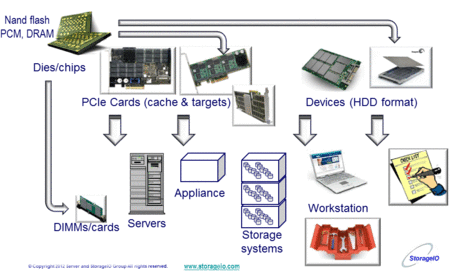
    Now and then somebody asks me if I’m familiar with flash or nand flash Solid State Devices (SSD) along with other non-volatile memory (NVM) technologies and trends including NVM Express (NVMe).

    Having been involved with various types of SSD technology, products and solutions since the late 80s initially as a customer in IT (including as a lunch customer for DEC’s ESE20 SSD’s), then later as a vendor selling SSD solutions, as well as an analyst and advisory consultant cover the technologies, I tell the person asking, well, yes, of course.

    That gave me the idea as well as to help me keep track of some of the content and make it easy to find by putting it here in this post (which will be updated now and then).

    Thus this is a collection of articles, tips, posts, presentations, blog posts and other content on SSD including nand flash drives, PCIe cards, DIMMs, NVM Express (NVMe), hybrid and other storage solutions along with related themes.

    Also if you can’t find it here, you can always do a Google search like this or this to find some more material (some of which is on this page).

    HDD, SSHD, HHDD and HDD

    Flash SSD Articles, posts and presentations

    The following are some of my tips, articles, blog posts, presentations and other content on SSD. Keep in mind that the question should not be if SSD are in your future, rather when, where, with what, from whom and how much. Also keep in mind that a bit of SSD as storage or cache in the right place can go a long way, while a lot of SSD will give you a benefit however also cost a lot of cash.

    • How to Prepare for the NVMe Server Storage I/O Wave (Via Micron.com)
    • Why NVMe Should Be in Your Data Center (Via Micron.com)
    • NVMe U2 (8639) vs. M2 interfaces (Via Gamersnexus)
    • Enmotus FuzeDrive MicroTiering (StorageIO Lab Report)
    • EMC DSSD D5 Rack Scale Direct Attached Shared SSD All Flash Array Part I (Via StorageIOBlog)
    • Part II – EMC DSSD D5 Direct Attached Shared AFA (Via StorageIOBlog)
    • NAND, DRAM, SAS/SCSI & SATA/AHCI: Not Dead, Yet! (Via EnterpriseStorageForum)
    • Non Volatile Memory (NVM), NVMe, Flash Memory Summit and SSD updates (Via StorageIOblog)
    • Microsoft and Intel showcase Storage Spaces Direct with NVM Express at IDF ’15 (Via TechNet)
    • MNVM Express solutions (Via SuperMicro)
    • Gaining Server Storage I/O Insight into Microsoft Windows Server 2016 (Via StorageIOblog)
    • PMC-Sierra Scales Storage with PCIe, NVMe (Via EEtimes)
    • RoCE updates among other items (Via InfiniBand Trade Association (IBTA) December Newsletter)
    • NVMe: The Golden Ticket for Faster Flash Storage? (Via EnterpriseStorageForum)
    • What should I consider when using SSD cloud? (Via SearchCloudStorage)
    • MSP CMG, Sept. 2014 Presentation (Flash back to reality – Myths and Realities – Flash and SSD Industry trends perspectives plus benchmarking tips)– PDF
    • Selecting Storage: Start With Requirements (Via NetworkComputing)
    • PMC Announces Flashtec NVMe SSD NVMe2106, NVMe2032 Controllers With LDPC (Via TomsITpro)
    • Exclusive: If Intel and Micron’s “Xpoint” is 3D Phase Change Memory, Boy Did They Patent It (Via Dailytech)
    • Intel & Micron 3D XPoint memory — is it just CBRAM hyped up? Curation of various posts (Via Computerworld)
    • How many IOPS can a HDD, HHDD or SSD do (Part I)?
    • How many IOPS can a HDD, HHDD or SSD do with VMware? (Part II)
    • I/O Performance Issues and Impacts on Time-Sensitive Applications (Via CMG)
    • Via EnterpriseStorageForum: 5 Hot Storage Technologies to Watch
    • Via EnterpriseStorageForum: 10-Year Review of Data Storage
    • Via CustomPCreview: Samsung SM961 PCIe NVMe SSD Shows Up for Pre-Order
    • StorageIO Industry Trends Perspective White Paper: Seagate 1200 Enterprise SSD (12Gbps SAS) with proof points (e.g. Lab test results)
    • Companion: Seagate 1200 12Gbs Enterprise SAS SSD StorgeIO lab review (blog post part I and Part II)
    • NewEggBusiness: Seagate 1200 12Gbs Enterprise SAS SSD StorgeIO lab review Are NVMe m.2 drives ready for the limelight?
    • Google (Research White Paper): Disks for Data Centers (vs. just SSD)
    • CMU (PDF White Paper): A Large-Scale Study of Flash Memory Failures in the Field
    • Via ZDnet: Google doubles Cloud Compute local SSD capacity: Now it’s 3TB per VM
    • EMC DSSD D5 Rack Scale Direct Attached Shared SSD All Flash Array Part I (Via StorageIOBlog)
    • Part II – EMC DSSD D5 Direct Attached Shared AFA (Via StorageIOBlog)
    • NAND, DRAM, SAS/SCSI & SATA/AHCI: Not Dead, Yet! (Via EnterpriseStorageForum)
    • Here’s why Western Digital is buying SanDisk (Via ComputerWorld)
    • HP, SanDisk partner to bring storage-class memory to market (Via ComputerWorld)
    • Non Volatile Memory (NVM), NVMe, Flash Memory Summit and SSD updates (Via StorageIOblog)
    • Microsoft and Intel showcase Storage Spaces Direct with NVM Express at IDF ’15 (Via TechNet)
    • PMC-Sierra Scales Storage with PCIe, NVMe (Via EEtimes)
    • Seagate Grows Its Nytro Enterprise Flash Storage Line (Via InfoStor)
    • New SAS Solid State Drive First Product From Seagate Micron Alliance (Via Seagate)
    • Wow, Samsung’s New 16 Terabyte SSD Is the World’s Largest Hard Drive (Via Gizmodo)
    • Samsung ups the SSD ante with faster, higher capacity drives (Via ITworld)
    • PMC Announces Flashtec NVMe SSD NVMe2106, NVMe2032 Controllers With LDPC (Via TomsITpro)
    • New SATA SSD powers elastic cloud agility for CSPs (Via Cbronline)
    • Toshiba Solid-State Drive Family Features PCIe Technology (Via Eweek)
    • SanDisk aims CloudSpeed Ultra SSD at cloud providers (Via ITwire)
    • Everspin & Aupera reveal all-MRAM Storage Module in M.2 Form Factor (Via BusinessWire)
    • Intel, Micron Launch “Bulk-Switching” ReRAM (Via EEtimes)
    • Exclusive: If Intel and Micron’s “Xpoint” is 3D Phase Change Memory, Boy Did They Patent It (Via Dailytech)
    • Intel & Micron 3D XPoint memory — is it just CBRAM hyped up? Curation of various posts (Via Computerworld)
    • NVMe: The Golden Ticket for Faster Flash Storage? (Via EnterpriseStorageForum)

    server I/O hirearchy

    • What should I consider when using SSD cloud? (Via SearchCloudStorage)
    • MSP CMG, September 2014 Presentation (Flash back to reality – Myths and Realities Flash and SSD Industry trends perspectives plus benchmarking tips) – PDF
    • Selecting Storage: Start With Requirements (Via NetworkComputing)
    • Spot The Newest & Best Server Trends (Via Processor)
    • Market ripe for embedded flash storage as prices drop (Via Powermore (Dell))
    • 2015 Tech Preview: SSD and SMBs (Via ChannelProNetworks )
    • How to test your HDD, SSD or all flash array (AFA) storage fundamentals (Via StorageIOBlog)
    • Processor: Comments on What Abandoned Data Is Costing Your Company
    • Processor: Comments on Match Application Needs & Infrastructure Capabilities
    • Processor: Comments on Explore The Argument For Flash-Based Storage
    • Processor: Comments on Understand The True Cost Of Acquiring More Storage
    • Processor: Comments on What Resilient & Highly Available Mean
    • Processor: Explore The Argument For Flash-Based Storage
    • SearchCloudStorage What should I consider when using SSD cloud?
    • StorageSearch.com: (not to be confused with TechTarget, good site with lots of SSD related content)
    • StorageSearch.com: What kind of SSD world… 2015?
    • StorageSearch.com: Various links about SSD
    • FlashStorage.com: (Various flash links curated by Tegile and analyst firm Actual Tech Media [Scott D. Lowe])
    • StorageSearch.com: How fast can your SSD run backwards?
    • Seagate has shipped over 10 Million storage HHDD’s (SSHDs), is that a lot?
    • Are large storage arrays dead at the hands of SSD?
    • Can we get a side of context with them IOPS and other storage metrics?
    • Cisco buys Whiptail continuing the SSD storage I/O flash cash cache dash
    • EMC VFCache respinning SSD and intelligent caching (Part I)
    • Flash Data Storage: Myth vs. Reality (Via InfoStor)
    • Have SSDs been unsuccessful with storage arrays (with poll)?
    • How many IOPS can a HDD, HHDD or SSD do (Part I)?
    • How many IOPS can a HDD, HHDD or SSD do with VMware? (Part II)
    • I/O Performance Issues and Impacts on Time-Sensitive Applications (Via CMG)

    server storage i/o memory hirearchy

    • Spiceworks SSD and related conversation here and here, profiling IOPs here, and SSD endurance here.
    • SSD is in your future, How, when, with what and where you will be using it (PDF Presentation)
    • SSD for Virtual (and Physical) Environments: Part I Spinning up to speed on SSD (Via TheVirtualizationPractice), Part II, The call to duty, SSD endurance, Part III What SSD is best for you?, and Part IV what’s best for your needs.
    • IT and storage economics 101, supply and demand
    • SSD, flash and DRAM, DejaVu or something new?
    • The Many Faces of Solid State Devices/Disks (SSD)
    • The Nand Flash Cache SSD Cash Dance (Via InfoStor)
    • The Right Storage Option Is Important for Big Data Success (Via FedTech)

    server storage i/o nand flash ssd options

    • Viking SATADIMM: Nand flash SATA SSD in DDR3 DIMM slot?
    • WD buys nand flash SSD storage I/O cache vendor Virident (Via VMware Communities)
    • What is the best kind of IO? The one you do not have to do
    • When and Where to Use NAND Flash SSD for Virtual Servers (Via TheVirtualizationPractice)
    • Why SSD based arrays and storage appliances can be a good idea (Part I)
    • Why SSD based arrays and storage appliances can be a good idea (Part II)
    • Q&A on Access data more efficiently with automated storage tiering and flash (Via SearchSolidStateStorage)
    • InfoStor: Flash Data Storage: Myth vs. Reality (Via InfoStor)
    • Enterprise Storage Forum: Not Just a Flash in the Pan (Via EnterpriseStorageForum)

    SSD Storage I/O and related technologies comments in the news

    The following are some of my commentary and industry trend perspectives that appear in various global venues.

    • Comments on using Flash Drives To Boost Performance (Via Processor)
    • Comments on selecting the Right Type, Amount & Location of Flash Storage (Via Toms It Pro)
    • Comments Google vs. AWS SSD: Which is the better deal? (Via SearchAWS)
    • Tech News World: SANdisk SSD comments and perspectives.
    • Tech News World: Samsung Jumbo SSD drives perspectives
    • Comments on Why Degaussing Isn’t Always Effective (Via StateTech Magazine)
    • Processor: SSD (FLASH and RAM)
    • SearchStorage: FLASH and SSD Storage
    • Internet News: Steve Wozniak joining SSD startup
    • Internet News: SANdisk sale to Toshiba
    • SearchSMBStorage: Comments on SanDisk and wireless storage product
    • StorageAcceleration: Comments on When VDI Hits a Storage Roadblock and SSD
    • Statetechmagazine: Boosting performance with SSD
    • Edtechmagazine: Driving toward SSDsStorage I/O trends
    • SearchStorage: Seagate SLC and MLC flash SSD
    • SearchWindowServer: Making the move to SSD in a SAN/NAS
    • SearchSolidStateStorage: Comments SSD marketplace
    • InfoStor: Comments on SSD approaches and opportunities
    • SearchSMBStorage: Solid State Devices (SSD) benefits
    • SearchSolidState: Comments on Fusion-IO flash SSD and API’s
    • SeaarchSolidStateStorage: Comments on SSD industry activity and OCZ bankruptcy
    • Processor: Comments on Plan Your Storage Future including SSD
    • Processor: Comments on Incorporate SSDs Into Your Storage Plan
    • Digistor: Comments on SSD and flash storage
    • ITbusinessEdge: Comments on flash SSD and hybrid storage environments
    • SearchStorage: Perspectives on Cisco buying SSD storage vendor Whiptail
    • StateTechMagazine: Comments on all flash SSD storage arrays
    • Processor: Comments on choosing SSDs for your data center needs
    • Searchsolidstatestorage: Comments on how to add solid state devices (SSD) to your storage system
    • Networkcomputing: Comments on SSD/Hard Disk Hybrids Bridge Storage Divide
    • Internet Evolution: Comments on IBM buying flash SSD vendor TMS
    • ITKE: Comments on IBM buying flash SSD vendor TMSStorage I/O trends
    • Searchsolidstatestorage: SSD, Green IT and economic benefits
    • IT World Canada: Cloud computing, dot be scared, look before you leap
    • SearchStorage: SSD in storage systems
    • SearchStorage: SAS SSD
    • SearchSolidStateStorage: Comments on Access data more efficiently with automated storage tiering and flash
    • InfoStor: Comments on EMC’s Light to Speed: Flash, VNX, and Software-Defined
    • EnterpriseStorageForum: Cloud Storage Mergers and Acquisitions: What’s Going On?

    Check out the Server StorageIO NVM Express (NVMe) focus page aka www.thenvmeplace.com for additional related content. nterested in data protection, check out the data protection diaries series of posts here, or cloud and object storage here, and server storage I/O performance benchmarking here. Also check out the StorageIO events and activities page here, as well as tips and articles here, news commentary here, along out newsletter here.

    Ok, nuff said (for now)

    Cheers
    Gs

    Greg Schulz – Author Cloud and Virtual Data Storage Networking (CRC Press), The Green and Virtual Data Center (CRC Press) and Resilient Storage Networks (Elsevier)
    twitter @storageio

    All Comments, (C) and (TM) belong to their owners/posters, Other content (C) Copyright 2006-2026 Server StorageIO and UnlimitedIO LLC All Rights Reserved

    Data Protection Diaries: March 31 World Backup Day is Restore Data Test Time

    Storage I/O trends

    World Backup Day Generating Awareness About Data Protection

    This World Backup Day piece is part of my ongoing Data Protection Diaries series of posts (www.dataprotecitondiaries.com) about trends, strategies, tools and best practices spanning applications, archiving, backup/restore, business continuance (BC), business resiliency (BR), cloud, data footprint reduction (DFR), security, servers, storage and virtualization among other related topic themes.

    data protection threat risk scenarios
    Different threat risks and reasons to protect your digital assets (data)

    March 31 is World Backup Day which means you should make sure that your data and digital assets (photos, videos, music or audio, scanned items) along with other digital documents are protected. Keep in mind that various reasons for protecting, preserving and serving your data regardless of if you are a consumer with needs to protect your home and personal information, or a large business, institution or government agency.

    Why World Backup Day and Data Protection Focus

    By being protected this means making sure that there are copies of your documents, data, files, software tools, settings, configurations and other digital assets. These copies can be in different locations (home, office, on-site, off-site, in the cloud) as well as for various points in time or recovery point objective (RPO) such as monthly, weekly, daily, hourly and so forth.

    Having different copies for various times (e.g. your protection interval) gives you the ability to go back to a specific time to recover or restore lost, stolen, damaged, infected, erased, or accidentally over-written data. Having multiple copies is also a safeguard incase either the data, files, objects or items being backed up or protected are bad, or the copy is damaged, lost or stolen.

    Restore Test Time

    While the focus of world backup data is to make sure that you are backing up or protecting your data and digital assets, it is also about making sure what you think is being protected is actually occurring. It is also a time to make sure what you think is occurring or know is being done can actually be used when needed (restore, recover, rebuild, reload, rollback among other things that start with R). This means testing that you can find the files, folders, volumes, objects or data items that were protected, use those copies or backups to restore to a different place (you don’t want to create a disaster by over-writing your good data).

    In addition to making sure that the data can be restored to a different place, go one more step to verify that the data can actually be used which means has it be decrypted or unlocked, have the security or other rights and access settings along with meta data been applied. While that might seem obvious it is often the obvious that will bite you and cause problems, hence take some time to test that all is working, not to mention get some practice doing restores.

    Data Protection and Backup 3 2 1 Rule and Guide

    Recently I did a piece based on my own experiences with data protection including Backup as well as Restore over at Spiceworks called My copies were corrupted: The 3-2-1 rule. For those not familiar, or as a reminder 3 2 1 means have more than three copies or better yet, versions stored on at least two different devices, systems, drives, media or mediums in at least one different location from the primary or main copy.

    Following is an excerpt from the My copies were corrupted: The 3-2-1 rule piece:

    Not long ago I had a situation where something happened to an XML file that I needed. I discovered it was corrupted, and I needed to do a quick restore.

    “No worries,” I thought, “I’ll simply copy the most recent version that I had saved to my file server.” No such luck. That file had been just copied and was damaged.

    “OK, no worries,” I thought. “That’s why I have a periodic backup copy.” It turns out that had worked flawlessly. Except there was a catch — it had backed up the damaged file. This meant that any and all other copies of the file were also damaged as far back as to when the problem occurred.

    Read the full piece here.

    Backup and Data Protection Walking the Talk

    Yes I eat my own dog food meaning that I practice what I talk about (e.g. walking the talk) leveraging not just a  3 2 1 approach, actually more of a 4 3 2 1 hybrid which means different protection internals, various retention’s and frequencies, not all data gets treated the same, using local disk, removable disk to go off-site as well as cloud. I also test candidly more often by accident using the local, removable and cloud copies when I accidentally delete something, or save the wrong version.

    Some of my data and applications are protected throughout the day, others on set schedules that vary from hours to days to weeks to months or more. Yes, some of my data such as large videos or other items that are static do not change, so why backup them up or protect every day, week or month? I also align the type of protection, frequency, retention to meet different threat risks, as well as encrypt data. Part of actually testing and using the restores or recoveries is also determining what certificates or settings are missing, as well as where opportunities exist or needed to enhance data protection.

    Closing comments (for now)

    Take some time to learn more about data protection including how you can improve or modernize while rethinking what to protect, when, where, why how and with what.

    In addition to having copies from different points in time and extra copies in various locations, also make sure that they are secured or encrypted AND make sure to protect your encryption keys. After all, try to find a digital locksmith to unlock your data who is not working for a government agency when you need to get access to your data ;)…

    Learn more about data protection including Backup/Restore at www.storageioblog.com/data-protection-diaries-main/ where there are a collection of related posts and presentations including:

    Also check out the collection of technology and vendor / product neutral data protection and backup/restore content at BackupU (disclosure: sponsored by Dell Data Protection Software) that includes various webinars and Google+ hangout sessions that I have been involved with.

    Watch for more data protection conversations about related trends, themes, technologies, techniques perspectives in my ongoing data protection diaries discussions as well as read more about Backup and other related items at www.storageioblog.com/data-protection-diaries-main/.

    Ok, nuff said

    Cheers
    Gs

    Greg Schulz – Author Cloud and Virtual Data Storage Networking (CRC Press), The Green and Virtual Data Center (CRC Press) and Resilient Storage Networks (Elsevier)
    twitter @storageio

    All Comments, (C) and (TM) belong to their owners/posters, Other content (C) Copyright 2006-2026 Server StorageIO and UnlimitedIO LLC All Rights Reserved

    Matt Vogt of Computex talks VMware vCOPs in his first ever podcast

    Storage I/O trends

    Matt Vogt of Computex talks VMware vCOPs in his first ever podcast

    audio

    In this episode from the Computex Rethink your Datacenter for 2017 planning and strategy event I am joined by Matt Vogt (@MattVogt).

    Introducing Matt Vogt

    Matt is a Principal Architect with Computex Technology Solutions as well as certified VMware specialist and fellow vExpert.

    audio

    Not only is this the first appearance by Matt on the StorageIO Podcasts, it is also his first time as a guest on any podcast so I’m honored to host his global debut podcast appearance here.

    We talk about the role of automation for performance and capacity optimization along with how VMware vCOPs plays an important role.

    Listen in to learn more about how to gain insight and situational awareness to make informed decisions for your data infrastructure environment with Matt.

    Check out Matt’s blog here at blog.mattvogt.net and listen in to the pod cast here.

    Also available via 

    Ok, nuff said.

    Cheers
    Gs

    Greg Schulz – Author Cloud and Virtual Data Storage Networking (CRC Press), The Green and Virtual Data Center (CRC Press) and Resilient Storage Networks (Elsevier)
    twitter @storageio

    All Comments, (C) and (TM) belong to their owners/posters, Other content (C) Copyright 2006-2026 Server StorageIO and UnlimitedIO LLC All Rights Reserved

    March 2014 StorageIO Update Newsletter : Cisco Cloud, VMware VSAN and More

    Industry Trends Perspectives: Cisco Cloud and VMware VSAN

    Welcome to the March 2014 edition of the StorageIO Update (newsletter) containing trends perspectives on cloud, virtualization and data infrastructure topics. Technically it is now spring here in North America and to say that we have had abnormal cold weather would be an understatement. However it is March with April just around the corner meaning plenty to do including several upcoming events (see below).

    Clouds and Cisco

    Some recent industry activity has included Cisco announcing its Cloud intentions (e.g. more than simply selling servers and networking hardware). So far the Cisco Cloud move appears to be more about hybrid and partner ecosystem including channels vs. going toes to toe with an Amazon Web Service (AWS). Cisco appears to playing the hybrid theme of being a technology supplier as well as provider or partner. Thus, it looks like for the near term the Cisco cloud target is not as much AWS as the likes of an IBM who recently added Softlayer or an HP.

    Greg Schulz Storage I/OGreg Schulz on break

    This will also be interesting to watch where along with how other Cisco partners such as EMC, Microsoft, NetApp, VCE and VMware participate. Keep in mind that some of these and other Cisco partners also have their own public, private and hybrid cloud initiatives, services along with being a supplier to each other.

    VMware VSAN Software Defined Storage

    Another industry activity involving servers storage I/O networking hardware software and virtualization (aka software defined) was the general announcement (GA) by VMware of Virtual SAN (VSAN). VMware VSAN went into public beta shortly after VMworld 2013 timeframe when many of us downloaded, installed and did various types of testing with it.

    For those not familiar with VSAN, it is added licensed software functionality for VMware that creates a cluster to host Virtual Machines (VMs) along with its own shared resilient storage solution (e.g. Software Defined Storage). How VSAN works is to use PCIe, SAS, SATA dedicated direct attached storage (DAS) including that are local to the VMware host server (physical machine or PM). The VMware host PMs support DAS Hard Disk Drives (HDD), Solid State Devices (SSD) including PCIe cards, drives or DIMMs, along with Solid State Hybrid Drives (SSHD). This local DAS storage is served and shared among the nodes (up to 32 host or PMs) per VSAN cluster balancing performance, availability (and resiliency) along with space capacity to host VM objects. Note that VM objects include VMDKs (e.g. virtual disks) and are not to be confused with the other type of object storage or access such as CDMI/SWIFT/S3/HTTP/REST.

    VMs (and those managing them) see in the VSAN cluster dats that are familiar with other VMware implementations including storage policies and other tools. Here is a link to a great piece by Patrick Schulz a data infrastructure systems engineer in Germany (no relation, at least not that I know of yet) where he shares his experiences with VSAN implementation.

    storage I/O vsan
    Generic VSAN example

    Instead of using an external iSCSI, Fibre Channel (FC) or FC over Ethernet (FCoE) shared SAN or NAS storage system / appliance to create the storage repository, local DAS is leveraged in groups spread across the hosts in the VSAN cluster (up to 32 nodes ). VSAN requires a percentage of SSD for each storage group on the host cluster nodes that a part is used for caching data which is persistently stored on HDD based media.

    VSAN software is licensed by the number of active sockets (not the cores) in the host servers (PM) that are in the cluster or by number of VDI users (guest VMs). For example if there are four servers two with one socket and two with dual sockets there would be six socket licenses. MSRP License cost per processor socket is $2,495 USD which also assumes core VMware licenses already exist. There are also a per guest VM license of $50 per VDI instance, as well as other optional license models and bundles with different features or upgrades.

    What is different with VSAN vs. other VMware clusters is that a) the storage is only accessible to VMs that are in the VSAN cluster (unless a VM exports and serves to others via NFS, iSCSI, etc which is a different conversation for another day). Another difference is that today VSAN leverage storage inside of servers or direct attached as opposed to using iSCSI, FC, FCoE SAN or NAS storage systems.

    Btw, the current maximum LUN, volume or target storage device size is 4TB so if you were thinking of taking a SAS attached storage system and creating a bunch of small LUNs, you might want to review that from a cost perspective, or at least for today.

    There is much more to VSAN including how it works, what it can and can not do, who it is for and whom should not use for different app’s, however IMHO besides lower-end, SMB, workgroup, departmental, VMware centric environments, the number one scenario today is VDI along with where converged solutions such as those from Nutanix, Simplivity and Tintri among others are playing.

    Watch for more StorageIO posts, commentary, perspectives, presentations, webinars, tips and events on information and data infrastructure topics, themes and trends. Data Infrastructure topics include among others cloud, virtual, legacy server, storage I/O networking, data protection, hardware and software.

    Check out our backup, restore, BC, DR and archiving (Under the resources section on StorageIO.com) for extra content.

    StorageIO Industry Trends and PerspectivesIndustry trends tips, commentary, articles and blog posts
    What is being seen, heard and talked about while out and about

    The following is a synopsis of some StorageIOblog posts, articles and comments in different venues on various industry trends, perspectives and related themes about clouds, virtualization, data and storage infrastructure topics among related themes.

    Recent StorageIO comments and perspectives in the news

    SearchSolidStateStorage: Comments on automated storage tiering and flash
    EnterpriseStorageForum: Comments on Cloud-Storage Mergers and Acquisitions
    SearchDataBackup: Comments on near-CDP nudging true CDP from landscape
    EnterpriseStorageForum: Comments on Ways to Avoid Cloud Storage Pricing Surprises
    SearchDataBackup: Q&A: Snapshot, replication ‘great approach’ for data protection
    SearchDataBackup: Comments on LTFS-enabled products

    StorageIO tips and articles Recent StorageIO tips and articles in various venues

    InformationSecurityBuzz: Dark Territories – Do You Know Where Your Information Is?
    InformationSecurityBuzz: Rings Of Security For Data Protection Or For Appearance?
    SearchSolidStateStorage: Q&A on automated storage tiering and flash
    SpiceWorks: My copies were corrupted: The 3-2-1 data protection rule

    StorageIOblog postRecent StorageIOblog posts and perspectives

  • Missing MH370 reminds us, do you know where your digital assets are? Click to read more
  • Old School, New School, Current and Back to School – Click to read and view poll
  • USENIX FAST (File and Storage Technologies) 2014 Proceedings – Click to read more
  • Spring 2014 StorageIO Events and Activities Update Click to view
  • Review – iVMcontrol iPhone VMware management, iTool or iToy? Click to read more
  • February 2014 Server StorageIO Update Newsletter
  • Remember to check out our objectstoragecenter.com page where you will find a growing collection of information and links on cloud and object storage themes, technologies and trends from various sources.

    Server and StorageIO seminars, conferences, web cats, events, activities StorageIO activities (out and about)

    Seminars, symposium, conferences, webinars
    Live in person and recorded recent and upcoming events

    The StorageIO calendar continues to evolve, here are some recent and upcoming activities.

    129/78/148/103/1527/350/242/91 = 650

    June 12, 2014The Many Facets of Virtual Storage and Software Defined Storage VirtualizationWebinar
    9AM PT
    June 11, 2014The Changing Face and Landscape of Enterprise StorageWebinar
    9AM PT
    May 16, 2014 What you need to know about virtualization (Demystifying Virtualization)Nijkerk Holland
    May 15, 2014 Data Infrastructure Industry Trends: What’s New and TrendingNijkerk Holland
    May 14, 2014 To be announcedNijkerk Holland
    May 13, 2014 Data Movement and Migration: Storage Decision Making ConsiderationsNijkerk Holland
    May 12, 2014 Rethinking Business Resiliency: From Disaster Recovery to Business ContinuanceNijkerk Holland
    May 5-7, 2014EMC WorldLas Vegas
    April 22-23, 2014SNIA DSI Event

    Presenting – The “Cloud” Hybrid Home Run
    Life beyond they Hype

    Santa Clara CA
    April 16, 2014Open Source and Cloud Storage – Enabling business, or a technology enabler?Webinar
    9AM PT
    April 9, 2014Storage Decision Making for Fast, Big and Very Big Data EnvironmentsWebinar
    9AM PT
    April 8, 2014NABNational Association Broadcasters (e.g. Very Big Fast data Event)Las Vegas
    March 27, 2014
    Keynote: The 2017 Datacenter – PREPARING FOR THE 2017 DATACENTER SESSIONSEdina
    8:00AM
    Register Here

    Click here to view other upcoming along with earlier event activities. Watch for more 2014 events to be added soon to the StorageIO events calendar page. Topics include data protection modernization (backup/restore, HA, BC, DR, archive), data footprint reduction (archive, compression, dedupe), storage optimization, SSD, object storage, server and storage virtualization, big data, little data, cloud and object storage, performance and management trends among others.

    Vendors, VAR’s and event organizers, give us a call or send an email to discuss having us involved in your upcoming pod cast, web cast, virtual seminar, conference or other events.

    Thank you to the current StorageIoblog.com site sponsor advertisers

    Druva (End Point Data Protection)
    Unitrends (Enterprise backup solution and management tools)
    Veeam (VMware and Hyper-V virtual server backup and data protection tools).

    Contact StorageIO to learn about sponsorship and other partnership opportunities.

    Click here to view earlier StorageIO Update newsletters (HTML and PDF versions). Subscribe to this newsletter (and pass it along) and click here to subscribe to this news letter. View archives of past StorageIO update news letters as well as download PDF versions at: www.storageio.com/newsletter

    Ok, nuff said (for now)

    Cheers
    Gs

    Greg Schulz – Author Cloud and Virtual Data Storage Networking (CRC Press), The Green and Virtual Data Center (CRC Press) and Resilient Storage Networks (Elsevier)
    twitter @storageio

    All Comments, (C) and (TM) belong to their owners/posters, Other content (C) Copyright 2006-2026 Server StorageIO and UnlimitedIO LLC All Rights Reserved

    Missing MH370 should remind us, do you know where your digital assets are?

    Storage I/O trends

    Missing MH370 should remind us, do you know where your digital assets are?

    I recently did a piece over at InformationSecurityBuzz called Dark Territories, Do You Know Where Your Information Is?

    Clouds and lack of insight awarness

    In that piece (click here), I bring up the topic of dark territories which with the recent missing Malaysian Airlines flight 370 (e.g. MH370) reminds us that even with today’s 24×7 Internet of Things (IoT) connected world, there are still dark spot areas lacking in coverage or monitoring.

    Some of you might have heard of dark territories as a term used in days of old that refereed to parts of railroads or other transportation that were out of site with no command, control, monitoring or communications.

    Perhaps something that the tragedy of MH370 will remind us all is just how big this planet is, and not everything is connected or covered or monitored yet, or, at least that we know about or have access to.

    Excerpt from the piece:

    It might seem awkward today in this era of instant access to news, information as it happens, or in some cases before it happens how can we not know where something is?

    Between traditional media and social media, not to mention public on-line web sites, along with big data powered government (or private) surveillance using radar, cell-phone or other radio based, not to mention satellite tracking.

    Thus, how can we not know where things are?

    Do you know where your data and information are or have been?

    Do you have positive control over where you data and information have been?

    Is your data and information exposed to dark territories?

    With the recent disappearance of Malaysian Airlines flight 370 (MH 370) a Boeing 777 flying from Kula Lumpur to Beijing China, how can we not know where it is? After all, we all have public access to sites such as FlightAware and FlightRadar among many others, not to mention sites we in the public may not have access to. Same with using Cell phones or other forms of electronics, surely in the 7×24 non-stop, always connected world we should have insight and situational awareness about where things are always at, right?

    Wrong!

    Click here to read more.

    Do you have digital dark territory or security surveillance gaps in your environment?

    Dark Territory and digital data security

    How safe and secure are your digital assets and information resources including data, software applications, hardware and services?

    Are you securing your information and digital assets with rings or layers of defense?

    What about tracking where those items including data or hardware and software have been or do you have dark territory points of exposure

    Hopefully you are not one of those that I see at airports, coffee shops or at events who leave your computer or other digital assets alone, unattended while going to get a new beverage, or off to the rest room, talking on the phone? No worries, others will watch over your digital assets, right?

    Closing comments about MH370

    In the meantime condolences to those who lost friends and family including crew members on MH370. I only have flown MH a couple of times including over some dark or almost dark territories between the US and Asia and on to Australia in and out Kuala Lumpur which was a good experience. Also would like to extend thanks and best wishes to all of those involved in the search efforts so that someday we can learn what happened as well as to prevent it in the future.

    Ok, nuff said (for now)

    Cheers
    Gs

    Greg Schulz – Author Cloud and Virtual Data Storage Networking (CRC Press), The Green and Virtual Data Center (CRC Press) and Resilient Storage Networks (Elsevier)
    twitter @storageio

    All Comments, (C) and (TM) belong to their owners/posters, Other content (C) Copyright 2006-2026 Server StorageIO and UnlimitedIO LLC All Rights Reserved

    Spring 2014 StorageIO Events and Activities Update

    Storage I/O trends

    Cloud Virtual Server Storage I/O and Networking events

    Speaking of Old School, New School, Current and Future School, here are some upcoming events including live in-person as well as virtual or online StorageIO activities. The following calendar also includes a series of one-day workshop sessions that are part of a week of seminars to be held in Nijkerk Netherlands being Organized by Brouwer Storage Consultancy (learn more here).

    The current calendar which continues to be updated includes a mix of webinars (playback are available), and live events covering data infrastructure topics from cloud, virtual, physical and software defined across servers, storage I/O networking, SSD, performance, object storage and data protection among other related themes.

    June 19, 2014
    Server and StorageIO BrightTalk Channel
    Evolving from Disaster Recovery and Business Continuity (BC) to Business Resiliency (BR)Webinar
    9AM PT
    June 12, 2014
    Server and StorageIO BrightTalk Channel
    The Many Facets of Virtual Storage and Software Defined Storage Virtualization9AM PTWebinar
    June 11, 2014
    Server and StorageIO BrightTalk Channel
    The Changing Face and Landscape of Enterprise Storage9AM PTWebinar
    May 16, 2014 What you need to know about virtualization (Demystifying Virtualization)Nijkerk Holland
    Netherlands
    May 15, 2014 Data Infrastructure Industry Trends: What’s New and TrendingNijkerk Holland
    Netherlands
    May 14, 2014 To be announcedNijkerk Holland
    Netherlands
    May 13, 2014 Data Movement and Migration: Storage Decision Making ConsiderationsNijkerk Holland
    Netherlands
    May 12, 2014 Rethinking Business Resiliency: From Disaster Recovery to Business ContinuanceNijkerk Holland
    Netherlands
    May 5-7, 2014EMC WorldLas Vegas
    April 22-23, 2014SNIA DSI EventTBASanta Clara CA
    April 16, 2014
    Server and StorageIO BrightTalk Channel
    Open Source and Cloud Storage – Enabling business, or a technology enabler?9AM PT
    Webinar
    April 9, 2014
    Server and StorageIO BrightTalk Channel
    Storage Decision Making for Fast, Big and Very Big Data Environments9AM PT
    Webinar
    April 8, 2014NABNational Association Broadcasters (e.g. Very Big Fast data Event)Las Vegas NV
    March 27, 2014
    Keynote: The 2017 Datacenter – PREPARING FOR THE 2017 DATACENTER SESSIONSEdina MN
    8:00AM CT
    Register Here
    March 19, 2014
    Server and StorageIO BrightTalk Channel
    Business Resiliency (BR), Business Continuity (BC) and Disaster Recovery (DR) Management9AM PT
    Webinar
    March 19, 2014
    Server and StorageIO BrightTalk Channel
    Data Center Monitoring – Metrics that Matter for Effective Management7AM PT
    Webinar
    March 12, 2014
    Server and StorageIO BrightTalk Channel
    Hybrid Clouds – Bridging the Gap between public and private environments11AM PT
    Webinar

    View other recent and past activities along with new additions at the StorageIO.com/events page. Also check out recent commentary in the news here as well as tips and articles here.

    Ok, nuff said (for now)

    Cheers Gs

    Greg Schulz – Author Cloud and Virtual Data Storage Networking (CRC Press), The Green and Virtual Data Center (CRC Press) and Resilient Storage Networks (Elsevier)
    twitter @storageio

    All Comments, (C) and (TM) belong to their owners/posters, Other content (C) Copyright 2006-2026 Server StorageIO and UnlimitedIO LLC All Rights Reserved

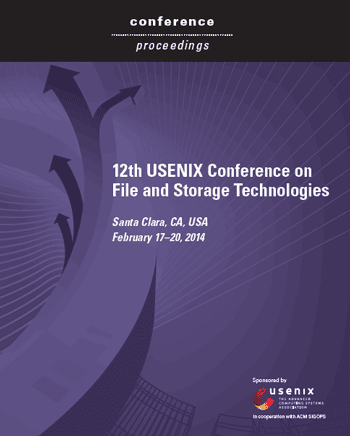
    USENIX FAST (File and Storage Technologies) 2014 Conference Proceedings

    Storage I/O trends

    USENIX FAST (File and Storage Technologies) 2014 Conference Proceedings

    In case you missed it, the 12th annual USENIX conference on File and Storage Technologies (FAST) was recently held in Santa Clara, CA.

    USENIX FAST 2014

    Big Data, Little Data, Fast SSD and Erasure Code Data

    If like me you are interested in FAST related technologies, trends, tools and related research, check out the conference PDF proceedings here.

    You can also go here to the USENIX FAST site to view additional information about the sessions along with other download material.

    The PDF format proceedings contain over 320 pages of content including some good white papers and information covering RAID and Erasure code, Big Data and Little Data, Cloud and Virtualization, Flash, DRAM, SSD, Filesystem performance, metrics, measurement and related software along with plenty of file system related material.

    USENIX FAST 2014 Proceedings Index

    USENIX FAST 2014 Proceedings Index part 3

    Heads up though, these are not your usual vendor high-level marketing white papers rather what you would expect from a technical conference such as FAST as you can see in the above index with abstracts.

    So add the 2014 USENIX FAST Proceedings to your reading list.

    Ok, nuff said

    Cheers gs

    Greg Schulz – Author Cloud and Virtual Data Storage Networking (CRC Press), The Green and Virtual Data Center (CRC Press) and Resilient Storage Networks (Elsevier)
    twitter @storageio

    All Comments, (C) and (TM) belong to their owners/posters, Other content (C) Copyright 2006-2026 Server StorageIO and UnlimitedIO LLC All Rights Reserved

    Its Award Season: Time for 2014 top VMware and virtualization blog voting

    Storage I/O trends

    Its Award Season: Time for 2014 top VMware and virtualization blog voting

    It’s that time of the year again for award season including with the recently wrapped up 2014 Winter Olympic (and benchmarking games), the academy awards and many others. That also means it is time again for the annual top VMware, Virtualization, Storage and related blogs voting now taking place until March 17th over at Eric Siebert (aka @ericsiebert) vsphere-land.com site that then appears on his vLaunchPad site. There is plenty of new school, as well as some old school and a few current or future school theme blogs represented with some being more VMware specific while others are cloud, virtual, server, storage, networking, development or other related themes.

    Click on the above image to cast your vote

    My StorageIOblog.com has been on the vLaunchPad site for a few years now as well as having syndicated content that also appears via some of the other venues listed there.

    Greg Schulz StorageIOblog

    Thus as this is a peoples choice process, I’m asking if you can take a few moments and cast your vote here (thank you in advance) which I hope includes StorageIOblog.com as part of the top ten, in addition to being nominated in the Storage, Podcast and Independent blogger categories.

    VMware vExpert

    In addition to mine, you will also find many of my fellow VMware vExperts among others at the vLaunchpad site so check them out as well.

    Ok, nuff said (other than thanks for reading)

    Cheers gs

    Greg Schulz – Author Cloud and Virtual Data Storage Networking (CRC Press), The Green and Virtual Data Center (CRC Press) and Resilient Storage Networks (Elsevier)
    twitter @storageio

    All Comments, (C) and (TM) belong to their owners/posters, Other content (C) Copyright 2006-2026 Server StorageIO and UnlimitedIO LLC All Rights Reserved

    Old School, New School, Current and Back to School (With Poll)

    Storage I/O trends

    Old School, New School, Current and Back to School

    Are you old school or new school?

    If you are new school or old school, then will you be stuck on those school’s of thought or advanced to the current and future schools?

    Old School

    From the old school folks you will hear things along the lines of that is how we do or did it. Also you might hear things along the lines of lets use what we have as long as we can make it work to fix problems while learning from mistakes. Also from old school you may here things like new school is only focused on the newest latest greatest shiny technology. Not to mention themes such as we have to stick around and clean up and take care of the mess left when new schoolers move to their next focus.

    New School

    On the other hand from new school you may hear snarky comments about old school either in kidding and jest, as a way to put down to promote self up in status. Some other new school perspectives are focus on the newest technology that can be used wherever with focus on the tool, product or service as opposed to sometimes lack of focus on the problem to address. Another theme can be don’t worry about the future, we will either throw away what we have and get something new, or leave it up to somebody else to take care, after all, the old schoolers are good at doing that.

    Current and Future School

    Storage I/O trends

    Then there are the current and future schoolers that are hybrid, combing the best of old-school leveraging their experiences with openness to explore new things of the new schoolers. The current or future schoolers are a blend of risk-averse yet willing to explore and find new ways to fix problems vs. simply moving, masking or leaving issues behind. The new or current schoolers are keen on learning lessons and mistakes of the past to avoid making them in the future.

    Likewise they are also dialed into using both new and old tools, technologies and techniques in new ways vs. simply using new things in old ways. Another characteristics of the new or future schoolers is that they are open and willing to create converged teams to leverage converged technologies. Not only are they dialed into the new technology, trends and techniques, they are also dialed into how to use them for different things, situations and apply to business or other needs as opposed to just a focus on the tech.

    This means that they are willing and interested in learning other skills, crafts capabilities vs. creating old or new silos or fiefdoms of technology. These new schoolers could care less who is a cloud, virtual, server, storage, networking, database, applications, backup, security, hardware or software person as they are focused on all of those as data infrastructure professionals.

    What this all means

    Stay in School and be a student of the game

    Some of you might be old school while others are may be new school or what ever is current trendy and cool. However new schoolers to become future or current schoolers can learn from the old schoolers. Likewise the old schoolers can learn a new thing or two as well as help transfer some knowledge experience to the new schoolers to become future schoolers. Granted old schoolers can settle in to their comfort zone while new schoolers can stay out front of the curve and both watch the rise of the new and future schoolers.

    Are you old school, new school, current or no school, cast your vote and see results below:

    Some more reading:

    Who or what is your sphere of influence?
    How many degrees separate you and your information?
    Technology buying, do you decide on G2 or GQ?
    What does gaining industry traction or adoption mean too you?
    Industry adoption vs. industry deployment, is there a difference?
    Pulling Together a Converged Team
    People, Not Tech, Prevent IT Convergence

    Ok, nuff said (for now)

    Cheers Gs

    Greg Schulz – Author Cloud and Virtual Data Storage Networking (CRC Press), The Green and Virtual Data Center (CRC Press) and Resilient Storage Networks (Elsevier)
    twitter @storageio

    All Comments, (C) and (TM) belong to their owners/posters, Other content (C) Copyright 2006-2026 Server StorageIO and UnlimitedIO LLC All Rights Reserved
    February 2014 Server StorageIO Update Newsletter Data Infrastructure Insights


    Welcome to the February 2014 edition of the StorageIO Update (newsletter) containing trends perspectives on cloud, virtualization and data infrastructure topics. Its winter here in North America and specifically in the Stillwater Minnesota to say that there is plenty of snow and cold would be an understatement. However in a few months instead of dealing with -20F or -40F wind chills, it will be 100F head index, thus the saying of if you don’t like the weather, either leave or wait a bit as it will change.

    In case you missed the December 2013 StorageIO holiday greeting which was in place of the normal newsletter you can view that here. In the absence of the regular December and January StorageIO Update newsletters, this is a larger edition to get caught up. However not to worry as there is more content and items in the wings for March.

    2013 wrapped up with a flurry of industry activity including some acquisitions (Avago buying LSI and Seagate acquiring Xyratex among others). Likewise 2014 so far is continuing the momentum living up to the mantra that while there may be economic challenges, there is no such thing as a data or information recession.

    Greg Schulz StorageIO
    Watch for future posts, commentary, perspectives and other information down the road (and in the not so distant future) pertaining to information and data infrastructure topics, themes and trends across cloud, virtual, legacy server, storage, networking, hardware and software. Also check out our backup, restore, BC, DR and archiving (Under the resources section on StorageIO.com) for various presentation, book chapter downloads and other content.

    Enjoy this edition of the StorageIO Update newsletter and keep in mind, at least here in North America spring is just around the corner with summer not to far off either.

    Ok, nuff said (for now)

    Cheers gs

    StorageIO Industry Trends and PerspectivesIndustry trends tips, commentary, articles and blog posts
    What is being seen, heard and talked about while out and about

    The following is a synopsis of some StorageIOblog posts, articles and comments in different venues on various industry trends, perspectives and related themes about clouds, virtualization, data and storage infrastructure topics among related themes.

    Recent StorageIO comments and perspectives in the news

    SearchSMBStorage: Comments on Lenovo EMC Iomega new SMB NAS products
    ChannelProSMB: Comments on what the future holds for HDDs
    NetworkAsia: Comments on WORM disk and tape
    SeaarchSolidStateStorage: Comments on SSD industry activity and OCZ bankruptcy
    EnterpriseStorageForum: Comments on software defined storage
    Ironmountain: Comments on storage efficiency in small businesses
    PC Today: Comments on best practices
    PC Today: Commnets on How to recover lost data
    PC Today: Comments on Virtualization 101, understand context which virtualization is used
    PC Today: Comments on going paperless
    PC Today: Optimize Now – Comments on optimize to improve IT productivity
    Processor: Comments on Know Which Emerging Technologies Could Make An Impact
    Processor: Comments on Backup Problems – What To Do Before & After Issues Arise
    Processor: Comments on Know When & When Not To Replace Servers
    Processor: Comments on Enterprise Backup Solutions Buying Tips
    Processor: Comments on Server Trends, Technologies Reshape The Industry

    StorageIO tips and articles Recent StorageIO tips and articles in various venues

    Information Security Buzz: How Secure Is Your Data Storage?
    SearchStorage: Bridging the gap: Choosing storage-over-distance network technology 
    SearchEnterpriseWAN: Wide area network resiliency best practices 
    StateTech: 5 Tips for Factoring Software into Disaster Recovery Plans
    BizTech: How to Turn Storage Networks into Better Performers
    InfoStor: The Many Variations of RAID Storage

    StorageIOblog postRecent StorageIOblog posts and perspectives

  • Server Storage I/O Network Benchmark Winter Olympic Games – Click to read more
  • Removing complexity and cost to drive return on innovation – Click to read more
  • StorageIO data infrastructure links page updated (1,200+ entries) – Click to read more
  • Welcome to Data Protection Diaries – Visit www.storageioblog.com/data-protection-diaries-main/
  • Data Protection Diaries series – My data protection needs and wants – Click to read more
  • Until focus expands to data protection, backup is staying alive! – Click to read here
  • IT and data center sustainability, the other convergence zone – Click to read more
  • Lenovo buys IBM’s xSeries server business, what about EMC? – Click to read more
  • Securing your information assets and data, what about storage?Click to read more
  • Dell Inspiron 660 i660, Virtual Server Diamond in the rough?Click to read more
  • Book review: Rethinking Enterprise Storage by Marc FarleyClick to read more
  • Some Windows Server Storage I/O related commandsClick to read more
  • IoD, IoT, IoE, IoS, IoP, IoU and IoX are in your futureClick to read more
  • Goodbye 2013, hello 2014, predictions past, present and futureClick to read more
  • Small Medium Business (SMB) IT gains respect, what about SOHO?Click to read more
  • Seasons Greetings, Happy Holidays 2013 from StorageIOClick to read more
  • Server virtualization nested and tiered hypervisorsClick to read more
  • Remember to check out our objectstoragecenter.com page where you will find a growing collection of information and links on cloud and object storage themes, technologies and trends from various sources.

    Server and StorageIO seminars, conferences, web cats, events, activities StorageIO activities (out and about)

    Seminars, symposium, conferences, webinars
    Live in person and recorded recent and upcoming events

    The StorageIO calendar continues to evolve, here are some recent and upcoming activities.

    March 13, 2014 BrightTalkBusiness Resiliency (BR), Business Continuity (BC) and Disaster Recovery (DR) ManagementWebinar
    9AM PT
    March 12, 2014 BrightTalkHybrid Clouds – Bridging the Gap between public and private environmentsWebinar
    9AM PT
    February 18, 2014 BrightTalkNetworking with your Servers and Storage – Cloud, virtual and physical environmentsWebinar
    9AM PT
    January 28, 2014 Backup.UData Protection for Hybrid Environments 201Backup.U
    Google+ hangout
    January 23, 2014 DataCenter
    Acceleration
    Building and Managing the Sustainable Datacenter – Driving efficiency, productivity, effectiveness and economicsLive chat
    11AM PT
    January 15, 2014 BrightTalkModernizing Data Protection For Cloud, Virtual and Physical EnvironmentsWebinar
    11AM CT
    January 14, 2014 Backup.UData Protection for Hybrid Environments 101Backup.U
    Online Webinar
    December 12, 2013 Backup.UData Protection for Cloud 201Backup.U
    Google+ hangout
    December 6, 2013Code42Panelist – Endpoint Data Management
    Protecting the Perimeter of the Internet of Things
    (Replay)
    1PM CT
    Web Based
    December 3, 2013 Backup.UData Protection for Cloud 101Backup.U
    Online Webinar

    Click here to view other upcoming along with earlier event activities. Watch for more 2014 events to be added soon to the StorageIO events calendar page. Topics include data protection modernization (backup/restore, HA, BC, DR, archive), data footprint reduction (archive, compression, dedupe), storage optimization, SSD, object storage, server and storage virtualization, big data, little data, cloud and object storage, performance and management trends among others.

    Vendors, VAR’s and event organizers, give us a call or send an email to discuss having us involved in your upcoming pod cast, web cast, virtual seminar, conference or other events.

    Thank you to the current StorageIoblog.com site sponsor advertisers

    Druva (End Point Data Protection)

    EMC (EMC Community Network)
    Unitrends (Enterprise backup solution and management tools)
    Veeam (VMware and Hyper-V virtual server backup and data protection tools).

    Contact StorageIO to learn about sponsorship and other partnership opportunities.

    Click here to view previous StorageIO Update newsletters (HTML and PDF versions). Subscribe to this newsletter (and pass it along) click here to subscribe to this news letter. View archives of past StorageIO update news letters as well as download PDF versions at: www.storageio.com/newsletter.

    Thank you for reading this edition of the StorageIO Update Newsletter.

    Ok, nuff said

    Cheers
    Gs

    Greg Schulz – Author Cloud and Virtual Data Storage Networking (CRC Press), The Green and Virtual Data Center (CRC Press) and Resilient Storage Networks (Elsevier)
    twitter @storageio

    All Comments, (C) and (TM) belong to their owners/posters, Other content (C) Copyright 2006-2026 Server StorageIO and UnlimitedIO LLC All Rights Reserved