The Human Face of Big Data, a Book Review

The Human Face of Big Data, a Book Review

My copy of the new book The Human Face of Big Data created by Rick Smolan and Jennifer Erwitt arrived yesterday compliments of EMC (the lead sponsor). In addition to EMC, the other sponsors of the book are Cisco, VMware, FedEx, Originate and Tableau software.

To say this is a big book would be an understatement, then again, big data is a big topic with a lot of diversity if you open your eyes and think in a pragmatic way, which once you open and see the pages you will see. This is physically a big book (11x 14 inches) with lots of pictures, texts, stories, factoids and thought stimulating information of the many facets and dimensions of big data across 224 pages.

While Big Data as a buzzword and industry topic theme might be new, along with some of the related technologies, techniques and focus areas, other as aspects have been around for some time. Big data means many things to various people depending on their focus or areas of interest ranging from analytics to images, videos and other big files. A common theme is the fact that there is no such thing as an information or data recession, and that people and data are living longer, getting larger, and we are all addicted to information for various reasons.

Big data needs to be protected and preserved as it has value, or its value can increase over time as new ways to leverage it are discovered which also leads to changing data access and life cycle patterns. With many faces, facets and areas of interests applying to various spheres of influence, big data is not limited to programmatic, scientific, analytical or research, yet there are many current and use cases in those areas.

Big data is not limited to videos for security surveillance, entertainment, telemetry, audio, social media, energy exploration, geosciences, seismic, forecasting or simulation, yet those have been areas of focus for years. Some big data files or objects are millions of bytes (MBytes), billion of bytes (GBytes) or trillion of bytes (TBytes) in size that when put into file systems or object repositories, add up to Exabytes (EB – 1000 TBytes) or Zettabytes (ZB – 1000 EBs). Now if you think those numbers are far-fetched, simply look back to when you thought a TByte, GByte let alone a MByte was big or far-fetched future. Remember, there is no such thing as a data or information recession, people and data are living longer and getting larger.

Big data is more than hadoop, map reduce, SAS or other programmatic and analytical focused tool, solution or platform, yet those all have been and will be significant focus areas in the future. This also means big data is more than data warehouse, data mart, data mining, social media and event or activity log processing which also are main parts have continued roles going forward. Just as there are large MByte, GByte or TByte sized files or objects, there are also millions and billions of smaller files, objects or pieces of information that are part of the big data universe.

You can take a narrow, product, platform, tool, process, approach, application, sphere of influence or domain of interest view towards big data, or a pragmatic view of the various faces and facets. Of course you can also spin everything that is not little-data to be big data and that is where some of the BS about big data comes from. Big data is not exclusive to the data scientist, researchers, academia, governments or analysts, yet there are areas of focus where those are important. What this means is that there are other areas of big data that do not need a data science, computer science, mathematical, statistician, Doctoral Phd or other advanced degree or training, in other words big data is for everybody.

Cover image of Human Face of Big Data Book

Back to how big this book is in both physical size, as well as rich content. Note the size of The Human Face of Big Data book in the adjacent image that for comparison purposes has a copy of my last book Cloud and Virtual Data Storage Networking (CRC), along with a 2.5 inch hard disk drive (HDD) and a growler. The Growler is from Lift Bridge Brewery (Stillwater, MN), after all, reading a big book about big data can create the need for a big beer to address a big thirst for information ;).

The Human Face of Big Data is more than a coffee table or picture book as it is full of with information, factoids and perspectives how information and data surround us every day. Check out the image below and note the 2.5 inch HDD sitting on the top right hand corner of the page above the text. Open up a copy of The Human Face of Big Data and you will see examples of how data and information are all around us, and our dependence upon it.

A look inside the book The Humand Face of Big Data image

Book Details:
Copyright 2012
Against All Odds Productions
ISBN 978-1-4549-0827-2
Hardcover 224 pages, 11 x 0.9 x 14 inches
4.8 pounds, English

There is also an applet to view related videos and images found in the book at HumanFaceofBigData.com/viewer in addition to other material on the companion site www.HumanFacesofBigData.com.

Get your copy of
The Human Face of Big Data at Amazon.com by clicking here or at other venues including by clicking on the following image (Amazon.com).

Some added and related material:
Little data, big data and very big data (VBD) or big BS?
How many degrees separate you and your information?
Hardware, Software, what about Valueware?
Changing Lifecycles and Data Footprint Reduction (Data doesnt have to lose value over time)
Garbage data in, garbage information out, big data or big garbage?
Industry adoption vs. industry deployment, is there a difference?
Is There a Data and I/O Activity Recession?
Industry trend: People plus data are aging and living longer
Supporting IT growth demand during economic uncertain times
No Such Thing as an Information Recession

For those who can see big data in a broad and pragmatic way, perhaps using the visualization aspect this book brings forth the idea that there are and will be many opportunities. Then again for those who have a narrow or specific view of what is or is not big data, there is so much of it around and various types along with focus areas you too will see some benefits.

Do you want to play in or be part of a big data puddle, pond, or lake, or sail and explore the oceans of big data and all the different aspects found in, under and around those bigger broader bodies of water.

Bottom line, this is a great book and read regardless of if you are involved with data and information related topics or themes, the format and design lend itself to any audience. Broaden your horizons, open your eyes, ears and thinking to the many facets and faces of big data that are all around us by getting your copy of The Human Face of Big Data (Click here to go to Amazon for your copy) book.

Ok, nuff said.

Cheers gs

Greg Schulz – Author Cloud and Virtual Data Storage Networking (CRC Press, 2011), The Green and Virtual Data Center (CRC Press, 2009), and Resilient Storage Networks (Elsevier, 2004)

twitter @storageio

All Comments, (C) and (TM) belong to their owners/posters, Other content (C) Copyright 2006-2026 Server StorageIO and UnlimitedIO LLC All Rights Reserved

December 2012 StorageIO Update news letter

StorageIO News Letter Image
December 2012 News letter

Welcome to the December 2012 year end edition of the StorageIO Update news letter including a new format and added content.

You can get access to this news letter via various social media venues (some are shown below) in addition to StorageIO web sites and subscriptions.

Click on the following links to view the December 2012 edition as brief (short HTML sent via Email) version, or the full HTML or PDF versions.

Visit the news letter page to view previous editions of the StorageIO Update.

You can subscribe to the news letter by clicking here.

Enjoy this edition of the StorageIO Update news letter, let me know your comments and feedback.

Nuff said for now

Cheers
Gs

Greg Schulz – Author Cloud and Virtual Data Storage Networking (CRC Press), The Green and Virtual Data Center (CRC Press) and Resilient Storage Networks (Elsevier)
twitter @storageio

All Comments, (C) and (TM) belong to their owners/posters, Other content (C) Copyright 2006-2012 StorageIO and UnlimitedIO All Rights Reserved

IBM vs. Oracle, NAD intervenes, again

StorageIO industry trends cloud, virtualization and big data

With HP announcing that they were sold a bogus deal with Autonomy (read here, here and here among others) and the multi billion write off (loss), or speculation of who will be named the new CEO of Intel in 2013, don’t worry if you missed the latest in the ongoing IBM vs. Oracle campaign. The other day the NAD (National Advertising Directive) part of the Better Business Bureau (BBB) issued yet another statement about IBM and Oracle (read here and posted below).

NAD BBB logo

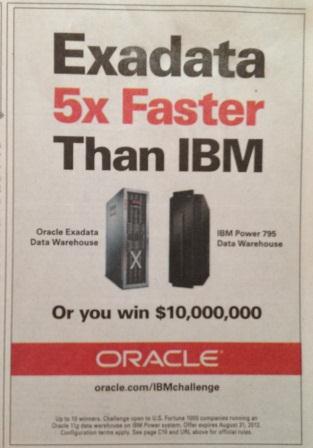
In case you had not heard, earlier this year, Oracle launched an advertising promotion touting how much faster their solutions are vs. IBM. Perhaps you even saw the advertising billboards along highways or in airports making the Oracle claims.

Big Blue (e.g. IBM) being the giant that they are was not going take the Oracle challenge sitting down and stepped up and complained to the better business bureau (BBB). As a result, the NAD issued a decision for Oracle to stop the ads (read more here). Oracle at 37.1B (May 2012 annual earnings) is about a third the size of IBM at 106.9B (2011 earnings), thus neither is exactly a small business.

Lets get back to the topic at hand the NAD issued yet another directive. In the latest spat, after the first Ads, Oracle launched the 10M challenge (you can read about that here).

Oracle 10 million dollar challenge ad image

Once again the BBB and the NAD weighs in for IBM and issued the following statement (mentioned above):

For Immediate Release
Contact: Linda Bean
212.705.0129

NAD Determines Oracle Acted Properly in Discontinuing Performance Claim Couched in ‘Contest’ Language

New York, NY – Nov. 20, 2012 – The National Advertising Division has determined that Oracle Corporation took necessary action in discontinuing advertising that stated its Exadata server is “5x Faster Than IBM … Or you win $10,000,000.”

The claim, which appeared in print advertising in the Wall Street Journal and other major newspapers, was challenged before NAD by International Business Machines Corporation.

NAD is an investigative unit of the advertising industry system of self-regulation and is administered by the Council of Better Business Bureaus.

As an initial matter, NAD considered whether or not Oracle’s advertisement conveyed a comparative performance claim – or whether the advertisement simply described a contest.

In an NAD proceeding, the advertiser is obligated to support all reasonable interpretations of its advertising claims, not just the message it intended to convey. In the absence of reliable consumer perception evidence, NAD uses its judgment to determine what implied messages, if any, are conveyed by an advertisement.

Here, NAD found that, even accounting for a sophisticated target audience, a consumer would be reasonable to take away the message that all Oracle Exadata systems run five times as fast as all IBM’s Power computer products. NAD noted in its decision that the fact that the claim was made in the context of a contest announcement did not excuse the advertiser from its obligation to provide substantiation.

The advertiser did not provide any speed performance tests, examples of comparative system speed superiority or any other data to substantiate the message that its Exadata computer systems run data warehouses five times as fast as IBM Power computer systems.

Accordingly, NAD determined that the advertiser’s decision to permanently discontinue this advertisement was necessary and appropriate. Further, to the extent that Oracle reserves the right to publish similar advertisements in the future, NAD cautioned that such performance claims require evidentiary support whether or not the claims are couched in a contest announcement.

Oracle, in its advertiser’s statement, said it disagreed with NAD’s findings, but would take “NAD’s concerns into account should it disseminate similar advertising in the future.”

###

NAD’s inquiry was conducted under NAD/CARU/NARB Procedures for the Voluntary Self-Regulation of National Advertising. Details of the initial inquiry, NAD’s decision, and the advertiser’s response will be included in the next NAD/CARU Case Report.

About Advertising Industry Self-Regulation: The Advertising Self-Regulatory Council establishes the policies and procedures for advertising industry self-regulation, including the National Advertising Division (NAD), Children’s Advertising Review Unit (CARU), National Advertising Review Board (NARB), Electronic Retailing Self-Regulation Program (ERSP) and Online Interest-Based Advertising Accountability Program (Accountability Program.) The self-regulatory system is administered by the Council of Better Business Bureaus.

Self-regulation is good for consumers. The self-regulatory system monitors the marketplace, holds advertisers responsible for their claims and practices and tracks emerging issues and trends. Self-regulation is good for advertisers. Rigorous review serves to encourage consumer trust; the self-regulatory system offers an expert, cost-efficient, meaningful alternative to litigation and provides a framework for the development of a self-regulatory to emerging issues.

To learn more about supporting advertising industry self-regulation, please visit us at: www.asrcreviews.org.

Linda Bean Director, Communications,
Advertising Self-Regulatory Council

Tel: 212.705.0129
Cell: 908.812.8175
lbean@asrc.bbb.org

112 Madison Ave.
3rd Fl.
New York, NY
10016

Not surprisingly, IBM sent the following email to highlight their latest news:

Greg,

For the third time in eight months Oracle has agreed to kill a misleading advertisement targeting IBM after scrutiny from the Better Business Bureau’s National Advertising Division.

Oracle’s ‘$10 Million Challenge’ ad claimed that its Exadata server was ‘Five Times Faster than IBM Power or You Win $10,000,000.’ The advertising council just issued a press release announcing that the claim was not supported by the evidence in the record, and that Oracle has agreed to stop making the claim. ‘[Oracle] did not provide speed performance tests, examples of comparative systems speed superiority or any other data to  substantiate its message,’ the BBB says in the release: The ads ran in The Wall Street Journal, The Economist, Chief Executive Magazine, trade publications and online.

The National Advertising Division reached similar judgments against Oracle advertising on two previous occasions this year. Lofty and unsubstantiated claims about Oracle systems being ‘Twenty Times Faster than IBM’ and ‘Twice as Fast Running Java’ were both deemed to be unsubstantiated and misleading. Oracle quietly shelved both campaigns.

If you follow Oracle’s history of claims, you won’t be surprised that the company issues misleading ads until they’re called out in public and forced to kill the campaign. As far back as 2001, Oracle’s favorite tactic has been to launch unsubstantiated attacks on competitors in ads while promising prize money to anyone who can disprove the bluff. Not surprisingly, no prize money is ever paid as the campaigns wither under scrutiny. They are designed to generate publicity for Oracle, nothing more. You may be familiar with their presentation, ‘Ridding the Market of Competition,’ which they issued to the Society of Competitive Intelligence Professionals laying out their strategy.

The repeated rulings by the BBB even caused analyst Rob Enderle to comment that, ‘there have been significant forced retractions and it is also apparent that increasingly the only people who could cite these false Oracle performance advantages with a straight face were Oracle’s own executives, who either were too dumb to know they were false or too dishonest to care.’

Let me know if you’re interested in following up on this news. You won’t hear anything about it from Oracle.

Best,

Chris

Christopher Rubsamen
Worldwide Communications for PureSystems and Cloud Computing
IBM Systems & Technology Group
aim: crubsamen
twitter: @crubsamen

Wow, I never knew however I should not be surprised that there is a Society of Competitive Intelligence Professionals.

Now Oracle is what they are, aggressive and have a history of doing creative or innovative (e.g. stepping out-of-bounds) in sales and marketing campaigns, benchmarking and other activities. On the other hand has IBM been victimized at the hands of Oracle and thus having to resort to using the BBB and NAD as part of its new sales and marketing tool to counter Oracle?

Does anybody think that the above will cause Oracle to retreat, repent, and tone down how they compete on the field of sales and marketing of servers, storage, database and related IT, ICT, big and little data, clouds?

Anyone else have a visual of a group of IBMers sitting around a table at an exclusive country club enjoying a fine cigar along with glass of cognac toasting each other on their recent success in having the BBB and NAD issue another ruling against Oracle. Meanwhile perhaps at some left coast yacht club, the Oracle crew are high fiving, congratulating each other on their commission checks while spraying champagne all over the place like they just won the Americas cup race?

How about it Oracle, IBM says Im not going to hear anything from you, is that true?

Ok, nuff said (for now).

Cheers gs

Greg Schulz – Author Cloud and Virtual Data Storage Networking (CRC Press, 2011), The Green and Virtual Data Center (CRC Press, 2009), and Resilient Storage Networks (Elsevier, 2004)

twitter @storageio

All Comments, (C) and (TM) belong to their owners/posters, Other content (C) Copyright 2006-2012 StorageIO and UnlimitedIO All Rights Reserved
Trick or treat and vendor fun games

In the spirit of Halloween and zombies season, a couple of thoughts come to mind about vendor tricks and treats. This is an industry trends and perspectives post, part of an ongoing series looking at various technology and fun topics.

The first trick or treat game pertains to the blame game; you know either when something breaks, or at the other extreme, before you have even made a decision to buy something. The trick or treat game for decision-making goes something like this.

StorageIO industry trends cloud, virtualization and big data

Vendor “A” says products succeed with their solution while failure results with a solution from “B” when doing “X”. Otoh, vendor “B” claims that “X” will fail when using a solution from vendor “A”. In fact, you can pick what you want to substitute for “X”, perhaps VDI, PCIe, Big Data, Little Data, Backup, Archive, Analytics, Private Cloud, Public Cloud, Hybrid Cloud, eDiscovery you name it.

This is not complicated math or big data problem requiring a high-performance computing (HPC) platform. A HPC Zetta-Flop processing ability using 512 bit addressing of 9.9 (e.g. 1 nine) PettaBytes of battery-backed DRAM and an IO capability of 9.99999 (e.g. 5 9’s) trillion 8 bit IOPS to do table pivots or runge kutta numerical analysis, map reduce, SAS or another modeling with optional iProduct or Android interface are not needed.

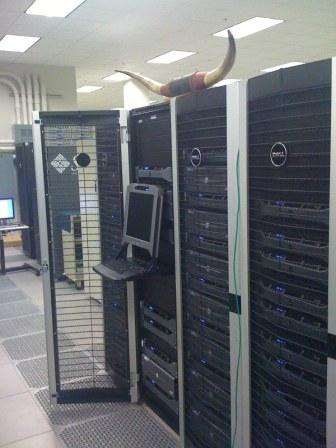
image of StorageIO big data HPC cloud storageimage of StorageIO big data HPC cloud storage
StorageIO images of touring Texas Advanced Computing (e.g. HPC) Center

Can you solve this equation? Hint it does not need a PhD or any other advanced degree. Another hint, if you have ever been at any side of the technology product and services decision-making table, regardless of the costume you wore, you should know the answer.

Of course the question of would “X” fail regardless of who or what “A” or “B” let alone a “C”, “D” or “F”? In other words, it is not the solution, technology, vendor or provider, rather the problem or perhaps even lack thereof that is the issue. Or is it a case where there is a solution from “A”, “B” or any others that is looking for a problem, and if it is the wrong problem, there can be a wrong solution thus failure?

StorageIO industry trends cloud, virtualization and big data

Another trick or treat game is vendors public relations (PR) or analyst relations (AR) people to ask for one thing and delivery or ask another. For example, some vendor, service provider, their marketing AR and PR people or surrogates make contact wanting to tell of various success and failure story. Of course, this is usually their success and somebody else’s failure, or their victory over something or someone who sometimes can be interesting. Of course, there are also the treats to get you to listen to the above, such as tempt you with a project if you meet with their subject, which may be a trick of a disappearing treat (e.g. magic, poof it is gone after the discussion).

There are another AR and PR trick and treat where they offer on behalf of their representative organization or client to a perspective or exclusive insight on their competitor. Of course, the treat from their perspective is that they will generously expose all that is wrong with what a competitor is saying about their own (e.g. the competitors) product.

StorageIO industry trends cloud, virtualization and big data

Let me get this straight, I am not supposed to believe what somebody says about his or her own product, however, supposed to believe what a competitor says is wrong with the competition’s product, and what is right with his or her own product.

Hmm, ok, so let me get this straight, a competitor say “A” wants to tell me what somebody say from “B” has told me is wrong and I should schedule a visit with a truth squad member from “A” to get the record set straight about “B”?

Does that mean then that I go to “B” for a rebuttal, as well as an update about “A” from “B”, assuming that what “A” has told me is also false about themselves, and perhaps about “B” or any other?

Too be fair, depending on your level of trust and confidence in either a vendor, their personal or surrogates, you might tend to believe more from them vs. others, or at least until you been tricked after given treats. There may be some that have been tricked, or they tried applying to many treats to present a story that behind the costume might be a bit scary.

StorageIO industry trends cloud, virtualization and big data

Having been through enough of these, and I candidly believe that sometimes “A” or “B” or any other party actually do believe that they have more or better info about their competitor and that they can convince somebody about what their competitor is doing better than the competitor can. I also believe that there are people out there who will go to “A” or “B” and believe what they are told by based on their preference, bias or interests.

When I hear from vendors, VARs, solution or service providers and others, it’s interesting hearing point, counterpoint and so forth, however if time is limited, I’am more interested in hearing from such as “A” about them, what they are doing, where success, where challenges, where going and if applicable, under NDA go into more detail.

Customer success stories are good, however again, if interested in what works, what kind of works, or what does not work, chances are when looking for G2 vs. GQ, a non-scripted customer conversation or perspective of the good, the bad and the ugly is preferred, even if under NDA. Again, if time is limited which it usually is, focus on what is being done with your solution, where it is going and if compelled send follow-up material that can of course include MUD and FUD about others if that is your preference.

Then there is when during a 30 minute briefing, the vendor or solution provider is still talking about trends, customer pain points, what competitors are doing at 21 minutes into the call with no sign of an announcement, update or news in site

Lets not forget about the trick where the vendor marketing or PR person reaches out and says that the CEO, CMO, CTO or some other CxO or Chief Jailable Officer (CJO) wants to talk with you. Part of the trick is when the CxO actually makes it to the briefing and is not ready, does not know why the call is occurring, or, thinks that a request for an audience has been made with them for an interview or something else.

StorageIO industry trends cloud, virtualization and big data

A treat is when 3 to 4 minutes into a briefing, the vendor or solution provider has already framed up what and why they are doing something. This means getting to what they are announcing or planning on doing and getting into a conversation to discuss what they are doing and making good follow-up content and resources available.

StorageIO industry trends cloud, virtualization and big data

Sometimes a treat is when a briefer goes on autopilot nailing their script for 29 of a 30 minute session then use the last-minute to ask if there are any questions. The reason autopilot briefings can be a treat is when they are going over what is in the slide deck, webex, or press release thus affording an opportunity to get caught up on other things while talk at you. Hmm, perhaps need to consider playing some tricks in reward for those kind of treats? ;)

StorageIO industry trends cloud, virtualization and big data

Do not be scared, not everybody is out to trick you with treats, and not all treats have tricks attached to them. Be prepared, figure out who is playing tricks with treats, and who has treats without tricks.

Oh, and as a former IT customer, vendor and analyst, one of my favorites is contact information of my dogs to vendors who require registration on their websites for basic things such as data sheets. Another is supplying contact information of competing vendors sales reps to vendors who also require registration for basic data sheets or what should otherwise be generally available information as opposed to more premium treats. Of course there are many more fun tricks, however lets leave those alone for now.

Note: Zombie voting rules apply which means vote early, vote often, and of course vote for those who cannot include those that are dead (real or virtual).

Where To Learn More

View additiona related material via the following links.

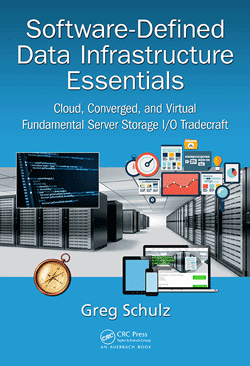
Additional learning experiences along with common questions (and answers), as well as tips can be found in Software Defined Data Infrastructure Essentials book.

Software Defined Data Infrastructure Essentials Book SDDC

What This All Means

Watch out for tricks and treats, have a safe and fun Zombie (aka Halloween) season. See you while out and about this fall and don’t forget to take part in the ongoing zombie technology poll. Oh, and be safe with trick or treat and vendor fun games

Ok, nuff said, for now.

Gs

Greg Schulz – Microsoft MVP Cloud and Data Center Management, VMware vExpert 2010-2018. Author of Software Defined Data Infrastructure Essentials (CRC Press), as well as Cloud and Virtual Data Storage Networking (CRC Press), The Green and Virtual Data Center (CRC Press), Resilient Storage Networks (Elsevier) and twitter @storageio. Courteous comments are welcome for consideration. First published on https://storageioblog.com any reproduction in whole, in part, with changes to content, without source attribution under title or without permission is forbidden.

All Comments, (C) and (TM) belong to their owners/posters, Other content (C) Copyright 2006-2026 Server StorageIO and UnlimitedIO. All Rights Reserved. StorageIO is a registered Trade Mark (TM) of Server StorageIO.

Over 1,000 entries now on the StorageIO industry links page

Industry trends and perspective data protection modernization

Is your company, organization or one that you are a fan of, or represent listed on the StorageIO industry links page (click here to learn more about it).

The StorageIO industry links page has been updated with over thousand different industry related companies, vendors, vars, trade groups, part and solution suppliers along with cloud and managed service providers. The common theme with these industry links is information and data infrastructures which means severs, storage, IO and networking, hardware, software, applications and tools, services, products and related items for traditional, virtual and cloud environments.

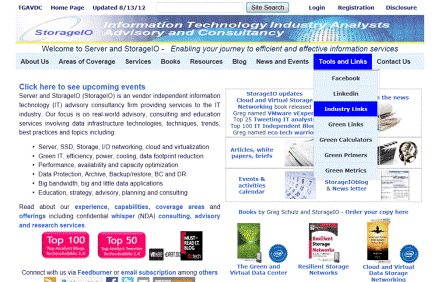
StorageIO server storage IO networking cloud and virtualization links

The industry links page is accessed from the StorageIO main web page via the Tools and Links menu tab, or via the URL https://storageio.com/links. An example of the StorageIO industry links page is shown below with six different menu tabs in alphabetical order.

StorageIO server storage IO networking cloud and virtualization links

Know of a company, service or organization that is not listed on the links page, if so, send an email note to info at storageio.com. If your company or organization is listed, contact StorageIO to discuss how to expand your presence on the links page and other related options.

Visit the updated StorageIO industry links page and watch for more updates, and click here to learn more about the links page.

Ok, nuff said for now.

Cheers Gs

Greg Schulz – Author Cloud and Virtual Data Storage Networking (CRC Press, 2011), The Green and Virtual Data Center (CRC Press, 2009), and Resilient Storage Networks (Elsevier, 2004)

twitter @storageio

All Comments, (C) and (TM) belong to their owners/posters, Other content (C) Copyright 2006-2012 StorageIO and UnlimitedIO All Rights Reserved

Announcing SAS SANs for Dummies book, LSI edition

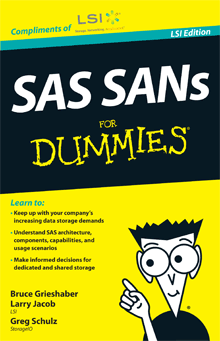
There is a new (free) book that I’m a co-author of along Bruce Grieshaber and Larry Jacob (both of LSI) along with foreword by Harry Mason of LSI and President of the SCSI Trade Association titled SAS SANs for Dummies compliments of LSI.

SAS SANs for Dummies, LSI Edition

This new book (ebook and print hard copy) looks at Serial Attached SCSI (SAS) and how it can be used beyond traditional direct attached storage (DAS) configurations for support various types of storage mediums including SSD, HDD and tape. These configuration options include as entry-level SAN with SAS switches for small clusters or server virtualization, or as shared DAS as well as being a scale out back-end solution for NAS, object, cloud and big data storage solutions.

Here is the table of contents (TOC) of SAS SANs for Dummies

Chapter 1: Data storage challenges

  • Storage Growth Demand Drivers
  • Recognizing Challenges
  • Solutions and Opportunities
  • Chapter 2: Storage Area Networks

  • Introducing Storage Area Networks
  • Moving from Dedicated Internal to Shared Storage
  • Chapter 3: SAS Basics

  • Introducing the Basics of SAS
  • How SAS Functions
  • Components of SAS
  • SAS Target Devices
  • SAS for SANs
  • Chapter 4: SAS Usage Scenarios

  • Understanding SAS SANs Usage
  • Shared SAS SANs Scenarios including:
    • SAS in HPC environments
    • Big data and big bandwidth
    • Database, e-mail, back-office
    • NAS and object storage servers
    • Cloud, wen and high-density
    • Server virtualization

    Chapter 5: Advanced SAS Topics

  • The SAS Physical Layer
  • Choosing SAS Cabling
  • Using SAS Switch Zoning
  • SAS HBA Target Mode
  • Chapter 6: Nine Common Questions

  • Can You Interconnect Switches?
  • What Is SAS Cable Distance?
  • How Many Servers Can Be In a SAS SAN?
  • How Do You Manage SAS Zones?
  • How Do You Configure SAS for HA?
  • How Does SAS Zoning Compare to LUN Mapping?
  • Who Has SAS Solutions?
  • How Do SAS SANs Compare?
  • Where Can You Learn More?
  • Chapter 7: Next Steps

  • SAS Going Forward
  • Next Steps
  • Great Take Away’s
  • Regardless of if you are looking to use SAS as a primary SAN interface, or leverage it for DAS or implementing back-end storage for big-data, NAS, object, cloud or other types of scalable storage solutions, check out and get your free copy of SAS SANs for Dummies here compliments of LSI.

    SAS SANs for Dummies, LSI Edition

    Click here to ask your free copy of SAS SANs for Dummies compliments of LSI, tell them Greg from StorageIO sent you and enjoy the book.

    Ok, nuff said.

    Cheers Gs

    Greg Schulz – Author Cloud and Virtual Data Storage Networking (CRC Press, 2011), The Green and Virtual Data Center (CRC Press, 2009), and Resilient Storage Networks (Elsevier, 2004)

    twitter @storageio

    All Comments, (C) and (TM) belong to their owners/posters, Other content (C) Copyright 2006-2012 StorageIO and UnlimitedIO All Rights Reserved
    How can direct attached storage (DAS) make a comeback if it never left?

    Server and StorageIO industry trend and perspective DAS

    Have you seen or heard the theme that Direct Attached Storage (DAS), either dedicated or shared, internal or external is making a comeback?

    Wait, if something did not go away, how can it make a comeback?

    IMHO it is as simple as for the past decade or so, DAS has been overshadowed by shared networked storage including switched SAS, iSCSI, Fibre Channel (FC) and FC over Ethernet (FCoE) based block storage area networks (SAN) and file based (NFS and Windows SMB/CIFS) network attached storage (NAS) using IP and Ethernet networks. This has been particularly true by most of the independent storage vendors who have become focused on networked storage (SAN or NAS) solutions.

    However some of the server vendors have also jumped into the deep end of the storage pool with their enthusiasm for networked storage, even though they still sell a lot of DAS including internal dedicated, along with external dedicated and shared storage.

    Server and StorageIO industry trend and perspective DAS

    The trend for DAS storage has evolved with the interfaces and storage mediums including from parallel SCSI and IDE to SATA and more recently 3Gbs and 6Gbs SAS (with 12Gbs in first lab trials). Similarly the storage mediums include a mix of fast 10K and 15K hard disk drives (HDD) along with high-capacity HDDs and ultra-high performance solid state devices (SSD) moving from 3.5 to 2.5 inch form factors.

    While there has been a lot of industry and vendor marketing efforts around networked storage (e.g. SAN and NAS), DAS based storage was over shadowed so it should not be a surprise that those focused on SAN and NAS are surprised to hear DAS is alive and well. Not only is DAS alive and well, it’s also becoming an important scaling and convergence topic for adding extra storage to appliances as well as servers including those for scale out, big data, cloud and high density not to mention high performance and high productivity computing.

    Server and StorageIO industry trend and perspective DAS

    Consequently its becoming ok to talk about DAS again. Granted you might get some peer pressure from your trend setting or trend following friends to get back on the networked storage bandwagon. Keep this in mind, take a look at some of the cool trend setting big data and little data (database) appliances, backup, dedupe and archive appliances, cloud and scale out NAS and object storage systems among others and will likely find DAS on the back-end. On a smaller scale, or in high-density rack deployments in large cloud or similar environments you may also find DAS including switched shared SAS.

    Does that mean SANs are dead?
    No, not IMHO despite what some vendors marketers and their followers will claim which is ironic given how some of them were leading the DAS is dead campaign in favor of iSCSI or FC or NAS a few years ago. However simply comparing DAS to SAN or NAS in a competing way is like comparing apples to oranges, instead, look at how and where they can complement and enable each other. In other words, different tools for various tasks, various storage and interfaces for different needs.

    Thus IMHO DAS never left or went anywhere per say, it just was not fashionable or cool to talk about until now as it is cool and trend to discuss it again.

    Ok, nuff said for now.

    Cheers Gs

    Greg Schulz – Author Cloud and Virtual Data Storage Networking (CRC Press, 2011), The Green and Virtual Data Center (CRC Press, 2009), and Resilient Storage Networks (Elsevier, 2004)

    twitter @storageio

    All Comments, (C) and (TM) belong to their owners/posters, Other content (C) Copyright 2006-2012 StorageIO and UnlimitedIO All Rights Reserved

    Dell is buying Quest software, not the phone company Qwest

    Dell Storage Customer Advisory Panel (CAP)

    For those not familiar with Quest, they are a software company not to be confused with the telephone communications company formerly known as Qwest (aka now known as centurylink).

    Both Dell and Quest have been on software related acquisition initiatives that past few years with Quest having purchased vKernel, Vizoncore (vRanger virtualization backup), BakBone (who had acquire Alavarii and Asempra) for traditional backup and data protection among others. Not to be out done, as well as purchasing Quest, Dell has also more recently bought Appassure (Disclosure: StorageIOblog site sponsor) for data protection, Sonicwall and Wyse in addition to some other recent purchases (ASAP, Boomi, Compellent, Exanet, EqualLogic, Force10, InsightOne, KACE, Ocarina, Perot, RNA and Scalent among others).

    What does this mean?
    Dell is expanding the scope of their business with more products (hardware, software), solution bundles, services and channel partnering opportunities Some of the software tools and focus areas that Quest brings to the Dell table or portfolio include:

    Database management (Oracle, SQLserver)
    Data protection (virtual and physical backup, replication, bc, dr)
    Performance monitoring (DCIM and IRM) of applications and infrastructure
    User workspace management (application delivery)
    Windows server management (migrate and manage, AD, exchange, sharepoint)
    Identify and access management (security, compliance, privacy)

    What does Dell get by spending over $2B USD on quest?

  • Additional software titles or product
  • More software developers for their Software group
  • Sales people to help promote, partner and sell software solutions
  • Create demand pull for other Dell products and services via software
  • Increase its partner reach via existing Quest VARs and business partners
  • Extend the size of the Dell software and intellectual property (IP) portfolio
  • New revenue streams that compliment existing products and lines of business
  • Potential for better rate of return on some of its $12B USD in cash or equivalence

    Is this a good move for Dell?
    Yes for the above reasons

  • Is there a warning to this for Dell?
    Yes, they need to execute, keep the Quest team focused along with their other teams on the respective partners, products and market opportunities while expanding into new areas. Dell needs to also leverage Quest to further its cause in creating trust, confidence and strategic relationships with channel partners to reach new markets in different geographies. In addition, Dell needs to articulate its strategy and positioning of the various solutions to avoid products being perceived as competing vs. complimenting each other.

    Additional Dell related links:
    Dell Storage Customer Advisory Panel (CAP)
    Dell Storage Forum 2011 revisited
    Dude, is Dell doing a disk deal again with Compellent?
    Data footprint reduction (Part 2): Dell, IBM, Ocarina and Storwize
    Post Holiday IT Shopping Bargains, Dell Buying Exanet?
    Dell Will Buy Someone, However Not Brocade (At least for now)

    Ok, nuff said for now

    Cheers Gs

    Greg Schulz – Author Cloud and Virtual Data Storage Networking (CRC Press, 2011), The Green and Virtual Data Center (CRC Press, 2009), and Resilient Storage Networks (Elsevier, 2004)

    twitter @storageio

    All Comments, (C) and (TM) belong to their owners/posters, Other content (C) Copyright 2006-2012 StorageIO and UnlimitedIO All Rights Reserved

    Green IT deferral blamed on economic recession might be result of green gap

    Storage I/O Industry Trends and Perspectives

    I recently saw a comment somewhere that talked about Green IT being deferred or set aside due to lack of funding because of ongoing global economic turmoil. For those who see Green IT in the context of the green washing efforts that requiring spending to gain some benefits that I can understand. After all, if your goal is to simply go and be or be seen as being green, there is a cost to doing that.

    With tight or shrinking IT budgets, there are other realities and while organizations may want to do the right thing helping the environment, however that is often seen as overhead to financial conscious management.

    On the other hand, turn the green washing messaging off or at least dial-it back a bit as has been the case the past couple of years.

    Expand the Green IT discussion or change it around a bit from that of being seen or perceived as being green by energy efficiency or avoidance to that of effectiveness, enhanced productivity, doing more with what you have or with less and there is a different opportunity.

    That opportunity is to meet the financial and business goals or requirements that as a by-product help the environment. In other words, expand the focus of Green IT to that of economics and improving on resource effectiveness and the environment gets a free ride, or, Green gets self-funded.

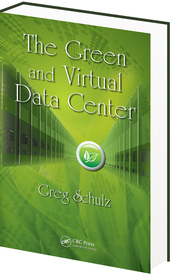
    The Green and Virtual Data Center Book addressing optimization, effectivness, productivity and economics

    The challenge is what I refer to as the Green Gap, which is the disconnect between what is talked about (e.g. messaging) and thus perceived to be Green IT and where common IT opportunities exist (or missed opportunities have occurred).

    Green IT or at least the tenants of driving efficiency and effectiveness to use energy more effectively, address recycling and waste, removable of hazardous substance and other items continues to thrive. However, the green washing is subsiding and overtime organizations will not be as dismissive of Green IT in the context of improving productivity, reducing complexity and costs, optimization and related themes tied to economics where the environment gets a free ride.

    Here are some related links:
    Closing the Green Gap
    Energy efficient technology sales depend on the pitch
    EPA Energy Star for Data Center Storage Update
    Green IT Confusion Continues, Opportunities Missed!
    How to reduce your Data Footprint impact (Podcast)
    Optimizing storage capacity and performance to reduce your data footprint
    Performance metrics: Evaluating your data storage efficiency
    PUE, Are you Managing Power, Energy or Productivity?
    Saving Money with Green Data Storage Technology
    Saving Money with Green IT: Time To Invest In Information Factories
    Shifting from energy avoidance to energy efficiency
    Storage Efficiency and Optimization: The Other Green
    Supporting IT growth demand during economic uncertain times
    The new Green IT: Efficient, Effective, Smart and Productive
    The other Green Storage: Efficiency and Optimization
    The Green and Virtual Data Center Book (CRC Press, Intel Recommended Reading)

    Ok, nuff said for now

    Cheers Gs

    Greg Schulz – Author Cloud and Virtual Data Storage Networking (CRC Press, 2011), The Green and Virtual Data Center (CRC Press, 2009), and Resilient Storage Networks (Elsevier, 2004)

    twitter @storageio

    All Comments, (C) and (TM) belong to their owners/posters, Other content (C) Copyright 2006-2012 StorageIO and UnlimitedIO All Rights Reserved

    Why FC and FCoE vendors get beat up over bandwidth?

    Storage I/O Industry Trends and Perspectives

    Have you noticed how Fibre Channel (FC) and FC over Ethernet (FCoE) switch and adapter vendors and their followers focus around bandwidth vs. response time, latency or other performance activity? For example, 8Gb FC (e.g. 8GFC), or 10Gb as opposed to latency and response time, or IOPS and other activity indicators.

    When you look at your own environment, or that of a customers or prospects or hear of a conversation involving storage networks, is the focus on bandwidth, or lack of it, or perhaps throughput being a non-issue? For example, a customer says why go to 16GFC when they are barely using 8Gb with their current FC environment.

    This is not a new phenomenon and is something I saw when working for a storage-networking vendor who had SAN, MAN and WAN solutions (E.g. INRANGE). Those with networking backgrounds tended to focus on bandwidth when discussing storage networks while those with storage, server or applications background also look at latency or IO completion time (response time), queuing, message size, IOPs or frames and packets per second. Thus there are different storage and networking metrics that matter that are also discussed further in my first book Resilient Storage Networks: Designing Flexible Scalable Data Infrastructures.

    When I hear a storage networking vendor talk about their latest 16GFC based product I like to ask them what is the biggest benefit vs. 8GFC and not surprisingly, the usual response is like twice the bandwidth. When I ask them about what that means in terms of more IOPS in a given amount of time, or reduced IO completion time, lower latency, sometimes I often get the response along the lines of Yeah, that too, however it has twice the bandwidth.

    Ok, I get it, yes, bandwidth is important for some applications, however so too are activity measured in IOPS, transactions, packets, frames, pages, sequences and exchanges among other units of measure along with response time and latency (e.g. different storage and networking metrics that matter).

    What many storage networking vendors actually get, however they don’t talk about it for various reasons, perhaps because they are not be asked about it, or engaged in the conversation is that there is an improvement in response time in going from such as 8GFC to 16GFC. Likewise, there can be improvements in response time in addition to the more commonly discussed bandwidth.

    If you are a storage networking switch, adapter or other component vendor, var or channel partner expand your conversation to include activity and response time as part of your value proposition. Likewise, if you are a customer, ask your technology providers to expand on the conversation of how new technologies help in areas other than bandwidth.

    Ok, nuff said for now

    Cheers Gs

    Greg Schulz – Author Cloud and Virtual Data Storage Networking (CRC Press, 2011), The Green and Virtual Data Center (CRC Press, 2009), and Resilient Storage Networks (Elsevier, 2004)

    twitter @storageio

    All Comments, (C) and (TM) belong to their owners/posters, Other content (C) Copyright 2006-2012 StorageIO and UnlimitedIO All Rights Reserved

    Spring (May) 2012 StorageIO news letter

    StorageIO News Letter Image
    Spring (May) 2012 News letter

    Welcome to the Spring (May) 2012 edition of the Server and StorageIO Group (StorageIO) news letter. This follows the Fall (December) 2011 edition.

    You can get access to this news letter via various social media venues (some are shown below) in addition to StorageIO web sites and subscriptions.

    Click on the following links to view the Spring May 2012 edition as an HTML or PDF or, to go to the news letter page to view previous editions.

    You can subscribe to the news letter by clicking here.

    Enjoy this edition of the StorageIO newsletter, let me know your comments and feedback.

    Nuff said for now

    Cheers
    Gs

    Greg Schulz – Author Cloud and Virtual Data Storage Networking (CRC Press), The Green and Virtual Data Center (CRC Press) and Resilient Storage Networks (Elsevier)
    twitter @storageio

    All Comments, (C) and (TM) belong to their owners/posters, Other content (C) Copyright 2006-2012 StorageIO and UnlimitedIO All Rights Reserved

    Is SSD dead? No, however some vendors might be

    Storage I/O trends

    Is SSD dead? No, however some vendors might be

    In a recent conversation with Dave Raffo about the nand flash solid state disk (SSD) market, we talked about industry trends, perspectives and where the market is now as well as headed. One of my comments is, has been and will remain that the industry has still not reached anywhere near full potential for deployment of SSD for enterprise, SMB and other data storage needs. Granted, there is broad adoption in terms of discussion or conversation and plenty of early adopters.

    SSD and in particular nand flash is anything but dead, in fact in the big broad picture of things, it is still very early in the game. Sure, for those who cover and crave the newest, latest and greatest technology to talk about, nand flash SSD might seem old, yesterday news, long in the tooth and time for something else. However, for those who are focused on deployment vs. adoption such as customers, in general, nand flash SSD in its many packaging options has still not yet reached its full potential.

    Despite the hype, fanfare from CEOs or their evangelist along with loyal followers of startups that help drive industry adoption (e.g. what is talked about), there is still lots of upside growth in the customer drive industry deployment (actually buying, installing and using) for nand flash SSD.

    What about broad customer deployments?

    Sure, there are the marquee customer success stories that you need a high-capacity SAS or SATA drive to hold the YouTube videos, slide decks, press releases for.

    However, have we truly, reached broad customer deployment or broad industry adoption?

    Hence, I see more startups coming into the market space, and some exiting on their own, via mergers and acquisition or other means.

    Will we see a feeding frenzy or IPO craze as with earlier hype cycles of technologies, IMHO there will be some companies that get the big deal, some will survive as new players running as a business vs. running to be acquired or IPO. Others will survive by evolving into something else while others will join the where are they now list.

    If you are a SSD startup, CEO, CxO, or marketer, their PR, evangelist or loyal follower do not worry as the SSD market and even nand flash is far from being dead. On the other hand, if you think that it has hit its full stride, you are missing either the bigger picture, or too busy patting yourselves on the back for a job well done. There is much more opportunity out there and not even all the low hanging fruit has been picked yet.

    Check out the conversation with Dave Raffo along with comments from others here.

    Related links on storage IO metrics and SSD performance
    What is the best kind of IO? The one you do not have to do
    Is SSD dead? No, however some vendors might be
    Storage and IO metrics that matter
    IO IO it is off to Storage and IO metrics we go
    SSD and Storage System Performance
    Speaking of speeding up business with SSD storage
    Are Hard Disk Drives (HDD’s) getting too big?
    Has SSD put Hard Disk Drives (HDD’s) On Endangered Species List?
    Why SSD based arrays and storage appliances can be a good idea (Part I)
    IT and storage economics 101, supply and demand
    Researchers and marketers dont agree on future of nand flash SSD
    EMC VFCache respinning SSD and intelligent caching (Part I)
    SSD options for Virtual (and Physical) Environments Part I: Spinning up to speed on SSD
    SSD options for Virtual (and Physical) Environments Part II: The call to duty, SSD endurance
    SSD options for Virtual (and Physical) Environments Part III: What type of SSD is best for you?
    SSD options for Virtual (and Physical) Environments Part IV: What type of SSD is best for your needs

    Ok, nuff said for now

    Cheers Gs

    Greg Schulz – Author Cloud and Virtual Data Storage Networking (CRC Press, 2011), The Green and Virtual Data Center (CRC Press, 2009), and Resilient Storage Networks (Elsevier, 2004)

    twitter @storageio

    All Comments, (C) and (TM) belong to their owners/posters, Other content (C) Copyright 2006-2012 StorageIO and UnlimitedIO All Rights Reserved

    More storage and IO metrics that matter

    It is great to see more conversations and coverage around storage metrics that matter beyond simply focusing on cost per GByte or TByte (e.g. space capacity). Likewise, it is also good to see conversations expanding beyond data footprint reduction (DFR) from a space capacity savings or reduction ratio to also address data movement and transfer rates. Also good to see is increase in discussion around input/output operations per section (IOPs) tying into conversations from virtualization, VDI, cloud to Sold State Devices (SSD).

    Other storage and IO metrics that matter include latency or response time, which is how fast work is done, or time spent. Latency also ties to IOPS in that as more work arrives to be done (IOPS) of various size, random or sequential, reads or writes, queue depths are an indicator of how well work is flowing. Another storage and IO metric that matters is availability because without it, performance or capacity can be affected. Likewise, without performance, availability can be affected.

    Needless to say that I am just scratching the surface here with storage and IO metrics that matter for physical, virtual and cloud environments from servers to networks to storage.

    Here is a link to a post I did called IO, IO, it is off to storage and IO metrics we go that ties in themes of performance measurements and solid-state disk (SSD) among others. Also check out this piece about why VASA (VMware storage analysis metrics) is important to have your VMware CASA along with Windows boot storage and IO performance for VDI and traditional planning purposes.

    Check out this post about metrics and measurements that matter along with this conversation about IOPs, capacity, bandwidth and purchasing discussion topics.

    Related links on storage IO metrics and SSD performance
    What is the best kind of IO? The one you do not have to do
    Is SSD dead? No, however some vendors might be
    Storage and IO metrics that matter
    IO IO it is off to Storage and IO metrics we go
    SSD and Storage System Performance
    Speaking of speeding up business with SSD storage
    Are Hard Disk Drives (HDD’s) getting too big?
    Has SSD put Hard Disk Drives (HDD’s) On Endangered Species List?
    Why SSD based arrays and storage appliances can be a good idea (Part I)
    IT and storage economics 101, supply and demand
    Researchers and marketers dont agree on future of nand flash SSD
    EMC VFCache respinning SSD and intelligent caching (Part I)
    SSD options for Virtual (and Physical) Environments Part I: Spinning up to speed on SSD
    SSD options for Virtual (and Physical) Environments Part II: The call to duty, SSD endurance
    SSD options for Virtual (and Physical) Environments Part III: What type of SSD is best for you?
    SSD options for Virtual (and Physical) Environments Part IV: What type of SSD is best for your needs

    Ok, nuff said for now

    Cheers Gs

    Greg Schulz – Author Cloud and Virtual Data Storage Networking (CRC Press, 2011), The Green and Virtual Data Center (CRC Press, 2009), and Resilient Storage Networks (Elsevier, 2004)

    twitter @storageio

    All Comments, (C) and (TM) belong to their owners/posters, Other content (C) Copyright 2006-2012 StorageIO and UnlimitedIO All Rights Reserved

    What is the best kind of IO? The one you do not have to do

    What is the best kind of IO? The one you do not have to do

    data infrastructure server storage I/O trends

    Updated 2/10/2018

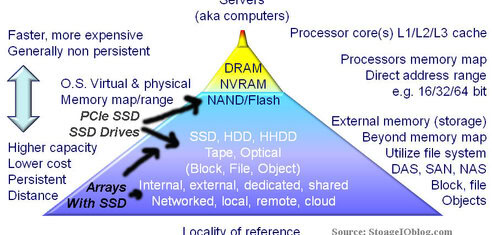
    What is the best kind of IO? If no IO (input/output) operation is the best IO, than the second best IO is the one that can be done as close to the application and processor with best locality of reference. Then the third best IO is the one that can be done in less time, or at least cost or impact to the requesting application which means moving further down the memory and storage stack (figure 1).

    Storage and IO or I/O locality of reference and storage hirearchy
    Figure 1 memory and storage hierarchy

    The problem with IO is that they are basic operation to get data into and out of a computer or processor so they are required; however, they also have an impact on performance, response or wait time (latency). IO require CPU or processor time and memory to set up and then process the results as well as IO and networking resources to move data to their destination or retrieve from where stored. While IOs cannot be eliminated, their impact can be greatly improved or optimized by doing fewer of them via caching, grouped reads or writes (pre-fetch, write behind) among other techniques and technologies.

    Think of it this way, instead of going on multiple errands, sometimes you can group multiple destinations together making for a shorter, more efficient trip; however, that optimization may also take longer. Hence sometimes it makes sense to go on a couple of quick, short low latency trips vs. one single larger one that takes half a day however accomplishes many things. Of course, how far you have to go on those trips (e.g. locality) makes a difference of how many you can do in a given amount of time.

    What is locality of reference?

    Locality of reference refers to how close (e.g location) data exists for where it is needed (being referenced) for use. For example, the best locality of reference in a computer would be registers in the processor core, then level 1 (L1), level 2 (L2) or level 3 (L3) onboard cache, followed by dynamic random access memory (DRAM). Then would come memory also known as storage on PCIe cards such as nand flash solid state device (SSD) or accessible via an adapter on a direct attached storage (DAS), SAN or NAS device. In the case of a PCIe nand flash SSD card, even though physically the nand flash SSD is closer to the processor, there is still the overhead of traversing the PCIe bus and associated drivers. To help offset that impact, PCIe cards use DRAM as cache or buffers for data along with Meta or control information to further optimize and improve locality of reference. In other words, help with cache hits, cache use and cache effectiveness vs. simply boosting cache utilization.

    Where To Learn More

    View additional NAS, NVMe, SSD, NVM, SCM, Data Infrastructure and HDD related topics via the following links.

    Additional learning experiences along with common questions (and answers), as well as tips can be found in Software Defined Data Infrastructure Essentials book.

    Software Defined Data Infrastructure Essentials Book SDDC

    What This All Means

    What can you do the cut the impact of IO

    • Establish baseline performance and availability metrics for comparison
    • Realize that IOs are a fact of IT virtual, physical and cloud life
    • Understand what is a bad IO along with its impact
    • Identify why an IO is bad, expensive or causing an impact
    • Find and fix the problem, either with software, application or database changes
    • Throw more software caching tools, hyper visors or hardware at the problem
    • Hardware includes faster processors with more DRAM and fast internal busses
    • Leveraging local PCIe flash SSD cards for caching or as targets
    • Utilize storage systems or appliances that have intelligent caching and storage optimization capabilities (performance, availability, capacity).
    • Compare changes and improvements to baseline, quantify improvement

    Ok, nuff said, for now.

    Gs

    Greg Schulz – Microsoft MVP Cloud and Data Center Management, VMware vExpert 2010-2017 (vSAN and vCloud). Author of Software Defined Data Infrastructure Essentials (CRC Press), as well as Cloud and Virtual Data Storage Networking (CRC Press), The Green and Virtual Data Center (CRC Press), Resilient Storage Networks (Elsevier) and twitter @storageio. Courteous comments are welcome for consideration. First published on https://storageioblog.com any reproduction in whole, in part, with changes to content, without source attribution under title or without permission is forbidden.

    All Comments, (C) and (TM) belong to their owners/posters, Other content (C) Copyright 2006-2026 Server StorageIO and UnlimitedIO. All Rights Reserved. StorageIO is a registered Trade Mark (TM) of Server StorageIO.