The new Green IT: Efficient, Effective, Smart and Productive

Given the buzz about big data and conversations or confusion around clouds along with virtualizing virtually anything possible, Green IT has fallen off the Buzzword Bingo Bandwagon.

Green IT like so many other buzzwords and trends typically go through a hype cycle before getting tired, worn out, or disillusioned (see here and here). Often these buzzwords will go to Some Day Isle for some rest and recuperation before reappearing later as part of a second or third buzzword wave either making it to broad adoption which means the plateau of profitability (for vendors or vars) and productivity (for customers) or disappearing.

Some Day Isle for those not familiar with it is a visional or fictional place that some day you will go to, a wishful happy place so to speak that is perfect for hyperbole R and R. After some R and R, these trends, technologies or techniques often reappear well rested and ready for the next wave of buzz, FUD, hype and activity.

Keep in mind that industry adoption (e.g. everybody is talking about it) can differ from industry deployment (e.g. some people have actually paid for, deployed and using the technology) to broad customer adoption (e.g. many people are actually paying for, deploying and using the technology on a routine basis).

Confusion still reigns around Green IT not surprising given the heavy dose of Green Washing that has occurred.

Consequently Green IT themes or pitches often fall on deaf ears as people have either become numb or ignore the Green washing hype or FUD. For example many people will skip reading this post because the word Green is in the title assuming that it is another CO2 or related themed piece missing out on the other themes or messages here. Unfortunately as I have discussed in the past, there remains a Green Gap that results in missed opportunities for vendors, vars, service providers, IT organizations along with those who would like to see environmental benefits or change.

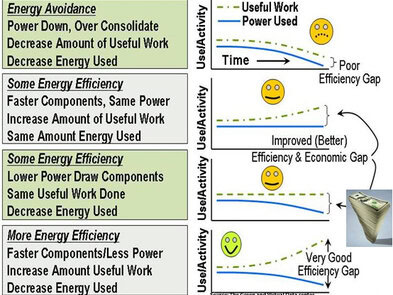
Another example of a Green gap is messaging around energy avoidance as being efficient vs. using energy in a more productive or effective manner (doing more work with the same or fewer resources) shown in the figure below.

Tiered Storage
Expanding focus from energy avoidance to energy usage effectiveness

In routine conversations with IT professionals it is clear that the Green Gap and thus missed opportunities will continue for some time until the business and economic values of efficient, effective, smart and productive IT are understood to have environmental benefits as a by product and thus being Green. Watch for more missed messaging around CO2 and related themes popular with so called Greenies (or if you prefer environmentalists) that miss the mark with most business and IT organizations.

Business and thus IT are driven by economics and as such will invest where they can reduce complexity and costs, become more efficient and effective while increasing productivity and reducing waste by working smarter. In other words, by changing how information services are delivered in a smarter more effective efficient manner maximizes what resources are used enabling more to be done in a denser footprint (budget, people staffing, management, power, cooling, floor space) that have positive environmental benefits. Put another way, a benefit for IT organizations to remove complexity results in lower costs, by becoming more efficient and effective reducing waste results in better productivity and fewer missed opportunities meaning enhanced profits. The net result is that environmental concerns get a free ride or being funded as a result of IT organizations improving their productivity which of course should have a business benefit.

Efficient and Optimized IT Wheel of Oppourtunity
Wheel of Opportunity: Various techniques and technologies for infrastructure optimization

Efficient and effective IT (aka the other Green IT) that links to common technology and business issues with the benefit of helping the environment can be accomplished using a combination approaches. The approaches for enabling an efficient, effective, smarter and productive IT environment includes from a generic perspective various technologies, techniques and best practices shown in the wheel of opportunity figure.

For example:

Here are some related links for additional reading:

Also check out my book for enabling efficient, effective and smart IT The Green and Virtual Data Center (CRC) including a free sample chapter download here.

Ok, nuff said for now, go hug a tree, your computer, hybrid car, droid, ipad or whatever suits your needs.

Cheers gs

Greg Schulz – Author Cloud and Virtual Data Storage Networking (CRC), The Green and Virtual Data Center (CRC), Resilient Storage Networks (Elsevier)
twitter @storageio

All Comments, (C) and (TM) belong to their owners/posters, Other content (C) Copyright 2006-2011 StorageIO and UnlimitedIO All Rights Reserved

What do you need when its time to buy a new server?

You have been told by someone or determined on your own that it is time for a new server, however what to get?

A blade server, rack mount, floor model, physical or virtual perhaps cloud?

How about one that is fully configured and accessorized to meet your specific environments needs?

There are several considerations involving what type of server or computer is needed to meet your specific needs or application requirements. Options include price, packaging, vendor preferences, blade center, freestanding, 1U rack mount, virtual and cloud support, with or without storage and networking, performance as well as power and cooling among other considerations.

Here is a link (PDF version here, may require registration) to an article that I put together to help determine your needs as well as consider various options for your next server.

Hope you find the information useful!

Nuff said for now

Cheers gs

Greg Schulz – Author The Green and Virtual Data Center (CRC), Resilient Storage Networks (Elsevier) and coming summer 2011 Cloud and Virtual Data Storage Networking (CRC) at https://storageio.com/books
twitter @storageio

Winter 2011 Server and StorageIO News Letter

StorageIO News Letter Image
Winter 2011 Newsletter

Welcome to the Winter 2011 edition of the Server and StorageIO Group (StorageIO) newsletter. This follows the Fall 2011 edition.

You can access this news letter via various social media venues (some are shown below) in addition to StorageIO web sites and subscriptions. Click on the following links to view the Winter 2011 edition as an HTML or PDF or, to go to the newsletter page to view previous editions.

Follow via Goggle Feedburner here or via email subscription here.

You can also subscribe to the news letter by simply sending an email to newsletter@storageio.com

Enjoy this edition of the StorageIO newsletter, let me know your comments and feedback.

Cheers gs

Nuff said for now

Cheers gs

Greg Schulz – Author The Green and Virtual Data Center (CRC), Resilient Storage Networks (Elsevier) and coming summer 2011 Cloud and Virtual Data Storage Networking (CRC)
twitter @storageio

Securing data at rest: Self Encrypting Disks (SEDs)

Here is a link to a recent guest post that I was invited to do over at The Virtualization Practice (TVP) pertaining to Self Encrypting Disk (SEDs).

Based on the trusted computing group (TCG) DriveTrust and OPAL disk drive security models, SEDs offload encryption to the disk drive while complimenting other encryption security solutions to protect against theft or lost storage devices. There is another benefit however for SEDs which is simplifying the process of decommissioning a storage device safely and quickly.

If you are not familiar with them, SEDs perform encryption within the hard disk drive (HDD) itself using the onboard processor and resident firmware. Since SEDs only protect data at rest, other forms of encryption should be combined to protect data in flight or on the move.

There is also another benefit of SEDs in that for those of you concerned about how to digital destroy, shred or erase large capacity disks in the future, you may have a new option. While intended for protecting data, a byproduct is that when a SED is removed from the system or server or controller that it has established an affinity with, its contents are effectively useless until reattached. If the encryption key for a SED is changed, then the data is instantly rendered useless, or at least for most environments.

Learn more about SEDs here and via the following links:

  • Self-Encrypting Drives for IBM System x
  • Trusted Computing Group OPAL Summary
  • Storage Performance Council (SPC) SED and Non SED benchmarks
  • Seagate SED information
  • Trusted Computing Group SED information

Ok, nuff said.

Cheers gs

Greg Schulz – Author Cloud and Virtual Data Storage Networking (CRC Press), The Green and Virtual Data Center (CRC Press) and Resilient Storage Networks (Elsevier)
twitter @storageio

All Comments, (C) and (TM) belong to their owners/posters, Other content (C) Copyright 2006-2026 Server StorageIO and UnlimitedIO LLC All Rights Reserved

What have I been doing this winter?

Its been almost a month since my last post and want to say hello and let you know what I have been doing.

What I have been doing is:

  • Accumulating a long list of ideas for upcoming blog post, article, tips, webinars and other content.
  • Recording some podcasts, web casts doing interviews and commentary along with a few articles here and there.
  • Working with some new venues where if all comes together you should be seeing material or commentary appearing soon.
  • Filling some dates for the 2011 out and about events and activities page.
  • Doing research in several different areas as well as working with clients on various project activities, many of which that are NDA.
  • Getting some recently finished content ready to appear on the main web site as well as in the blog and other venues.
  • Attending vendor events and briefing sessions on solutions some of which are yet to be announced.
  • Enjoying the cold and snowy winter as best as can be (see some videos here) while trying to avoid cold and flue season.

In addition to the above, I have been trying to stay very focused on is getting my new book which is titled Cloud and Virtual Data Storage Networking (CRC) wrapped up for a summer 2011 release. This is my third solo book project that is in addition to co writing or contributing to several other book projects.

Cloud and Virtual Data Storage Networking

Im doing the project the old fashioned way which means writing it myself as opposed to using ghost writers along with a traditional publishing house (CRC, same as my last book) all of which takes a bit more time. For anyone who has done a project like this you know what is involved. For those who have not it includes research, writing, editing, working with editors and copyeditors, subject matter experts doing initial reviews, illustrations and page layouts, markups, more edits and proofs. Then there are the general project management activities along with marketing and rollout plans, companion presentation material working with the publisher and others.

Anyway, hope you are all doing well, look forward to sharing more with you soon, now it is time to get back to work…

Nuff said for now

Cheers gs

Greg Schulz – Author The Green and Virtual Data Center (CRC), Resilient Storage Networks (Elsevier) and coming summer 2011 Cloud and Virtual Data Storage Networking (CRC)
twitter @storageio

Are you on the StorageIO IT Data Infrastructure industry links page?

Hey IT data infrastructure vendors, VARs or service providers, are you on the Server and StorageIO IT industry interesting links page?

Dont worry, its free and no obligation!

There are no hidden charges or fees, you will not be obligated to pay a fee or subscribe to a service, or be called or contacted via a sales or account manager person to buy something. Nor will you be required to sign up for a annual or short term retainer, make a donation, honorarium, endowment, contribution, subsidy, renumerate or sponsor in any other manner directly or via indirect means including second, third, fourth or by way of other virtual means or physical means. This also means via other organizations, venues, institutes, associations, communities, events or causes. (Btw, that is some industry humor some will get however to others that feel it is poking fun of their lively hoods, too bad!)

Your contact information will not be sold, bartered, traded, borrowed or abused being kept confidential nor will you be called or bothered (contact me if somebody does reach out to you). However you may get an occasional Server and StorageIO newsletter sent to you via email (privacy and disclosure statement can be found here).

There is however one small caveat and that is no spamming and direct submissions on yours or your companies behalf. If you are a public relations firm feel free to submit on behalf of your own organization, however have your clients submit on their own (or use their identity when doing so on their own behalf).

Why do I make this links page and list available for free to those who read it, as well as to those who are on it?

Simple, I use it myself to keep a list of companies, firms or organizations that are involved with data infrastructures (servers, storage, I/O and networking, hardware, software, services) that I have come across and worth keeping track of that I also feel worth sharing with others.

Of course, if you feel compelled, you can always contact Server and StorageIO to discuss other services or simply buy one of my books including Resilient Storage Networks: Designing Flexible Scalable Data Infrastructures (Elsevier), The Green and Virtual Data Center (CRC) and coming summer 2011 Cloud and Virtual Data Storage Networking (CRC) at Amazon or one of the other many fine global venues.


Still interested, all you need to do is the following:

No SPAM submission please

Please do not submit via web or blog page unless you want your contact information known to others.

Send an email to links at storageio dot com that includes the following:

1. Your company name
2. Your company URL
3. Your company contact person (you or someone else) including:
Name
Title or position
Phone or Skype
Email
Optional twitter

4. Brief 40 character or less description of what you do, or solution categories (tip, avoid superlatives, see links page for ideas)

5. Optionally indicate to DND (Do Not Disturb) you with email newsletters, coverage or mentions.

Again, please, No Spam!

Its that simple.

Now its up to you to decide if you want to be included or not.

Ok, nuff said.

Cheers gs

Greg Schulz – Author Cloud and Virtual Data Storage Networking (CRC Press), The Green and Virtual Data Center (CRC Press) and Resilient Storage Networks (Elsevier)
twitter @storageio

All Comments, (C) and (TM) belong to their owners/posters, Other content (C) Copyright 2006-2026 Server StorageIO and UnlimitedIO LLC All Rights Reserved

E2E Awareness and insight for IT environments

I recently did a couple of Industry Trends and Perspectives webcast events around the topic and themes of End to End (E2E) awareness and cross domain (or technology) management insight for cloud, virtual and other abstracted as well as physical IT environments.

The importance of E2E awareness of IT resources across different technology domains (or focus areas) is that you can not effectively manage what you do not have timely access or visibility into. Hence the theme of session being You cannot effectively manage what you do not know about in a timely manner.

Here is the abstract for the webcast:

Virtualization, clouds and other forms of abstraction help IT organizations enable flexible and scalable services delivery. While abstraction of underlying resources simplifies services delivery from an IT customers perspective, additional layers of technology along with interdependencies still need to be tracked as well as managed.  A key enabler for IT organizations is having end to end (E2E) situational awareness of available resources and how they are being used. By having timely situational awareness across various technology domains, IT organizations gain insight into how resources can be more effectively deployed in an efficient manner.

Join independent IT industry analyst, author and blogger Greg Schulz as he looks at common challenges as well as opportunities for leveraging E2E situational awareness to remove blind spots from efficient effective IT services delivery. Greg will look several scenarios including among others cost reduction, maximize resource usage, shrink migration and data consolidation times for cloud, virtual and traditional IT environments while maintaining or enhancing IT services delivery.

If you are interested in IT Infrastructure Resource Management (IRM) of servers, storage, IO networking, virtualization, cloud, backup or restore, optimization as well as cloud or legacy environments and metrics, I invite you to view the following web cast.

E2E cross domain awareness webcast

Click on the above image to access the BrightTalk web cast from their recent Virtualization Summit series (may require registration)

If you are interested, here is a link to a previous post I did on E2E management, SRA (systems or storage resource analysis) and management insight along with a recent related white paper sponsored by SANpulse that you can access here.

Ok, nuff said.

Cheers gs

Greg Schulz – Author Cloud and Virtual Data Storage Networking (CRC Press), The Green and Virtual Data Center (CRC Press) and Resilient Storage Networks (Elsevier)
twitter @storageio

All Comments, (C) and (TM) belong to their owners/posters, Other content (C) Copyright 2006-2026 Server StorageIO and UnlimitedIO LLC All Rights Reserved

As the Hard Disk Drive HDD continues to spin

As the Hard Disk Drive HDD continues to spin

server storage data infrastructure i/o iop hdd ssd trends

Updated 2/10/2018

Despite having been repeatedly declared dead at the hands of some new emerging technology over the past several decades, the Hard Disk Drive (HDD) continues to spin and evolve as it moves towards its 60th birthday.

More recently HDDs have been declared dead due to flash SSD that according to some predictions, should have caused the HDD to be extinct by now.

Meanwhile, having not yet died in addition to having qualified for its AARP membership a few years ago, the HDD continues to evolve in capacity, smaller form factor, performance, reliability, density along with cost improvements.

Back in 2006 I did an article titled Happy 50th, hard drive, but will you make it to 60?

IMHO it is safe to say that the HDD will be around for at least a few more years if not another decade (or more).

This is not to say that the HDD has outlived its usefulness or that there are not other tiered storage mediums to do specific jobs or tasks better (there are).

Instead, the HDD continues to evolve and is complimented by flash SSD in a way that HDDs are complimenting magnetic tape (another declared dead technology) each finding new roles to support more data being stored for longer periods of time.

After all, there is no such thing as a data or information recession!

What the importance of this is about technology tiering and resource alignment, matching the applicable technology to the task at hand.

Technology tiering (Servers, storage, networking, snow removal) is about aligning the applicable resource that is best suited to a particular need in a cost as well as productive manner. The HDD remains a viable tiered storage medium that continues to evolve while taking on new roles coexisting with SSD and tape along with cloud resources. These and other technologies have their place which ideally is finding or expanding into new markets instead of simply trying to cannibalize each other for market share.

Here is a link to a good story by Lucas Mearian on the history or evolution of the hard disk drive (HDD) including how a 1TB device that costs about $60 today would have cost about a trillion dollars back in the 1950s. FWIW, IMHO the 1 trillion dollars is low and should be more around 2 to 5 trillion for the one TByte if you apply common costs for management, people, care and feeding, power, cooling, backup, BC, DR and other functions.

Where To Learn More

View additional NAS, NVMe, SSD, NVM, SCM, Data Infrastructure and HDD related topics via the following links.

Additional learning experiences along with common questions (and answers), as well as tips can be found in Software Defined Data Infrastructure Essentials book.

Software Defined Data Infrastructure Essentials Book SDDC

What This All Means

IMHO, it is safe to say that the HDD is here to stay for at least a few more years (if not decades) or at least until someone decides to try a new creative marketing approach by declaring it dead (again).

Ok, nuff said, for now.

Gs

Greg Schulz – Microsoft MVP Cloud and Data Center Management, VMware vExpert 2010-2017 (vSAN and vCloud). Author of Software Defined Data Infrastructure Essentials (CRC Press), as well as Cloud and Virtual Data Storage Networking (CRC Press), The Green and Virtual Data Center (CRC Press), Resilient Storage Networks (Elsevier) and twitter @storageio. Courteous comments are welcome for consideration. First published on https://storageioblog.com any reproduction in whole, in part, with changes to content, without source attribution under title or without permission is forbidden.

All Comments, (C) and (TM) belong to their owners/posters, Other content (C) Copyright 2006-2026 Server StorageIO and UnlimitedIO. All Rights Reserved. StorageIO is a registered Trade Mark (TM) of Server StorageIO.

Re visiting if IBM XIV is still relevant with V7000

Over the past couple of years I routinely get asked what I think of XIV by fans as well as foes in addition to many curious or neutral onlookers including XIV competitors, other analysts, media, bloggers, consultants as well as IBM customers, prospects, vars and business partners. Consequently I have done some blog posts about my thoughts and perspectives.

Its time again for what has turned out to be the third annual perspective or thoughts around IBM XIV and if it is still relevant as a result of the recent IBM V7000 (excuse me, I meant to say IBM Storwize V7000) storage system launch.

For those wanting to take a step back in time, here is an initial thought perspective about IBM and XIV storage from 2008, as well as the 2009 revisiting of XIV relevance post and the latest V7000 companion post found here.

What is the IBM V7000?

Here is a link to a companion post pertaining to the IBM V7000 that you will want to have a look at.

In a nut shell, the V7000 is a new storage system with built in storage virtualization or virtual storage if you prefer that leverages IBM developed software from its San Volume Controller (SVC), DS8000 enterprise system and others.

Unlike the SVC which is a gateway or appliance head that virtualizes various IBM and third party storage systems providing data movement, migration, copy, replication, snapshot and other agility or abstraction capabilities, the V7000 is a turnkey integrated solution.

By being a turnkey solution, the V7000 combines the functionality of the SVC as a basis for adding other IBM technologies including a GUI management tool similar to that found on XIV along with dedicated attached storage (e.g. SAS disk drives including fast, high capacity as well as SSD).

In other words, for those customer or prospects who liked XIV because of its management GUI interface, you may like the V7000.

For those who liked the functionality capabilities of the SVC however needed it to be a turnkey solution, you might like the V7000.

For those of you who did not like or competed with the SVC in the past, well, you know what to do.

BTW, for those who knew of Storwize the Data Footprint Reduction (DFR) vendor with real time compression that IBM recently acquired and renamed IBM Real time Compression, the V7000 does not contain any real time compression (yet).

What are my thoughts and perspectives?

In addition to the comments in the companion post found here, right now Im of the mind set that XIV does not fade away quietly into the sunset or take a timeout at the IBM technology rest and recuperation resort located on the beautiful someday isle.

The reason I think XIV will remain somewhat relevant for some time, (time to be determined of course) is that IBM has expended over the past two and half years significant resources to promote it. Those resources have included marketing time, messaging space and in some instances perhaps inadvertinly at the expense of other IBM storage solutions. Simiarly, a lot of time, money and effort have gone into business partner outreach to establish and keep XIV relevant with those commuities who in turn have gone to their customers to tell and sell the XIV story to some customers who have bought it.

Consequently or as a result of all of that investment, I would be surprised if IBM were simply to walk away from XIV at least near term.

What I do see as happening including some early indicators is that the V7000 (along with other IBM products) now will be getting equal billing, resources and promotional support. Weather this means the XIV division finally being assimilated into the mainstream IBM fold and on equal footing with other IBM products, or, that other IBM products being brought up to an elevated position of XIV is subject to interpretation and your own perception.

I expect to continue to see IBM teams and subsequently their distributors, vars and other business partners get more excited talking about the V7000 along with other IBM solutions. For example, SONAS for bulk, clustered and scale out NAS, DS8000 for high end, GMAS and Information Archive platforms as well as N and DS3K/DS4K/DS5K not to mentiuon the TS/TL backup and archive target platforms along with associated Tivoli software. Also, lets not forget about SVC among other IBM solutions including of course, XIV.

I would also not be surprised if some of the diehard XIV loyalist (e.g. sales and marketing reps that were faithful members of Moshe Yani army who appears to be MIA at IBM) pack up their bags and leave the IBM storage SANdbox in virtual protest. That is, refusing to be assimilated into the general IBM storage pool and thus leaving for Greener IT pastures elsewhere. Some will stick around discovering the opportunities associated with selling a broader more diverse product portfolio into their target accounts where they have spent time and resources to establish relationships or getting thier proverbial foot in the door.

Consequently, I think XIV remains somewhat relevant for now given all of the resources that IBM poured into it and relationships that their partner ecosystem also spent on establishing with the installed customer base.

However, I do think that the V7000 despite some confusion (here and here) around its recycled Storwize name that is built around the field proven SVC and other IBM technology has some legs. Those legs of the V7000 are both from a technology standpoint as well as a means to get the entire IBM systems and storage group energized to go out and compete with their primary nemesis (e.g. Dell, EMC, HP, HDS, NetApp and Oracle among others).

As has been the case for the past couple of years, lets see how this all plays out in a year or so from now. Meanwhile cast your vote or see the results of others as to if XIV remains relevant. Likewise, join in on the new poll below as to if the V7000 is now relevant or not.

Note: As with the ongoing is XIV relevant polling (above), for the new is the V7000 relevant polling (below) you are free to vote early, vote often, vote for those who cannot or that care not to vote.

Here are some links to read more about this and related topics:

Ok, nuff said.

Cheers gs

Greg Schulz – Author Cloud and Virtual Data Storage Networking (CRC Press), The Green and Virtual Data Center (CRC Press) and Resilient Storage Networks (Elsevier)
twitter @storageio

All Comments, (C) and (TM) belong to their owners/posters, Other content (C) Copyright 2006-2026 Server StorageIO and UnlimitedIO LLC All Rights Reserved

End to End (E2E) Systems Resource Analysis (SRA) for Cloud and Virtual Environments

A new StorageIO Industry Trends and Perspective (ITP) white paper titled “End to End (E2E) Systems Resource Analysis (SRA) for Cloud, Virtual and Abstracted Environments” is now available at www.storageioblog.com/reports compliments of SANpulse technologies.

End to End (E2E) Systems Resource Analysis (SRA) for Virtual, Cloud and abstracted environments: Importance of Situational Awareness for Virtual and Abstracted Environments

Abstract:
Many organizations are in the planning phase or already executing initiatives moving their IT applications and data to abstracted, cloud (public or private) virtualized or other forms of efficient, effective dynamic operating environments. Others are in the process of exploring where, when, why and how to use various forms of abstraction techniques and technologies to address various issues. Issues include opportunities to leverage virtualization and abstraction techniques that enable IT agility, flexibility, resiliency and salability in a cost effective yet productive manner.

An important need when moving to a cloud or virtualized dynamic environment is to have situational awareness of IT resources. This means having insight into how IT resources are being deployed to support business applications and to meet service objectives in a cost effective manner.

Awareness of IT resource usage provides insight necessary for both tactical and strategic planning as well as decision making. Effective management requires insight into not only what resources are at hand but also how they are being used to decide where different applications and data should be placed to effectively meet business requirements.

Learn more about the importance and opportunities associated with gaining situational awareness using E2E SRA for virtual, cloud and abstracted environments in this StorageIO Industry Trends and Perspective (ITP) white paper compliments of SANpulse technologies by clicking here.

Ok, nuff said.

Cheers gs

Greg Schulz – Author Cloud and Virtual Data Storage Networking (CRC Press), The Green and Virtual Data Center (CRC Press) and Resilient Storage Networks (Elsevier)
twitter @storageio

All Comments, (C) and (TM) belong to their owners/posters, Other content (C) Copyright 2006-2026 Server StorageIO and UnlimitedIO LLC All Rights Reserved

What is DFR or Data Footprint Reduction?

What is DFR or Data Footprint Reduction?

What is DFR or Data Footprint Reduction?

Updated 10/9/2018

What is DFR or Data Footprint Reduction?

Data Footprint Reduction (DFR) is a collection of techniques, technologies, tools and best practices that are used to address data growth management challenges. Dedupe is currently the industry darling for DFR particularly in the scope or context of backup or other repetitive data.

However DFR expands the scope of expanding data footprints and their impact to cover primary, secondary along with offline data that ranges from high performance to inactive high capacity.

Consequently the focus of DFR is not just on reduction ratios, its also about meeting time or performance rates and data protection windows.

This means DFR is about using the right tool for the task at hand to effectively meet business needs, and cost objectives while meeting service requirements across all applications.

Examples of DFR technologies include Archiving, Compression, Dedupe, Data Management and Thin Provisioning among others.

Read more about DFR in Part I and Part II of a two part series found here and here.

Where to learn more

Learn more about data footprint reducton (DFR), data footprint overhead and related topics via the following links:

Additional learning experiences along with common questions (and answers), as well as tips can be found in Software Defined Data Infrastructure Essentials book.

Software Defined Data Infrastructure Essentials Book SDDC

What this all means

That is all for now, hope you find these ongoing series of current or emerging Industry Trends and Perspectives posts of interest.

Ok, nuff said, for now.

Cheers Gs

Greg Schulz – Microsoft MVP Cloud and Data Center Management, VMware vExpert 2010-2018. Author of Software Defined Data Infrastructure Essentials (CRC Press), as well as Cloud and Virtual Data Storage Networking (CRC Press), The Green and Virtual Data Center (CRC Press), Resilient Storage Networks (Elsevier) and twitter @storageio. Courteous comments are welcome for consideration. First published on https://storageioblog.com any reproduction in whole, in part, with changes to content, without source attribution under title or without permission is forbidden.

All Comments, (C) and (TM) belong to their owners/posters, Other content (C) Copyright 2006-2026 Server StorageIO and UnlimitedIO. All Rights Reserved. StorageIO is a registered Trade Mark (TM) of Server StorageIO.

August 2010 StorageIO News Letter

StorageIO News Letter Image
August 2010 Newsletter

Welcome to the August Summer Wrap Up 2010 edition of the Server and StorageIO Group (StorageIO) newsletter. This follows the June 2010 edition building on the great feedback received from recipients.
Items that are new in this expanded edition include:

  • Out and About Update
  • Industry Trends and Perspectives (ITP)
  • Featured Article

You can access this news letter via various social media venues (some are shown below) in addition to StorageIO web sites and subscriptions. Click on the following links to view the August 2010 edition as an HTML or PDF or, to go to the newsletter page to view previous editions.

Follow via Goggle Feedburner here or via email subscription here.

You can also subscribe to the news letter by simply sending an email to newsletter@storageio.com

Enjoy this edition of the StorageIO newsletter, let me know your comments and feedback.

Cheers gs

Greg Schulz – Author The Green and Virtual Data Center (CRC) and Resilient Storage Networks (Elsevier)
twitter @storageio

Data footprint reduction (Part 2): Dell, IBM, Ocarina and Storwize

Dell

IBM

Over the past couple of weeks there has been a flurry of IT industry activity around data footprint impact reduction with Dell buying Ocarina and IBM acquiring Storwize. For those who want the quick (compacted, reduced) synopsis of what Dell buying Ocarina as well as IBM acquiring Storwize means read the first post in this two part series as well as some of my comments here and here.

This piece and it companion in part I of this two part series is about expanding the discussion to the much larger opportunity for vendors or vars of overall data footprint impact reduction beyond where they are currently focused. Likewise, this is about IT customers realizing that there are more opportunities to address data and storage optimization across your entire organization using various techniques instead of just focusing on backup or vmware virtual servers.

Who is Ocarina and Storwize?
Ocarina is a data and storage management software startup focused on data footprint reduction using a variety of approaches, techniques and algorithms. They differ from the traditional data dedupers (e.g. Asigra, Bakbone, Commvault, EMC Avamar, Datadomain and Networker, Exagrid, Falconstor, HP, IBM Protectier and TSM, Quantum, Sepaton and Symantec among others) by looking at data footprint reduction beyond just backup.

This means looking at how to reduce data footprint across different types of data including videos, image as well as text based documents among others. As a result, the market sweet spot for Ocarina is for general data footprint reduction including static along with active data including entertainment, video surveillance or gaming, reference data, web 2.0 and other bulk storage application data needs (this should compliment Dells recent Exanet acquisition).

What this means is that Ocarina is very well suited to address the rapidly growing amount of unstructured data that may not otherwise be handled as efficiently with by dedupe alone.

Storwize is a data and storage management startup focused on data footprint reduction using inline compression with an emphasis on maintaining performance for reads as well as writes of unstructured as well as structured database data. Consequently the market sweet spot for Storwize is around boosting the capacity of existing NAS storage systems from different vendors without negatively impacting performance. The trade off of the Storwize approach is that you do not get the spectacular data reduction ratios associated with backup centric or focused dedupe, however, you maintain performance associated with online storage that some dedupers dream of.

Both Dell and IBM have existing dedupe solutions for general purpose as well as backup along with other data footprint impact reduction tools (either owned or via partners). Now they are both expanding their focus and reach similar to what others such as EMC, HP, NetApp, Oracle and Symantec among others are doing. What this means is that someone at Dell and IBM see that there is much more to data footprint impact reduction than just a focus on dedupe for backup.

Wait, what does all of this discussion (or read here for background issues, challenges and opportunities) about unstructured data and changing access lifecycles have to do with dedupe, Ocarina and Storwize?

Continue reading on as this is about the expanding opportunity for data footprint reduction across entire organizations. That is, more data is being kept online and expanding data footprint impact needs to be addressed to meet business objectives using various techniques balancing performance, availability, capacity and energy or economics (PACE).

Dell

IBM

What does all of this have to do with IBM buying Storwize and Dell acquiring Ocarina?
If you have not pieced this together yet, let me net it out.

This is about the opportunity to address the organization wide expanding data footprint impact across all applications, types of data as well as tiers of storage to support business growth (more data to store) while maintaining QoS yet reduce per unit costs including management.

This is about expanding the story to the broader data footprint impact reduction from the more narrowly focused backup and dedupe discussion which are still in their infancy on a relative basis to their full market potential (read more here).

Now are you seeing where this is going and fits?

Does this mean IBM and Dell defocus on their existing Dedupe product lines or partners?
I do not believe so, at least as long as their respective revenue prevention departments are kept on the sidelines and off of the field of play. What I mean by this is that the challenge for IBM and Dell is similar to that of what others such as EMC are faced with having diverse portfolios or technology toolboxes. The challenge is messaging to the bigger issues, then aligning the right tool to the task at hand to address given issues and opportunities instead of singularly focused on a specific product causing revenue prevention elsewhere.

As an example, for backup, I would expect Dell to continue to work with its existing dedupe backup centric partners and technologies however find new opportunities to leverage their Ocarina solution. Likewise, IBM I would expect to continue to show customers where Tivoli software based dedupe or Protectier (aka the deduper formerly known as Diligent) or other target based dedupe fits and expand into other data footprint impact areas with Storewize.

Does this change the playing field?
IMHO these moves as well as some previous moves by the likes of EMC and NetApp among others are examples of expanding the scope and dimension of the playing field. That is, the focus is much more than just dedupe for backup or of virtual machines (e.g. VMware vSphere or Microsoft HyperV).

This signals a growing awareness around the much larger and broader opportunity around organization wide data footprint impact reduction. In the broader context some applications or data gets compressed either in application software such as databases, file systems, operating systems or even hypervisors as well as in networks using protocol or bandwidth optimizers as well as inline compression or post processing techniques as has been the case with streaming tape devices for some time.

This also means that where with dedupe the primary focus or marketing angle up until recently has been around reduction ratios, to meet the needs of time or performance sensitive applications data transfer rates also become important.

Hence the role of policy based data footprint reduction where the right tool or technique to meet specific service requirements is applied. For those vendors with a diverse data footprint impact reduction tool kit including archive, compression, dedupe, thin provision among other techniques, I would expect to hear expanded messaging around the theme of applying the right tool to the task at hand.

Does this mean Dell bought Ocarina to accessorize EqualLogic?
Perhaps, however that would then beg the question of why EqualLogic needs accessorizing. Granted there are many EqualLogic along with other Dell sold storage systems attached to Dell and other vendors servers operating as NFS or Windows CIFS file servers that are candidates for Ocarina. However there are also many environments that do not yet include Dell EqualLogic solutions where Ocarina is a means for Dell to extend their reach enabling those organizations to do more with what they have while supporting growth.

In other words, Ocarina can be used to accessorize, or, it can be used to generate and create pull through for various Dell products. I also see a very strong affinity and opportunity for Dell to combine their recent Exanet NAS storage clustering software with Dell servers, storage to create bulk or scale out solutions similar to what HP and other vendors have done. Of course what Dell does with the Ocarina software over time, where they integrate it into their own products as well as OEM to others should be interesting to watch or speculate upon.

Does this mean IBM bought Storwize to accessorize XIV?
Well, I guess if you put a gateway (or software on a server which is the same thing) in front of XIV to transform it into a NAS system, sure, then Storwize could be used to increase the net usable capacity of the XIV installed base. However that is a lot of work and cost for what is on a relative basis a small footprint, yet it is a viable option never the less.

IMHO IBM has much more of a play, perhaps a home run by walking before they run by placing Storwize in front of their existing large installed base of NetApp N series (not to mention targeting NetApps own install base) as well as complimenting their SONAS solutions. From there as IBM gets their legs and mojo, they could go on the attack by going after other vendors NAS solutions with an efficiency story similar to how IBM server groups target other vendors server business for takeout opportunities except in a complimenting manner.

Longer term I would not be surprised to see IBM continue development of the block based IP (as well as file) in the storwize product for deployment in solutions ranging from SVC to their own or OEM based products along with articulating their comprehensive data footprint reduction solution portfolio. What will be important for IBM to do is articulating what solution to use when, where, why and how without confusing their customers, partners and rest of the industry (something that Dell will also have to do).

Some links for additional reading on the above and related topics

Wrap up (for now)

Organizations of all shape and size are encountering some form of growing data footprint impact that currently, or soon will need to be addressed. Given that different applications and types of data along with associated storage mediums or tiers have various performance, availability, capacity, energy as well as economic characteristics multiple data footprint impact reduction tools or techniques are needed. What this all means is that the focus of data footprint reduction is expanding beyond that of just dedupe for backup or other early deployment scenarios.

Note what this means is that dedupe has an even brighter future than where it currently is focused which is still only scratching the surface of potential market adoption as was discussed in part 1 of this series.

However this also means that dedupe is not the only solution to all data footprint reduction scenarios. Other techniques including archiving, compression, data management, thin provisioning, data deletion, tiered storage and consolidation will start to gain respect, coverage discussions and debates.

Bottom line, use the most applicable technologies or combinations along with best practice for the task and activity at hand.

For some applications reduction ratios are an important focus on the tools or modes of operations that achieve those results.

Likewise for other applications where the focus is on performance with some data reduction benefit, tools are optimized for performance first and reduction secondary.

Thus I expect messaging from some vendors to adjust (expand) to those capabilities that they have in their toolboxes (product portfolios) offerings

Consequently, IMHO some of the backup centric dedupe solutions may find themselves in niche roles in the future unless they can diversity. Vendors with multiple data footprint reduction tools will also do better than those with only a single function or focused tool.

However for those who only have a single or perhaps a couple of tools, well, guess what the approach and messaging will be. After all, if all you have is a hammer everything looks like a nail, if all you have is a screw driver, well, you get the picture.

On the other hand, if you are still not clear on what all this means, send me a note, give a call, post a comment or a tweet and will be happy to discuss with you.

Oh, FWIW, if interested, disclosure: Storwize was a client a couple of years ago.

Ok, nuff said.

Cheers gs

Greg Schulz – Author Cloud and Virtual Data Storage Networking (CRC Press), The Green and Virtual Data Center (CRC Press) and Resilient Storage Networks (Elsevier)
twitter @storageio

All Comments, (C) and (TM) belong to their owners/posters, Other content (C) Copyright 2006-2026 Server StorageIO and UnlimitedIO LLC All Rights Reserved

Availability or lack there of: Lessons From Our Frail & Aging Infrastructure

I have a new blog post over at Enterprise Efficiency about aging infrastructures including those involved with IT, Telcom and related ones.

As a society, we face growing problems repairing and maintaining the vital infrastructure we once took for granted.

Most of these incidents involve aging, worn-out physical infrastructure desperately in need of repair or replacement. But infrastructure doesn’t have to be old or even physical to cause problems when it fails.

The IT systems and applications all around us form a digital infrastructure that most enterprises take for granted until it’s not there.

Bottom line, there really isn’t much choice.

You can either pay up front now to update aging infrastructures, or, wait and pay more later. Either way, there will be a price to pay and you can not realize a cost savings until you actually embark on that endeavor.

Here is the link to the full blog post over at Enterprise Efficiency.

Ok, nuff said.

Cheers gs

Greg Schulz – Author Cloud and Virtual Data Storage Networking (CRC Press), The Green and Virtual Data Center (CRC Press) and Resilient Storage Networks (Elsevier)
twitter @storageio

All Comments, (C) and (TM) belong to their owners/posters, Other content (C) Copyright 2006-2026 Server StorageIO and UnlimitedIO LLC All Rights Reserved