Green and Virtual IT Data Center Primer

Green and Virtual Data Center Primer

Moving beyond Green Hype and Green washing

Green IT is about enabling efficient, effective and productive information services delivery. There is a growing green gap between green hype messaging or green washing and IT pain point issues including limits on availability or rising costs of power, cooling, floor-space as well as e-waste and environmental health and safety (PCFE). To close the gap will involve addressing green messaging and rhetoric closer to where IT organizations pain points are and where budget dollars exists that can address PCFE and other green related issues as a by-product. The green gap will also be narrowed as awareness of broader green related topics coincide with IT data center pain points, in other words, alignment of messaging with IT issues that have or will have budget dollars allocated towards them to sustain business and economic growth via IT resource usage efficiency. Read more here.

There are many aspects to "Green" Information Technology including servers, storage, networks and associated management tools and techniques. The reasons and focus of "Green IT" including "Green Data Storage ", "Green Computing" and related focus areas are varied to discuss diverse needs, issues and requirements including among others:

  • Power, Cooling, Floor-space, Environmental (PCFE) related issues or constraints
  • Reduction of carbon dioxide (CO2) emissions and other green house gases (GHGs)
  • Business growth and economic sustain in an environmental friendly manner
  • Proper disposal or recycling of environmental harmful retired technology components
  • Reduction or better efficiency of electrical power consumption used for IT equipment
  • Cost avoidance or savings from lower energy fees and cooling costs
  • Support data center and application consolidation to cut cost and management
  • Enable growth and enhancements to application service level objectives
  • Maximize the usage of available power and cooling resources available in your region
  • Compliance with local or federal government mandates and regulations
  • Economic sustain and ability to support business growth and service improvements
  • General environmental awareness and stewardship to save and protect the earth

While much of the IT industry focuses on CO2 emissions footprints, data management software and electrical power consumption, cooling and ventilation of IT data centers is an area of focus associated with "Green IT" as well as a means to discuss more effective use of electrical energy that can yield rapid results for many environments. Large tier-1 vendors including HP and IBM among others who have an IT and data center wide focus have services designed to do quick assessments as well as detailed analysis and re-organization of IT data center physical facilities to improve air flow and power consumption for more effective cooling of IT technologies including servers, storage, networks and other equipment.

Similar to your own residence, basic steps to improve your cooling effectiveness can lead to use of less energy to cut your budget impact, or, enable you to do more with what you already have with your cooling capacity to support growth, acquisitions and or consolidation initiatives. Vendors are also looking at means and alternatives for cooling IT equipment ranging from computer assisted computational fluid dynamics (CFD) software analysis of data center cooling and ventilation to refrigerated cooling racks some leveraging water or inert liquid cooling.

Various metrics exists and others are evolving for measuring, estimating, reporting, analyzing and discussing IT Data Center infrastructure resource topics including servers, storage, networks, facilities and associated software management tools from a power, cooling and green environmental standpoint. The importance of metrics is to focus on the larger impact of a piece of IT equipment that includes its cost and energy consumption that factors in cooling and other hosting or site environmental costs. Naturally energy costs and CO2 (carbon offsets) will vary by geography and region along with type of electrical power being used (Coal, Natural Gas, Nuclear, Wind, Thermo, Solar, etc) and other factors that should be kept in perspective as part of the big picture.

Consequently your view and needs or interests around "Green" IT may be from an electrical power conservation perspective to maximize your power consumption or to adapt to a given power footprint or ceiling. Your focus around "Green" Data Centers and Green Storage may be from a carbon savings standpoint or proper disposition of old and retired IT equipment or from a data center cooling standpoint. Another area of focus may be that you are looking to cut your data footprint to align with your power, cooling and green footprint while enhancing application and data service delivery to your customers.

Where to learn more

The following are useful links to related efficient, effective, productive, flexible, scalable and resilient IT data center along with server storage I/O networking hardware and software that supports cloud and virtual green data centers.

Various IT industry vendor and service provider links
Green and Virtual Data Center: Productive Economical Efficient Effective Flexible
Green and Virtual Data Center links
Are large storage arrays dead at the hands of SSD?
Closing the Green Gap
Energy efficient technology sales depend on the pitch

What this all means

The result of a green and virtual data center is that of a flexible, agile, resilient, scalable information factory that is also economical, productive, efficient, productive as well as sustainable.

Ok, nuff said (for now)

Cheers gs

Greg Schulz – Author Cloud and Virtual Data Storage Networking (CRC Press), The Green and Virtual Data Center (CRC Press) and Resilient Storage Networks (Elsevier)
twitter @storageio

All Comments, (C) and (TM) belong to their owners/posters, Other content (C) Copyright 2006-2026 Server StorageIO and UnlimitedIO LLC All Rights Reserved

Green and Virtual Data Center: Productive Economical Efficient Effective Flexible

Green and Virtual Data Center

A Green and Virtual IT Data Center (e.g. an information factory) means an environment comprising:

  • Habitat for technology or physical infrastructure (e.g. physical data center, yours, co-lo, managed service or cloud)
  • Power, cooling, communication networks, HVAC, smoke and fire suppression, physical security
  • IT data information infrastructure (e.g. hardware, software, valueware, cloud, virtual, physical, servers, storage, network)
  • Data Center Infrastructure Management (DCIM) along with IT Service Management (ITSM) software defined management tools
  • Tools for monitoring, resource tracking and usage, reporting, diagnostics, provisioning and resource orchestration
  • Portals and service catalogs for automated, user initiated and assisted operation or access to IT resources
  • Processes, procedures, best-practices, work-flows and templates (including data protection with HA, BC, BR, DR, backup/restore, logical and physical security)
  • Metrics that matter for management insight and awareness
    People and skill sets among other items

Green and Virtual Data Center Resources

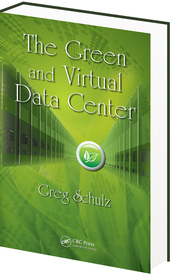
Click here to learn about "The Green and Virtual Data Center" book (CRC Press) for enabling efficient, productive IT data centers. This book covers cloud, virtualization, servers, storage, networks, software, facilities and associated management topics, technologies and techniques including metrics that matter. This book by industry veteran IT advisor and author Greg Schulz is the definitive guide for enabling economic efficiency and productive next generation data center strategies.

Intel recommended reading
Publisher: CRC Press – Taylor & Francis Group
By Greg P. Schulz of StorageIO www.storageio.com
 ISBN-10: 1439851739 and ISBN-13: 978-1439851739
 Hardcover * 370 pages * Over 100 illustrations figures and tables

Read more here and order your copy here. Also check out Cloud and Virtual Data Storage Networking (CRC Press) a new book by Greg Schulz.

Productive Efficient Effective Economical Flexible Agile and Sustainable

Green hype and green washing may be on the endangered species list and going away, however, green IT for servers, storage, networks, facilities as well as related software and management techniques that address energy efficiency including power and cooling along with e-waste, environmental health and safety related issues are topics that wont be going away anytime soon. There is a growing green gap between green hype messaging or green washing and IT pain point issues including limits on availability or rising costs of power, cooling, floor-space as well as e-waste and environmental health and safety (PCFE). To close the gap will involve addressing green messaging and rhetoric closer to where IT organizations pain points are and where budget dollars exists that can address PCFE and other green related issues as a by-product.

The green gap will also be narrowed as awareness of broader green related topics coincide with IT data center pain points, in other words, alignment of messaging with IT issues that have or will have budget dollars allocated towards them to sustain business and economic growth via IT resource usage efficiency. Read more here.

Where to learn more

The following are useful links to related efficient, effective, productive, flexible, scalable and resilient IT data center along with server storage I/O networking hardware and software that supports cloud and virtual green data centers.

Various IT industry vendor and service provider links
Green and Virtual Data Center Primer
Green and Virtual Data Center links
Are large storage arrays dead at the hands of SSD?
Closing the Green Gap
Energy efficient technology sales depend on the pitch
EPA Energy Star for Data Center Storage Update
EPA Energy Star for data center storage draft 3 specification
Green IT Confusion Continues, Opportunities Missed! 
Green IT deferral blamed on economic recession might be result of green gap
How much SSD do you need vs. want?
How to reduce your Data Footprint impact (Podcast) 
Industry trend: People plus data are aging and living longer
In the data center or information factory, not everything is the same
More storage and IO metrics that matter
Optimizing storage capacity and performance to reduce your data footprint 
Performance metrics: Evaluating your data storage efficiency
PUE, Are you Managing Power, Energy or Productivity?
Saving Money with Green Data Storage Technology
Saving Money with Green IT: Time To Invest In Information Factories 
Shifting from energy avoidance to energy efficiency
SNIA Green Storage Knowledge Center
Speaking of speeding up business with SSD storage
SSD and Green IT moving beyond green washing
Storage Efficiency and Optimization: The Other Green
Supporting IT growth demand during economic uncertain times
The Green and Virtual Data Center Book (CRC Press, Intel Recommended Reading)
The new Green IT: Efficient, Effective, Smart and Productive 
The other Green Storage: Efficiency and Optimization 
What is the best kind of IO? The one you do not have to do

Watch for more links and resources to be added soon.

What this all means

The result of a green and virtual data center is that of a flexible, agile, resilient, scalable information factory that is also economical, productive, efficient, productive as well as sustainable.

Ok, nuff said (for now)

Cheers gs

Greg Schulz – Author Cloud and Virtual Data Storage Networking (CRC Press), The Green and Virtual Data Center (CRC Press) and Resilient Storage Networks (Elsevier)
twitter @storageio

All Comments, (C) and (TM) belong to their owners/posters, Other content (C) Copyright 2006-2026 Server StorageIO and UnlimitedIO LLC All Rights Reserved

Green and Virtual Data Center Links

Updated 10/25/2017

Green and Virtual IT Data Center Links

Moving beyond Green Hype and Green washing

Green hype and green washing may be on the endangered species list and going away, however, green IT for servers, storage, networks, facilities as well as related software and management techniques that address energy efficiency including power and cooling along with e-waste, environmental health and safety related issues are topics that wont be going away anytime soon.

There is a growing green gap between green hype messaging or green washing and IT pain point issues including limits on availability or rising costs of power, cooling, floor-space as well as e-waste and environmental health and safety (PCFE).

To close the gap will involve addressing green messaging and rhetoric closer to where IT organizations pain points are and where budget dollars exists that can address PCFE and other green related issues as a by-product. The green gap will also be narrowed as awareness of broader green related topics coincide with IT data center pain points, in other words, alignment of messaging with IT issues that have or will have budget dollars allocated towards them to sustain business and economic growth via IT resource usage efficiency. Read more here.

Enabling Effective Produtive Efficient Economical Flexible Scalable Resilient Information Infrastrctures

The following are useful links to related efficient, effective, productive, flexible, scalable and resilient IT data center along with server storage I/O networking hardware and software that supports cloud and virtual green data centers.

Various IT industry vendors and other links

Via StorageIOblog – Happy Earth Day 2016 Eliminating Digital and Data e-Waste

Green and Virtual Data Center Primer
Green and Virtual Data Center: Productive Economical Efficient Effective Flexible
Are large storage arrays dead at the hands of SSD?
Closing the Green Gap
Energy efficient technology sales depend on the pitch
EPA Energy Star for Data Center Storage Update
EPA Energy Star for data center storage draft 3 specification
Green IT Confusion Continues, Opportunities Missed! 
Green IT deferral blamed on economic recession might be result of green gap
How much SSD do you need vs. want?
How to reduce your Data Footprint impact (Podcast) 
Industry trend: People plus data are aging and living longer
In the data center or information factory, not everything is the same
More storage and IO metrics that matter
Optimizing storage capacity and performance to reduce your data footprint 
Performance metrics: Evaluating your data storage efficiency
PUE, Are you Managing Power, Energy or Productivity?
Saving Money with Green Data Storage Technology
Saving Money with Green IT: Time To Invest In Information Factories 
Shifting from energy avoidance to energy efficiency
SNIA Green Storage Knowledge Center
Speaking of speeding up business with SSD storage
SSD and Green IT moving beyond green washing
Storage Efficiency and Optimization: The Other Green
Supporting IT growth demand during economic uncertain times
The Green and Virtual Data Center Book (CRC Press, Intel Recommended Reading)
The new Green IT: Efficient, Effective, Smart and Productive 
The other Green Storage: Efficiency and Optimization 
What is the best kind of IO? The one you do not have to do

Intel recommended reading
Click here to learn about "The Green and Virtual Data Center" book (CRC Press) for enabling efficient , productive IT data centers. This book covers cloud, virtualization, servers, storage, networks, software, facilities and associated management topics, technologies and techniques including metrics that matter. This book by industry veteran IT advisor and author Greg Schulz is the definitive guide for enabling economic efficiency and productive next generation data center strategies. Read more here and order your copyhere. Also check out Cloud and Virtual Data Storage Networking (CRC Press) a new book by Greg Schulz.

White papers, analyst reports and perspectives

Business benefits of data footprint reduction (archiving, compression, de-dupe)
Data center I/O and performance issues – Server I/O and storage capacity gap
Analysis of EPA Report to Congress (Law 109-431)
The Many Faces of MAID Storage Technology
Achieving Energy Efficiency with FLASH based SSD
MAID 2.0: Energy Savings without Performance Compromises

Articles, Tips, Blogs, Webcasts and Podcasts

AP – SNIA Green Emerald Program and measurements
AP – Southern California heat wave strains electrical system
Ars Technica – EPA: Power usage in data centers could double by 2011
Ars Technica – Meet the climate savers: Major tech firms launch war on energy-inefficient PCs – Article
Askageek.com – Buying an environmental friendly laptop – November 2008
Baseline – Examining Energy Consumption in the Data Center
Baseline – Burts Bees: What IT Means When You Go Green
Bizcovering – Green architecture for the masses
Broadstuff – Are Green 2.0 and Enterprise 2.0 Incompatible?
Business Week – CEO Guide to Technology
Business Week – Computers’ elusive eco factor
Business Week – Clean Energy – Its Getting Affordable
Byte & Switch – Keeping it Green This Summer – Don’t be "Green washed"
Byte & Switch – IBM Sees Green in Energy Certificates
Byte & Switch – Users Search for power solutions
Byte & Switch – DoE issues Green Storage Warning
CBR – The Green Light for Green IT
CBR – Big boxes make greener data centers
CFO – Power Scourge
Channel Insider – A 12 Step Program to Dispose of IT Equipment
China.org.cn – China publishes Energy paper
CIO – Green Storage Means Money Saved on Power
CIO – Data center designers share secrets for going green
CIO – Best Place to Build a Data Center in North America
CIO Insight – Clever Marketing or the Real Thing?
Cleantechnica – Cooling Data Centers Could Prevent Massive Electrical Waste – June 2008
Climatebiz – Carbon Calculators Yield Spectrum of Results: Study
CNET News – Linux coders tackle power efficiency
CNET News – Research: Old data centers can be nearly as ‘green’ as new ones
CNET News – Congress, Greenpeace move on e-wast
CNN Money – A Green Collar Recession
CNN Money – IBM creates alliance with industry leaders supporting new data center standards
Communication News – Utility bills key to greener IT
Computerweekly – Business case for green storage
Computerweekly – Optimising data centre operations
Computerweekly – Green still good for IT, if it saves money
Computerweekly – Meeting the Demands for storage
Computerworld – Wells Fargo Free Data Center Cooling System
Computerworld – Seven ways to get green and save money
Computerworld – Build your data center here: The most energy-efficient locations
Computerworld – EPA: U.S. needs more power plants to support data centers
Computerworld – GreenIT: A marketing ploy or new technology?
Computerworld – Gartner Criticizes Green Grid
Computerworld – IT Skills no longer sufficient for data center execs.
Computerworld – Meet MAID 2.0 and Intelligent Power Management
Computerworld – Feds to offer energy ratings on servers and storage
Computerworld – Greenpeace still hunting for truly green electronics
Computerworld – How to benchmark data center energy costs
ComputerworldUK – Datacenters at risk from poor governance
ComputerworldUK – Top IT Leaders Back Green Survey
ComputerworldMH – Lean and Green
CTR – Strategies for enhancing energy efficiency
CTR – Economies of Scale – Green Data Warehouse Appliances
Datacenterknowledge – Microsoft to build Illinois datacenter
Data Center Strategies – Storage The Next Hot Topic
Earthtimes – Fujitsu installs hydrogen fuel cell power
eChannelline – IBM Goes Green(er)
Ecoearth.info – California Moves To Speed Solar, Wind Power Grid Connections
Ecogeek – Solar power company figures they can power 90% of America
Economist – Cool IT
Electronic Design – How many watts in that Gigabyte
eMazzanti – Desktop virtualization movement creeping into customer sites
ens-Newswire – Western Governors Ask Obama for National Green Energy Plan
Environmental Leader – Best Place to Build an Energy Efficient Data Center
Environmental Leader – New Guide Helps Advertisers Avoid Greenwash Complaints
Enterprise Storage Forum – Power Struggles Take Center Stage at SNW
Enterprise Storage Forum – Pace Yourself for Storage Power & Cooling Needs
Enterprise Storage Forum – Storage Power and Cooling Issues Heat Up – StorageIO Article
Enterprise Storage Forum – Score Savings With A Storage Power Play
Enterprise Storage Forum – I/O, I/O, Its off to Virtual Work I Go
Enterprise Storage Forum – Not Just a Flash in the Pan – Various SSD options
Enterprise Storage Forum – Closing the Green Gap – Article August 2008
EPA Report to Congress and Public Law 109-431 – Reports & links
eWeek – Saving Green by being Green
eWeek – ‘No Cooling Necessary’ Data Centers Coming?
eWeek – How the ‘Down’ Macroeconomy Will Impact the Data Storage Sector
ExpressComputer – In defense of Green IT
ExpressComputer – What data center crisis
Forbes – How to Build a Quick Charging Battery
GCN – Sun launches eco data center
GreenerComputing – New Code of Conduct to Establish Best Practices in Green Data Centers
GreenerComputing – Silicon valley’s green detente
GreenerComputing – Majority of companies plan to green their data centers
GreenerComputing – Citigroup to spend $232M on Green Data Center
GreenerComputing – Chicago and Quincy, WA Top Green Data Center Locations
GreenerComputing – Using airside economizers to chill data center cooling bills
GreenerComputing – Making the most of asset disposal
GreenerComputing – Greenpeace vendor rankings
GreenerComputing – Four Steps to Improving Data Center Efficiency without Capital Expenditures
GreenerComputing – Enabling a Green and Virtual Data Center
Green-PC – Strategic Steps Down the Green Path
Greeniewatch – BBC news chiefs attack plans for climate change campaign
Greeniewatch – Warmest year predictions and data that has not yet been measured
GoverenmentExecutive – Public Private Sectors Differ on "Green" Efforts
HPC Wire – How hot is your code
Industry Standard – Why green data centers mean partner opportunities
InformationWeek – It could be 15 years before we know what is really green
InformationWeek – Beyond Server Consolidaiton
InformationWeek – Green IT Beyond Virtualization: The Case For Consolidation
InfoWorld – Sun celebrates green datacenter innovations
InfoWorld – Tech’s own datacenters are their green showrooms
InfoWorld – 2007: The Year in Green
InfoWorld – Green Grid Announces Tech Forum in Feb 2008
InfoWorld – SPEC seeds future green-server benchmarks
InfoWorld – Climate Savers green catalog proves un-ripe
InfoWorld – Forester: Eco-minded activity up among IT pros
InfoWorld – Green ventures in Silicon Valley, Mass reaped most VC cash in ’07
InfoWorld – Congress misses chance to see green-energy growth
InfoWorld – Unisys pushes green envelope with datacenter expansion
InfoWorld – No easy green strategy for storage
Internet News – Storage Technologies for a Slowing Economy
Internet News – Economy will Force IT to Transform
ITManagement – Green Computing, Green Revenue
itnews – Data centre chiefs dismiss green hype
itnews – Australian Green IT regulations could arrive this year
IT Pro – SNIA Green storage metrics released
ITtoolbox – MAID discussion
Linux Power – Saving power with Linux on Intel platforms
MSNBC – Microsoft to build data center in Ireland
National Post – Green technology at the L.A. Auto Show
Network World – Turning the datacenter green
Network World – Color Interop Green
Network World – Green not helpful word for setting environmental policies
NewScientistEnvironment – Computer servers as bad for climate as SUVs
Newser – Texas commission approves nation’s largest wind power project
New Yorker – Big Foot: In measuring carbon emissions, it’s easy to confuse morality and science
NY Times – What the Green Bubble Will Leave Behind
PRNewswire – Al Gore and Cisco CEO John Chambers to debate climate change
Processor – More than just monitoring
Processor – The new data center: What’s hot in Data Center physical infrastructure:
Processor – Liquid Cooling in the Data Center
Processor – Curbing IT Power Usage
Processor – Services To The Rescue – Services Available For Today’s Data Centers
Processor – Green Initiatives: Hire A Consultant?
Processor – Energy-Saving Initiatives
Processor – The EPA’s Low Carbon Campaig
Processor – Data Center Power Planning
SAN Jose Mercury – Making Data Centers Green
SDA-Asia – Green IT still a priority despite Credit Crunch
SearchCIO – EPA report gives data centers little guidance
SearchCIO – Green IT Strategies Could Lead to hefty ROIs
SearchCIO – Green IT In the Data Center: Plenty of Talk, not much Walk
SearchCIO – Green IT Overpitched by Vendors, CIOs beware
SearchDataCenter – Study ranks cheapest places to build a data center
SearchDataCenter – Green technology still ranks low for data center planners
SearchDataCenter – Green Data Center: Energy Effiecnty Computing in the 21st Century
SearchDataCenter – Green Data Center Advice: Is LEED Feasible
SearchDataCenter – Green Data Centers Tackle LEED Certification
SearchDataCenter – PG&E invests in data center effieicny
SearchDataCenter – A solar powered datacenter
SearchSMBStorage – Improve your storage energy efficiency
SearchSMBStorage – SMB capacity planning: Focusing on energy conservation
SearchSMBStorage – Data footprint reduction for SMBs
SearchSMBStorage – MAID & other energy-saving storage technologies for SMBs
SearchStorage – How to increase your storage energy efficiency
SearchStorage – Is storage now top energy hog in the data center
SearchStorage – Storage eZine: Turning Storage Green
SearchStorage – The Green Storage Gap
SearchStorageChannel – Green Data Storage Projects
Silicon.com – The greening of IT: Cooling costs
SNIA – SNIA Green Storage Overview
SNIA – Green Storage
SNW – Beyond Green-wash
SNW Spring 2008 Beyond Green-wash
State.org – Why Texas Has Its Own Power Grid
StorageDecisions – Different Shades of Green
Storage Magazine – Storage still lacks energy metrics
StorageIOblog – Posts pertaining to Green, power, cooling, floor-space, EHS (PCFE)
Storage Search – Various postings, news and topics pertaining to Green IT
Technology Times – Revealed: the environmental impact of Google searches
TechTarget – Data center power efficiency
TechTarget – Tip for determining power consumption
Techworld – Inside a green data center
Techworld – Box reduction – Low hanging green datacenter fruit
Techworld – Datacentere used to heat swimming pool
Theinquirer – Spansion and Virident flash server farms
Theinquirer – Storage firms worry about energy efficiency How green is the valley
TheRegister – Data Centre Efficiency, the good, the bad and the way to hot
TheRegister – Server makers snub whalesong for serious windmill abuse
TheRegister – Green data center threat level: Not Green
The Standard – Growing cynicism around going Green
ThoughtPut – Energy Central
Thoughtput – Power, Cooling, Green Storage and related industry trends
Wallstreet Journal – Utilities Amp Up Push To Slash Energy Use
Wallstreet Journal – The IT in Green Investing
Wallstreet Journal – Tech’s Energy Consumption on the Rise
Washingtonpost – Texas approves major new wind power project
WhatPC – Green IT: It doesnt have to cost the earth
WHIRnews – SingTel building green data center
Wind-watch.org – Loss of wind causes Texas power grid emergency
WyomingNews – Overcoming Greens Stereotype
Yahoo – Washington Senate Unviel Green Job Plan
ZDnet – Will supercomputer speeds hit a plateau?
Are data centers causing climate change

News and Press Releases

Business Wire – The Green and Virtual Data Center
Enterprise Storage Forum – Intel and HGST (Hitachi) partner on FLASH SSD
PCworld – Intel and HP describe Green Strategy
DoE – To Invest Approximately $1.3 Billion to Commercialize CCS Technology
Yahoo – Shell Opens Los Angeles’ First Combined Hydrogen and Gasoline Station
DuPont – DuPont Projects Save Enough Energy to Power 25,000 Homes
Gartner – Users Are Becoming Increasingly Confused About the Issues and Solutions Surrounding Green IT

Websites and Tools

Various power, cooling, emmisions and device configuration tools and calculators
Solar Action Alliance web site
SNIA Emerald program
Carbon Disclosure Project
The Chicago Climate Exchange
Climate Savers
Data Center Decisions
Electronic Industries Alliance (EIA)
EMC – Digital Life Calculator
Energy Star
Energy Star Data Center Initiatives
Greenpeace – Technology ranking website also here
GlobalActionPlan
KyotoPlanet
LBNL High Tech Data centers
Millicomputing
RoHS & WEE News
Storage Performance Council (SPC)
SNIA Green Technical Working Group
SPEC
Transaction Processing Council (TPC)
The Green Grid
The Raised Floor
Terra Pass Carbon Offset Credits – Website with CO2 calculators
Energy Information Administration – EIA (US and International Electrical Information)
U.S. Department of Energy and related information
U.S. DOE Energy Efficient Industrial Programs
U.S. EPA server and storage energy topics
Zerofootprint – Various "Green" and environmental related links and calculators

Vendor Centric and Marketing Website Links and tools

Vendors and organizations have different types of calculators some with focus on power, cooling, floor space, carbon offsets or emissions,

ROI, TCO and other IT data center infrastructure resource management. Following is an evolving list and by no means definitive even for a particular vendors as

different manufactures may have multiple different calculators for different product lines or areas of focus.

Brocade – Green website
Cisco – Green and Environmental websites here, here and here
Dell – Green website
EMC – EMC Energy, Power and Cooling Related Website
HDS – How to be green – HDS Positioning White Paper
HP – HP Green Website
IBM – Green Data Center – IBM Positioning White Paper
IBM – Green Data Center for Education – IBM Positioning White Paper
Intel – What is an Efficient Data Center and how do I measure it?
LSI – Green site and white paper
NetApp – Press Release and related information
Sun – Various articles and links
Symantec – Global 2000 Struggle to Adopt "Green" Data Centers – Announcement of Survey results
ACTON
Adinfa
APC
Australian Conservation Foundation
Avocent
BBC
Brocade
Carbon Credit Calculator UK
Carbon Footprint Site
Carbon Planet
Carbonify
CarbonZero
Cassatt
CO2 Stats Site
Copan
Dell
DirectGov UK Acton
Diesel Service & Supply Power Calculator & Converter
Eaton Powerware
Ecobusinesslinks
Ecoscale
EMC Power Calculator
EMC Web Power Calculator
EMC Digital Life Calculator
EPA Power Profiler
EPA Related Tools
EPEAT
Google UK Green Footprint
Green Grid Calculator
HP and more here
HVAC Calculator
IBM
Logicalis
Kohler Power (Business and Residential)
Micron
MSN Carbon Footprint Calculator
National Wildlife Foundation
NEF UK
NetApp
Rackwise
Platespin
Safecom
Sterling Planet
Sun and more here and here and here
Tandberg
TechRepublic
TerraPass Carbon Offset Credits
Thomas Kreen AG
Toronto Hydro Calculator
80 Plus Calculator
VMware
42u Green Grid PUE DCiE calculator
42u energy calculator

Green and Virtual Tools

What’s your power, cooling, floor space, energy, environmental or green story?

What’s your power, cooling, floor space, energy, environmental or green story? Do you have questions or want to learn more about

energy issues pertaining to IT data center and data infrastructure topics? Do you have a solution or technology or a success story that you would like to share

with us pertaining to data storage and server I/O energy optimization strategies?  Do you need assistance in developing, validating or reviewing your strategy

or story? Contact us at: info@storageio.com or 612-810-9890 to learn more about green data storage and server I/O or to

schedule a briefing to tell us about your energy efficiency and effectiveness story pertaining to IT data centers and data infrastructures.

Disclaimer and note:  URL’s submitted for inclusion on this site will be reviewed for consideration and to be

in generally accepted good taste in regards to the theme of this site.  Best effort has been made to validate and verify the URLs that appear on this page and

website however they are subject to change. The author and/or maintainer’s) of this page and web site make no endorsement to and assume no responsibility for the

URLs and their content that are listed on this page.

Green and Virtual Metrics

Chapter 5 "Measurement, Metrics, and Management of IT Resources" in the book "The Green and Virtual Data Center" (CRC Press) takes a look at the importance of being able to measure and monitor to enable effective management and utilization of IT resources across servers, storage, I/O networks, software, hardware and facilities.

There are many different points of interest for collecting metrics in an IT data center for servers, storage, networking and facilities along with various points of interest or perspectives. Data center personal have varied interest from a facilities to a resource (server, storage, networking) usage and effectiveness perspective for normal use as well as planning purposes or comparison when evaluating new technology. Vendors have different uses for metrics during R&D, Q/A testing and marketing or sales campaigns as well as on-going service and support. Industry trade groups including 80 Plus, SNIA and the green grid along with government groups including the EPA Energy Star are working to define and establish applicable metrics pertinent for Green and Virtual data centers.

Acronym

Description

Comment

DCiE

Data center Efficiency = (IT equipment / Total facility power) * 100

Shows a ratio of how well a data center is consuming power

DCPE

Data center Performance Efficiency = Effective IT workload / total facility power

Shows how effective data center is consuming power to produce a given level of service or work such as energy per transaction or energy per business function performed

PUE

Power usage effectiveness = Total facility power / IT equipment power

Inverse of DCE

Kilowatts (kw)

Watts / 1,000

One thousand watts

Annual kWh

kWh x 24 x 365

kWh used in on year

Megawatts (mw)

kW / 1,000

One thousand kW

BTU/hour

watts x 3.413

Heat generated in an hour from using energy in British Thermal Units. 12,000 BTU/hour can equate to 1 Ton of cooling.

kWh

1,000 watt hours

The number of watts used in one hour

Watts

Amps x Volts (e.g. 12 amps * 12 volts = 144 watts)

Unit of electrical energy power

Watts

BTU/hour x 0.293

Convert BTU/hr to watts

Volts

Watts / Amps (e.g. 144 watts / 12 amps = 12 volts)

The amount of force on electrons

Amps

Watts / Volts (e.g. 144 watts / 12 volts = 12 amps)

The flow rate of electricity

Volt-Amperes (VA)

Volts x Amps

Sometimes power expressed in Volt-Ampres

kVA

Volts x Amp / 1000

Number of kilovolt-ampres

kW

kVA x power-factor

Power factor is the efficiency of a piece of equipments use of power

kVA

kW / power-factor

Killovolt-Ampres

U

1U = 1.75”

EIA metric describing height of equipment in racks.


Activity / Watt Amount of work accomplished per unit of energy consumed. This could be IOPS, Transactions or Bandwidth per watt. Indicator how much work and how efficient energy is being used to accomplish useful work. This metric applies to active workloads or actively used and frequently accessed storage and data. Examples would be IOPS per watt, Bandwidth per watt, Transactions per watt, Users or streams per watt. Activity per watt should also be used in conjunction with another metric such as how much capacity is supported per watt and total watts consumed for a representative picture.

IOPS / Watt

Number of I/O operations (or transactions) / energy (watts)

Indicator of how effectively energy is being used to perform a given amount of work. The work could be I/Os, transactions, throughput or other indicator of application activity. For example SPC-1 / Watt, SPEC / Watt, TPC / Watt, transaction / watt,  IOP / Watt.

Bandwidth / Watt GBPS or TBPS or PBPS / Watt Amount of data transferred or moved per second and energy used. Often confused with Capacity per watt This indicates how much data is moved or accessed per second or time interval per unit of energy consumed. This is often confused with capacity per watt given that both bandwidth and capacity reference GByte, TByte, PByte.

Capacity / Watt

GB or TB or PB (storage capacity space / watt

Indicator of how much capacity (space) or bandwidth supported in a given configuration or footprint per watt of energy. For inactive data or off-line and archive data, capacity per watt can be an effective measurement gauge however for active workloads and applications activity per watt also needs to be looked at to get a representative indicator of how energy is being used

Mhz / Watt

Processor performance / energy (watts)

Indicator of how effectively energy is being used by a CPU or processor.

Carbon Credit

Carbon offset credit

Offset credits that can be bought and sold to offset your CO2 emissions

CO2 Emission

Average 1.341 lbs per kWh of electricity generated

The amount of average carbon dioxide (CO2) emissions from generating an average kWh of electricity

Various power, cooling, floor space and green storage or IT  related metrics

Metrics include Data center Efficiency (DCiE) via the greengrid which is the indicator ratio of a IT data center energy efficiency defined as IT equipment (servers, disk and tape storage, networking switches, routers, printers, etc) / Total facility power x 100 (for percentage). For example, if the sum of all IT equipment energy usage resulted in 1,500 kilowatt hours (kWh) per month yet the total facility power including UPS, energy switching, power conversation and filtering, cooling and associated infrastructure costs as well as IT equipment resulting in 3,500 kWh, the DCiE would be (1,500 / 3,500) x 100 = 43%. DCiE can be used as a ratio for example to show in the above scenario that IT equipment accounts for about 43% of energy consumed by the data center with in this scenario 57% of electrical energy being consumed by cooling, conversion and conditioning or lighting.

Power usage effectiveness (PUE) is the indicator ratio of total energy being consumed by the data center to energy being used to operate IT equipment. PUE is defined as total facility power / IT equipment energy consumption. Using the above scenario PUE = 2.333 (3,500 / 1,500) which means that a server requiring 100 watts of power would actually require (2.333 * 100) 233.3 watts of energy that includes both direct power and cooling costs. Similarly a storage system that required 1,500 kWh of energy to power would require (1,500*2.333) 3,499.5 kWh of electrical power including cooling.

Another metric that has the potential to have meaning is Data center Performance Efficiency (DCPE) that takes into consideration how much useful and effective work is performed by the IT equipment and data center per energy consumed. DCPE is defined as useful work / total facility power with an example being some number of transactions processed using servers, networks and storage divided by energy for the data center to power and cool the equipment. An relatively easy and straightforward implementation of DCPE is an IOPs per watt measurement that looks at how many IOPs can be performed (regardless of size or type such as reads or writes) per unit of energy in this case watts.

DCPE = Useful work / Total facility power, for example IOPS per watt of energy used

DCiE = IT equipment energy / Total facility power = 1 / PUE

PUE = Total facility energy / IT equipment energy

IOPS per Watt = Number of IOPs (or bandwidth) / energy used by the storage system

The importance of these numbers and metrics is to focus on the larger impact of a piece of IT equipment that includes its cost and energy consumption that factors in cooling and other hosting or site environmental costs. Naturally energy costs and CO2 (carbon offsets) will vary by geography and region along with type of electrical power being used (Coal, Natural Gas, Nuclear, Wind, Thermo, Solar, etc) and other factors that should be kept in perspective as part of the big picture. Learn more in Chapter 5 "Measurement, Metrics, and Management of IT Resources" in the book "The Green and Virtual Data Center" (CRC) and in the book Cloud and Virtual Data Storage Networking (CRC).

Disclaimer and notes

Disclaimer and note:  URL’s submitted for inclusion on this site will be reviewed for consideration and to be in generally accepted good taste in regards to the theme of this site.  Best effort has been made to validate and verify the URLs that appear on this page and web site however they are subject to change. The author and/or maintainer’s) of this page and web site make no endorsement to and assume no responsibility for the URLs and their content that are listed on this page.

What this all means

The result of a green and virtual data center is that of a flexible, agile, resilient, scalable information factory that is also economical, productive, efficient, productive as well as sustainable.

Ok, nuff said (for now)

Cheers gs

Greg Schulz – Author Cloud and Virtual Data Storage Networking (CRC Press), The Green and Virtual Data Center (CRC Press) and Resilient Storage Networks (Elsevier)
twitter @storageio

All Comments, (C) and (TM) belong to their owners/posters, Other content (C) Copyright 2006-2026 Server StorageIO and UnlimitedIO LLC All Rights Reserved

January 2015 Server StorageIO Industry Trends Newsletter

Volume 15, Issue I

Hello and welcome to this January 2015 Server and StorageIO update newsletter. Its 2015 and the new year is off and running picking up where 2014 left off. January is typically a relatively quiet month when it comes to technology announcements and other industry activity. However January is also time where there is a lot going on behind the scenes. This means that there are many things to watch for in the coming months, weeks or perhaps even days.

Commentary In The News

Following are some Server and StorageIO industry trends perspectives comments that have appeared in various venues. In case you missed it, Box recently did their IPO and here are some perspectives over at SaaS In the Enterprise prior to the IPO.

Over at Enterprise Storage Forum I have some perspectives on High Performance Compute (HPC) aka High Productivity Compute along with big data and object storage in the Lustre buying guide.

Also over at Enterprise Storage Forum some tips and comments on data storage benchmarking guide. Meanwhile over at  InfoStor check see 9 Storage Startups to Watch. Search SolidState Storage has some perspectives on NexGen Storage ioControl following SanDisk spinout and over at Processor some comments on avoiding common mistakes with virtualization. View more trends comments here

Tips and Articles

Cloud storage: Is It All About Cost?

Is cloud storage all about removing cost, cost cutting, free storage? Or perhaps even getting something else in addition to free storage?

You might ask: what type of cloud storage am I referring to? That’s a great question. After all, there are many types or categories of public cloud storage services, not to mention private and hybrid options. There are cloud storage services for consumers to save and share their photos, videos, music and other documents to. Then there is business and enterprise file, document, object and collaboration cloud storage options. Read the entire article here.

View recent as well as past tips and articles here

Server StorageIOblog posts

Recent StorageIOblog posts include:

View other recent as well as past blog posts here

In This Issue

  • Industry Trends Perspectives
  • Commentary in the news
  • Server StorageIO Tips and Articles
  • Server StorageIO blog posts
  • Events & Activities

    May 4-6, 2015 EMCworld Las Vegas
    April 29, 2015 Interop Las Vegas
    April 12 -13, 2015 NAB Las Vegas
    March 3, 2015 – TBA (St. Paul)
    Feb 18, 2015 Usenix FAST Santa Clara

    View other recent and upcoming events here

    Webinars

    December 11, 2014 – BrightTalk
    Server & Storage I/O Performance
    December 10, 2014 – BrightTalk
    Server & Storage I/O Decision Making
    December 9, 2014 – BrightTalk
    Virtual Server and Storage Decision Making
    December 3, 2014 – BrightTalk
    Data Protection Modernization
    November 13 9AM PT – BrightTalk
    Software Defined Storage

    Videos and Podcasts

    StorageIO podcasts are also available via and at StorageIO.tv

    From Server StorageIO Labs

    Research, Reviews and Reports

    Intel NUC nick knack notes and review

    Intel nuc server storage I/O
    Intel nuc server storage I/O ports
    Intel Nuc

    This Server StorageIO lab review looks at  Intel NUC for virtual, physical and software defined storage networking. Read more about Intel Nuc here.

    View other StorageIO lab and reports here.

    Resources and Links

    Check out these useful links and pages:
    storageio.com/links
    objectstoragecenter.com
    storageioblog.com/data-protection-diaries-main/
    storageio.com/raid
    storageio.com/ssd

    Enjoy this edition of the Server and StorageIO update newsletter and watch for new tips, articles, StorageIO lab report reviews, blog posts, videos and podcasts along with in the news commentary appearing soon.

    Cheers gs

    Greg Schulz – Author Cloud and Virtual Data Storage Networking (CRC Press), The Green and Virtual Data Center (CRC Press) and Resilient Storage Networks (Elsevier)
    twitter @storageio

    All Comments, (C) and (TM) belong to their owners/posters, Other content (C) Copyright 2006-2026 Server StorageIO and UnlimitedIO LLC All Rights Reserved

    December 2014 Server StorageIO Newsletter

    December 2014

    Hello and welcome to this December Server and StorageIO update newsletter.

    Seasons Greetings

    Seasons greetings

    Commentary In The News

    Following are some StorageIO industry trends perspectives comments that have appeared in various venues. Cloud conversations continue to be popular including concerns about privacy, security and availability. Over at BizTech Magazine there are some comments about cloud and ROI. Some comments on AWS and Google SSD services can be viewed at SearchAWS. View other trends comments here

    Tips and Articles

    View recent as well as past tips and articles here

    StorageIOblog posts

    Recent StorageIOblog posts include:

    View other recent as well as past blog posts here

    In This Issue

  • Industry Trends Perspectives
  • Commentary in the news
  • Tips and Articles
  • StorageIOblog posts
  • Events & Activities

    View other recent and upcoming events here

    Webinars

    December 11, 2014 – BrightTalk
    Server & Storage I/O Performance

    December 10, 2014 – BrightTalk
    Server & Storage I/O Decision Making

    December 9, 2014 – BrightTalk
    Virtual Server and Storage Decision Making

    December 3, 2014 – BrightTalk
    Data Protection Modernization

    Videos and Podcasts

    StorageIO podcasts are also available via and at StorageIO.tv

    From StorageIO Labs

    Research, Reviews and Reports

    StarWind Virtual SAN for Microsoft SOFS

    May require registration
    This looks at the shared storage needs of SMB’s and ROBO’s leveraging Microsoft Scale-Out File Server (SOFS). Focus is on Microsoft Windows Server 2012, Server Message Block version (SMB) 3.0, SOFS and StarWind Virtual SAN management software

    View additional reports and lab reviews here.

    Resources and Links

    Check out these useful links and pages:
    storageio.com/links
    objectstoragecenter.com
    storageioblog.com/data-protection-diaries-main/
    storageio.com/ssd
    storageio.com/ssd

    Enjoy this edition of the Server and StorageIO update newsletter and watch for new tips, articles, StorageIO lab report reviews, blog posts, videos and podcasts along with in the news commentary appearing soon.

    Seasons greetings 2014

    Greg Schulz – Author Cloud and Virtual Data Storage Networking (CRC Press), The Green and Virtual Data Center (CRC Press) and Resilient Storage Networks (Elsevier)
    twitter @storageio

    All Comments, (C) and (TM) belong to their owners/posters, Other content (C) Copyright 2006-2026 Server StorageIO and UnlimitedIO LLC All Rights Reserved

    Server Storage I/O Cables Connectors Chargers & other Geek Gifts

    Server Storage I/O Cables Connectors Chargers & other Geek Gifts

    server storage I/O trends

    This is part one of a two part series for what to get a geek for a gift, read part two here.

    It is that time of the year when annual predictions are made for the upcoming year, including those that will be repeated next year or that were also made last year.

    It’s also the time of the year to get various projects wrapped up, line up new activities, get the book-keeping things ready for year-end processing and taxes, as well as other things.

    It’s also that time of the year to do some budget and project planning including upgrades, replacements, enhancements while balancing an over-subscribed holiday party schedule some of you may have.

    Lets not forget getting ready for vacations, perhaps time off from work with some time upgrading your home lab or other projects.

    Then there are the gift lists or trying to figure out what to get that difficult to shop for person particular geek’s who may have everything, or want the latest and greatest that others have, or something their peers don’t have yet.

    Sure I have a DJI Phantom II on my wish list, however also have other things on my needs list (e.g. what I really need and want vs. what would be fun to wish for).

    DJI Phantom helicopter drone
    Image via DJI.com, click on image to learn more and compare models

    So here are some things for the geek or may have everything or is up on having the latest and greatest, yet forgot or didn’t know about some of these things.

    Not to mention some of these might seem really simple and low-cost, think of them like a Lego block or erector set part where your imagination will be your boundary how to use them. Also, most if not all of these are budget friendly particular if you shop around.

    Replace a CD/DVD with 4 x 2.5″ HDD’s or SSD’s

    So you need to add some 2.5" SAS or SATA HDD’s, SSD’s, HHDD’s/SSHD’s to your server for supporting your VMware ESXi, Microsoft Hyper-V, KVM, Xen, OpenStack, Hadoop or legacy *nix or Windows environment or perhaps gaming system. Challenge is that you are out of disk drive bay slots and you want things neatly organized vs. a rat’s nest of cables hanging out of your system. No worries assuming your server has an empty media bay (e.g. those 5.25" slots where CDs/DVDs or really old HDD’s go), or if you can give up the CD/DVD, then use that bay and its power connector to add ones of these. This is a 4 x 2.5" SAS and SATA drive bay that has a common power connector (molex male) with each drive bay having its own SATA drive connection. By each drive having its own SATA connection you can map the drives to an on-board available SATA port attached to a SAS or SATA controller, or attach an available port on a RAID adapter to the ports using a cable such as small form factor (SFF) 8087 to SATA.

    sas storage enclosuresas sata storage enclosure
    (Left) Rear view with Molex power and SATA cables (Right) front view

    I have a few of these in different systems and what I like about them is that they support different drive speeds, plus they will accept a SAS drive where many enclosures in this category only support SATA. Once you mount your 2.5" HDD or SSD using screws, you can hot swap (requires controller and OS support) the drives and move them between other similar enclosures as needed. The other thing I like is that there are front indicator lights as well as by each drive having its own separate connection, you can attach some of the drives to a RAID adapter while others connected to on-board SATA ports. Oh, and you can also have different speeds of drives as well.

    Power connections

    Depending on the type of your server, you may have Molex, SATA or some other type of power connections. You can use different power connection cables to go from one type (Molex) to another, create a connection for two devices, create an extension to reach hard to get to mounting locations.

    Warning and disclosure note, keep in mind how much power you are drawing when attaching devices to not cause an electrical or fire hazard, follow manufactures instructions and specification doing so at your own risk! After all, Just like Clark Grizzwald in National Lampoon Christmas Vacation who found you could attach extension cord to splitters to splitters and fan-out to have many lights attached, you don’t want to cause a fire or blackout when you plug to many drives in.


    National Lampoon Christmas Vacation

    Measuring Power

    Ok so you do not want to do a Clark Grizzwald (see above video) and overload a power circuit, or perhaps you simply want to know how many watts, amps or quality of your voltage is.

    There are many types of power meters along with various prices, some even have interfaces where you can grab event data to correlate with server storage I/O networking performance to do things such as IOP’s per watt among other metrics. Speaking of IOP’s per watt, check out the SNIA Emerald site where they have some good tools including a benchmark script that uses Vdbench to drive hot band workload (e.g. basically kick the crap out of a storage system).

    Back to power meters, I like the Kill A Watt series of meters as they give good info about amps, volts, power quality. I have these plugged into outlets so I can see how much power is being used by the battery backup units (BBU) aka UPS that also serve as power surge filters. If needed I can move these further downstream to watch the power intake of a specific server, storage, network or other device.

    Kill A Watt Power meter

    Standby and backup power

    Electrical power surge strips should be a given or considered common sense, however what is or should be common sense should be repeated so that it remains common sense, you should be using power surge strips or other devices.

    Standby, UPS and BBU

    For most situations a good surge suppressor will cover short power transients.

    Image via APC and model similar to those that I have

    For slightly longer power outages of a few seconds to minutes, that’s where battery backup up (BBU) units that also have surge suppression comes into play. There are many types, sizes with various features to meet your needs and budget. I have several of theses in a couple of different sizes not only for servers, storage and networking equipment (including some WiFi access points, routers, etc), I also have them for home things such as satellite DVR’s. However not everything needs to stay on while others simply need to stay on long-enough in order to shutdown manually or via automated power off sequences.

    Alternate Power Generation

    Generators are not just for the rich and famous or large data center, like other technologies they are available in different sizes, power capacity, fuel sources, manual or automated among other things.

    kohler residential generator
    Image via Kohler Power similar to model that I have

    Note that even with a typical generator there will be a time gap from the time power goes off until the generator starts, stabilizes and you have good power. That’s where the BBU and UPS mentioned above comes into play to bridge those time gaps which in my cases is about 25-30 seconds. Btw, knowing how much power your technology is drawing using tools such as the Kill A Watt is part of the planning process to avoid surprises.

    What about Solar Power

    Yup, whether it is to fit in and be green, or simply to get some electrical power when or where it is not needed to charge a battery or power some device, these small solar power devices are very handy.

    solar charger
    Image via Amazon.com
    solar battery charger
    Image via Amazon.com

    For example you can get or easily make an adapter to charge laptops, cell phones or even power them for normal use (check manufactures information on power usage, Amps and Voltage draws among other warnings to prevent fire and other things). Btw, not only are these handy for computer related things, they also work great for keeping batteries on my fishing boat charged so that I have my fish finder and other electronics, just saying.

    Fire suppression

    How about a new or updated smoke and fire detection alarm monitor, as well as fire extinguisher for the geek’s software defined hardware that runs on power (electrical or battery)?

    The following is from the site Fire Extinguisher 101 where you can learn more about different types of suppression technologies.

    Image via Fire Extinguisher 101
    • Class A extinguishers are for ordinary combustible materials such as paper, wood, cardboard, and most plastics. The numerical rating on these types of extinguishers indicates the amount of water it holds and the amount of fire it can extinguish. Geometric symbol (green triangle)
    • Class B fires involve flammable or combustible liquids such as gasoline, kerosene, grease and oil. The numerical rating for class B extinguishers indicates the approximate number of square feet of fire it can extinguish. Geometric symbol (red square)
    • Class C fires involve electrical equipment, such as appliances, wiring, circuit breakers and outlets. Never use water to extinguish class C fires – the risk of electrical shock is far too great! Class C extinguishers do not have a numerical rating. The C classification means the extinguishing agent is non-conductive. Geometric symbol (blue circle)
    • Class D fire extinguishers are commonly found in a chemical laboratory. They are for fires that involve combustible metals, such as magnesium, titanium, potassium and sodium. These types of extinguishers also have no numerical rating, nor are they given a multi-purpose rating – they are designed for class D fires only. Geometric symbol (Yellow Decagon)
    • Class K fire extinguishers are for fires that involve cooking oils, trans-fats, or fats in cooking appliances and are typically found in restaurant and cafeteria kitchens. Geometric symbol (black hexagon)

    Wrap up for part I

    This wraps up part I of what to get a geek V2014, continue reading part II here.

    Ok, nuff said, for now…

    Cheers gs

    Greg Schulz – Author Cloud and Virtual Data Storage Networking (CRC Press), The Green and Virtual Data Center (CRC Press) and Resilient Storage Networks (Elsevier)
    twitter @storageio

    All Comments, (C) and (TM) belong to their owners/posters, Other content (C) Copyright 2006-2026 Server StorageIO and UnlimitedIO LLC All Rights Reserved

    Cloud Conversations: Revisiting re:Invent 2014 and other AWS updates

    server storage I/O trends

    This is part one of a two-part series about Amazon Web Services (AWS) re:Invent 2014 and other recent cloud updates, read part two here.

    Revisiting re:Invent 2014 and other AWS updates

    AWS re:Invent 2014

    A few weeks ago I attended Amazon Web Service (AWS) re:Invent 2014 in Las Vegas for a few days. For those of you who have not yet attended this event, I recommend adding it to your agenda. If you have interest in compute servers, networking, storage, development tools or management of cloud (public, private, hybrid), virtualization and related topic themes, you should check out AWS re:invent.

    AWS made several announcements at re:invent including many around development tools, compute and data storage services. One of those to keep an eye on is cloud based Aurora relational database service that complement existing RDS tools. Aurora is positioned as an alternative to traditional SQL based transactional databases commonly found in enterprise environments (e.g. SQL Server among others).

    Some recent AWS announcements prior to re:Invent include

    AWS vCenter Portal

    Using the AWS Management Portal for vCenter adds a plug-in within your VMware vCenter to manage your AWS infrastructure. The vCenter for AWS plug-in includes support for AWS EC2 and Virtual Machine (VM) import to migrate your VMware VMs to AWS EC2, create VPC (Virtual Private Clouds) along with subnet’s. There is no cost for the plug-in, you simply pay for the underlying AWS resources consumed (e.g. EC2, EBS, S3). Learn more about AWS Management Portal for vCenter here, and download the OVA plug-in for vCenter here.

    AWS re:invent content


    AWS Andy Jassy (Image via AWS)

    November 12, 2014 (Day 1) Keynote (highlight video, full keynote). This is the session where AWS SVP Andy Jassy made several announcements including Aurora relational database that complements existing RDS (Relational Data Services). In addition to Andy, the key-note sessions also included various special guests ranging from AWS customers, partners and internal people in support of the various initiatives and announcements.


    Amazon.com CTO Werner Vogels (Image via AWS)

    November 13, 2014 (Day 2) Keynote (highlight video, full keynote). In this session, Amazon.com CTO Werner Vogels appears making announcements about the new Container and Lambda services.

    AWS re:Invent announcements

    Announcements and enhancements made by AWS during re:Invent include:

    • Key Management Service (KMS)
    • Amazon RDS for Aurora
    • Amazon EC2 Container Service
    • AWS Lambda
    • Amazon EBS Enhancements
    • Application development, deployed and life-cycle management tools
    • AWS Service Catalog
    • AWS CodeDeploy
    • AWS CodeCommit
    • AWS CodePipeline

    Key Management Service (KMS)

    Hardware security module (HSM) based key managed service for creating and control of encryption keys to protect security of digital assets and their keys. Integration with AWS EBS and others services including S3 and Redshift along with CloudTrail logs for regulatory, compliance and management. Learn more about AWS KMS here

    AWS Database

    For those who are not familiar, AWS has a suite of database related services including SQL and no SQL based, simple to transactional to Petabyte (PB) scale data warehouses for big data and analytics. AWS offers the Relational Database Service (RDS) which is a suite of different database types, instances and services. RDS instance and types include SimpleDB, MySQL, Postgress, Oracle, SQL Server and the new AWS Aurora offering (read more below).  Other little data database and big data repository related offerings include DynamoDB (a non-SQL database), ElasticCache (in memory cache repository) and Redshift (large-scale data warehouse and big data repository).

    In addition to database services offered by AWS, you can also combine various AWS resources including EC2 compute, EBS and other storage offerings to create your own solution. For example there are various Amazon Machine Images (AMI’s) or pre-built operating systems and database tools available with EC2 as well as via the AWS Marketplace , such as MongoDB and Couchbase among others. For those not familiar with MongoDB, Couchbase, Cassandra, Riak along with other non SQL or alternative databases and key value repositories, check out Seven Databases in Seven Weeks in my book review of it here.

    Seven Databases book review
    Seven Databases in Seven Weeks and NoSQL movement available from Amazon.com

    Amazon RDS for Aurora

    Aurora is a new relational database offering part of the AWS RDS suite of services. Positioned as an alternative to commercial high-end database, Aurora is a cost-effective database engine compatible with MySQL. AWS is claiming 5x better performance than standard MySQL with Aurora while being resilient and durable. Learn more about Aurora which will be available in early 2015 and its current preview here.

    Amazon EC2 C4 instances

    AWS will be adding a new C4 instance as a next generation of EC2 compute instance based on Intel Xeon E5-2666 v3 (Haswell) processors. The Intel Xeon E5-2666 v3 processors run at a clock speed of 2.9 GHz providing the highest level of EC2 performance. AWS is targeting traditional High Performance Computing (HPC) along with other compute intensive workloads including analytics, gaming, and transcoding among others. Learn more AWS EC2 instances here, and view this Server and StorageIO EC2, EBS and associated AWS primer here.

    Amazon EC2 Container Service

    Containers such as those via Docker have become popular to support developers rapidly build as well as deploy scalable applications. AWS has added a new feature called EC2 Container Service that supports Docker using simple API’s. In addition to supporting Docker, EC2 Container Service is a high performance scalable container management service for distributed applications deployed on a cluster of EC2 instances. Similar to other EC2 services, EC2 Container Service leverages security groups, EBS volumes and Identity Access Management (IAM) roles along with scheduling placement of containers to meet your needs. Note that AWS is not alone in adding container and docker support with Microsoft Azure also having recently made some announcements, learn more about Azure and Docker here. Learn more about EC2 container service here and more about Docker here.

    Docker for smarties

    Continue reading about re:Invent 2014 and other recent AWS enhancements here in part two of this two-part series.

    Ok, nuff said (for now)

    Cheers gs

    Greg Schulz – Author Cloud and Virtual Data Storage Networking (CRC Press), The Green and Virtual Data Center (CRC Press) and Resilient Storage Networks (Elsevier)
    twitter @storageio

    All Comments, (C) and (TM) belong to their owners/posters, Other content (C) Copyright 2006-2026 Server StorageIO and UnlimitedIO LLC All Rights Reserved

    Part II: Revisiting re:Invent 2014, Lambda and other AWS updates

    server storage I/O trends

    Part II: Revisiting re:Invent 2014 and other AWS updates

    This is part two of a two-part series about Amazon Web Services (AWS) re:Invent 2014 and other recent cloud updates, read part one here.

    AWS re:Invent 2014

    AWS re:Invent announcements

    Announcements and enhancements made by AWS during re:Invent include:

    • Key Management Service (KMS)
    • Amazon RDS for Aurora
    • Amazon EC2 Container Service
    • AWS Lambda
    • Amazon EBS Enhancements
    • Application development, deployed and life-cycle management tools
    • AWS Service Catalog
    • AWS CodeDeploy
    • AWS CodeCommit
    • AWS CodePipeline

    AWS Lambda

    In addition to announcing new higher performance Elastic Cloud Compute (EC2) compute instances along with container service, another new service is AWS Lambda. Lambda is a service that automatically and quickly runs your applications code in response to events, activities, or other triggers. In addition to running your code, Lambda service is billed in 100 millisecond increments along with corresponding memory use vs. standard EC2 per hour billing. What this means is that instead of paying for an hour of time for your code to run, you can choose to use the Lambda service with more fine-grained consumption billing.

    Lambda service can be used to have your code functions staged ready to execute. AWS Lambda can run your code in response to S3 bucket content (e.g. objects) changes, messages arriving via Kinesis streams or table updates in databases. Some examples include responding to event such as a web-site click, response to data upload (photo, image, audio, file or other object), index, stream or analyze data, receive output from a connected device (think Internet of Things IoT or Internet of Device IoD), trigger from an in-app event among others. The basic idea with Lambda is to be able to pay for only the amount of time needed to do a particular function without having to have an AWS EC2 instance dedicated to your application. Initially Lambda supports Node.js (JavaScript) based code that runs in its own isolated environment.

    AWS cloud example
    Various application code deployment models

    Lambda service is a pay for what you consume, charges are based on the number of requests for your code function (e.g. application), amount of memory and execution time. There is a free tier for Lambda that includes 1 million requests and 400,000 GByte seconds of time per month. A GByte second is the amount of memory (e.g. DRAM vs. storage) consumed during a second. An example is your application is run 100,000 times and runs for 1 second consuming 128MB of memory = 128,000,000MB = 128,000GB seconds. View various pricing models here on the AWS Lambda site that show examples for different memory sizes, times a function runs and run time.

    How much memory you select for your application code determines how it can run in the AWS free tier, which is available to both existing and new customers. Lambda fees are based on the total across all of your functions starting with the code when it runs. Note that you could have from one to thousands or more different functions running in Lambda service. As of this time, AWS is showing Lambda pricing as free for the first 1 million requests, and beyond that, $0.20 per 1 million request ($0.0000002 per request) per duration. Duration is from when you code runs until it ends or otherwise terminates rounded up to the nearest 100ms. The Lambda price also depends on the amount of memory you allocated for your code. Once past the 400,000 GByte second per month free tier the fee is $0.00001667 for every GB second used.

    Why use AWS Lambda vs. an EC2 instance

    Why would you use AWS Lambda vs. provisioning an Container, EC2 instance or running your application code function on a traditional or virtual machine?

    If you need control and can leverage an entire physical server with its operating system (O.S.), application and support tools for your piece of code (e.g. JavaScript), that could be an option. If you simply need to have an isolated image instance (O.S., applications and tools) for your code on a shared virtual on-premises environment then that can be an option. Likewise if you have the need to move your application to an isolated cloud machine (CM) that hosts an O.S. along with your application paying for those resources such as on an hourly basis, that could be your option. Simply need a lighter-weight container to drop your application into that’s where Docker and containers comes into play to off-load some of the traditional application dependencies overhead.

    However, if all you want to do is to add some code logic to support processing activity for example when an object, file or image is uploaded to AWS S3 without having to standup an EC2 instance along with associated server, O.S. and complete application activity, that’s where AWS Lambda comes into play. Simply create your code (initially JavaScript) and specify how much memory it needs, define what events or activities will trigger or invoke the event, and you have a solution.

    View AWS Lambda pricing along with free tier information here.

    Amazon EBS Enhancements

    AWS is increasing the performance and size of General Purpose SSD and Provisioned IOP’s SSD volumes. This means that you can create volumes up to 16TB and 10,000 IOP’s for AWS EBS general-purpose SSD volumes. For EBS Provisioned IOP’s SSD volumes you can create up to 16TB for 20,000 IOP’s. General-purpose SSD volumes deliver a maximum throughput (bandwidth) of 160 MBps and Provisioned IOP SSD volumes have been specified by AWS at 320MBps when attached to EBS optimized instances. Learn more about EBS capabilities here. Verify your IO size and verify AWS sizing information to avoid surprises as all IO sizes are not considered to be the same. Learn more about Provisioned IOP’s, optimized instances, EBS and EC2 fundamentals in this StorageIO AWS primer here.

    Application development, deployed and life-cycle management tools

    In addition to compute and storage resource enhancements, AWS has also announced several tools to support application development, configuration along with deployment (life-cycle management). These include tools that AWS uses themselves as part of building and maintaining the AWS platform services.

    AWS Config (Preview e.g. early access prior to full release)

    Management, reporting and monitoring capabilities including Data center infrastructure management (DCIM) for monitoring your AWS resources, configuration (including history), governance, change management and notifications. AWS Config enables similar capabilities to support DCIM, Change Management Database (CMDB), trouble shooting and diagnostics, auditing, resource and configuration analysis among other activities. Learn more about AWS Config here.

    AWS Service Catalog

    AWS announced a new service catalog that will be available in early 2015. This new service capability will enable administrators to create and manage catalogs of approved resources for users to use via their personalized portal. Learn more about AWS service catalog here.

    AWS CodeDeploy

    To support code rapid deployment automation for EC2 instances, AWS has released CodeDeploy. CodeDeploy masks complexity associated with deployment when adding new features to your applications while reducing human error-prone operations. As part of the announcement, AWS mentioned that they are using CodeDeploy as part of their own applications development, maintenance, and change-management and deployment operations. While suited for at scale deployments across many instances, CodeDeploy works with as small as a single EC2 instance. Learn more about AWS CodeDeploy here.

    AWS CodeCommit

    For application code management, AWS will be making available in early 2015 a new service called CodeCommit. CodeCommit is a highly scalable secure source control service that host private Git repositories. Supporting standard functionalities of Git, including collaboration, you can store things from source code to binaries while working with your existing tools. Learn more about AWS CodeCommit here.

    AWS CodePipeline

    To support application delivery and release automation along with associated management tools, AWS is making available CodePipeline. CodePipeline is a tool (service) that supports build, checking workflow’s, code staging, testing and release to production including support for 3rd party tool integration. CodePipeline will be available in early 2015, learn more here.

    Additional reading and related items

    Learn more about the above and other AWS services by actually truing hands on using their free tier (AWS Free Tier). View AWS re:Invent produced breakout session videos here, audio podcasts here, and session slides here (all sessions may not yet be uploaded by AWS re:Invent)

    What this all means

    AWS amazon web services

    AWS continues to invest as well as re-invest into its environment both adding new feature functionality, as well as expanding the extensibility of those features. This means that AWS like other vendors or service providers adds new check-box features, however they also like some increase the depth extensibility of those capabilities. Besides adding new features and increasing the extensibility of existing capabilities, AWS is addressing both the data and information infrastructure including compute (server), storage and database, networking along with associated management tools while also adding extra developer tools. Developer tools include life-cycle management supporting code creation, testing, tracking, testing, change management among other management activities.

    Another observation is that while AWS continues to promote the public cloud such as those services they offer as the present and future, they are also talking hybrid cloud. Granted you have to listen carefully as you may not simply hear hybrid cloud used like some toss it around, however listen for and look into AWS Virtual Private Cloud (VPC), along with what you can do using various technologies via the AWS marketplace. AWS is also speaking the language of enterprise and traditional IT from an applications and development to data and information infrastructure perspective while also walking the cloud talk. What this means is that AWS realizes that they need to help existing environments evolve and make the transition to the cloud which means speaking their language vs. converting them to cloud conversations to then be able to migrate them to the cloud. These steps should make AWS practical for many enterprise environments looking to make the transition to public and hybrid cloud at their pace, some faster than others. More on these and some related themes in future posts.

    The AWS re:Invent event continues to grow year over year, I heard a figure of over 12,000 people however it was not clear if that included exhibiting vendors, AWS people, attendees, analyst, bloggers and media among others. However a simple validation is that the keynotes were in the larger rooms used by events such as EMCworld and VMworld when they hosted in Las Vegas as was the expo space vs. what I saw last year while at re:Invent. Unlike some large events such as VMworld where at best there is a waiting queue or line to get into sessions or hands on lab (HOL), while becoming more crowded, AWS re:Invent is still easy to get in and spend some time using the HOL which is of course powered by AWS meaning you can resume what you started while at re:Invent later. Overall a good event and nice series of enhancements by AWS, looking forward to next years AWS re:Invent.

    Ok, nuff said (for now)

    Cheers gs

    Greg Schulz – Author Cloud and Virtual Data Storage Networking (CRC Press), The Green and Virtual Data Center (CRC Press) and Resilient Storage Networks (Elsevier)
    twitter @storageio

    All Comments, (C) and (TM) belong to their owners/posters, Other content (C) Copyright 2006-2026 Server StorageIO and UnlimitedIO LLC All Rights Reserved

    September October 2014 Server and StorageIO Update Newsletter

    September and October 2014

    Hello and welcome to this joint September and October Server and StorageIO update newsletter. Since the August newsletter, things have been busy with a mix of behind the scenes projects, as well as other activities including several webinars, on-line along with in-person events in the US as well as Europe.

    Enjoy this edition of the Server and StorageIO update newsletter and watch for new tips, articles, StorageIO lab report reviews, blog posts, videos and podcasts along with in the news commentary appearing soon.

    Cheers gs

    Industry Trends and Perspectives

    Storage trends

    In September I was invited to do a key-note opening presentation at the MSP area CMG event. Theme for the September CMG event was "Flash – A Real Life Experience" with a focus of what people are doing, how testing and evaluating including use of hybrid solutions as opposed to vendor marketing sessions. My session was titled "Flash back to reality – Myths and Realities, Flash and SSD Industry trends perspectives plus benchmarking tips and can be found here. Thanks to Tom Becchetti an the MSP CMG (@mspcmg) folks for a great event.

    There are many facets to hybrid storage including different types of media (SSD and HDD’s) along with unified or multi-protocol access. Then there are hybrid storage that spans local and public clouds. Here is a link to an on-line Internet Radio show via Information Week along with on-line chat about Hybrid Storage for Government.

    Some things I’m working with or keeping an eye on include Cloud, Converged solutions, Data Protection, Business Resiliency, DCIM, Docker, InfiniBand, Microsoft (Hyper-V, SOFS, SMB 3.0), Object Storage, SSD, SDS, VMware and VVOL among others items.

    Commentary In The News

    A lot has been going on in the IT industry since the last StorageIO Update newsletter. The following are some StorageIO industry trends perspectives comments that have appeared in various venues. Cloud conversations continue to be popular including concerns about privacy, security and availability. Here are some comments at SearchCloudComputing: about moving on from cloud deployment heartbreak.

    Nand flash Solid State Devices (SSD) continue to increase in customer deployments, over at Processor, here are some here are some comments on Incorporating SSD’s Into Your Storage Plan. Also on SSD, here are some perspectives making the Argument For Flash-Based Storage. Some other comments over at Processer.com include looking At Disaster Recovery As A Service, tips to Avoid In Data Center Planning, making the most of Enterprise Virtualization, as well as New Tech, Advancements To Justify Servers. Part of controlling and managing storage costs is having timely insight, metrics that matter, here are some more perspectives and also here.

    Over at SearchVirtualStorage I have some comments on how to configure and manage storage for a virtual desktop environment (VDI) while over at TechPageOne there are perspectives on top reasons to switch to Windows 8. 

    Some other comments and perspectives are over at EnterpriseStorageForum including Top 10 Ways to Improve Data Center Energy Efficiency. At InfoStor there are comments and tips about Object Storage, while at SearchDataBackup I have some perspectives about Symantec being broken up.

    View other industry trends comments at the here

    Tips and Articles

    Recent Server and StorageIO tips and articles appearing in various venues include over at SearchCloudStorage a series of discussion often asked question pieces:

    Are you concerned with the security of the cloud?
    Is the cost of cloud storage really cheaper?
    What’s important to know about cloud privacy policy?
    Are more than five nines of availability really possible?
    What to look for enterprise file sync-and-share app?
    How primary storage clouds and cloud backup differ?
    What should I consider when using SSD cloud?
    What is difference between a snapshot and a clone?

    View other recent as well as past tips and articles here

    StorageIOblog posts

    Recent StorageIOblog posts include:

    View other recent as well as past blog posts here

    In This Issue

  • Industry Trends Perspectives
  • Commentary in the news
  • Tips and Articles
  • StorageIOblog posts
  • Events & Activities

    September 25, 2014
    MSP CMG – Flash and SSD performance

    October 8-10, 2014
    Nijkerk Netherlands Brouwer Seminar Series

    November 11-13, 2014
    AWS re:Invent Las Vegas

    View other recent and upcoming events here

    Webinars

    November 13 9AM PT
    BrightTalk – Software Defined Storage

    November 11 10AM PT
    Google+ Hangout Dell BackupU

    November 11 9AM PT
    BrightTak – Software Defined Data Centers

    October 16 9AM PT
    BrightTalk – Cloud Storage Decision Making

    October 15 1PM PT
    BrightTalk – Hybrid Cloud Trends

    October 7 11AM PT
    BackupU – Data Protection Management

    September 18 8AM CT
    Nexsan – Hybrid Storage

    September 18 9AM PT
    BrightTalk – Converged Storage

    September 17 1PM PT
    BrightTalk – DCIM

    September 16 1PM PT
    BrightTalk – Data Center Convergence

    September 16 Noon PT
    BrightTalk – BC, BR and DR

    September 16 1PM CT
    StarWind – SMB 3.0 & Microsoft SOFS

    September 16 9AM PT
    Google+ Hangout – BackupU – Replication

    September 2 11AM PT
    Dell BackupU – Replication

    Videos and Podcasts

    Docker for Smarties
    Video: Docker for Smarties

    StorageIO podcasts are also available via and at StorageIO.tv

    From StorageIO Labs

    Research, Reviews and Reports

    Enterprise 12Gbps SAS and SSD’s
    Better Together – Part of an Enterprise Tiered Storage Strategy

    In this StorageIO Industry Trends Perspective thought leadership white paper we look at how enterprise class SSD’s and 12Gbps SAS address current and next generation tiered storage for virtual, cloud, traditional Little and Big Data environments. This report includes proof points running various workloads including Database TPC-B, TPC-E, Microsoft Exchange in the StorageIO Labs along with cache software comparing SSD, SSHD and HDD’s. Read the  white paper  compliments of Seagate 1200 12Gbs SAS SSD’s.

    Seagate SSD White Paper

    Resources and Links

    Check out these useful links and pages:
    storageio.com/links
    objectstoragecenter.com
    storageioblog.com/data-protection-diaries-main/
    storageio.com/ssd
    storageio.com/ssd

    Ok, nuff said (for now)

    Cheers
    Gs

    Greg Schulz – Author Cloud and Virtual Data Storage Networking (CRC Press), The Green and Virtual Data Center (CRC Press) and Resilient Storage Networks (Elsevier)
    twitter @storageio

    All Comments, (C) and (TM) belong to their owners/posters, Other content (C) Copyright 2006-2026 Server StorageIO and UnlimitedIO LLC All Rights Reserved

    June 2014 Server and StorageIO Update newsletter

    Server and StorageIO Update newsletter – June 2014

    Welcome to the June 2014 edition of the StorageIO Update (newsletter) containing trends perspectives on cloud, virtualization and data infrastructure topics. June has been busy on many fronts with lots of activities, not to mention spring and summer are finally here in the Stillwater MN area.

    Speaking of busy, the spring rains came a month or two late, or the summer storms early as we will end up with one of the, if not rainiest Junes in history here in Stillwater MN area.

    Greg Schulz Storage I/OGreg Schulz @StorageIO

    Industry and Technology Updates

    There has also been plenty of activity in the Information Technology (IT) and in particular the data infrastructure sector (databases, file systems, operating systems, servers, storage, I/O networking, cloud, virtualization, SSD, data protection and DCIM among others). SANdisk announced their intention to buy SSD vendor Fusion IO for a $1.1 Billion dollars as part of a continued flash consolidation trend For example Cisco buys Whiptail, WD buys Virident, Seagate buys Avago/LSI Flash division among others (read more about flash SSD here). Even with flash SSD vendor and technology consolidation, this is in no way an indication of the health of the market. Quite the opposite in that flash SSD has a very bright future and we are still in the relative early phase or waves and flash will be in your future. The question remains how much, when, where, with what and from whom. Needless to say there is plenty of SSD related hardware and software activity occurring in the StorageIO labs as well as StorageIO.com/SSD;).

    StorageIO Industry Trends and Perspectives

    NetApp Updates

    In early June I was invited by NetApp to attend their annual analyst summit along with many others from around the world for a series of briefings, NDA updates and other meetings. Disclosure NetApp has been a client in the past and covered travel and lodging expenses to attend their event.

    While the material under NDA naturally can not be discussed, there was discussion around NetApp previously announced earnings, their continued relationship with IBM (for the E Series) along with the June product updates. Shortly after the NetApp event they announced enhancements to there ONTAP FAS based systems that followup to those released earlier this year. These recent enhancements NetApp claims as being their fastest FAS based systems ever.

    Given the success NetApp has had with their ONTAP FAS based systems including with FlexPod, it should not be a surprise that they continue to focus on those as their flagship offerings. What was clear from listening to CEO Tom Georgens is that NetApp as a company needs to offer, promote and sell the entire portfolio including E Series (disk, hybrid and all flash EF), StorageGrid (bycast), FlexPod and FAS among other tools (software defined storage management) and services (for legacy, virtual and cloud). Watch for some interesting updates and enhancements for the above and other things from NetApp in the future.

    Staying busy is a good thing

    What have I been doing during June 2014 to stay busy besides getting ready for summer fun (as well as preparing for fall industry events) including in and around the water?

    • Presented several BrightTalk Webinars (see events below) with more coming up
    • Release of new ITP white paper and StorageIO lab proof points with more in the works
    • More videos and pod casts, technology reviews including servers among other things
    • Moderated a software defined panel discussion at MSP area VMUG
    • Providing industry commentary in different venues (see below)
    • Not to mention various client consulting projects

    What’s in the works?

    Several projects and things are in the works that will show themselves in the coming weeks or months if not sooner. Some of which are more proof points coming out of the StorageIO labs involving software defined, converged, cloud, virtual, SSD, data protection and more.

    Speaking of Software Defined, join me for a free Spiceworks Webinar on July 2, Do More with Less Hardware Using Software Defined Storage Management (sponsored by Starwind Software). The webinar looks at the many faces and facets of virtualization and software defined storage and software defined storage management for Hyper-V environments. Learn more about the Hyper-V event here or here.

    In addition to the upcoming July 2 Hyper-V software defined storage webinar ( a recording for replay will be posted to the StorageIO.com/events page after the event), I also did a webinar on BrightTalk a few weeks covering software defined storage management. View the BrightTalk webinar replays by clicking the following links The Changing Face and Landscape of Enterprise Storage (June 11), The Many Facets of Virtual Storage and Software Defined Storage Virtualization (June 12), Evolving from Disaster Recovery and Business Continuity (BC) to Business Resiliency (BR) recorded Jun 19.

    Watch for more StorageIO posts, commentary, perspectives, presentations, webinars, tips and events on information and data infrastructure topics, themes and trends. Data Infrastructure topics include among others cloud, virtual, legacy server, storage I/O networking, data protection, hardware and software.

    Enjoy this edition of the StorageIO Update newsletter and look forward to catching up with you live or online while out and about this spring.

    Ok, nuff said (for now)

    Cheers gs

    June 2014 Industry trend and perspectives

    Tips, commentary, articles and blog posts

    StorageIO Industry Trends and Perspectives

    The following is a synopsis of some StorageIOblog posts, articles and comments in different venues on various industry trends, perspectives and related themes about clouds, virtualization, data and storage infrastructure topics among related themes.

    StorageIO comments and perspectives in the news

    Toms Hardware: Comments on Selecting the Right Type, Amount and Location of Flash SSD to use 
    TechPageOne: Comments on best practices for virtual data protection
    SearchAWS: Comments on Google vs. AWS SSD which is better
    InfoStor: Comments on Cloud Appliance Buying Guide

    StorageIO video and audio pod casts

    StorageIOblog postStorageIOblog post
    StorageIO audio podcasts are also available via
    and at StorageIO.tv

    StorageIOblog posts and perspectives

    StorageIOblog post

  • Is there an information or data recession, are you using less storage (with polls)
  • April and May 2014 Server and StorageIO Update newsletter
  • StorageIO White Papers, Solution Briefs and StorageIO Lab reports

    White Paper

    New White Paper: StarWind Virtual SAN:
    Hardware Agnostic Hyper-Convergence for Microsoft Hyper-V
    Using less hardware with software defined storage management There is no such thing as an information recession with more data being generated, processed, moved, stored and retained longer. In addition, people and data are living longer as well as getting larger.

    Key to support various types of business environments and their information technology (IT) / ITC applications are cost effective, flexible and resilient data infrastructures that support virtual machine (VM) centric solutions. This StorageIO Industry Trends Perspective thought leadership white paper looks at addressing the needs of Microsoft Hyper-V environments to address economic, service, growth, flexibility and technology challenges.

    The focus is on how software defined storage management solutions unlock the full value of server-based storage for Hyper-V environments. Benefits include removing complexity to cut cost while enhancing flexibility, service and business systems resiliency along with disaster recovery without compromise. Primary audiences include Small Medium Business (SMB), Remote Office Branch Office (ROBO) of larger organizations along with managed service providers (Cloud, Internet and Web) that are using Hyper-V as part of their solutions. Read more in this StorageIO Industry Trends and Perspective (ITP) white paper compliments of StarWind Software Virtual SAN (VSAN) for Microsoft Hyper-V.

    Remember to check out our objectstoragecenter.com page where you will find a growing collection of information and links on cloud and object storage themes, technologies and trends from various sources.

    If you are interested in data protection including Backup/Restore, BC, DR, BR and Archiving along with associated technologies, tools, techniques and trends visit our storageioblog.com/data-protection-diaries-main/ page.

    StorageIO events and activities

    Server and StorageIO seminars, conferences, web cats, events, activities

    The StorageIO calendar continues to evolve, here are some recent and upcoming activities including live in-person seminars, conferences, keynote and speaking activities as well as on-line webinars, twitter chats, Google+ hangouts among others.

    October 10, 2014 Seminar: Server, Storage and IO Data Center Virtualization JumpstartNijkerk Holland
    Netherlands
    October 9, 2014 Seminar: Data Infrastructure Industry Trends and Perspectives – Whats The BuzzNijkerk Holland
    Netherlands
    October 8, 2014 Private Seminar – Contact Brouwer Storage ConsultancyNijkerk Holland
    Netherlands
    October 7, 2014 Seminar: Data Movement and MigrationNijkerk Holland
    Netherlands
    October 6, 2014 Seminar: From Backup and Disaster Recovery to Business Resiliency and ContinuanceNijkerk Holland
    Netherlands
    August 25-28, 2014VMworldTBASan Francisco
    August 7, 2014TBATBATBA
    July 2, 2014Starwind SoftwareLive webinar: Live Webinar: Do More with Less Hardware Using Software Defined Storage ManagementWebinar
    1PM CT
    June 26, 2014MSP VMUGModerate Live Panel Software Defined DiscussionPanel
    12:45PM CT
    June 17, 2014Dell BackupUExploring the Data Protection Toolbox – Data Footprint ReductionDell BackupU
    Online Webinar
    May 14, 2014 Seminar: Vendor Neutral Archiving for HealthcareNijkerk Holland
    Netherlands
    May 5-7, 2014EMC WorldLas Vegas
    April 23, 2014SNIA DSI EventKeynote: Enabling Data Infrastructure Return On Innovation – The Other ROIbackup, restore, BC, DR and archiving
    April 22, 2014SNIA DSI EventThe Cloud Hybrid “Homerun” – Life Beyond The Hypebackup, restore, BC, DR and archiving
    April 16, 2014
    Open Source and Cloud Storage – Enabling business, or a technology enabler?Webinar
    9AM PT
    April 9, 2014
    Storage Decision Making for Fast, Big and Very Big Data EnvironmentsWebinar
    9AM PT

    Click here to view other upcoming along with earlier event activities. Watch for more 2014 events to be added soon to the StorageIO events calendar page. Topics include data protection modernization (backup/restore, HA, BC, DR, archive), data footprint reduction (archive, compression, dedupe), storage optimization, SSD, object storage, server and storage virtualization, big data, little data, cloud and object storage, performance and management trends among others.

    Vendors, VAR’s and event organizers, give us a call or send an email to discuss having us involved in your upcoming pod cast, web cast, virtual seminar, conference or other events.

    StorageIO Update Newsletter Archives

    Click here to view earlier StorageIO Update newsletters (HTML and PDF versions) at www.storageio.com/newsletter. Subscribe to this newsletter (and pass it along) by clicking here (Via Secure Campaigner site). View archives of past StorageIO update news letters as well as download PDF versions at: www.storageio.com/newsletter

    Ok, nuff said (for now)

    Cheers
    Gs

    Greg Schulz – Author Cloud and Virtual Data Storage Networking (CRC Press), The Green and Virtual Data Center (CRC Press) and Resilient Storage Networks (Elsevier)

    twitter @storageio

    All Comments, (C) and (TM) belong to their owners/posters, Other content (C) Copyright 2006-2026 Server StorageIO and UnlimitedIO LLC All Rights Reserved

    April and May 2014 Server and StorageIO Update newsletter


    Server and StorageIO Update newsletter – April and May 2014

    Welcome to the April and May 2014 edition of the StorageIO Update (newsletter) containing trends perspectives on cloud, virtualization and data infrastructure topics.

    The good news is that while spring is running late (as is this newsletter ;) here in the Stillwater MN area as well as other parts of the world, both are finally here. To say that a lot has been going on and things busy would be an understatement, however that is probably also the situation with you as well. So what has been going on during April and May 2014?

    Industry and Technology Updates

    Sony and Fujifilm (with their partner IBM) are trading marketing and proof of concept (POC) lab material in the efforts to show tape is still alive for data storage. Sony announced a month or so ago that it was moving the bar to 185TB per tape (without dedupe). Not to be out done, Fujifilm announced in late May that they in conjunction with IBM have a POC for a 154 TB LTO in the works.

    Greg Schulz Storage I/OGreg Schulz on break
    On the Hard Disk Drive (HDD) front, Seagate released a new 6TB device that they claim to be fast. I asked Seagate to send me one of the drives to see how fast it really is vs. their claims. While I have not completed all tests yet, what I can tell you is that the 6TB 3.5" 12Gbps SAS 7.2K RPM drive is like an american football linebacker or fullback. Its big, bulky, high-capacity, resilient with 10 to the 15 bit error rate (higher than normal high-capacity HDD’s) and fast.

    Sure the 6TB HDD is not in the speed race of a quick SSD or SSHD or 15K, however I was surprised at just how fast it is for its space capacity. Watch for a follow-up review in the not so distant future and if a WD 6TB drive were to show up on my door step can give some perspectives on that as well.

    As for SSD, they are following the trend paths of tape and HDD’s of increasing in space capacity, coming down in price and improving on resiliency. While I see HDD and even tape surviving for some time, granted in different roles, I’m also a firm believer that flash SSD in some form are in your future. The question is how much, when, where, with what and from whom. Needless to say there is plenty of SSD related hardware and software activity occurring in the StorageIO labs ;).

    Vendors and revenue earnings, is there storage slowdown?

    In other industry news and activity, vendor quarterly earnings are out and there is mixed information (see this recent post of if there is an information recession). IBM is one of those who have announced lowered storage related revenues as NetApp had mixed results (as did other vendors). In addition IBM is officially saying they are finally dropping the NetApp (FAS/ONTAP) based N series (was originally reported a week or so ago via Bloomberg). Note that IBM will continue to OEM NetApp E series (e.g. Engenio based). Some of you might remember (or do a Google search) that IBM indicated a few years back that it was De emphasizing the N series or moving away from it. Perhaps this time they really mean it while NetApp could move to embrace those VAR’s and IBM business partners to sell NetApp vs. IBM branded versions of the product. Here are some more perspectives appearing in SearchStorage. Watch for more about NetApp in a future follow-up post.

    In some other industry news, you might remember back in the February StorageIO update newsletter there was mention of Avago buying LSI. Now Avago is selling the flash business of LSI to Seagate for about $450M USD in the ongoing flash dance for cache and cash.

    Staying busy is a good thing

    What have I been doing during April and May 2014 to stay busy besides getting ready for spring and summer fun including in and around the water?

    • Attended NAB 2014 in Las Vegas where it is not just about archiving pertaining to data storage
    • Presented backup, restore, BC, DR and archiving including a keynote at the SNIA DSI conference
    • Was back in Las Vegas to attend EMCworld, I have some updates in the works from that event
    • Presented several BrightTalk Webinars (see events below) with more coming up in June
    • Release of new ITP white paper and StorageIO lab proof points with more in the works
    • More videos and pod casts, technology reviews including servers among other things
    • Participated including keynote at a vendor neutral archiving event in Europe
    • Providing industry commentary in different venues (see below) along with some writing
    • Not to mention various client consulting projects
    • Remember, work hard play hard, play hard and work hard!

    Whats in the works?

    Several projects and things are in the works that will show themselves in the coming weeks or months if not sooner. Some of which are more proof points coming out of the StorageIO labs involving software defined, converged, cloud, virtual, SSD, data protection and more.

    Speaking of Software Defined, join me for a free BrightTalk Webinar on June 12 on the many faces and facets of virtualization and software defined storage. Learn more about that event here as well as in the activities section down below.

    Watch for more StorageIO posts, commentary, perspectives, presentations, webinars, tips and events on information and data infrastructure topics, themes and trends. Data Infrastructure topics include among others cloud, virtual, legacy server, storage I/O networking, data protection, hardware and software.

    Enjoy this edition of the StorageIO Update newsletter and look forward to catching up with you live or online while out and about this spring.

    Ok, nuff said (for now)

    Cheers gs

    April and May 2014 Industry trend and perspectives

    Tips, commentary, articles and blog posts

    StorageIO Industry Trends and Perspectives

    The following is a synopsis of some StorageIOblog posts, articles and comments in different venues on various industry trends, perspectives and related themes about clouds, virtualization, data and storage infrastructure topics among related themes.

    StorageIO comments and perspectives in the news

    SearchStorage: Comments on IBM dropping N series, NetApp is still OEM to IBM
    InfoStor: Comments on Software Defined Storage: 10 Things You Need to Know
    SearchDataBackup: Comments about buying guides for enterprise Hard Disk Drives (HDD)
    SearchDataBackup: Conversation about data protection modernization
    InfoStor: Comments on cloud storage, 10 things you need to know
    InfoStor: Comments on Data Archiving: Life Beyond Compliance
    NetworkComputing: Comments on Sorting Through Storage Industry Hype
    StateTech: Comments on Secure Erasing HDDs and SSDs including planning in advance
    SNIA: Comments on CDMI Cloud Management Conformance Testing
    EnterpriseStorageForum: Comments on Hybrid Cloud Storage Tips
    NetworkComputing: Comments on Sorting Through Storage Industry Hype

    StorageIO tips and articles appearing in various venues

    StorageIO tips and articles

    Via InformationSecurityBuzz:  Dark Territories MH370 Do You Know Where Your Information Is? We still dont know 100% where the missing Malaysian airlines flight 370 is which amplifies the fact that there are still dar territories or gaps in coverage in this large world. Likewise there are gaps in coverage in many IT environments yet tools and technologies are available to gain better situational awareness and insight.

    Via The Virtualization Practice: This piece looks at the EMC ViPR V1.1 and SRM V3.0 (Software Defined Storage Management) announcements from earlier this year, along with links to earlier announcement and technology analysis. Note that EMC announced May 5, 2014 ViPR 2.0 along with their new Elastic Cloud Storage Appliance (ECS) among other enhancements at EMC World. Additional perspectives on ViPR 2.0, Elastic Cloud Storage Appliance and EMCworld announcement summary analysis can be found here in this video (with text) that I did (produced via TechTarget) while at EMCworld 2014. Watch for more coverage of ViPR 2.0 and other related new as well as updated items from EMCworld 2014 in upcoming posts, articles and commentary.

    Via InfoStor: Data Archiving: Life Beyond Compliance. Today many people think or assume based on what they hear that Archiving is only for regulatory archiving. Meanwhile some of you may remember a time before the regulatory compliance era of the early 2000s when Archiving was used as a general purpose tool, technology and solution to many IT data management storage challenges. This piece I did over at InfoStor looks at Data Archiving: Life Beyond Compliance and how Archiving is also a key technology that are part of Data Footprint Reduction (DFR) that also includes compression, dedupe, thin provisioning amount other techniques and tools. Here is a related Email Archiving piece (beyond compliance) from over at StateTech along with Practical tips in a piece over at VMware Communities.

    StorageIO video and audio pod casts

    StorageIOblog postStorageIOblog post
    Video conversation with Rob Emsley of EMC and me discussing data protection modernization moving beyond the product pitch!(Via TechTarget SearchDataBackup). In this conversation Rob and me talk about various aspects of data protection modernization including finding and fixing problems at the source, accidental architectures, using new (and old) things in new ways, rethinking data protection. However the conversation is a discussion about the topics, issues, trends, what can be done as opposed to a product pitch infomercial. Check out this video blog (vblog) of Rob and me via TechTarget SearchDataBackup, then weigh in with your comments.

    audioSNIA DSI David Dale
    Audio Podcast: Data Storage Innovation Conversation with SNIA Wayne Adams and David Dale
    In this episode, SNIA Chairman Emeritus Wayne Adams and current Chairman David Dale join me in a conversation from the Data Storage Innovation (DSI) 2014 conference event. DSI is a new event produced by SNIA targeted for IT professionals involved with data storage related topics, themes, technologies and tools spanning hardware, software, cloud, virtual and physical. In this conversation, we talk about the new DSI event, the diversity of new attendees who are attending their first SNIA event, along with other updates. Some of these updates include what is new with the SNIA Cloud Data Management Initiative (CDMI), Non Volatile Memory (think flash and SSD), SMIS, education and more. Listen in to our conversation in this podcast here as we cover cloud, convergence, software defined and more about data storage.

    audiocash coleman cleardb
    Audio Podcast: Catching up with Cash Coleman talking ClearDB, cloud database and Johnny Cash
    In this episode from the SNIA DSI 2014 event I am joined by Cashton Coleman (@Cash_Coleman). Cashton (Cash) is a Software architect, product mason, family bonder, life builder, idea founder along with Founder & CEO of SuccessBricks, Inc., makers of ClearDB. ClearDB is a provider of MySQL database software tools for cloud and physical environments. We talk about ClearDB, what they do and whom they do it with including deployments in cloud’s as well as onsite. For example if you are using some of the Microsoft Azure cloud services using MySQL, you may already be using this technology. However, there is more to the story and discussion including how Cash got his name, how to speed up databases for little and big data among other topics. Check out ClearDB and listen in to the conversation with Cash podcast here.

    audio
    Audio Podcast: Matt Vogt talks VMware vCOP in his first ever podcast
    In this episode from the Computex Rethink your Datacenter for 2017 planning and strategy event I am joined by Matt Vogt (@MattVogt). Matt is a Principal Architect with Computex Technology Solutions as well as certified VMware specialist and fellow vExpert. We talk about the role of automation for performance and capacity optimization along with how VMware vCop plays an important role. Listen in to learn more about how to gain insight and situational awareness to make informed decisions for your data infrastructure environment with Matt. Check out Matt’s blog here at blog.mattvogt.net and listen in to the podcast here.

    StorageIO audio podcasts are also available via
    and at StorageIO.tv

    StorageIOblog posts and perspectives

    StorageIOblog post

  • Is there an information or data recession, are you using less storage (with polls)
  • Lenovo TS140 Server and Storage IO Review Part I here and Part II here
  • Nand flash SSD server storage I/O conversations: See more SSD stories here
  • Data Protection Diaries: March 31 World Backup Day is Restore Data Test, read more here
  • March 2014 StorageIO Update Newsletter: Click here to read more
  • StorageIO White Papers, Solution Briefs and StorageIO Lab reports

    White Paper

    New White Paper: Solid State Hybrid Drives (SSHD)
    Enterprise SSHD and Flash SSD – Better Together – Part of an Enterprise Tiered Storage Strategy The question to ask yourself is not if flash Solid State Device (SSD) technologies are in your future. Instead the questions are when, where, using what, how to configure and related themes. SSD including traditional DRAM and NAND flash-based technologies are like real estate where location matters; however, there are different types of properties to meet various needs.

    This means leveraging different types of NAND flash SSD technologies in different locations in a complementary and cooperative aka hybrid way. In this StorageIO Industry Trends Perspective thought leadership white paper we look at how enterprise class Solid State Hybrid Drives (SSHD) and how they address current and next generation tiered storage for virtual, cloud, traditional Little and Big Data infrastructure environments. This includes providing proof points running various workloads including Database TPC-B, TPC-E and Microsoft Exchange in the StorageIO Labscomparing SSHD, SSD and different HDDs. Read more in this StorageIO Industry Trends and Perspective (ITP) white paper compliments of Seagate Enterprise Turbo SSHD. Read the companion blog post here that includes more proof points for large file transfer performance.

    Remember to check out our objectstoragecenter.com page where you will find a growing collection of information and links on cloud and object storage themes, technologies and trends from various sources.

    If you are interested in data protection including Backup/Restore, BC, DR, BR and Archiving along with associated technologies, tools, techniques and trends visit our storageioblog.com/data-protection-diaries-main/ page. For those who follow SSD and related technologies, we have organized a series of items at storageio.com/ssd.

    StorageIO events and activities

    Server and StorageIO seminars, conferences, web cats, events, activities

    The StorageIO calendar continues to evolve, here are some recent and upcoming activities including live in-person seminars, conferences, keynote and speaking activities as well as on-line webinars, twitter chats, Google+ hangouts among others.

    June 12, 2014The Many Facets of Virtual Storage and Software Defined Storage VirtualizationWebinar
    9AM PT
    June 11, 2014The Changing Face and Landscape of Enterprise StorageWebinar
    9AM PT
    May 14, 2014Brouwer Storage ConsultancyKeynote – Healthcare Vendor Neutral Archiving SymposiumNijkerk Netherlands
    May 5-7, 2014EMC WorldLas Vegas
    April 23, 2014SNIA DSI EventKeynote: Enabling Data Infrastructure Return On Innovation – The Other ROIbackup, restore, BC, DR and archiving
    April 22, 2014SNIA DSI EventThe Cloud Hybrid “Homerun” – Life Beyond The Hypebackup, restore, BC, DR and archiving
    April 16, 2014Open Source and Cloud Storage – Enabling business, or a technology enabler?Webinar
    9AM PT
    April 9, 2014Storage Decision Making for Fast, Big and Very Big Data EnvironmentsWebinar
    9AM PT

    Click here to view other upcoming along with earlier event activities. Watch for more 2014 events to be added soon to the StorageIO events calendar page. Topics include data protection modernization (backup/restore, HA, BC, DR, archive), data footprint reduction (archive, compression, dedupe), storage optimization, SSD, object storage, server and storage virtualization, big data, little data, cloud and object storage, performance and management trends among others.

    Vendors, VAR’s and event organizers, give us a call or send an email to discuss having us involved in your upcoming pod cast, web cast, virtual seminar, conference or other events.

    StorageIO Update Newsletter Archives

    Click here to view previous StorageIO Update newsletters (HTML and PDF versions) at www.storageio.com/newsletter. Subscribe to this newsletter (and pass it along) by clicking here (Via Secure Campaigner site). View archives of past StorageIO update news letters as well as download PDF versions at: www.storageio.com/newsletter

    Ok, nuff said (for now)

    Cheers
    Gs

    Greg Schulz – Author Cloud and Virtual Data Storage Networking (CRC Press), The Green and Virtual Data Center (CRC Press) and Resilient Storage Networks (Elsevier)
    twitter @storageio

    All Comments, (C) and (TM) belong to their owners/posters, Other content (C) Copyright 2006-2026 Server StorageIO and UnlimitedIO LLC All Rights Reserved

    Matt Vogt of Computex talks VMware vCOPs in his first ever podcast

    Storage I/O trends

    Matt Vogt of Computex talks VMware vCOPs in his first ever podcast

    audio

    In this episode from the Computex Rethink your Datacenter for 2017 planning and strategy event I am joined by Matt Vogt (@MattVogt).

    Introducing Matt Vogt

    Matt is a Principal Architect with Computex Technology Solutions as well as certified VMware specialist and fellow vExpert.

    audio

    Not only is this the first appearance by Matt on the StorageIO Podcasts, it is also his first time as a guest on any podcast so I’m honored to host his global debut podcast appearance here.

    We talk about the role of automation for performance and capacity optimization along with how VMware vCOPs plays an important role.

    Listen in to learn more about how to gain insight and situational awareness to make informed decisions for your data infrastructure environment with Matt.

    Check out Matt’s blog here at blog.mattvogt.net and listen in to the pod cast here.

    Also available via 

    Ok, nuff said.

    Cheers
    Gs

    Greg Schulz – Author Cloud and Virtual Data Storage Networking (CRC Press), The Green and Virtual Data Center (CRC Press) and Resilient Storage Networks (Elsevier)
    twitter @storageio

    All Comments, (C) and (TM) belong to their owners/posters, Other content (C) Copyright 2006-2026 Server StorageIO and UnlimitedIO LLC All Rights Reserved

    March 2014 StorageIO Update Newsletter : Cisco Cloud, VMware VSAN and More

    Industry Trends Perspectives: Cisco Cloud and VMware VSAN

    Welcome to the March 2014 edition of the StorageIO Update (newsletter) containing trends perspectives on cloud, virtualization and data infrastructure topics. Technically it is now spring here in North America and to say that we have had abnormal cold weather would be an understatement. However it is March with April just around the corner meaning plenty to do including several upcoming events (see below).

    Clouds and Cisco

    Some recent industry activity has included Cisco announcing its Cloud intentions (e.g. more than simply selling servers and networking hardware). So far the Cisco Cloud move appears to be more about hybrid and partner ecosystem including channels vs. going toes to toe with an Amazon Web Service (AWS). Cisco appears to playing the hybrid theme of being a technology supplier as well as provider or partner. Thus, it looks like for the near term the Cisco cloud target is not as much AWS as the likes of an IBM who recently added Softlayer or an HP.

    Greg Schulz Storage I/OGreg Schulz on break

    This will also be interesting to watch where along with how other Cisco partners such as EMC, Microsoft, NetApp, VCE and VMware participate. Keep in mind that some of these and other Cisco partners also have their own public, private and hybrid cloud initiatives, services along with being a supplier to each other.

    VMware VSAN Software Defined Storage

    Another industry activity involving servers storage I/O networking hardware software and virtualization (aka software defined) was the general announcement (GA) by VMware of Virtual SAN (VSAN). VMware VSAN went into public beta shortly after VMworld 2013 timeframe when many of us downloaded, installed and did various types of testing with it.

    For those not familiar with VSAN, it is added licensed software functionality for VMware that creates a cluster to host Virtual Machines (VMs) along with its own shared resilient storage solution (e.g. Software Defined Storage). How VSAN works is to use PCIe, SAS, SATA dedicated direct attached storage (DAS) including that are local to the VMware host server (physical machine or PM). The VMware host PMs support DAS Hard Disk Drives (HDD), Solid State Devices (SSD) including PCIe cards, drives or DIMMs, along with Solid State Hybrid Drives (SSHD). This local DAS storage is served and shared among the nodes (up to 32 host or PMs) per VSAN cluster balancing performance, availability (and resiliency) along with space capacity to host VM objects. Note that VM objects include VMDKs (e.g. virtual disks) and are not to be confused with the other type of object storage or access such as CDMI/SWIFT/S3/HTTP/REST.

    VMs (and those managing them) see in the VSAN cluster dats that are familiar with other VMware implementations including storage policies and other tools. Here is a link to a great piece by Patrick Schulz a data infrastructure systems engineer in Germany (no relation, at least not that I know of yet) where he shares his experiences with VSAN implementation.

    storage I/O vsan
    Generic VSAN example

    Instead of using an external iSCSI, Fibre Channel (FC) or FC over Ethernet (FCoE) shared SAN or NAS storage system / appliance to create the storage repository, local DAS is leveraged in groups spread across the hosts in the VSAN cluster (up to 32 nodes ). VSAN requires a percentage of SSD for each storage group on the host cluster nodes that a part is used for caching data which is persistently stored on HDD based media.

    VSAN software is licensed by the number of active sockets (not the cores) in the host servers (PM) that are in the cluster or by number of VDI users (guest VMs). For example if there are four servers two with one socket and two with dual sockets there would be six socket licenses. MSRP License cost per processor socket is $2,495 USD which also assumes core VMware licenses already exist. There are also a per guest VM license of $50 per VDI instance, as well as other optional license models and bundles with different features or upgrades.

    What is different with VSAN vs. other VMware clusters is that a) the storage is only accessible to VMs that are in the VSAN cluster (unless a VM exports and serves to others via NFS, iSCSI, etc which is a different conversation for another day). Another difference is that today VSAN leverage storage inside of servers or direct attached as opposed to using iSCSI, FC, FCoE SAN or NAS storage systems.

    Btw, the current maximum LUN, volume or target storage device size is 4TB so if you were thinking of taking a SAS attached storage system and creating a bunch of small LUNs, you might want to review that from a cost perspective, or at least for today.

    There is much more to VSAN including how it works, what it can and can not do, who it is for and whom should not use for different app’s, however IMHO besides lower-end, SMB, workgroup, departmental, VMware centric environments, the number one scenario today is VDI along with where converged solutions such as those from Nutanix, Simplivity and Tintri among others are playing.

    Watch for more StorageIO posts, commentary, perspectives, presentations, webinars, tips and events on information and data infrastructure topics, themes and trends. Data Infrastructure topics include among others cloud, virtual, legacy server, storage I/O networking, data protection, hardware and software.

    Check out our backup, restore, BC, DR and archiving (Under the resources section on StorageIO.com) for extra content.

    StorageIO Industry Trends and PerspectivesIndustry trends tips, commentary, articles and blog posts
    What is being seen, heard and talked about while out and about

    The following is a synopsis of some StorageIOblog posts, articles and comments in different venues on various industry trends, perspectives and related themes about clouds, virtualization, data and storage infrastructure topics among related themes.

    Recent StorageIO comments and perspectives in the news

    SearchSolidStateStorage: Comments on automated storage tiering and flash
    EnterpriseStorageForum: Comments on Cloud-Storage Mergers and Acquisitions
    SearchDataBackup: Comments on near-CDP nudging true CDP from landscape
    EnterpriseStorageForum: Comments on Ways to Avoid Cloud Storage Pricing Surprises
    SearchDataBackup: Q&A: Snapshot, replication ‘great approach’ for data protection
    SearchDataBackup: Comments on LTFS-enabled products

    StorageIO tips and articles Recent StorageIO tips and articles in various venues

    InformationSecurityBuzz: Dark Territories – Do You Know Where Your Information Is?
    InformationSecurityBuzz: Rings Of Security For Data Protection Or For Appearance?
    SearchSolidStateStorage: Q&A on automated storage tiering and flash
    SpiceWorks: My copies were corrupted: The 3-2-1 data protection rule

    StorageIOblog postRecent StorageIOblog posts and perspectives

  • Missing MH370 reminds us, do you know where your digital assets are? Click to read more
  • Old School, New School, Current and Back to School – Click to read and view poll
  • USENIX FAST (File and Storage Technologies) 2014 Proceedings – Click to read more
  • Spring 2014 StorageIO Events and Activities Update Click to view
  • Review – iVMcontrol iPhone VMware management, iTool or iToy? Click to read more
  • February 2014 Server StorageIO Update Newsletter
  • Remember to check out our objectstoragecenter.com page where you will find a growing collection of information and links on cloud and object storage themes, technologies and trends from various sources.

    Server and StorageIO seminars, conferences, web cats, events, activities StorageIO activities (out and about)

    Seminars, symposium, conferences, webinars
    Live in person and recorded recent and upcoming events

    The StorageIO calendar continues to evolve, here are some recent and upcoming activities.

    129/78/148/103/1527/350/242/91 = 650

    June 12, 2014The Many Facets of Virtual Storage and Software Defined Storage VirtualizationWebinar
    9AM PT
    June 11, 2014The Changing Face and Landscape of Enterprise StorageWebinar
    9AM PT
    May 16, 2014 What you need to know about virtualization (Demystifying Virtualization)Nijkerk Holland
    May 15, 2014 Data Infrastructure Industry Trends: What’s New and TrendingNijkerk Holland
    May 14, 2014 To be announcedNijkerk Holland
    May 13, 2014 Data Movement and Migration: Storage Decision Making ConsiderationsNijkerk Holland
    May 12, 2014 Rethinking Business Resiliency: From Disaster Recovery to Business ContinuanceNijkerk Holland
    May 5-7, 2014EMC WorldLas Vegas
    April 22-23, 2014SNIA DSI Event

    Presenting – The “Cloud” Hybrid Home Run
    Life beyond they Hype

    Santa Clara CA
    April 16, 2014Open Source and Cloud Storage – Enabling business, or a technology enabler?Webinar
    9AM PT
    April 9, 2014Storage Decision Making for Fast, Big and Very Big Data EnvironmentsWebinar
    9AM PT
    April 8, 2014NABNational Association Broadcasters (e.g. Very Big Fast data Event)Las Vegas
    March 27, 2014
    Keynote: The 2017 Datacenter – PREPARING FOR THE 2017 DATACENTER SESSIONSEdina
    8:00AM
    Register Here

    Click here to view other upcoming along with earlier event activities. Watch for more 2014 events to be added soon to the StorageIO events calendar page. Topics include data protection modernization (backup/restore, HA, BC, DR, archive), data footprint reduction (archive, compression, dedupe), storage optimization, SSD, object storage, server and storage virtualization, big data, little data, cloud and object storage, performance and management trends among others.

    Vendors, VAR’s and event organizers, give us a call or send an email to discuss having us involved in your upcoming pod cast, web cast, virtual seminar, conference or other events.

    Thank you to the current StorageIoblog.com site sponsor advertisers

    Druva (End Point Data Protection)
    Unitrends (Enterprise backup solution and management tools)
    Veeam (VMware and Hyper-V virtual server backup and data protection tools).

    Contact StorageIO to learn about sponsorship and other partnership opportunities.

    Click here to view earlier StorageIO Update newsletters (HTML and PDF versions). Subscribe to this newsletter (and pass it along) and click here to subscribe to this news letter. View archives of past StorageIO update news letters as well as download PDF versions at: www.storageio.com/newsletter

    Ok, nuff said (for now)

    Cheers
    Gs

    Greg Schulz – Author Cloud and Virtual Data Storage Networking (CRC Press), The Green and Virtual Data Center (CRC Press) and Resilient Storage Networks (Elsevier)
    twitter @storageio

    All Comments, (C) and (TM) belong to their owners/posters, Other content (C) Copyright 2006-2026 Server StorageIO and UnlimitedIO LLC All Rights Reserved

    Spring 2014 StorageIO Events and Activities Update

    Storage I/O trends

    Cloud Virtual Server Storage I/O and Networking events

    Speaking of Old School, New School, Current and Future School, here are some upcoming events including live in-person as well as virtual or online StorageIO activities. The following calendar also includes a series of one-day workshop sessions that are part of a week of seminars to be held in Nijkerk Netherlands being Organized by Brouwer Storage Consultancy (learn more here).

    The current calendar which continues to be updated includes a mix of webinars (playback are available), and live events covering data infrastructure topics from cloud, virtual, physical and software defined across servers, storage I/O networking, SSD, performance, object storage and data protection among other related themes.

    June 19, 2014
    Server and StorageIO BrightTalk Channel
    Evolving from Disaster Recovery and Business Continuity (BC) to Business Resiliency (BR)Webinar
    9AM PT
    June 12, 2014
    Server and StorageIO BrightTalk Channel
    The Many Facets of Virtual Storage and Software Defined Storage Virtualization9AM PTWebinar
    June 11, 2014
    Server and StorageIO BrightTalk Channel
    The Changing Face and Landscape of Enterprise Storage9AM PTWebinar
    May 16, 2014 What you need to know about virtualization (Demystifying Virtualization)Nijkerk Holland
    Netherlands
    May 15, 2014 Data Infrastructure Industry Trends: What’s New and TrendingNijkerk Holland
    Netherlands
    May 14, 2014 To be announcedNijkerk Holland
    Netherlands
    May 13, 2014 Data Movement and Migration: Storage Decision Making ConsiderationsNijkerk Holland
    Netherlands
    May 12, 2014 Rethinking Business Resiliency: From Disaster Recovery to Business ContinuanceNijkerk Holland
    Netherlands
    May 5-7, 2014EMC WorldLas Vegas
    April 22-23, 2014SNIA DSI EventTBASanta Clara CA
    April 16, 2014
    Server and StorageIO BrightTalk Channel
    Open Source and Cloud Storage – Enabling business, or a technology enabler?9AM PT
    Webinar
    April 9, 2014
    Server and StorageIO BrightTalk Channel
    Storage Decision Making for Fast, Big and Very Big Data Environments9AM PT
    Webinar
    April 8, 2014NABNational Association Broadcasters (e.g. Very Big Fast data Event)Las Vegas NV
    March 27, 2014
    Keynote: The 2017 Datacenter – PREPARING FOR THE 2017 DATACENTER SESSIONSEdina MN
    8:00AM CT
    Register Here
    March 19, 2014
    Server and StorageIO BrightTalk Channel
    Business Resiliency (BR), Business Continuity (BC) and Disaster Recovery (DR) Management9AM PT
    Webinar
    March 19, 2014
    Server and StorageIO BrightTalk Channel
    Data Center Monitoring – Metrics that Matter for Effective Management7AM PT
    Webinar
    March 12, 2014
    Server and StorageIO BrightTalk Channel
    Hybrid Clouds – Bridging the Gap between public and private environments11AM PT
    Webinar

    View other recent and past activities along with new additions at the StorageIO.com/events page. Also check out recent commentary in the news here as well as tips and articles here.

    Ok, nuff said (for now)

    Cheers Gs

    Greg Schulz – Author Cloud and Virtual Data Storage Networking (CRC Press), The Green and Virtual Data Center (CRC Press) and Resilient Storage Networks (Elsevier)
    twitter @storageio

    All Comments, (C) and (TM) belong to their owners/posters, Other content (C) Copyright 2006-2026 Server StorageIO and UnlimitedIO LLC All Rights Reserved