Amazon cloud storage options enhanced with Glacier

StorageIO industry trend for storage IO

In case you missed it, Amazon Web Services (AWS) has enhanced their cloud services (Elastic Cloud Compute or EC2) along with storage offerings. These include Relational Database Service (RDS), DynamoDB, Elastic Block Store (EBS), and Simple Storage Service (S3). Enhancements include new functionality along with availability or reliability in the wake of recent events (outages or service disruptions). Earlier this year AWS announced their Cloud Storage Gateway solution that you can read an analysis here. More recently AWS announced provisioned IOPS among other enhancements (see AWS whats new page here).

Amazon Web Services logo

Before announcing Glacier, options for Amazon storage services relied on general purpose S3, or EBS with other Amazon services. S3 has provided users the ability to select different availability zones (e.g. geographical regions where data is stored) along with level of reliability for different price points for their applications or services being offered.

Note that AWS S3 flexibility lends itself to individuals or organizations using it for various purposes. This ranges from storing backup or file sharing data to being used as a target for other cloud services. S3 pricing options vary depending on which availability zones you select as well as if standard or reduced redundancy. As its name implies, reduced redundancy trades lower availability recovery time objective (RTO) in exchange for lower cost per given amount of space capacity.

AWS has now announced a new class or tier of storage service called Glacier, which as its name implies moves very slow and capable of supporting large amounts of data. In other words, targeting inactive or seldom accessed data where emphasis is on ultra-low cost in exchange for a longer RTO. In exchange for an RTO that AWS is stating that it can be measured in hours, your monthly storage cost can be as low as 1 cent per GByte or about 12 cents per year per GByte plus any extra fees (See here).

Here is a note that I received from the Amazon Web Services (AWS) team:

Dear Amazon Web Services Customer,
We are excited to announce the immediate availability of Amazon Glacier – a secure, reliable and extremely low cost storage service designed for data archiving and backup. Amazon Glacier is designed for data that is infrequently accessed, yet still important to keep for future reference. Examples include digital media archives, financial and healthcare records, raw genomic sequence data, long-term database backups, and data that must be retained for regulatory compliance. With Amazon Glacier, customers can reliably and durably store large or small amounts of data for as little as $0.01/GB/month. As with all Amazon Web Services, you pay only for what you use, and there are no up-front expenses or long-term commitments.

Amazon Glacier is:

  • Low cost– Amazon Glacier is an extremely low-cost, pay-as-you-go storage service that can cost as little as $0.01 per gigabyte per month, irrespective of how much data you store.
  • Secure – Amazon Glacier supports secure transfer of your data over Secure Sockets Layer (SSL) and automatically stores data encrypted at rest using Advanced Encryption Standard (AES) 256, a secure symmetrix-key encryption standard using 256-bit encryption keys.
  • Durable– Amazon Glacier is designed to give average annual durability of 99.999999999% for each item stored.
  • Flexible -Amazon Glacier scales to meet your growing and often unpredictable storage requirements. There is no limit to the amount of data you can store in the service.
  • Simple– Amazon Glacier allows you to offload the administrative burdens of operating and scaling archival storage to AWS, and makes long term data archiving especially simple. You no longer need to worry about capacity planning, hardware provisioning, data replication, hardware failure detection and repair, or time-consuming hardware migrations.
  • Designed for use with other Amazon Web Services – You can use AWS Import/Export to accelerate moving large amounts of data into Amazon Glacier using portable storage devices for transport. In the coming months, Amazon Simple Storage Service (Amazon S3) plans to introduce an option that will allow you to seamlessly move data between Amazon S3 and Amazon Glacier using data lifecycle policies.

Amazon Glacier is currently available in the US-East (N. Virginia), US-West (N. California), US-West (Oregon), EU-West (Ireland), and Asia Pacific (Japan) Regions.

A few clicks in the AWS Management Console are all it takes to setup Amazon Glacier. You can learn more by visiting the Amazon Glacier detail page, reading Jeff Barrs blog post, or joining our September 19th webinar.
Sincerely,
The Amazon Web Services Team

StorageIO industry trend for storage IO

What is AWS Glacier?

Glacier is low-cost for lower performance (e.g. access time) storage suited to data applications including archiving, inactive or idle data that you are not in a hurry to retrieve. Pay as you go pricing that can be as low as $0.01 USD per GByte per month (and other optional fees may apply, see here) depending on availability zone. Availability zone or regions include US West coast (Oregon or Northern California), US East Coast (Northern Virginia), Europe (Ireland) and Asia (Tokyo).

Amazon Web Services logo

Now what is understood should have to be discussed, however just to be safe, pity the fool who complains about signing up for AWS Glacier due to its penny per month per GByte cost and it being too slow for their iTunes or videos as you know its going to happen. Likewise, you know that some creative vendor or their surrogate is going to try to show a miss-match of AWS Glacier vs. their faster service that caters to a different usage model; it is just a matter of time.

StorageIO industry trend for storage IO

Lets be clear, Glacier is designed for low-cost, high-capacity, slow access of infrequently accessed data such as an archive or other items. This means that you will be more than disappointed if you try to stream a video, or access a document or photo from Glacier as you would from S3 or EBS or any other cloud service. The reason being is that Glacier is designed with the premise of low-cost, high-capacity, high availability at the cost of slow access time or performance. How slow? AWS states that you may have to wait several hours to reach your data when needed, however that is the tradeoff. If you need faster access, pay more or find a different class and tier of storage service to meet that need, perhaps for those with the real need for speed, AWS SSD capabilities ;).

Here is a link to a good post over at Planforcloud.com comparing Glacier vs. S3, which is like comparing apples and oranges; however, it helps to put things into context.

Amazon Web Services logo

In terms of functionality, Glacier security includes secure socket layer (SSL), advanced encryption standard (AES) 256 (256-bit encryption keys) data at rest encryption along with AWS identify and access management (IAM) policies.

Persistent storage designed for 99.999999999% durability with data automatically placed in different facilities on multiple devices for redundancy when data is ingested or uploaded. Self-healing is accomplished with automatic background data integrity checks and repair.

Scale and flexibility are bound by the size of your budget or credit card spending limit along with what availability zones and other options you choose. Integration with other AWS services including Import/Export where you can ship large amounts of data to Amazon using different media and mediums. Note that AWS has also made a statement of direction (SOD) that S3 will be enhanced to seamless move data in and out of Glacier using data policies.

Part of stretching budgets for organizations of all size is to avoid treating all data and applications the same (key theme of data protection modernization). This means classifying and addressing how and where different applications and data are placed on various types of servers, storage along with revisiting modernizing data protection.

While the low-cost of Amazon Glacier is an attention getter, I am looking for more than just the lowest cost, which means I am also looking for reliability, security among other things to gain and keep confidence in my cloud storage services providers. As an example, a few years ago I switched from one cloud backup provider to another not based on cost, rather functionality and ability to leverage the service more extensively. In fact, I could switch back to the other provider and save money on the monthly bills; however I would end up paying more in lost time, productivity and other costs.

StorageIO industry trend for storage IO

What do I see as the barrier to AWS Glacier adoption?

Simple, getting vendors and other service providers to enhance their products or services to leverage the new AWS Glacier storage category. This means backup/restore, BC and DR vendors ranging from Amazon (e.g. releasing S3 to Glacier automated policy based migration), Commvault, Dell (via their acquisitions of Appassure and Quest), EMC (Avamar, Networker and other tools), HP, IBM/Tivoli, Jungledisk/Rackspace, NetApp, Symantec and others, not to mention cloud gateway providers will need to add support for this new capabilities, along with those from other providers.

As an Amazon EC2 and S3 customer, it is great to see Amazon continue to expand their cloud compute, storage, networking and application service offerings. I look forward to actually trying out Amazon Glacier for storing encrypted archive or inactive data to compliment what I am doing. Since I am not using the Amazon Cloud Storage Gateway, I am looking into how I can use Rackspace Jungledisk to manage an Amazon Glacier repository similar to how it manages my S3 stores.

Some more related reading:
Only you can prevent cloud data loss
Data protection modernization, more than swapping out media
Amazon Web Services (AWS) and the NetFlix Fix?
AWS (Amazon) storage gateway, first, second and third impressions

As of now, it looks like I will have to wait for either Jungledisk adds native support as they do today for managing my S3 storage pool today, or, the automated policy based movement between S3 and Glacier is transparently enabled.

Ok, nuff said for now

Cheers Gs

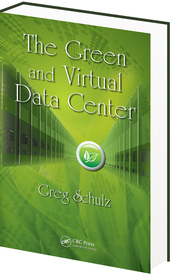
Greg Schulz – Author Cloud and Virtual Data Storage Networking (CRC Press, 2011), The Green and Virtual Data Center (CRC Press, 2009), and Resilient Storage Networks (Elsevier, 2004)

twitter @storageio

All Comments, (C) and (TM) belong to their owners/posters, Other content (C) Copyright 2006-2012 StorageIO and UnlimitedIO All Rights Reserved

IBM buys flash solid state device (SSD) industry veteran TMS

How much flash (or DRAM) based Solid State Device (SSD) do you want or need?

IBM recently took a flash step announcing it wants and needs more SSD capabilities in different packaging and functionality capabilities to meet the demands and opportunities of customers, business partners and prospects by acquiring Texas Memory Systems (TMS).

IBM buys SSD flash vendor TMS

Unlike most of the current generation of SSD vendors besides those actually making the dies (chips or semiconductors) or SSD drives that are startups or relatively new, TMS is the industry veteran. Where most of the current SSD vendors experiences (as companies) is measured in months or at best years, TMS has seen several generations and SSD adoption cycles during its multi-decade existence.

IBM buys SSD vendor Texas Memory Systems TMS

What this means is that TMS has been around during past dynamic random access memory (DRAM) based SSD cycles or eras, as well as being an early adopter and player in the current nand flash SSD era or cycle.

Granted, some in the industry do not consider the previous DRAM based generation of products as being SSD, and vice versa, some DRAM era SSD aficionados do not consider nand flash as being real SSD. Needless to say that there are many faces or facets to SSD ranging in media (DRAM, and nand flash among others) along with packaging for different use cases and functionality.

IBM along with some other vendors recognize that the best type of IO is the one that you do not have to do. However reality is that some type of Input Output (IO) operations need to be done with computer systems. Hence the second best type of IO is the one that can be done with the least impact to applications in a cost-effective way to meet specific service level objectives (SLO) requirements. This includes leveraging main memory or DRAM as cache or buffers along with server-based PCIe SSD flash cards as cache or target devices, along with internal SSD drives, as well as external SSD drives and SSD drives and flash cards in traditional storage systems or appliances as well as purpose-built SSD storage systems.

While TMS does not build the real nand flash single level cell (SLC) or multi-level cell (MLC) SSD drives (like those built by Intel, Micron, Samsung, SANdisk, Seagate, STEC and Western Digital (WD) among others), TMS does incorporate nand flash chips or components that are also used by others who also make nand flash PCIe cards and storage systems.

StorageIO industry trend for storage IO

IMHO this is a good move for both TMS and IBM, both of whom have been StorageIO clients in the past (here, here and here) that was a disclosure btw ;) as it gives TMS, their partners and customers a clear path and large organization able to invest in the technologies and solutions on a go forward basis. In other words, TMS who had looked to be bought gets certainty about their future as do they clients.

IBM who has used SSD based components such as PCIe flash SSD cards and SSD based drives from various suppliers gets a PCIe SSD card of their own, along with purpose-built mature SSD storage systems that have lineages to both DRAM and nand flash-based experiences. Thus IBM controls some of their own SSD intellectual property (e.g. IP) for PCIe cards that can go in theory into their servers, as well as storage systems and appliances that use Intel based (e.g. xSeries from IBM) and IBM Power processor based servers as a platform such. For example DS8000 (Power processor), and Intel based XIV, SONAS, V7000, SVC, ProtecTier and Pursystems (some are Power based).

In addition IBM also gets a field proven purpose-built all SSD storage system to compete with those from startups (Kaminario, Purestorage, Solidfire, Violin and Whiptail among others), as well as those being announced from competitors such as EMC (e.g. project X and project thunder) in addition to SSD drives that can go into servers and storage systems.

The question should not be if SSD is in your future, rather where will you be using it, in the server or a storage system, as a cache or a target, as a PCIe target or cache card or as a drive or as a storage system. This also means the question of how much SSD do you need along with what type (flash or DRAM), for what applications and how configured among other topics.

Storage and Memory Hirearchy diagram where SSD fits

What this means is that there are many locations and places where SSD fits, one type of product or model does not fit or meet all requirements and thus IBM with their acquisition of TMS, along with presumed partnership with other SSD based components will be able to offer a diverse SSD portfolio.

StorageIO industry trend for storage IO

The industry trend is for vendors such as Cisco, Dell, EMC, IBM, HP, NetApp, Oracle and others all of whom are either physical server and storage vendors, or in the case of EMC, virtual servers partnered with Cisco (vBlock and VCE) and Lenovo for physical servers.

Different types and locations for SSD

Thus it only makes sense for those vendors to offer diverse SSD product and solution offerings to meet different customer and application needs vs. having a single solution that users adapt to. In other words, if all you have is a hammer, everything needs to look like a nail, however if you have a tool box of various technologies, then it comes down to being able to leverage including articulating what to use when, where, why and how for different situations.

I think this is a good move for both IBM and TMS. Now lets watch how IBM and TMS can go beyond the press release, slide decks and webex briefings covering why it is a good move to justify their acquisition and plans, moving forward and to see the results of what is actually accomplished near and long-term.

Read added industry trends and perspective commentary about IBM buying TMS here and here, as well as check out these related posts and content:

How much SSD do you need vs. want?
What is the best kind of IO? The one you do not have to do
Is SSD dead? No, however some vendors might be
Has SSD put Hard Disk Drives (HDDs) On Endangered Species List?
Why SSD based arrays and storage appliances can be a good idea (Part I)
EMC VFCache respinning SSD and intelligent caching (Part I)
SSD options for Virtual (and Physical) Environments: Part I Spinning up to speed on SSD
Speaking of speeding up business with SSD storage
Is SSD dead? No, however some vendors might be
Part I: PureSystems, something old, something new, something from big blue
The Many Faces of Solid State Devices/Disks (SSD)
SSD and Green IT moving beyond green washing

Meanwhile, congratulations to both IBM and TMS, ok, nuff said (for now).

Cheers Gs

Greg Schulz – Author Cloud and Virtual Data Storage Networking (CRC Press, 2011), The Green and Virtual Data Center (CRC Press, 2009), and Resilient Storage Networks (Elsevier, 2004)

twitter @storageio

All Comments, (C) and (TM) belong to their owners/posters, Other content (C) Copyright 2006-2012 StorageIO and UnlimitedIO All Rights Reserved

Over 1,000 entries now on the StorageIO industry links page

Industry trends and perspective data protection modernization

Is your company, organization or one that you are a fan of, or represent listed on the StorageIO industry links page (click here to learn more about it).

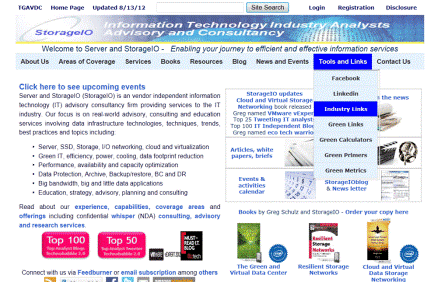
The StorageIO industry links page has been updated with over thousand different industry related companies, vendors, vars, trade groups, part and solution suppliers along with cloud and managed service providers. The common theme with these industry links is information and data infrastructures which means severs, storage, IO and networking, hardware, software, applications and tools, services, products and related items for traditional, virtual and cloud environments.

StorageIO server storage IO networking cloud and virtualization links

The industry links page is accessed from the StorageIO main web page via the Tools and Links menu tab, or via the URL https://storageio.com/links. An example of the StorageIO industry links page is shown below with six different menu tabs in alphabetical order.

StorageIO server storage IO networking cloud and virtualization links

Know of a company, service or organization that is not listed on the links page, if so, send an email note to info at storageio.com. If your company or organization is listed, contact StorageIO to discuss how to expand your presence on the links page and other related options.

Visit the updated StorageIO industry links page and watch for more updates, and click here to learn more about the links page.

Ok, nuff said for now.

Cheers Gs

Greg Schulz – Author Cloud and Virtual Data Storage Networking (CRC Press, 2011), The Green and Virtual Data Center (CRC Press, 2009), and Resilient Storage Networks (Elsevier, 2004)

twitter @storageio

All Comments, (C) and (TM) belong to their owners/posters, Other content (C) Copyright 2006-2012 StorageIO and UnlimitedIO All Rights Reserved

Give HP storage some love and short strokin

Server and StorageIO industry trends and perspective DAS

Following up from my last post over at InfoStor about metrics that matter, here is a link to a new piece that I did on storage vendors benchmarking and related topics. This new post looked at an storage performance council (SPC1) benchmark that HP did with their P10000 (e.g. 3PAR) storage system under assertions by some in the industry that they were short stroking to meet better performance.

I’m surprised some creative technical marketer, blogger or prankster has yet to rework Clarence Carters (e.g. Dr. CC) iconic song into something about storage performance and capacity short strokin.


Ok, nuff said before I get a visit from the HP truth squads, in the meantime, give HP a hug and some love if so inclined.

Cheers Gs

Greg Schulz – Author Cloud and Virtual Data Storage Networking (CRC Press, 2011), The Green and Virtual Data Center (CRC Press, 2009), and Resilient Storage Networks (Elsevier, 2004)

twitter @storageio

All Comments, (C) and (TM) belong to their owners/posters, Other content (C) Copyright 2006-2012 StorageIO and UnlimitedIO All Rights Reserved

Announcing SAS SANs for Dummies book, LSI edition

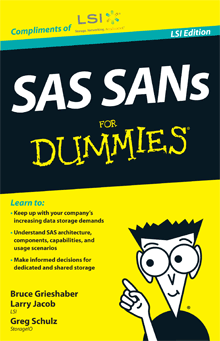
There is a new (free) book that I’m a co-author of along Bruce Grieshaber and Larry Jacob (both of LSI) along with foreword by Harry Mason of LSI and President of the SCSI Trade Association titled SAS SANs for Dummies compliments of LSI.

SAS SANs for Dummies, LSI Edition

This new book (ebook and print hard copy) looks at Serial Attached SCSI (SAS) and how it can be used beyond traditional direct attached storage (DAS) configurations for support various types of storage mediums including SSD, HDD and tape. These configuration options include as entry-level SAN with SAS switches for small clusters or server virtualization, or as shared DAS as well as being a scale out back-end solution for NAS, object, cloud and big data storage solutions.

Here is the table of contents (TOC) of SAS SANs for Dummies

Chapter 1: Data storage challenges

  • Storage Growth Demand Drivers
  • Recognizing Challenges
  • Solutions and Opportunities
  • Chapter 2: Storage Area Networks

  • Introducing Storage Area Networks
  • Moving from Dedicated Internal to Shared Storage
  • Chapter 3: SAS Basics

  • Introducing the Basics of SAS
  • How SAS Functions
  • Components of SAS
  • SAS Target Devices
  • SAS for SANs
  • Chapter 4: SAS Usage Scenarios

  • Understanding SAS SANs Usage
  • Shared SAS SANs Scenarios including:
    • SAS in HPC environments
    • Big data and big bandwidth
    • Database, e-mail, back-office
    • NAS and object storage servers
    • Cloud, wen and high-density
    • Server virtualization

    Chapter 5: Advanced SAS Topics

  • The SAS Physical Layer
  • Choosing SAS Cabling
  • Using SAS Switch Zoning
  • SAS HBA Target Mode
  • Chapter 6: Nine Common Questions

  • Can You Interconnect Switches?
  • What Is SAS Cable Distance?
  • How Many Servers Can Be In a SAS SAN?
  • How Do You Manage SAS Zones?
  • How Do You Configure SAS for HA?
  • How Does SAS Zoning Compare to LUN Mapping?
  • Who Has SAS Solutions?
  • How Do SAS SANs Compare?
  • Where Can You Learn More?
  • Chapter 7: Next Steps

  • SAS Going Forward
  • Next Steps
  • Great Take Away’s
  • Regardless of if you are looking to use SAS as a primary SAN interface, or leverage it for DAS or implementing back-end storage for big-data, NAS, object, cloud or other types of scalable storage solutions, check out and get your free copy of SAS SANs for Dummies here compliments of LSI.

    SAS SANs for Dummies, LSI Edition

    Click here to ask your free copy of SAS SANs for Dummies compliments of LSI, tell them Greg from StorageIO sent you and enjoy the book.

    Ok, nuff said.

    Cheers Gs

    Greg Schulz – Author Cloud and Virtual Data Storage Networking (CRC Press, 2011), The Green and Virtual Data Center (CRC Press, 2009), and Resilient Storage Networks (Elsevier, 2004)

    twitter @storageio

    All Comments, (C) and (TM) belong to their owners/posters, Other content (C) Copyright 2006-2012 StorageIO and UnlimitedIO All Rights Reserved
    EPA Energy Star for data center storage draft 3 specification

    US EPA Energy Star for Data Center StorageUncle SAM wants you to be energy efficient and effective with optimized data center storage

    The U.S. EPA is ready to release DRAFT 3 of the Energy Star for data center storage specification and has an upcoming web session that you can sign up for if are not on their contact list of interested stake holders. If you are not familiar with the EPA Energy star for data center storage program, here is some background information.

    Thus if you are interested, see the email and information below, signup and take part if so inclined as opposed to saying that you did not have a chance to comment.

    Dear ENERGY STAR® Data Center Storage Manufacturer or Other Interested Party:

    The U.S. Environmental Protection Agency (EPA) would like to announce the release of the Draft 3 Version 1.0 ENERGY STAR Specification for Data Center Storage. The draft is attached and is accompanied by a cover letter and Draft Test Method. Stakeholders are invited to review these documents and submit comments to EPA via email to storage@energystar.gov by Friday, July 27, 2012.

    EPA will host a webinar on Wednesday, July 11, 2012, tentatively starting at 1:00PM EST. The agenda will be focused on elements from Draft 3, Product Families, and other key topics. Please RSVP to storage@energystar.gov no later than Tuesday, July 3, 2012 with the subject "RSVP – Storage Draft 3 specification meeting."

    If you have any questions, please contact Robert Meyers, EPA, at Meyers.Robert@epa.gov or (202) 343-9923; or John Clinger, ICF International, at John.Clinger@icfi.com or (202) 572-9432.

    Thank you for your continued support of the ENERGY STAR program.

    For more information, visit: www.energystar.gov

    This message was sent to you on behalf of ENERGY STAR. Each ENERGY STAR partner organization must have at least one primary contact receiving e-mail to maintain partnership. If you are no longer working on ENERGY STAR, and wish to be removed as a contact, please update your contact status in your MESA account. If you are not a partner organization and wish to opt out of receiving e-mails, you may call the ENERGY STAR Hotline at 1-888-782-7937 and request to have your mass mail settings changed. Unsubscribing means that you will no longer receive program-wide or product-specific e-mails from ENERGY STAR.


    Ok, you have been advised, nuff said for now

    Cheers Gs

    Greg Schulz – Author Cloud and Virtual Data Storage Networking (CRC Press, 2011), The Green and Virtual Data Center (CRC Press, 2009), and Resilient Storage Networks (Elsevier, 2004)

    twitter @storageio

    All Comments, (C) and (TM) belong to their owners/posters, Other content (C) Copyright 2006-2012 StorageIO and UnlimitedIO All Rights Reserved

    Enabling Bitlocker on Microsoft Windows 7 Professional 64 bit

    Enabling Bitlocker on Microsoft Windows 7 Professional 64 bit
    Updated 6/24/18

    A while back, I added a new laptop that required Enabling Bitlocker on Microsoft Windows 7 Professional 64 bit. At that time some of my other devices run Windows 7 Ultimate 32 bit with Bitlocker security encryption enabled (since upgraded to various Windows 10 editions). However back then, I ran into a problem getting Bitlocker to work on the 64 bit version of Windows 7 Professional.

    Yes I know I should not be using Windows and I also have plenty of iDevices and other Apple products lying around. Likewise to the security pros and security arm-chair quarterbacks I know I should not be using Bitlocker, instead using Truecrypt of which I have done some testing and may migrate too in the future along with self-encrypting device (SED).

    However lets stay on track here ;).

    Image courtesy of Lenovo.com

    The problem that I ran into with my then new Lenovo X1 was that it came with Windows 7 Professional 64 bit, which has a few surprises when trying to turn on Bitlocker drive encryption. Initializing and turning on the Trusted Platform Module (TPM) management was not a problem, however for those needing to figure out how to do that, check out this Microsoft TechNet piece.

    The problem was as simple as not having a tab and easy way to enable Bitlocker Drive Encryption with Windows 7 Professional 64 bit. After spending some time searching around various Microsoft and other sites to figure out how to hack, patch, script and do other things that would take time (and time is money), it dawned on me. Could the solution to the problem be as simple as upgrading from the Professional version of Windows 7 bit to Windows 7 Ultimate?

    Update: 6/25/18

    While this post is about Windows 7, there are some new challenges with Windows 10 bit locker and removable devices including USB. These new issues are tied to Windows 10 running in BIOS instead of UEFI boot mode.

    Here are some additional Windows 10 Bitlocker related resources:

  • Via Microsoft: Bitlocker Frequently Asked Questions
  • Via Microsoft: Bitlocker Overview and Requirements
  • Via Intel: Converting Windows Installation from BIOS to UEFI
  • Microsoft Windows 7 via amazon
    Windows 7 image courtesy of Amazon.com

    The answer was going to the Microsoft store (or Amazon among other venues) and for $139.21 USD (with tax) purchase the upgrade.

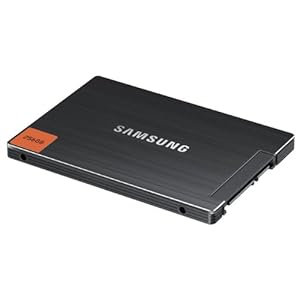
    Once the transaction was complete, the update was automatically and within minutes I had Bitlocker activated on the Lenovo X1 (TPM was previously initiated and turned on), a new key was protected and saved elsewhere, and the internal Samsung 830 256GB Solid State Device (SSD) initializing and encrypting. Oh, fwiw, yes the encryption of the 256GB SSD took much less time than on a comparable Hard Disk Drive (HDD) or even an HHDD (Hybrid HDD).

    Could I have saved the $139.21 and spent some time on work around? Probably, however as I did not have the time or interest to go that route, however IMHO for my situation it was a bargain.

    Sometimes spending a little money particular if you are short on or value, your time can be a bargain as opposed to if you are short on money however long on time.

    I found the same to be true when I replaced the internal HDD that came with the Lenovo X1 with a Samsung 256GB SSD in that it improved my productivity for writing and saving data. For example in the first month of use I estimate easily 2 to three minutes of time saved per day waiting on things to be written to HDDs. In other words 2 to three minutes times five days (10 to 15 minutes) times four weeks (40 to 60 minutes) starts to add up (e.g. small amounts or percentages spread over a large interval add up), more on using and justifying SSD in a different post.

    Microsoft Windows 7 Ultimate

    Samsung SSD image courtesy of Amazon.com

    If your time is not of value or you have a lot of it, then the savings may not be as valuable. On the other hand, if you are short on time or have a value on your time, you can figure out what the benefits are quite quickly (e.g. return on investment or traditional ROI).

    Where To Learn More

    Learn more about Windows, Bitlocker and related topics

    Additional learning experiences along with common questions (and answers), as well as tips can be found in Software Defined Data Infrastructure Essentials book.

    Software Defined Data Infrastructure Essentials Book SDDC

    What This All Means

    The reason I bring the topic of time and money into this discussion about Bitlocker is to make a point that there are situations where spending some time has value such as for learning, the experience, fun or simple entertainment aspect, not to mention a shortage of money. On the other hand, sometimes it is actually cheaper to spend some money to get to the solution or result as part of being productive or effective. For example, other than spending some time browsing various sites to figure out that there was an issue with Windows 7 Professional and Bitlocker, time that was educational and interesting, the money spent on the simple upgrade was worth it in my situations. While many if not most of you have since upgraded to Windows 8 or Windows 10, some may still have the need for Enabling Bitlocker on Microsoft Windows 7 Professional 64 bit.

    Ok, nuff said, for now.

    Gs

    Greg Schulz – Microsoft MVP Cloud Data Center Management, VMware vExpert 2010-2018. Author of Software Defined Data Infrastructure Essentials (CRC Press), as well as Cloud and Virtual Data Storage Networking (CRC Press), The Green and Virtual Data Center (CRC Press), Resilient Storage Networks (Elsevier) and twitter @storageio. Courteous comments are welcome for consideration. First published on https://storageioblog.com any reproduction in whole, in part, with changes to content, without source attribution under title or without permission is forbidden.

    All Comments, (C) and (TM) belong to their owners/posters, Other content (C) Copyright 2006-2026 Server StorageIO and UnlimitedIO. All Rights Reserved. StorageIO is a registered Trade Mark (TM) of Server StorageIO.

    How much SSD do you need vs. want?

    Storage I/O Industry Trends and Perspectives

    I have been getting asked by IT customers, VAR’s and even vendors how much solid state device (SSD) storage is needed or should be installed to address IO performance needs to which my standard answer is it depends.

    I also am also being asked if there is rule of thumb (RUT) of how much SSD you should have either in terms of the number of devices or a percentage; IMHO, the answer is it depends. Sure, there are different RUTs floating around based on different environments, applications, workloads however are they applicable to your needs.

    What I would recommend is instead of focusing on percentages, RUTs, or other SWAG estimate’s or PIROMA calculations, look at your current environment and decide where the activity or issues are. If you know how many fast hard disk drives (HDD) are needed to get to a certain performance level and amount of used capacity that is a good starting point.

    If you do not have that information, use tools from your server, storage or third-party provider to gain insight into your activity to help size SSD. Also if you have a database environment and are not familiar with the tools, talk with your DBA’s to have them run some reports that show performance information the two of you can discuss to zero in hot spots or opportunity for SSD.

    Keep in mind when looking at SSD what is that you are trying to address by installing SSD. For example, is there a specific or known performance bottleneck resulting in poor response time or latency or is there a general problem or perceived opportunity?

    Storage I/O Industry Trends and Perspectives

    Is there a lack of bandwidth for large data transfers or is there a constraint on how many IO operations per second (e.g. IOPS) or transaction or activity that can be done in a given amount of time. In other words the more you know where or what the bottleneck is including if you can trace it back to a single file, object, database, database table or other item the closer you are to answering how much SSD you will need.

    As an example if using third-party tools or those provided by SSD vendors or via other sources you decide that your IO bottleneck are database transaction logs and system paging files, then having enough SSD space capacity to fit those in part of the solution. However, what happens when you remove the first set of bottlenecks, what new ones will appear and will you have enough space capacity on your SSD to accommodate the next in line hot spot?

    Keep in mind that you may want more SSD however what can you get budget approval to buy now without having more proof and a business case. Get some extra SSD space capacity to use for what you are confident can address other bottlenecks, or, enable new capabilities.

    On other hand if you can only afford enough SSD to get started, make sure you also protect it. If you decide that two SSD devices (PCIe cache or target cards, drives or appliances) will take care of your performance and capacity needs, make sure to keep availability in mind. This means having extra SSD devices for RAID 1 mirroring, replication or other form of data protection and availability. Keep in mind that while traditional hard disk drive (HDD) storage is often gauged on cost per capacity, or dollar per GByte or dollar per TByte, with SSD measure its value on cost to performance. For example, how many IOPS, or response time improvement or bandwidth are obtained to meet your specific needs per dollar spent.

    Related links
    What is the best kind of IO? The one you do not have to do
    Is SSD dead? No, however some vendors might be
    Speaking of speeding up business with SSD storage
    Has SSD put Hard Disk Drives (HDD’s) On Endangered Species List?
    Why SSD based arrays and storage appliances can be a good idea (Part I)
    EMC VFCache respinning SSD and intelligent caching (Part I)
    SSD options for Virtual (and Physical) Environments Part I: Spinning up to speed on SSD

    Ok, nuff said for now

    Cheers Gs

    Greg Schulz – Author Cloud and Virtual Data Storage Networking (CRC Press, 2011), The Green and Virtual Data Center (CRC Press, 2009), and Resilient Storage Networks (Elsevier, 2004)

    twitter @storageio

    All Comments, (C) and (TM) belong to their owners/posters, Other content (C) Copyright 2006-2012 StorageIO and UnlimitedIO All Rights Reserved

    Spring (May) 2012 StorageIO news letter

    StorageIO News Letter Image
    Spring (May) 2012 News letter

    Welcome to the Spring (May) 2012 edition of the Server and StorageIO Group (StorageIO) news letter. This follows the Fall (December) 2011 edition.

    You can get access to this news letter via various social media venues (some are shown below) in addition to StorageIO web sites and subscriptions.

    Click on the following links to view the Spring May 2012 edition as an HTML or PDF or, to go to the news letter page to view previous editions.

    You can subscribe to the news letter by clicking here.

    Enjoy this edition of the StorageIO newsletter, let me know your comments and feedback.

    Nuff said for now

    Cheers
    Gs

    Greg Schulz – Author Cloud and Virtual Data Storage Networking (CRC Press), The Green and Virtual Data Center (CRC Press) and Resilient Storage Networks (Elsevier)
    twitter @storageio

    All Comments, (C) and (TM) belong to their owners/posters, Other content (C) Copyright 2006-2012 StorageIO and UnlimitedIO All Rights Reserved
    Various cloud, virtualization, server, storage I/O poll’s

    The following are a collection of on-going industry trends and perspectives poll’s pertaining to server, storage, IO, networking, cloud, virtualization, data protection (backup, archive, BC and DR) among other related themes and topics.

    In addition to those listed below, check out the comments section where additional poll’s are added over time.

    Storage I/O Industry Trends and Perspectives

    Here is a link to a poll as a follow-up to a recent blog post Are large storage arrays dead at the hands of SSD? (also check these posts pertaining to storage arrays and SSD and flash SSD’s emerging role).

    Poll: Are large storage arrays day’s numbered?

    Poll: What’s your take on magnetic tape storage?

    Poll: What do you think of IT clouds?

    Poll: Who is responsible for cloud storage data loss?

    Poll: What are the most popular Zombie technologies?

    Storage I/O Industry Trends and Perspectives

    Poll: What’s your take on OVA and other alliances?

    Poll: Where is most common form or concern of vendor lockin?

    Poll: Who is responsible for, or preventing vendor lockin?

    Poll: Is vendor lockin a good or bad thing?

    Poll: Is IBM V7000 relevant?

    Storage I/O Industry Trends and Perspectives

    Poll: What is your take on EMC and NetApp on similar tracks or paths?

    Poll: What’s your take on RAID still being relevant?

    Poll: What do you see as barriers to converged networks?

    Poll: Who are you?

    Poll: What is your preferred converged network?

    Storage I/O Industry Trends and Perspectives

    Poll: What is your converged network status?

    Poll: Are converged networks in your future?

    Poll: What do you think were top 2009 technologies, events or vendors?

    Poll: What technologies, events, products or vendors did not live up to 2009 predictions?

    Storage I/O Industry Trends and Perspectives

    Poll: What do you think of IT clouds?

    Poll: What is your take on the new FTC blogger disclosure guidelines?

    Poll: Is RAID dead?

    Poll: When will you deploy Windows 7? Note: I upgraded all my systems to Windows 7 during summer of 2011

    Poll: EMC and Cisco VCE, what does it mean?

    Poll: Is IBM XIV still relevant?

    Storage I/O Industry Trends and Perspectives

    Note: Feel free to share, use and make reference to the above poll’s and their results however please remember to attribute the source.

    Ok, nuff said for now

    Cheers Gs

    Greg Schulz – Author Cloud and Virtual Data Storage Networking (CRC Press, 2011), The Green and Virtual Data Center (CRC Press, 2009), and Resilient Storage Networks (Elsevier, 2004)

    twitter @storageio

    All Comments, (C) and (TM) belong to their owners/posters, Other content (C) Copyright 2006-2012 StorageIO and UnlimitedIO All Rights Reserved

    Are large storage arrays dead at the hands of SSD?

    Storage I/O trends

    An industry trends and perspective.

    .

    Are large storage arrays dead at the hands of SSD? Short answer NO not yet.
    There is still a place for traditional storage arrays or appliances particular those with extensive features, functionality and reliability availability serviceability (RAS). In other words, there is still a place for large (and small) storage arrays or appliances including those with SSDs.

    Is there a place for newer flash SSD storage systems, appliances and architectures? Yes
    Similar to how there is a place for traditional midrange storage arrays or appliances have found their roles vs. traditional higher end so-called enterprise arrays. Think as an example  EMC CLARiiON/VNX or HP EVA/P6000 or HDS AMS/HUS or NetApp FAS or IBM DS5000 or IBM V7000 among others vs. EMC Symmetrix/DMX/VMAX or HP P10000/3Par or HDS VSP/USP or IBM DS8000. In addition to traditional enterprise or high-end storage systems and midrange also known as modular, there are also specialized appliances or targets such as for backup/restore and archiving. Also do not forget the IO performance SSD appliances like those from TMS among others that have been around for a while.

    Is the role of large storage systems changing or evolving? Yes
    Given their scale and ability to do large amounts of work in a dense footprint, for some the role of these systems is still mission critical tier 1 application and data support. For other environments, their role continues to evolve being used for high-density tier 2 bulk or even near-line storage for on-line access at scale.

    Storage I/O trends

    Does this mean there is completion between the old and new systems? Yes
    In some circumstances as we have seen already with SSD solutions. Some will place as competing or replacements while others as complementing. For example in the PCIe flash SSD card segment EMC VFCache is positioned is complementing Dell, EMC, HDS, HP, IBM, NetApp, Oracle or others storage vs. FusionIO who positions as a replacement for the above and others. Another scenario is how some SSD vendors have and continue to position their all-flash SSD arrays using either drives or PCIe cards to complement and coexist with other storage systems in an environment (e.g. data center level tiering) vs. as a replacement. Also keep in mind SSD solutions that also support a mix of flash devices and traditional HDDs for capacity and cost savings or cloud access in the same solution.

    Does this mean that the industry has adopted all SSD appliances as the state of art?
    Avoid confusing industry adoption or talk with industry and customer deployment. They are similar, however one is focused on what the industry talks about or discusses as state of art or the future while the other is what customers are doing. Certainly some of the new flash SSD appliance and storage startups such as Solidfire, Nexgen, Violin, Whiptail or veteran TMS among others have promising futures, some of which may actually be in play with the current SSD market shakeout and consolidation.

    Does that mean everybody is going SSD?
    SSD customer adoption and deployment continues to grow, however so too does the deployment of high-capacity HDDs.

    Storage I/O trends

    Do SSDs need HDDs, do HDDs need SSDs? Yes
    Granted there are environments where needs can be addressed by all of one or the other. However at least near term, there is a very strong market for tiering and mix of SSD, some fast HDDs and lots of high-capacity HDDs to meet various needs including performance, availability, capacity, energy and economics. After all, there is no such thing, as a data or information recession yet budgets are tight or being reduced. Likewise, people and data are living longer.

    What does this mean?
    If there, were no such thing as a data recession and budgets a non-issue, perhaps everything could move to all flash SSD storage systems. However, we also know that people and data are living longer along with changing data life-cycle patterns. There is also the need for performance to close the traditional data center IO performance to space capacity gap and bottlenecks as well as store and keep data longer.

    There will continue to be a need for a mix of high-capacity and high performance. More IO will continue to gravitate towards the IO appliances, however more data will settle in for longer-term retention and continued access as data life-cycle continue to evolve. Watch for more SSD and cache in the large systems, along with higher density SAS-NL (SAS Near Line e.g. high capacity) type drives appearing in those systems.

    If you like new shiny new toys or technology (SNTs) to buy, sell or talk about, there will be plenty of those to continue industry adoption while for those who are focused on industry deployment, there will be a mix of new, and continued evolution for implementation.

    Related links
    Industry adoption vs. industry deployment, is there a difference?

    Industry trend: People plus data are aging and living longer

    No Such Thing as an Information Recession

    Changing Lifecycles & Data Footprint Reduction
    What is the best kind of IO? The one you do not have to do
    Is SSD dead? No, however some vendors might be
    Speaking of speeding up business with SSD storage
    Are Hard Disk Drives (HDD’s) getting too big?
    IT and storage economics 101, supply and demand
    Has SSD put Hard Disk Drives (HDD’s) On Endangered Species List?
    Why SSD based arrays and storage appliances can be a good idea (Part I)
    Researchers and marketers don’t agree on future of nand flash SSD
    EMC VFCache respinning SSD and intelligent caching (Part I)
    SSD options for Virtual (and Physical) Environments Part I: Spinning up to speed on SSD

    Ok, nuff said for now

    Cheers Gs

    Greg Schulz – Author Cloud and Virtual Data Storage Networking (CRC Press, 2011), The Green and Virtual Data Center (CRC Press, 2009), and Resilient Storage Networks (Elsevier, 2004)

    twitter @storageio

    All Comments, (C) and (TM) belong to their owners/posters, Other content (C) Copyright 2006-2012 StorageIO and UnlimitedIO All Rights Reserved

    Is SSD dead? No, however some vendors might be

    Storage I/O trends

    Is SSD dead? No, however some vendors might be

    In a recent conversation with Dave Raffo about the nand flash solid state disk (SSD) market, we talked about industry trends, perspectives and where the market is now as well as headed. One of my comments is, has been and will remain that the industry has still not reached anywhere near full potential for deployment of SSD for enterprise, SMB and other data storage needs. Granted, there is broad adoption in terms of discussion or conversation and plenty of early adopters.

    SSD and in particular nand flash is anything but dead, in fact in the big broad picture of things, it is still very early in the game. Sure, for those who cover and crave the newest, latest and greatest technology to talk about, nand flash SSD might seem old, yesterday news, long in the tooth and time for something else. However, for those who are focused on deployment vs. adoption such as customers, in general, nand flash SSD in its many packaging options has still not yet reached its full potential.

    Despite the hype, fanfare from CEOs or their evangelist along with loyal followers of startups that help drive industry adoption (e.g. what is talked about), there is still lots of upside growth in the customer drive industry deployment (actually buying, installing and using) for nand flash SSD.

    What about broad customer deployments?

    Sure, there are the marquee customer success stories that you need a high-capacity SAS or SATA drive to hold the YouTube videos, slide decks, press releases for.

    However, have we truly, reached broad customer deployment or broad industry adoption?

    Hence, I see more startups coming into the market space, and some exiting on their own, via mergers and acquisition or other means.

    Will we see a feeding frenzy or IPO craze as with earlier hype cycles of technologies, IMHO there will be some companies that get the big deal, some will survive as new players running as a business vs. running to be acquired or IPO. Others will survive by evolving into something else while others will join the where are they now list.

    If you are a SSD startup, CEO, CxO, or marketer, their PR, evangelist or loyal follower do not worry as the SSD market and even nand flash is far from being dead. On the other hand, if you think that it has hit its full stride, you are missing either the bigger picture, or too busy patting yourselves on the back for a job well done. There is much more opportunity out there and not even all the low hanging fruit has been picked yet.

    Check out the conversation with Dave Raffo along with comments from others here.

    Related links on storage IO metrics and SSD performance
    What is the best kind of IO? The one you do not have to do
    Is SSD dead? No, however some vendors might be
    Storage and IO metrics that matter
    IO IO it is off to Storage and IO metrics we go
    SSD and Storage System Performance
    Speaking of speeding up business with SSD storage
    Are Hard Disk Drives (HDD’s) getting too big?
    Has SSD put Hard Disk Drives (HDD’s) On Endangered Species List?
    Why SSD based arrays and storage appliances can be a good idea (Part I)
    IT and storage economics 101, supply and demand
    Researchers and marketers dont agree on future of nand flash SSD
    EMC VFCache respinning SSD and intelligent caching (Part I)
    SSD options for Virtual (and Physical) Environments Part I: Spinning up to speed on SSD
    SSD options for Virtual (and Physical) Environments Part II: The call to duty, SSD endurance
    SSD options for Virtual (and Physical) Environments Part III: What type of SSD is best for you?
    SSD options for Virtual (and Physical) Environments Part IV: What type of SSD is best for your needs

    Ok, nuff said for now

    Cheers Gs

    Greg Schulz – Author Cloud and Virtual Data Storage Networking (CRC Press, 2011), The Green and Virtual Data Center (CRC Press, 2009), and Resilient Storage Networks (Elsevier, 2004)

    twitter @storageio

    All Comments, (C) and (TM) belong to their owners/posters, Other content (C) Copyright 2006-2012 StorageIO and UnlimitedIO All Rights Reserved
    More storage and IO metrics that matter

    It is great to see more conversations and coverage around storage metrics that matter beyond simply focusing on cost per GByte or TByte (e.g. space capacity). Likewise, it is also good to see conversations expanding beyond data footprint reduction (DFR) from a space capacity savings or reduction ratio to also address data movement and transfer rates. Also good to see is increase in discussion around input/output operations per section (IOPs) tying into conversations from virtualization, VDI, cloud to Sold State Devices (SSD).

    Other storage and IO metrics that matter include latency or response time, which is how fast work is done, or time spent. Latency also ties to IOPS in that as more work arrives to be done (IOPS) of various size, random or sequential, reads or writes, queue depths are an indicator of how well work is flowing. Another storage and IO metric that matters is availability because without it, performance or capacity can be affected. Likewise, without performance, availability can be affected.

    Needless to say that I am just scratching the surface here with storage and IO metrics that matter for physical, virtual and cloud environments from servers to networks to storage.

    Here is a link to a post I did called IO, IO, it is off to storage and IO metrics we go that ties in themes of performance measurements and solid-state disk (SSD) among others. Also check out this piece about why VASA (VMware storage analysis metrics) is important to have your VMware CASA along with Windows boot storage and IO performance for VDI and traditional planning purposes.

    Check out this post about metrics and measurements that matter along with this conversation about IOPs, capacity, bandwidth and purchasing discussion topics.

    Related links on storage IO metrics and SSD performance
    What is the best kind of IO? The one you do not have to do
    Is SSD dead? No, however some vendors might be
    Storage and IO metrics that matter
    IO IO it is off to Storage and IO metrics we go
    SSD and Storage System Performance
    Speaking of speeding up business with SSD storage
    Are Hard Disk Drives (HDD’s) getting too big?
    Has SSD put Hard Disk Drives (HDD’s) On Endangered Species List?
    Why SSD based arrays and storage appliances can be a good idea (Part I)
    IT and storage economics 101, supply and demand
    Researchers and marketers dont agree on future of nand flash SSD
    EMC VFCache respinning SSD and intelligent caching (Part I)
    SSD options for Virtual (and Physical) Environments Part I: Spinning up to speed on SSD
    SSD options for Virtual (and Physical) Environments Part II: The call to duty, SSD endurance
    SSD options for Virtual (and Physical) Environments Part III: What type of SSD is best for you?
    SSD options for Virtual (and Physical) Environments Part IV: What type of SSD is best for your needs

    Ok, nuff said for now

    Cheers Gs

    Greg Schulz – Author Cloud and Virtual Data Storage Networking (CRC Press, 2011), The Green and Virtual Data Center (CRC Press, 2009), and Resilient Storage Networks (Elsevier, 2004)

    twitter @storageio

    All Comments, (C) and (TM) belong to their owners/posters, Other content (C) Copyright 2006-2012 StorageIO and UnlimitedIO All Rights Reserved
    What is the best kind of IO? The one you do not have to do

    What is the best kind of IO? The one you do not have to do

    data infrastructure server storage I/O trends

    Updated 2/10/2018

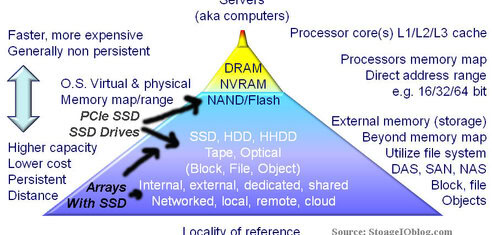
    What is the best kind of IO? If no IO (input/output) operation is the best IO, than the second best IO is the one that can be done as close to the application and processor with best locality of reference. Then the third best IO is the one that can be done in less time, or at least cost or impact to the requesting application which means moving further down the memory and storage stack (figure 1).

    Storage and IO or I/O locality of reference and storage hirearchy
    Figure 1 memory and storage hierarchy

    The problem with IO is that they are basic operation to get data into and out of a computer or processor so they are required; however, they also have an impact on performance, response or wait time (latency). IO require CPU or processor time and memory to set up and then process the results as well as IO and networking resources to move data to their destination or retrieve from where stored. While IOs cannot be eliminated, their impact can be greatly improved or optimized by doing fewer of them via caching, grouped reads or writes (pre-fetch, write behind) among other techniques and technologies.

    Think of it this way, instead of going on multiple errands, sometimes you can group multiple destinations together making for a shorter, more efficient trip; however, that optimization may also take longer. Hence sometimes it makes sense to go on a couple of quick, short low latency trips vs. one single larger one that takes half a day however accomplishes many things. Of course, how far you have to go on those trips (e.g. locality) makes a difference of how many you can do in a given amount of time.

    What is locality of reference?

    Locality of reference refers to how close (e.g location) data exists for where it is needed (being referenced) for use. For example, the best locality of reference in a computer would be registers in the processor core, then level 1 (L1), level 2 (L2) or level 3 (L3) onboard cache, followed by dynamic random access memory (DRAM). Then would come memory also known as storage on PCIe cards such as nand flash solid state device (SSD) or accessible via an adapter on a direct attached storage (DAS), SAN or NAS device. In the case of a PCIe nand flash SSD card, even though physically the nand flash SSD is closer to the processor, there is still the overhead of traversing the PCIe bus and associated drivers. To help offset that impact, PCIe cards use DRAM as cache or buffers for data along with Meta or control information to further optimize and improve locality of reference. In other words, help with cache hits, cache use and cache effectiveness vs. simply boosting cache utilization.

    Where To Learn More

    View additional NAS, NVMe, SSD, NVM, SCM, Data Infrastructure and HDD related topics via the following links.

    Additional learning experiences along with common questions (and answers), as well as tips can be found in Software Defined Data Infrastructure Essentials book.

    Software Defined Data Infrastructure Essentials Book SDDC

    What This All Means

    What can you do the cut the impact of IO

    • Establish baseline performance and availability metrics for comparison
    • Realize that IOs are a fact of IT virtual, physical and cloud life
    • Understand what is a bad IO along with its impact
    • Identify why an IO is bad, expensive or causing an impact
    • Find and fix the problem, either with software, application or database changes
    • Throw more software caching tools, hyper visors or hardware at the problem
    • Hardware includes faster processors with more DRAM and fast internal busses
    • Leveraging local PCIe flash SSD cards for caching or as targets
    • Utilize storage systems or appliances that have intelligent caching and storage optimization capabilities (performance, availability, capacity).
    • Compare changes and improvements to baseline, quantify improvement

    Ok, nuff said, for now.

    Gs

    Greg Schulz – Microsoft MVP Cloud and Data Center Management, VMware vExpert 2010-2017 (vSAN and vCloud). Author of Software Defined Data Infrastructure Essentials (CRC Press), as well as Cloud and Virtual Data Storage Networking (CRC Press), The Green and Virtual Data Center (CRC Press), Resilient Storage Networks (Elsevier) and twitter @storageio. Courteous comments are welcome for consideration. First published on https://storageioblog.com any reproduction in whole, in part, with changes to content, without source attribution under title or without permission is forbidden.

    All Comments, (C) and (TM) belong to their owners/posters, Other content (C) Copyright 2006-2026 Server StorageIO and UnlimitedIO. All Rights Reserved. StorageIO is a registered Trade Mark (TM) of Server StorageIO.