SSD activity continues to go virtually round and round

Storage I/O trends

Solid State Disk (SSD) (both FLASH and RAM based) activities and discussions continue to go round and round (pun intended) with announcements (here, here, here, here, here, and here and among others) of various improvements and evolution for technologies focused from the consumer to the small office home office (SOHO) to small medium business (SMB) to enterprise with technologies from vendors including Intel, Sandisk, Seagate and many others.

Recent innovations are looking to address write performance issues or challenges associated with FLASH based SSD, which while better than magnetic hard disk drives (HDD), are slower than their RAM based counterparts.

Other activity includes extending the useful life or duration of how many times a FLASH based device can be rewritten or modified before problems arise or performance degrades. Yet another activity is Sandisk introducing “virtual RPM” (vRPM) metrics to provide consumers an indication of relative revolutions per minute (RPM) of a non-rotating SSD device to make comparisons to help with shopping decisions makings. Can you say SSDs going round and round and round at least in a virtual world? Now that should make for some interesting “virtual benchmarking” discussions!

Meanwhile industry trade groups include the SNIA Solid State Storage Initiative (SSSI) are gathering momentum to address marketing, messaging, awareness, education as well as metrics or benchmarks among things normally done around industry trade group camp fires and camp outs.

So, as the HDDs spin, so to does the activity in and around SSD based technologies.

Ok, nuff said.

Cheers gs

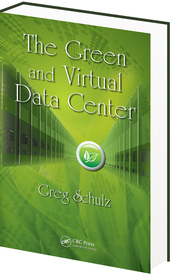
Greg Schulz – Author Cloud and Virtual Data Storage Networking (CRC Press), The Green and Virtual Data Center (CRC Press) and Resilient Storage Networks (Elsevier)
twitter @storageio

All Comments, (C) and (TM) belong to their owners/posters, Other content (C) Copyright 2006-2026 Server StorageIO and UnlimitedIO LLC All Rights Reserved

HP Storage Virtualization Services Platform (SVSP)

Storage I/O trends

HP recently announced announced their new SAN Virtualization Services Platform (SVSP) which is an appliance with software (oh, excuse me, I mean platform) for enabling various (e.g. replication, snapshots, pooling, consolidation, migration, etc) storage virtualization capabilities across different HP (e.g. MSA, EVA and in "theory" XP) or in "theory" as well, 3rd party (e.g. EMC, Dell, HDS, IBM, NetApp, Sun, etc) storage.

Sure HP has had a similar capability via their XP series which HP OEMs from Hitachi Ltd. (who also supplies the similar/same product to HDS which HP competes with), however what?s different from the XP based solution and the SVSP is that one (SVSP) is via software running on an appliance and the other implemented via software/firmware on dedicated Hitachi based hardware (e.g. the XP). One requires an investment in the XP which for larger organizations may be practical while the other enables smaller organizations to achieve the benefits of virtualization capabilties to enable efficient IT not to mention help transition from different generations of HP MSA, EVAs to newer versions of MSAs and EVAs or even to XPs .Other benefits of solutions like the HP SVSP which also include the IBM SAN Volume Controller (SVC) include cross storage system, or cross storage vendor based replication, snapshots, dynamic (e.g. thin) provisioning among other capabilities for block based storage access.

While there will be comparisons of HP SVSP to the XP, those in many ways will be apples to oranges, the more applicable apples to apples comparison would be IBM SVC to HP SVSP, or, perhaps HP SVSP to EMC Invista, Fujitsu VS900, Incipient, Falconstor or ?Datacore based solutions.

With the HP SVSP announcement, I’m suspecting that we will see the re-emergence of the storage virtualization in-band vs. out-of-band including fast-path control-path aka split path approaches being adopted by HP with the SVSP not to mention hardware vs. software and appliance based approaches as was the case a few years ago.

This time around as the storage virtualization discussions heat up again, we should see and hear the usual points, counter points and continued talk around consolidation and driving up utilization to save money and avoid costs. However, as part of enabling and transforming into an efficient IT organization (e.g. a ?Green and Virtual Data Center?) that embodies efficient, productivity in an economical and environmental friendly manner, virtualization discussions will also re-focus on using management transparency to enable data movement or migration for load-balancing, maintenance, upgrades and technology replacement, BC/DR and other common functions to enable more work to be done in the same or less anoint of time while supporting more data and storage processing and retention needs.

Thus similar to servers where not all servers have been, will be or can be consolidated, however most can be virtualized for management transparency for BC/DR and migration, the same holds true for storage, that is, not all storage can be consolidated for different quality of service reasons, however, most storage can be virtualized to assist with and facilatate common management functions.

Here are some additional resources to learn more about the many faces of Storage Virtualizaiton and related topics and trends:

Storage Virtualization: Myths, Realities and Other Considerations
Storage virtualization: How to deploy it
The Semantics of Storage Virtualization
Storage Virtualization: It’s More Common Than You Think
Choosing a storage virtualization approach
Switch-level storage virtualization: Special report
Resilient Storage Networks (Elsevier)
The Green and Virtual Data Center (Auerbach)

Cheers – gs

Greg Schulz – Author The Green and Virtual Data Center (CRC) and Resilient Storage Networks (Elsevier)
twitter @storageio

EPA Draft 3 of Energy Star for Computer Server Specification

Storage I/O trends

Today is the 2008 USA general election today pitting democratic senator Barack Obama vs. republican senator John McCain as well as several other lesser known party candidates who have made comments about the environment and going green as well as the economy, all of which have an impact on IT spending not to mention green IT and green computing.

Today is also the day that the US Environmental Protection Agency (EPA) sent out notification that Draft 3 of Energy Star for computer server specifications are available for comment (See here).

Energy Star is not a new program for IT equipment having been around for some time on PCs and other commodity products as well as many consumer goods. The EPA has been working on several Energy Star programs pertaining to IT data centers in addition to the Server specification working with industry groups covering servers, storage, networking and facilities among others, all of which to help enable the green and virtual data center on a go forward basis.

If you have not done so, check out the EPA Energy Star for data center programs.

Ok, nuff said.

Cheers gs

Greg Schulz – Author Cloud and Virtual Data Storage Networking (CRC Press), The Green and Virtual Data Center (CRC Press) and Resilient Storage Networks (Elsevier)
twitter @storageio

All Comments, (C) and (TM) belong to their owners/posters, Other content (C) Copyright 2006-2026 Server StorageIO and UnlimitedIO LLC All Rights Reserved

Did someone forget to tell Dell that Tape is dead?

Storage I/O trends

Did someone forget to send a memo to Dell that magnetic tape is dead, or, perhaps pre-occupied with other activities? Maybe no body at Dell read the “virtual” or “fictional” memo that tape is dead?

Ok, enough with the cynicism and joking around, tape is not dead (See recent Computerworld and Dell story) and Dell is one of several vendors including IBM who still find time to talk about tape as part of a solution to different customer and environment needs.

Sure, tape might be in or heading into its golden years or what can also be called the plateau of productivity (for customers) or profitability (for some vendors), tape does not get the marketing dollars and media coverage as its been around as a technology for a long time and their are cooler and niftier (techno term) things to discuss including disk based backup and data protection, CDP, VTLs, de-dupe debates, clusters, grids and clouds, FCoE vs. iSCSI, NAS, SAS, virtualization, OSD and pretty much anything except tape.

However, the reality is that many organizations, particular larger organizations still use and rely on tape based data protection for backup/BC/DR as well as archive for compliance and non-compliance data retention or data preservation activities, in some cases complimenting and co-existing with disk based solutions.

Disk to disk (D2D) based backups and data protection certainly continue to gain adoption and deployments in both large and small environments, however, the shift to disk based data protection, or, clinging to tape with a death grip does not have to be, nor should it be an all or nothing value proposition, that is, they can and do co-exist for different uses and purposes leveraging the various economics and benefits of the technologies to address various tasks and requirements.

New and emerging technologies certainly need to be discussed, dissected, developed and deployed as they are the future for maintaining and sustaining business growth via IT service delivery in economical and reliable fashion, that is, apply what technologies makes economic and business sense at a given point in time to minimize risk while maximizing useful benefits to your business.

Ok, nuff said.

Cheers gs

Greg Schulz – Author Cloud and Virtual Data Storage Networking (CRC Press), The Green and Virtual Data Center (CRC Press) and Resilient Storage Networks (Elsevier)
twitter @storageio

All Comments, (C) and (TM) belong to their owners/posters, Other content (C) Copyright 2006-2026 Server StorageIO and UnlimitedIO LLC All Rights Reserved

Vendors Who Dont’ Want to Be Virtualized?

Storage I/O trends

This past week I did a couple of keynote and round table discussions in Plano (Dallas) at Jaspers and in Boston at Smith and Wollensky with a theme of BC/DR for Virtualized environments. In both locations, where we had great participate involvement and discussions, audience members discussed the various merits and their experiences with server virtualization, and one of the many common themes was vendors whose do not support their vertical applications in virtualized environments.

Say it so Joe (or Jane), especially with so many vendors tripping over themselves to show how their software can be stuffed into a VM in order to jump on the VM bandwagon. How could it be so that some vendors dont’ want to be virtualized?

It’s true, there are some independent software vendors (ISV) whose vertical packages are commonly deployed in environments of all size who do not for various reasons want nor support their software running in a virtualized environment.

The reasons some vendors of vertical specific applications do not support their software in virtualized environments can vary from quality of service (QoS), performance, contention and response time or availability concerns, desire to continue selling physical servers and other hardware with their applications, to the desire to keep their application on a server platform that they can control the QoS by insuring that no other applications or changes are made to the server and associated operating system environment.

Yet another example can be that the vendor has simply not had a chance to test or, to test in various permutations and thus take the route of not supporting their solutions in a virtualized, or, what they may perceive as in a consolidated environment.

This is in no way a new trend as for decades vendors of vertical software have often take a stance of not allowing other applications to be installed on a server where their software is installed in order for them to maintain QoS and service level agreement (SLA) levels and support guarantees.

In some cases such as specialized applications including hospital patient care or related systems, this can make sense as well as perhaps complying with regulatory requirements. However there are plenty of other applications where vendors drag their feet or resist supporting virtualized environments without realizing that not all virtualized environments need to be consolidated. That is, a stepping stone or baby step can be to 1st install their software on a VM that has a dedicate physical machine (PM) to validate that their are no instabilities or QoS impacts of running in a VM.

After some period of time and comfort levels, then the application and its associated VM could be placed along side some other number of VMs in an incremental and methodical manner to determine what if any impacts occur.

The bottom line is this, not all applications and servers lend themselves to being consolidated for various reasons, however, many of those applications and servers can be virtualized to enable management transparency including facilitating movement to other servers during upgrades or maintenance as well as BC/DR (e.g. life beyond consolidation), a topic that I cover in more detail in my new book “The Green and Virtual Data Center” (Auerbach).

Likewise, there are some applications that truly for security, QoS, availability, politics, software or hardware dependencies or compatibility among other reasons that should be left alone for now. However there are also many applications where vendors need to re-think or look at why they do not support a virtualized server environment and better articulate those issues to their customers, or, start the testing and qualifications as well as put together best practices guides on how to deploy their applications into virtualized environments.

Thanks for all of those who ventured out this week in Plano and Boston and participating in the discussion, look forward to seeing and hearing from you again in the not so distant future.

Ok, nuff said.

Cheers gs

Greg Schulz – Author Cloud and Virtual Data Storage Networking (CRC Press), The Green and Virtual Data Center (CRC Press) and Resilient Storage Networks (Elsevier)
twitter @storageio

All Comments, (C) and (TM) belong to their owners/posters, Other content (C) Copyright 2006-2026 Server StorageIO and UnlimitedIO LLC All Rights Reserved

IT Belt Tightening and Stratigies for IT Economic Sustainment

Storage I/O trends

There’s been and will continue to be lots of talk around tightening IT budgets and spending. Here’s a link to a piece by Chris Preimesberger over at eWeek titled “How the ‘Down’ Macroeconomy Will Impact the Data Storage Sector”.

Here’s another related piece by Marty Foltyn over on Internet News that looks at “Storage Technologies for a Slowing Economy”.

A macro trend that Im seeing and hearing more often is that with the demise or should I say, falling out of favor of Green hype and Green washing, there is a growing realization of the practical aspects of boosting efficiency and productivity with a by-product of being environmental friendly while addressing economic issues.

The so called Green Gap (See here, here, here, here, and here) exists between green hype and rhetoric which is now destined for the endangered species or extinction list, while core issues including power, cooling, floor space/footprint and environmental health & safety (EH&S) known as PCFE that need to be addressed are in fact covered under the broader green umbrella.

With the growing realization that efficiency gains that can boost IT productivity to sustain and enable business and economic growth also help the environment, there is awareness that those initiatives and activities that address PCFE and related issues are in fact green and part of many organizations agendas and budgets. Consequently going green for the sake of going green may be falling out of favor or off of budgets for many, addressing PCFE related issues to sustain business and economic growth are gaining in popularity though not always associated with as being green.

Thus in tough economic times where dollars and productivity become important, the new green will be that of efficiency and productivity with a by-product benefit being to help the environment, some of the themes in my book, The Green and Virtual Data Center (Auerbach) that you can pre-order now at Amazon.com and other venues around the world.

Ok, nuff said.

Cheers gs

Greg Schulz – Author Cloud and Virtual Data Storage Networking (CRC Press), The Green and Virtual Data Center (CRC Press) and Resilient Storage Networks (Elsevier)
twitter @storageio

All Comments, (C) and (TM) belong to their owners/posters, Other content (C) Copyright 2006-2026 Server StorageIO and UnlimitedIO LLC All Rights Reserved

From ILM to IIM, Is this a solution sell looking for a problem?

Storage I/O trends

Enterprise Storage Forum has a new piece about what could be the successor to ILM from a marketing rallying cry perspective in the form of Intelligent Information Management (IIM).

Information management is an important topic, however, given tough economic times, can IIM be joined into some other discussions about efficiency and boosting productivity to help justify its cost what ever that cost may be in terms of more hardware, software and people to carry out? With EMC and Gartner banging the drum, it will be interesting to see who else jumps on the IIM bandwagon.

On the other hand, lets see what over variations surface perhaps an VIIM (Virtualized IIM), or a IIMaaS (IIM as a Service), or how about Cloud IIM or GIIM (Green IIM) among others like xIIM where you plug what ever letter you want in front if IIM (something that someone missed out on a few years ago by not grabbing xLM).

While I see the importance of data management, the bottom line is going to be how to budget and build a business case when sustaining business growth in tough economic times is a common theme. Hopefully we can see some business case and justifications that can involve some self-funded, that is, the cost of adopting and deploying IIM is covered by the savings in associated hardware and software management and maintenance fees as well as a means of boosting overall IT and data management productivity.

Ok, nuff said.

Cheers gs

Greg Schulz – Author Cloud and Virtual Data Storage Networking (CRC Press), The Green and Virtual Data Center (CRC Press) and Resilient Storage Networks (Elsevier)
twitter @storageio

All Comments, (C) and (TM) belong to their owners/posters, Other content (C) Copyright 2006-2026 Server StorageIO and UnlimitedIO LLC All Rights Reserved

Storage Performance Council releases Component (SPC-1C and SPC-2C) results

Storage I/O trends

For those interested in benchmarking activities or debates, the Storage Performance Council (aka SPC) released their new component level tests along with some first results for disk drives.

What differs the component SPC tests (e.g. SPC-1C and SPC-2C) from their the total system tests (SPC-1C and SPC-2C) is that only specific components are tested, such as a disk drive or adapter without being part of a total solution. If you recall from back in January of this year, NetApp stirred things up a bit by submitting SPC results for themselves as well as for EMC.

Here’s a link to a presentation from SPC about SPC-1C and SPC-2C.

In addition to the SPC-1C and SPC-2C, there are also several new SPC-1 and SPC-2 submissions from a long list of vendors and their latest technologies including with more in the works.

Cheers
gs

DAS, SAS, FCoE, Green Efficient Storage and I/O Podcast & FAQs

Storage I/O trends

Here are some links to several recent podcast and FAQs pertaining to various popular technolgies and trends.

Fibre Channel over Ethernet (FCoE) FAQs

Direct Attached Storage for SMB and other enviromnets that do not need networked (SAN or NAS) storage.

Green and Energy Efficient Storage as well as FCoE and related topics

Along with several other topics found here.

Ok, nuff said.

Cheers gs

Greg Schulz – Author Cloud and Virtual Data Storage Networking (CRC Press), The Green and Virtual Data Center (CRC Press) and Resilient Storage Networks (Elsevier)
twitter @storageio

All Comments, (C) and (TM) belong to their owners/posters, Other content (C) Copyright 2006-2026 Server StorageIO and UnlimitedIO LLC All Rights Reserved

Cisco wins FCoE Pre-Season and Primaries – Now for the Main Event!

Storage I/O trends

Ok, unless you have turned off all of your news feeds, RSS feeds, discontinued all printed industry and trade related publications and stopped visiting blogs and other on-line venues, you may not have heard that Cisco, NetApp, EMC, Emulex and Qlogic have made a series of announcements signaling proof of life for the emerging Fibre Channel over Ethernet (FCoE) based on the Cisco Data Center Ethernet (DCE) or on the emerging more general Converged Enhanced Ethernet (CEE).

Now if you have not heard, check out the various industry news and information venues and blogs. Likewise if you are a Brocadian, dont worry and do not get upset by the early poll or exit poll results from the primaries, the real and broad adoption game has not started yet, however, get your game faces on.

At this point given the newness of the technology and early adopter status, its safe to say that Cisco has won the pre-season or primaries for the first FCoE battle. However, despite the hype and proof of life activity which can be gauged by the counter claims from the iSCSI camps, the main event or real market adoption and deployment will start ramping up in 2009 and with broader adoption occurring in the 2010 to 2011 timeframes.

This is not to say that there will not be any adoption of FCoE between now and the next 12-18 months, quite the opposite, there will be plenty of early adopters, test and pilot cases as well as Cisco faithful who chose to go the FCoE route vs. another round of Fibre Channel at 8Gb, or, for those who want to go to FCoE at 10Gb instead of iSCSI or NAS at 10GbE for what ever reasons. However the core target market for FCoE is the higher-end, risk adverse environments that shy away from bleeding edge technology unless there is an adjacent and fully redundant blood bank located next door if not on-site.

Consequently similar how Fibre Channel and FICON were slow to ramp-up taking a couple of years from first product and components availability, FCoE will continue to gain ground and as the complete and open ecosystem comes into place including adapters, switches and directors, routers, bridges and gateways, storage systems as well as management tools and associated training and skills development.

Watch for vendors to ratchet up discussions about how many FCoE or FCoE enabled systems are shipped with an eye on the keyword, FCoE enabled which means that the systems may or may not actually be deployed in FCoE mode, rather that they are ready for it, sound familiar to early iSCSI or event FC product shipments?

Rest assured, FCoE has a very bright future (see here and here) at the mid to high-end of the market while iSCSI will continue to grow and gain in adoption in the mid-market down to the lower reaches of the SMB market. Of course there will be border skirmishes as iSCSI tries to move up market and FCoE tries to move down market and of course there will be those that stay the course for another round of Fibre Channel beyond 8Gb while NAS continues to gain ground in all market segments and SAS at the very low-end where even iSCSI is to expensive. Learn more over at the Fibre Channel Industry Association (FCIA) or FCoE Portal sites as well as at Brocade, Cisco, EMC, Emulex, NetApp and Qlogic sites among others.

Ok, nuff said.

Cheers gs

Greg Schulz – Author Cloud and Virtual Data Storage Networking (CRC Press), The Green and Virtual Data Center (CRC Press) and Resilient Storage Networks (Elsevier)
twitter @storageio

All Comments, (C) and (TM) belong to their owners/posters, Other content (C) Copyright 2006-2026 Server StorageIO and UnlimitedIO LLC All Rights Reserved

CMG, Enabling “The Green and Virtual Data Center”

Storage I/O trends

Last week I was invited to by Tom Becchetti and the Minneapolis CMG folks to keynote at their session hosted at the Brocade facity in Minneapolis along with other speakers from Brocade, IBM, Teamquest and Sun.

The theme of my talk was “The Green and Virtual Data Center and The Importance of Metrics” which can be downloaded here.

I have been a member of CMG for many years as a former performance and capacity planning analyst when I worked in IT organizations and having presented at many CMG events around the world. While CMG has been around for many decades and has seen its share of ups and downs. With a current focus on boosting use, maximizing resource usage, improving service delivery and performance while using less energy in smaller footprints, now is the perfect opportunity for CMG to re-invent itself and show relevance as the organization that knows how to measure, watch, model and manage resource usage and service delivery effectiveness across different technology domains including servers, storage, networks, applications, operating systems and facilities. There is a golden opportunity for CMG members to step up and leverage their skills across different technology domains working with others to establish metrics, models and baselines.

In my new book, “The Green and Virtual Data Center” (Auerbach) I include a chapter on metrics and measurement as well as many other topics and themes that tie into the notion of effective and efficient data centers need to carry out Infrastructure Resource Management (IRM) which is also a chapter in the book, that includes performance and capacity planning across technology domains.

Watch for more on this topic.

Ok, nuff said.

Cheers gs

Greg Schulz – Author Cloud and Virtual Data Storage Networking (CRC Press), The Green and Virtual Data Center (CRC Press) and Resilient Storage Networks (Elsevier)
twitter @storageio

All Comments, (C) and (TM) belong to their owners/posters, Other content (C) Copyright 2006-2026 Server StorageIO and UnlimitedIO LLC All Rights Reserved

SAS Disk Drives Appearing in Larger Mid-Range Arrays

Storage I/O trends

2.5″ and 3.5″ 10,000RPM (10K) and 15,000RPM (15K) SAS disk drives have been available for entry level and SMB solutions from the likes of Dell, EMC, HP, IBM, Infotrend, LSI, NetApp, Promise, Sun and Xyratex among others for some time now. HDS recently introduced a new mid-range solution the AMS 2000 that supports up to 480 3G SAS drives in place of traditional 2G or 4G Fibre Channel disk drives.

The benefit of supporting SAS disk drives moving forward is that as volume production and adoption increases, price will decline making the drives more affordable not to mention that the controller and interface chip sets and internal adapters support both SAS and SATA disk drives removing additional cost and complexity from storage systems. Similar to how Fibre Channel disk drives replaced parallel SCSI, SSA or other propriety disk drives, and how SATA replaced parallel ATA (PATA) drives, dual ported SAS disk drives continue the cycle of replacing Fibre Channel disk drives at the entry level and mid-range and eventually finding their way into high-end and ultra-high-end storage arrays over the next couple of years as 6G SAS drives begin to appear.

Watch for a SAS drive to appear in a storage system or server near you soon.

Ok, nuff said.

Cheers gs

Greg Schulz – Author Cloud and Virtual Data Storage Networking (CRC Press), The Green and Virtual Data Center (CRC Press) and Resilient Storage Networks (Elsevier)
twitter @storageio

All Comments, (C) and (TM) belong to their owners/posters, Other content (C) Copyright 2006-2026 Server StorageIO and UnlimitedIO LLC All Rights Reserved

Storage Bridge Bay (SBB) Industry Group Update

Storage I/O trends

The Storage Bridge Bay (SBB) industry trade group continues to expand their ecosystem and partner involvement around standardized packaging of power supplies and other infrastructure components for storage systems.

The list of vendors participating and shipping products that are SBB compliant continues to grow including Dell, EMC, IBM, LSI, Newisys and Xyratex among others who OEM or resell products from these and other SBB members.
Learn more about SBB at their website

Ok, nuff said.

Cheers gs

Greg Schulz – Author Cloud and Virtual Data Storage Networking (CRC Press), The Green and Virtual Data Center (CRC Press) and Resilient Storage Networks (Elsevier)
twitter @storageio

All Comments, (C) and (TM) belong to their owners/posters, Other content (C) Copyright 2006-2026 Server StorageIO and UnlimitedIO LLC All Rights Reserved

Tape Talk – Changing Role of Tape

Storage I/O trends

Here’s a link to a new article over at Enterprise Storage Forum titled “The Changing Role of Tape” for those of you who still use or care to admit to using magnetic tape as part of your data protection (backup, BC, DR) and data preservation (e.g. archiving and compliance) strategies.

Disk based solutions continue to grow in adoption for data protection, however tape remains relevant taking on different roles, similar to how disk drives are taking on different roles as FLASH and RAM based SSD continue to evolve and grow in terms of customer deployment adoption. Consequently, despite the continued hype that tape is dead, the reality is that tape remains on of if not the most energy-efficient or green storage mediums of in-active, off-line data in a given footprint and cost basis.

Tape is still being used in many environments particularly more so in larger environments with a focus shifting towards supporting ultra-dense large full backups that have been copied from disk to disk based backups as well as for archives.

Disk based data protection particularly with virtual tape libraries (VTLs) that combine data footprint reduction techniques such as compression, de-dupe, replication and migration to tape capabilities continue to gain in popularity as a convenient way to migrate from tape based backups to disk based backup preserving investment in existing people skills, policies, rules and software.

Ok, nuff said.

Cheers gs

Greg Schulz – Author Cloud and Virtual Data Storage Networking (CRC Press), The Green and Virtual Data Center (CRC Press) and Resilient Storage Networks (Elsevier)
twitter @storageio

All Comments, (C) and (TM) belong to their owners/posters, Other content (C) Copyright 2006-2026 Server StorageIO and UnlimitedIO LLC All Rights Reserved