April 2015 Server StorageIO Update Newsletter

Volume 15, Issue IV

Hello and welcome to this April 2015 Server and StorageIO update newsletter.

This months newsletter has a focus on cloud and object storage for bulk data, unstructured data, big data, archiving among other scenarios.

Enjoy this edition of the Server and StorageIO update newsletter and watch for new tips, articles, StorageIO lab report reviews, blog posts, videos and Podcasts along with in the news commentary appearing soon.

Storage I/O trends

StorageIOblog posts

April StorageIOblog posts include:

View other recent as well as past blog posts here

April Newsletter Feature Theme
Cloud and Object Storage Fundamentals

There are many facets to object storage including technology implementation, products, services, access and architectures for various applications and use scenarios. The following is a short synopsis of some basic terms and concepts associated with cloud and object storage.

Common cloud and object storage terms

  • Account or project – Top of the hierarchy that represent owner or billing information for a service that where buckets are also attached.
  • Availability Zone (AZ) can be rack of servers and storage or data center where data is spread across for storage and durability.
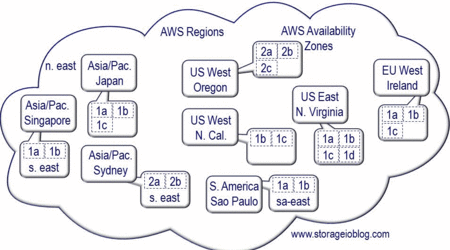
  • AWS regions and availability zones (AZ)
    Example of some AWS Regions and AZ’s

  • Bucket or Container – Where objects or sub-folders containing objects are attached and accessed. Note in some environments such as AWS S3 you can have sub-folders in a bucket.
  • Connector or how your applications access the cloud or object storage such as via an API, S3, Swift, Rest, CDMI, Torrent, JSON, NAS file, block of other access gateway or software.
  • Durability – Data dispersed with copies in multiple locations to survive failure of storage or server hardware, software, zone or even region. Availability = Access + Durability.
  • End-point – Where or what your software, application or tool and utilities or gateways attach to for accessing buckets and objects.
  • Ephemeral – Temporary or non-persistent
  • Eventual consistency – Data is eventually made consistency, think in terms of asynchronous or deferred writes where there is a time lag vs. synchronous or real-time updates.
  • Immutable – Persistent, non-altered or write once read many copy of data. Objects generally are not updated, rather new objects created.
  • Object storage and cloud
    Via Cloud Virtual Data Storage (CRC)

  • Object – Byte (or bit) stream that can be as small as one byte to as large as several TBytes (some solutions and services support up to 5TByte sized objects). The object contains what ever data in any organization along with meta data. Different solutions and services support from a couple hundred KBytes of meta-data to MBytes worth of meta-data. In terms of what can be stored in an object, anything from files, videos, images, virtual disks (VMDK’s, VHDX), ZIP or tar files, backup and archive save sets, executable images or ISO’s, anything you want.
  • OPS – Objects per second or how many objects accessed similar to a IOP. Access includes gets, puts, list, head, deletes for a CRUD interface e.g. Created, Read, Update, Delete.
  • Region – Location where data is stored that can include one or more data centers also known as Availability Zones.
  • Sub-folder – While object storage can be accessed in a flat name space for commonality and organization some solutions and service support the notion of sub-folder that resemble traditional directory hierarchy.

Learn more in Cloud Virtual Storage Networking (CRC) and www.objectstoragecenter.com

Storage I/O trends

OpenStack Manila (e.g. Folders and Files)

AWS recently announced their new cloud based Elastic File Storage (EFS) to compliment their existing Elastic Block Storage (EBS) offerings. However are you aware of what is going on with cloud files within OpenStack?

For those who are familiar with OpenStack or simply talk about it and Swift object storage, or perhaps Cinder block storage, are you aware that there is also a file (NAS or Network Attached Storage) component called Manila?

In concept Manila should provide a similar capability to what AWS has recently announce with their Elastic File Service (EFS), or depending on your perspective, perhaps the other way around. If you are familiar and have done anything with Manila what are your initial thoughts and perspectives.

What this all means

People routinely tell me this is the most exciting and interesting times ever in servers, storage, I/O networking, hardware, software, backup or data protection, performance, cloud and virtual or take your pick too which I would not disagree.

However, for the past several years (no, make that decade), there is new and more interesting things including in adjacent areas.

I predict that at least for the next few years (no, make that decades), we will continue to see plenty of new and interesting things, questions include.

However, what’s applicable to you and your environment vs. simply fun and interesting to watch?

Ok, nuff said, for now

Cheers gs


In This Issue

  • Industry Trends Perspectives News
  • Commentary in the news
  • Tips and Articles
  • StorageIOblog posts
  • Events and Webinars
  • StorageIOblog posts
  • Server StorageIO Lab reports
  • Resources and Links
  • Industry News and Activity

    Recent Industry news and activity

    View other recent industry activity here

    StorageIO Commentary in the news


    Recent Server StorageIO commentary and industry trends perspectives about news, activities and announcements.

    CyberTrend: Comments on Software Defined Data Center and Virtualization

    View more trends comments here

    StorageIO Tips and Articles

    Check out these resources and links on server storage I/O performance and benchmarking tools. View more tips and articles here

    Various Industry Events

    EMCworld – May 4-6 2015 (Las Vegas)

    Interop – April 29 2015 (Las Vegas)
    Presenting
    Smart Shopping for Your Enterprise Storage Strategy

    View other recent and upcoming events here

    Webinars


    BrightTalk Webinar – June 23 2015
    Server Storage I/O Innovation Update

    View other webinars here

    Videos and Podcasts

    Data Protection Gumbo Podcast
    Protect Preserve and Serve Data

    In this episode, Greg Schulz is a guest on Data Protection Gumbo hosted by Demetrius Malbrough(@dmalbrough). The conversation covers various aspects of data protection which has a focus of protect preserve and serve information, applications and data across different environments and customer segments.

    While we discuss enterprise and SMB data protection, we also talk about trends from Mobile to the cloud among many others tools, technologies and techniques. Check out the podcast here.

    Springtime in Kentucky
    With Kendrick Coleman of EMCcode
    Cloud Object Storage S3motion and more

    In this episode, @EMCcode (Part of EMC) developer advocate Kendrick Coleman (@KendrickColeman) joins me (e.g. Greg Schulz) for a conversation.

    Conversation covers what is EMCcode, EMC Federation, Cloud Foundryclouds, object storage, buckets, containers, objects, node.jsDocker, OpenStack, AWS S3, micro services, and the S3motion tool Kendrick developed.

    S3motion is a good tool to have in your server storage I/O tool box for working with cloud and object storage along with others such as Cloudberry, S3fs, Cyberduck, S3 browser among many others. You can get S3motion for free from git hub here Check out the companion blog post for this podcast here.

    StorageIO podcast’s are also available via Server Storage I/O audio podcastServer Storage I/O video & at StorageIO.tv

    From StorageIO Labs

    Research, Reviews and Reports

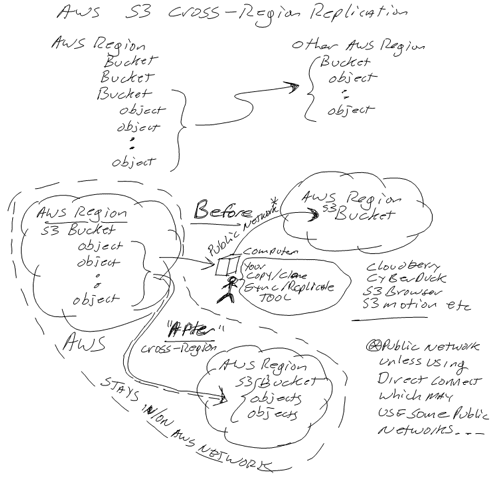
    AWS S3 Cross-Region Replication

    AWS S3 Cross region replication
    Moving and Replicating Buckets/Containers, Sub folders and Objects (Click on Image to read about AWS Cross-Region Replication)

    View other StorageIO lab review reports here

    Resources and Links

    Greg Schulz – Author Cloud and Virtual Data Storage Networking (CRC Press), The Green and Virtual Data Center (CRC Press) and Resilient Storage Networks (Elsevier)
    twitter @storageio

    All Comments, (C) and (TM) belong to their owners/posters, Other content (C) Copyright 2006-2026 Server StorageIO and UnlimitedIO LLC All Rights Reserved

    S3motion Buckets Containers Objects AWS S3 Cloud and EMCcode

    Storage I/O trends

    S3motion Buckets Containers Objects AWS S3 Cloud and EMCcode

    It’s springtime in Kentucky and recently I had the opportunity to have a conversation with Kendrick Coleman to talk about S3motion, Buckets, Containers, Objects, AWS S3, Cloud and Object Storage, node.js, EMCcode and open source among other related topics which are available in a podcast here, or video here and available at StorageIO.tv.

    In this Server StorageIO industry trends perspective podcast episode, @EMCcode (Part of EMC) developer advocate Kendrick Coleman (@KendrickColeman) joins me for a conversation. Our conversation spans spring-time in Kentucky (where Kendrick lives) which means Bourbon and horse racing as well as his blog (www.kendrickcoleman.com).

    Btw, in the podcast I refer to Captain Obvious and Kendrick’s beard, for those not familiar with who or what @Captainobvious is that is made reference to, click here to learn more.


    @Kendrickcoleman
    & @Captainobvious

    What about Clouds Object Storage Programming and other technical stuff?

    Of course we also talk some tech including what is EMCcode, EMC Federation, Cloud Foundry, clouds, object storage, buckets, containers, objects, node.js, Docker, Openstack, AWS S3, micro services, and the S3motion tool that Kendrick developed.

    Cloud and Object Storage Access
    Click to view video

    Kendrick explains the motivation behind S3motion along with trends in and around objects (including GET, PUT vs. traditional Read, Write) as well as programming among related topic themes and how context matters.

    S3motion for AWS S3 Google and object storage
    Click to listen to podcast

    I have used S3motion for moving buckets, containers and objects around including between AWS S3, Google Cloud Storage (GCS) and Microsoft Azure as well as to/from local. S3motion is a good tool to have in your server storage I/O tool box for working with cloud and object storage along with others such as Cloudberry, S3fs, Cyberduck, S3 browser among many others.

    You can get S3motion free from git hub here.

    Amazon Web Services AWS

    Where to learn more

    Here are some links to learn more about AWS S3, Cloud and Object Storage along with related topics

    Also available on

    What this all means and wrap-up

    Context matters when it comes to many things particular about objects as they can mean different things. Tools such as S3motion make it easy for moving your buckets or containers along with objects from one cloud storage system, solution or service to another. Also check out EMCcode to see what they are doing on different fronts from supporting new and greenfield development with Cloud Foundry and PaaS to Openstack to bridging current environments to the next generation of platforms. Also check out Kendricks blog site as he has a lot of good technical content as well as some other fun stuff to learn about. Look forward to having Kendrick on as a guest again soon to continue our conversations. In the meantime, check out S3motion to see how it can fit into your server storage I/O tool box.

    Ok, nuff said, for now..

    Cheers gs

    Greg Schulz – Author Cloud and Virtual Data Storage Networking (CRC Press), The Green and Virtual Data Center (CRC Press) and Resilient Storage Networks (Elsevier)
    twitter @storageio

    All Comments, (C) and (TM) belong to their owners/posters, Other content (C) Copyright 2006-2026 Server StorageIO and UnlimitedIO LLC All Rights Reserved

    Cloud Conversations: AWS EFS Elastic File System (Cloud NAS) First Preview Look

    Storage I/O trends

    Cloud Conversations: AWS EFS Elastic File System (Cloud NAS) First Preview Look

    Amazon Web Services (AWS) recently announced (preview) new Elastic File System (EFS) providing Network File System (NFS) NAS (Network Attached Storage) capabilities for AWS Elastic Cloud Compute (EC2) instances. EFS AWS compliments other AWS storage offerings including Simple Storage Service (S3) along with Elastic Block Storage (EBS), Glacier and Relational Data Services (RDS) among others.

    Ok, that’s a lot of buzzwords and acronyms so lets break this down a bit.

    Amazon Web Services AWS

    AWS EFS and Cloud Storage, Beyond Buzzword Bingo

    • EC2 – Instances exist in various Availability Zones (AZ’s) in different AWS Regions. Compute instance with various operating systems including Windows and Ubuntu among others that also can be pre-configured with applications such as SQL Server or web services among others. EC2 instances vary from low-cost to high-performance compute, memory, GPU, storage or general purposed optimized. For example, some EC2 instances rely solely on EBS, S3, RDS or other AWS storage offerings while others include on-board Solid State Disk (SSD) like DAS SSD found on traditional servers. EC2 instances on EBS volumes can be snapshot to S3 storage which in turn can be replicated to another region.
    • EBS – Scalable block accessible storage for EC2 instances that can be configured for performance or bulk storage, as well as for persistent images for EC2 instances (if you choose to configure your instance to be persistent)
    • EFS – New file (aka NAS) accessible storage service accessible from EC2 instances in various AZ’s in a given AWS region
    • Glacier – Cloud based near-line (or by some comparisons off-line) cold-storage archives.
    • RDS – Relational Database Services for SQL and other data repositories
    • S3 – Provides durable, scalable low-cost bulk (aka object) storage accessible from inside AWS as well as via externally. S3 can be used by EC2 instances for bulk durable storage as well as being used as a target for EBS snapshots.
    • Learn more about EC2, EBS, S3, Glacier, Regions, AZ’s and other AWS topics in this primer here

    aws regions architecture

    What is EFS

    Implements NFS V4 (SNIA NFS V4 primer) providing network attached storage (NAS) meaning data sharing. AWS is indicating initial pricing for EFS at $0.30 per GByte per month. EFS is designed for storage and data sharing from multiple EC2 instances in different AZ’s in the same AWS region with scalability into the PBs.

    What EFS is not

    Currently it seems that EFS has an end-point inside AWS accessible via an EC2 instance like EBS. This appears to be like EBS where the storage service is accessible only to AWS EC2 instances unlike S3 which can be accessible from the out-side world as well as via EC2 instances.

    Note however, that depending on how you configure your EC2 instance with different software, as well as configure a Virtual Private Cloud (VPC) and other settings, it is possible to have an application, software tool or operating system running on EC2 accessible from the outside world. For example, NAS software such as those from SoftNAS and NetApp among many others can be installed on an EC2 instance and with proper configuration, as well as being accessible to other EC2 instances, they can also be accessed from outside of AWS (with proper settings and security).

    AWS EFS at this time is NFS version 4 based however does not support Windows SMB/CIFS, HDFS or other NAS access protocols. In addition AWS EFS is accessible from multiple AZ’s within a region. To share NAS data across regions some other software would be required.

    EFS is not yet as of this writing released and AWS is currently accepting requests to join the EFS preview here.

    Amazon Web Services AWS

    Where to learn more

    Here are some links to learn more about AWS S3 and related topics

    What this all means and wrap-up

    AWS continues to extend its cloud platform include both compute and storage offerings. EFS compliments EBS along with S3, Glacier and RDS. For many environments NFS support will be welcome while for others CIFS/SMB would be appreciated and others are starting to find that value in HDFS accessible NAS.

    Overall I like this announcement and look forward to moving beyond the preview.

    Ok, nuff said, for now..

    Cheers gs

    Greg Schulz – Author Cloud and Virtual Data Storage Networking (CRC Press), The Green and Virtual Data Center (CRC Press) and Resilient Storage Networks (Elsevier)
    twitter @storageio

    All Comments, (C) and (TM) belong to their owners/posters, Other content (C) Copyright 2006-2026 Server StorageIO and UnlimitedIO LLC All Rights Reserved

    March 2015 Server StorageIO Update Newsletter


    Volume 15, Issue III

    Hello and welcome to this March 2015 Server and StorageIO update newsletter. Here in the northern hemisphere at least by the calendar spring is here, weather wise winter continues to linger in some areas. March also means in the US college university sports tournaments with many focused on their NCAA men’s basketball championship brackets.

    Besides various college championships, March also has a connection to back up and data protection. Thus this months newsletter has a focus on data protection, after all March 31 is World Backup Day which means it should also be World Restore test day!

    Focus on Data Protection

    Data protection including backup/restore, business continuance (BC), disaster recovery (DR), business resiliency (BR) and archiving across physical, virtual and cloud environments.

    Data Protection Fundamentals

    A reminder on the importance of data protection including backup, BC, DR and related technologies is to make sure they are occuring as planned. Also test your copies and remember the 4 3 2 1 rule or guide.

    4 – Versions (different time intervals)
    3 – Copies of critical data (including versions)
    2 – Different media, devices or systems
    1 – Off-site (cloud or elsewhere)

    The above means having at least four (4) different versions from various points in time of your data. Having three (3) copies including various versions protects against one or more copies being corrupt or damaged. Placing those versions and copies on at least two (2) different storage systems, devices or media if something happens.

    While it might be common sense, a bad April Fools recovery joke would be finding out all of your copies were on the same device which is damaged. That might seem obvious however sometimes the obvious needs to be stated. Also make sure that at least one (1) of your copies is off-site either on off-line media (tape, disk, ssd, optical) or cloud.

    Take a few moments and to verify that your data protection strategy is being implemented and practiced as intended. Also test what is being copied including not only restore the data from cloud, disk, ssd or tape, also make sure you can actually read or use the data being protected. This means make sure that your security credentials including access certificates and decryption occur as expected.

    Watch for more news, updates industry trends perspectives commentary, tips, articles and other information at Storageio.com, StorageIOblog.com, various partner venues as well as in future newsletters.

    StorageIOblog posts

    Data Protection Diaries
    Are restores ready for World Backup Day?
    In case you forgot or did not know, World Backup Day is March 31 2015 (@worldbackupday) so now is a good time to be ready. The only challenge that I have with the World Backup Day (view their site here) that has gone on for a few years know is that it is a good way to call out the importance of backing up or protecting data.
    world backup day test your restore

    However it’s also time to put more emphasis and focus on being able to make sure those backups or protection copies actually work.

    By this I mean doing more than making sure that your data can be read from tape, disk, SSD or cloud service actually going a step further and verifying that restored data can actually be used (read, written, etc).

    The problem, issue and challenges are simple, are your applications, systems and data protected as well as can you use those protection copies (e.g. backups, snapshots, replicas or archives) when as well as were needed? Read more here about World Backup Day and what I’m doing as well as various tips to be ready for successful recovery and avoid being an April 1st fool ;).

    Cloud Conversations
    AWS S3 Cross Region Replication
    Amazon Web Services (AWS) announced several enhancements including a new Simple Storage Service (S3) cross-region replication of objects from a bucket (e.g. container) in one region to a bucket in another region.

    AWS also recently enhanced Elastic Block Storage (EBS) increasing maximum performance and size of Provisioned IOPS (SSD) and General Purpose (SSD) volumes. EBS enhancements included ability to store up to 16 TBytes of data in a single volume and do 20,000 input/output operations per second (IOPS). Read more about EBS and other AWS server, storage I/O  enhancements here.
    AWS regions and availability zones (AZ)
    Example of some AWS Regions and AZs

    AWS S3 buckets and objects are stored in a specific region designated by the customer or user (AWS S3, EBS, EC2, Glacier, Regions and Availability Zone primer can be found here). The challenge being addressed by AWS with S3 replication is being able to move data (e.g. objects) stored in AWS buckets in one region to another in a safe, secure, timely, automated, cost-effective way.

    Continue reading more here about AWS S3 bucket and object replication feature along with related material.

    Additional March StorageIOblog posts include:

    Server Storage I/O performance (Image licensed from Shutterstock by StorageIO)


    View other recent as well as past blog posts here

    In This Issue

    • Industry Trends Perspectives News
    • Commentary in the news
    • Tips and Articles
    • StorageIOblog posts
    • Events and Webinars
    • Recommended Reading List
    • StorageIOblog posts
    • Server StorageIO Lab reports
    • Resources and Links


    Industry News and Activity

    Recent Industry news and activity

    EMC sets up cloudfoundry Dojo
    AWS S3, EBS IOPs and other updates
    New backup/data protection vendor Rubrik
    Google adds nearline Cloud Storage
    AWS and Microsoft Cloud Price battle

    View other recent and upcoming events here

    StorageIO Commentary in the news

    Recent Server StorageIO commentary and industry trends perspectives about news, activities and announcements.

    Processor: Enterprise Backup Solution Tips
    Processor: Failed & Old Drives
    EnterpriseStorageForum: Disk Buying Guide
    ChannelProNetwork: 2015 Tech and SSD
    Processor: Detect & Avoid Drive Failures

    View more trends comments here

    StorageIO Tips and Articles

    So you have a new storage device or system. How will you test or find its performance? Check out this quick-read tip on storage benchmark and testing fundamentals over at BizTech.

    Keeping with this months theme of data protection including backup/restore, BC, DR, BR and archiving, here are some more tips. These tips span server storage I/O networking hardware, software, cloud, virtual, performance, data protection applications and related themes including:

    • Test your data restores, can you read and actually use the data? Is you data decrypted, proper security certificates applied?
    • Remember to back up or protect your security encryption keys, certificates and application settings!
    • Revisit what format your data is being saved in including how will you be able to use data saved to the cloud. Will you be able to do a restore to a cloud server or do you need to make sure a copy of your backup tools are on your cloud server instances?

    Check out these resources and links on server storage I/O performance and benchmarking tools. View more tips and articles here

    Various Industry Events

    EMCworld – May 4-6 2015

    Interop – April 29 2015 (Las Vegas)

    Presenting Smart Shopping for Your Storage Strategy

    NAB – April 14-15 2015

    SNIA DSI Event – April 7-9

    View other recent and upcoming events here

    Webinars

    December 11, 2014 – BrightTalk
    Server & Storage I/O Performance

    December 10, 2014 – BrightTalk
    Server & Storage I/O Decision Making

    December 9, 2014 – BrightTalk
    Virtual Server and Storage Decision Making

    December 3, 2014 – BrightTalk
    Data Protection Modernization

    Videos and Podcasts

    StorageIO podcasts are also available via and at StorageIO.tv

    From StorageIO Labs

    Research, Reviews and Reports

    Datadynamics StorageX
    Datadynamics StorageX

    More than a data mover migration tool, StorageX is a tool for adding management and automation around unstructured local and distributed NAS (NFS, CIFS, DFS) file data. Read more here.

    View other StorageIO lab review reports here

    Recommended Reading List

    This is a new section being introduced in this edition of the Server StorageIO update mentioning various books, websites, blogs, articles, tips, tools, videos, podcasts along with other things I have found interesting and want to share with you.

      • Introducing s3motion (via EMCcode e.g. opensource) a tool for copying buckets and objects between public, private and hybrid clouds (e.g. AWS S3, GCS, Microsoft Azure and others) as well as object storage systems. This is a great tool which I have added to my server storage I/O cloud, virtual and physical toolbox. If you are not familiar with EMCcode check it out to learn more…
    • Running Hadoop on Ubuntu Linux (Series of tutorials) for those who want to get their hands dirty vs. using one of the All In One (AIO) appliances.
      • Yellow-bricks (Good blog focused on virtualization, VMware and other related themes) by Duncan Epping @duncanyb

    Resources and Links

    Check out these useful links and pages:
    storageio.com/links
    objectstoragecenter.com
    storageioblog.com/data-protection-diaries-main/

    storageperformance.us
    thessdplace.com
    storageio.com/raid
    storageio.com/ssd

    Enjoy this edition of the Server and StorageIO update newsletter and watch for new tips, articles, StorageIO lab report reviews, blog posts, videos and podcasts along with in the news commentary appearing soon.

    Cheers gs

    Greg Schulz – Author Cloud and Virtual Data Storage Networking (CRC Press), The Green and Virtual Data Center (CRC Press) and Resilient Storage Networks (Elsevier)
    twitter @storageio

    All Comments, (C) and (TM) belong to their owners/posters, Other content (C) Copyright 2006-2026 Server StorageIO and UnlimitedIO LLC All Rights Reserved

    Cloud Conversations: AWS S3 Cross Region Replication storage enhancements

    Storage I/O trends

    Cloud Conversations: AWS S3 Cross Region Replication storage enhancements

    Amazon Web Services (AWS) recently among other enhancements announced new Simple Storage Service (S3) cross-region replication of objects from a bucket (e.g. container) in one region to a bucket in another region. AWS also recently enhanced Elastic Block Storage (EBS) increasing maximum performance and size of Provisioned IOPS (SSD) and General Purpose (SSD) volumes. EBS enhancements included ability to store up to 16 TBytes of data in a single volume and do 20,000 input/output operations per second (IOPS). Read more about EBS and other recent AWS server, storage I/O and application enhancements here.

    Amazon Web Services AWS

    The Problem, Issue, Challenge, Opportunity and Need

    The challenge is being able to move data (e.g. objects) stored in AWS buckets in one region to another in a safe, secure, timely, automated, cost-effective way.

    Even though AWS has a global name-space, buckets and their objects (e.g. files, data, videos, images, bit and byte streams) are stored in a specific region designated by the customer or user (AWS S3, EBS, EC2, Glacier, Regions and Availability Zone primer can be found here).

    aws regions architecture

    Understanding the challenge and designing a strategy

    The following diagram shows the challenge and how to copy or replicate objects in an S3 bucket in one region to a destination bucket in a different region. While objects can be copied or replicated without S3 cross-region replication, that involves essentially reading your objects pulling that data out via the internet and then writing to another place. The catch is that this can add extra costs, take time, consume network bandwidth and need extra tools (Cloudberry, Cyberduck, S3fuse, S3motion, S3browser, S3 tools (not AWS) and a long list of others).
    aws cross region replication

    What is AWS S3 Cross-region replication

    Highlights of AWS S3 Cross-region replication include:

    • AWS S3 Cross region replication is as its name implies, replication of S3 objects from a bucket in one region to a destination bucket in another region.
    • S3 replication of new objects added to an existing or new bucket (note new objects get replicated)
    • Policy based replication tied into S3 versioning and life-cycle rules
    • Quick and easy to set up for use in a matter of minutes via S3 dashboard or other interfaces
    • Keeps region to region data replication and movement within AWS networks (potential cost advantage)

    To activate, you simply enable versioning on a bucket, enable cross-region replication, indicate source bucket (or prefix of objects in bucket), specify destination region and target bucket name (or create one), then create or select an IAM (Identify Access Management) role and objects should be replicated.

    • Some AWS S3 cross-region replication things to keep in mind (e.g. considerations):
    • As with other forms of mirroring and replication if you add something on one side it gets replicated to other side
    • As with other forms of mirroring and replication if you deleted something from the other side it can be deleted on both (be careful and do some testing)
    • Keep costs in perspective as you still need to pay for your S3 storage at both locations as well as applicable internal data transfer and GET fees
    • Click here to see current AWS S3 fees for various regions

    S3 Cross-region replication and alternative approaches

    There are several regions around the world and up until today AWS customers could copy, sync or replicate S3 bucket contents between AWS regions manually (or via automation) using various tools such as Cloudberry, Cyberduck, S3browser and S3motion to name just a few as well as via various gateways and other technologies. Some of those tools and technologies are open-source or free, some are freemium and some are premium for a few that also vary by interface (some with GUI, others with CLI or APIs) including ability to mount an S3 bucket as a local network drive and use tools to sync or copy.

    However a catch with the above mentioned tools (among others) and approaches is that to replicate your data (e.g. objects in a bucket) can involve other AWS S3 fees. For example reading data (e.g. a GET which has a fee) from one AWS region and then copying out to the internet has fees. Likewise when copying data into another AWS S3 region (e.g. a PUT which are free) there is also the cost of storage at the destination.

    Storage I/O trends

    AWS S3 cross-region hands on experience (first look)

    For my first hands on (first look) experience with AWS cross-region replication today I enabled a bucket in the US Standard region (e.g. Northern Virginia) and created a new target destination bucket in the EU Ireland. Setup and configuration was very quick, literally just a few minutes with most of the time spent reading the text on the new AWS S3 dashboard properties configuration displays.

    I selected an existing test bucket to replicate and noticed that nothing had replicated over to the other bucket until I realized that new objects would be replicated. Once some new objects were added to the source bucket within a matter of moments (e.g. few minutes) they appeared across the pond in my EU Ireland bucket. When I deleted those replicated objects from my EU Ireland bucket and switched back to my view of the source bucket in the US, those new objects were already deleted from the source. Yes, just like regular mirroring or replication, pay attention to how you have things configured (e.g. synchronized vs. contribute vs. echo of changes etc.).

    While I was not able to do a solid quantifiable performance test, simply based on some quick copies and my network speed moving via S3 cross-region replication was faster than using something like s3motion with my server in the middle.

    It also appears from some initial testing today that a benefit of AWS S3 cross-region replication (besides being bundled and part of AWS) is that some fees to pull data out of AWS and transfer out via the internet can be avoided.

    Amazon Web Services AWS

    Where to learn more

    Here are some links to learn more about AWS S3 and related topics

    What this all means and wrap-up

    For those who are looking for a way to streamline replicating data (e.g. objects) from an AWS bucket in one region with a bucket in a different region you now have a new option. There are potential cost savings if that is your goal along with performance benefits in addition to using what ever might be working in your environment. Replicating objects provides a way of expanding your business continuance (BC), business resiliency (BR) and disaster recovery (DR) involving S3 across regions as well as a means for content cache or distribution among other possible uses.

    Overall, I like this ability for moving S3 objects within AWS, however I will continue to use other tools such as S3motion and s3sfs for moving data in and out of AWS as well as among other public cloud serves and local resources.

    Ok, nuff said, for now..

    Cheers gs

    Greg Schulz – Author Cloud and Virtual Data Storage Networking (CRC Press), The Green and Virtual Data Center (CRC Press) and Resilient Storage Networks (Elsevier)
    twitter @storageio

    All Comments, (C) and (TM) belong to their owners/posters, Other content (C) Copyright 2006-2026 Server StorageIO and UnlimitedIO LLC All Rights Reserved

    Top vblog voting V2.015 (Its IT award season, cast your votes)

    Top vblog voting V2.015 (Its IT award season, cast your votes)

    Storage I/O trends

    It’s that time of the year again for award season:

    • The motion picture association Academy awards (e.g. the Oscars)
    • The Grammys and other entertainment awards
    • As well as Eric Siebert (aka @ericsiebert) vsphere-land.com top vblog

    Vsphere-land.com top vblog

    Eric has run for several years now an annual top VMware, Virtualization, Storage and related blogs voting now taking place until March 16th 2015 (click on the image below). You will find a nice mix of new school, old school and a few current or future school theme blogs represented with some being more VMware specific. However there are also many blogs at the vpad site that have a cloud, virtual, server, storage, networking, software defined, development and other related themes.

    Click on the above image to cast your vote for favorite:

    • Ten blogs (e.g. select up to ten and then rank 1 through 10)
    • Storage blog
    • Scripting blog
    • VDI blog
    • New Blogger
    • Independent Blogger (e.g. non-vendor)
    • News/Information Web site
    • Podcast

    Call to action, take a moment to cast your vote

    My StorageIOblog.com has been on the vLaunchPad site for several years now as well as having syndicated content that also appears via some of the other venues listed there.

    Six time VMware vExpert

    In addition to my StorageIOblog and podcast, you will also find many of my fellow VMware vExperts among others at the vLaunchpad site so check them out as well.

    What this means

    This is a people’s choice process (yes it is a popularity process of sorts as well) however also a way of rewarding or thanking those who take time to create and share content with you and others. If you take time to read various blogs, listen to podcasts as well as consume other content, please take a few moments and cast your vote here (thank you in advance) which I hope includes StorageIOblog.com as part of the top ten, as well as being nominated in the Storage, Podcast and Independent blogger categories.

    Ok, nuff said, for now…

    Cheers gs

    Greg Schulz – Author Cloud and Virtual Data Storage Networking (CRC Press), The Green and Virtual Data Center (CRC Press) and Resilient Storage Networks (Elsevier)
    twitter @storageio

    All Comments, (C) and (TM) belong to their owners/posters, Other content (C) Copyright 2006-2026 Server StorageIO and UnlimitedIO LLC All Rights Reserved

    VMware announces vSphere V6 and associated virtualization technologies

    VMware announces vSphere V6 and associated virtualization technologies

    server storage I/O trends

    VMware has announced version 6 (V6) of its software defined data center (SDDC) server virtualization hypervisor called vSphere aka ESXi. In addition to a new version of its software defined server hypervisor along with companion software defined management and convergence tools.

    VMware

    VMware vSphere Refresh

    As a refresh for those whose world does not revolve around VMware, vSphere and software defined data centers (believe it or not there are some who exist ;), ESXi is the hypervisor that virtualizes underlying physical machines (PM’s) known as hosts.

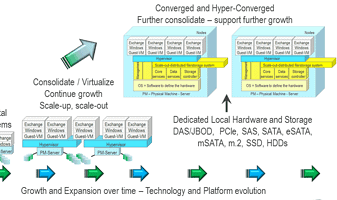
    software defined data center convergence
    The path to software defined data center convergence

    Guest operating systems (or other hypervisors using nesting) run as virtual machines (VM’s) on top of the vSphere hypervisor host (e.g. ESXi software). Various VMware management tools (or third-party) are used for managing the virtualized data center from initial configuration, configuration, conversion from physical to virtual (P2V) or virtual to virtual (V2V) along with data protection, performance, capacity planning across servers, storage and networks.

    virtual machines

    VMware vSphere is flexible and can adapt to different sized environments from small office home office (SOHO) or small SMB, to large SMB, SME, enterprise or cloud service provider. There are a free version of ESXi along with paid versions that include support and added management tool features. Besides the ESXi vSphere hypervisor, other commonly deployed modules include the vCenter administration along with Infrastructure Controller services platform among others. In addition, there are optional solution bundles to add support for virtual networking, cloud (public and private), data protection (backup/restore, replication, HA, BC, DR), big data among other capabilities.

    What is new with vSphere V6

    VMware has streamlined the installation, configuration and deployment of vSphere along with associated tools which for smaller environments makes things simply easier. For the larger environments, having to do less means being able to do more in the same amount of time which results in cost savings. In addition to easier to use, deploy and configure, VMware has extended the scaling capabilities of vSphere in terms of scaling-out (larger clusters), scaling-up (more and larger servers), as well as scaling-down (smaller environments and ease of use).

    cloud virtual software defined servers

    • Compute: Expanded support for new hardware, guest operating systems and general scalability in terms of physical, and virtual resources. For example increasing the number of virtual CPU (vCPUs), number of cluster nodes among other speeds and feeds enhancements.

    server storage I/O vsan

    • Storage: This is an area where several enhancements were made including updates for Storage I/O controls (Storage QoS and performance optimizations) with per VM reservations, NFS v4.1 with Kerberos client, Virtual SAN (VSAN) improvements (new back-end underlying file system) as well as new Virtual Volumes (vVOLs) for Storage Policy Based Management.
    • Availability: Improvements for vMotion (ability to live move virtual machines between physical servers (vmware hosts) including long distance fault-tolerance. Other improvements include faster replication, vMotion across vCenter servers, and long distance vMotion (up to 100ms round trip time latency).
    • Network: Network I/O Control (NIOC) provides per VM and dat (VM and data repository) bandwidth reservations for quality of service (QoS) performance optimization.
    • Management: Improvements for multi-site, virtual data centers, content-library (storage and versioning of files and objects including ISOs and OVFs (Open Virtualization Format files) that can be on a VMFS (VMware File System) dat or NFS volume, policy-based management and web-client performance enhancements.

    What is vVOL?

    The quick synopsis of VMware vVOL’s overview:

    • Higher level of abstraction of storage vs. traditional SCSI LUN’s or NAS NFS mount points
    • Tighter level of integration and awareness between VMware hypervisors and storage systems
    • Simplified management for storage and virtualization administrators
    • Removing complexity to support increased scaling
    • Enable automation and service managed storage aka software defined storage management

    server storage I/O volumes
    How data storage access and managed via VMware today (read more here)

    vVOL’s are not LUN’s like regular block (e.g. DAS or SAN) storage that use SAS, iSCSI, FC, FCoE, IBA/SRP, nor are they NAS volumes like NFS mount points. Likewise vVOL’s are not accessed using any of the various object storage access methods mentioned above (e.g. AWS S3, Rest, CDMI, etc) instead they are an application specific implementation. For some of you this approach of an applications specific or unique storage access method may be new, perhaps revolutionary, otoh, some of you might be having a DejaVu moment right about now.

    vVOL is not a LUN in the context of what you may know and like (or hate, even if you have never worked with them), likewise it is not a NAS volume like you know (or have heard of), neither are they objects in the context of what you might have seen or heard such as S3 among others.

    Keep in mind that what makes up a VMware virtual machine are the VMK, VMDK and some other files (shown in the figure below), and if enough information is known about where those blocks of data are or can be found, they can be worked upon. Also keep in mind that at least near-term, block is the lowest common denominator that all file systems and object repositories get built-up.

    server storage I/O vVOL basics
    How VMware data storage accessed and managed with vVOLs (read more here)

    Here is the thing, while vVOL’s will be accessible via a block interface such as iSCSI, FC or FCoE or for that matter, over Ethernet based IP using NFS. Think of these storage interfaces and access mechanisms as the general transport for how vSphere ESXi will communicate with the storage system (e.g. their data path) under vCenter management.

    What is happening inside the storage system that will be presented back to ESXi will be different than a normal SCSI LUN contents and only understood by VMware hypervisor. ESXi will still tell the storage system what it wants to do including moving blocks of data. The storage system however will have more insight and awareness into the context of what those blocks of data mean. This is how the storage systems will be able to more closely integrate snapshots, replication, cloning and other functions by having awareness into which data to move, as opposed to moving or working with an entire LUN where a VMDK may live.

    Keep in mind that the storage system will still function as it normally would, just think of vVOL as another or new personality and access mechanism used for VMware to communicate and manage storage. Watch for vVOL storage provider support from the who’s who of existing and startup storage system providers including Cisco, Dell, EMC, Fujitsu, HDS, HP, IBM, NetApp, Nimble and many others. Read more about Storage I/O fundamentals here and vVOLs here and here.

    What this announcement means

    Depending on your experiences, you might use revolutionary to describe some of the VMware vSphere V6 features and functionalities. Otoh, if you have some Dejavu moments looking pragmatically at what VMware is delivering with V6 of vSphere executing on their vision, evolutionary might be more applicable. I will leave it up to you do decide if you are having a Dejavu moment and what that might pertain to, or if this is all new and revolutionary, or something more along the lines of technolutionary.

    VMware continues to execute delivering on the Virtual Data Center aka Software Defined Data Center paradigm by increasing functionality, as well as enhancing existing capabilities with performance along with resiliency improvements. These abilities enable the aggregation of compute, storage, networking, management and policies for enabling a global virtual data center while supporting existing along with new emerging applications.

    Where to learn more

    If you were not part of the beta to gain early hands-on experience with VMware vSphere V6 and associated technologies, download a copy to check it out as part of making your upgrade or migration plans.

    Check out the various VMware resources including communities links here
    VMware vSphere Hypervisor getting started and general vSphere information (including download)
    VMware vSphere data sheet, compatibility guide along with speeds and feeds (size and other limits)
    VMware vExpert
    VMware Blogs and VMware vExpert page

    Various fellow VMware vExpert blogs including among many others vsphere-land, scott lowe, virtuallyghetto and yellow-bricks among many others found at the vpad here.

    StorageIO Out and About Update – VMworld 2014 (with Video)
    VMware vVOL’s and storage I/O fundamentals (Storage I/O overview and vVOL, details Part I and Part II)
    How many IOPs can a HDD or SSD do in a VMware environment (Part I and Part II)
    VMware VSAN overview and primer, DIY converged software defined storage on a budget

    Wrap up and summary

    Overall VMware vSphere V6 has a great set of features that support both ease of management for small environments as well as the scaling needs of larger organizations.

    Ok, nuff said, for now…

    Cheers gs

    Greg Schulz – Author Cloud and Virtual Data Storage Networking (CRC Press), The Green and Virtual Data Center (CRC Press) and Resilient Storage Networks (Elsevier)
    twitter @storageio

    All Comments, (C) and (TM) belong to their owners/posters, Other content (C) Copyright 2006-2026 Server StorageIO and UnlimitedIO LLC All Rights Reserved

    January 2015 Server StorageIO Industry Trends Newsletter

    Volume 15, Issue I

    Hello and welcome to this January 2015 Server and StorageIO update newsletter. Its 2015 and the new year is off and running picking up where 2014 left off. January is typically a relatively quiet month when it comes to technology announcements and other industry activity. However January is also time where there is a lot going on behind the scenes. This means that there are many things to watch for in the coming months, weeks or perhaps even days.

    Commentary In The News

    Following are some Server and StorageIO industry trends perspectives comments that have appeared in various venues. In case you missed it, Box recently did their IPO and here are some perspectives over at SaaS In the Enterprise prior to the IPO.

    Over at Enterprise Storage Forum I have some perspectives on High Performance Compute (HPC) aka High Productivity Compute along with big data and object storage in the Lustre buying guide.

    Also over at Enterprise Storage Forum some tips and comments on data storage benchmarking guide. Meanwhile over at  InfoStor check see 9 Storage Startups to Watch. Search SolidState Storage has some perspectives on NexGen Storage ioControl following SanDisk spinout and over at Processor some comments on avoiding common mistakes with virtualization. View more trends comments here

    Tips and Articles

    Cloud storage: Is It All About Cost?

    Is cloud storage all about removing cost, cost cutting, free storage? Or perhaps even getting something else in addition to free storage?

    You might ask: what type of cloud storage am I referring to? That’s a great question. After all, there are many types or categories of public cloud storage services, not to mention private and hybrid options. There are cloud storage services for consumers to save and share their photos, videos, music and other documents to. Then there is business and enterprise file, document, object and collaboration cloud storage options. Read the entire article here.

    View recent as well as past tips and articles here

    Server StorageIOblog posts

    Recent StorageIOblog posts include:

    View other recent as well as past blog posts here

    In This Issue

  • Industry Trends Perspectives
  • Commentary in the news
  • Server StorageIO Tips and Articles
  • Server StorageIO blog posts
  • Events & Activities

    May 4-6, 2015 EMCworld Las Vegas
    April 29, 2015 Interop Las Vegas
    April 12 -13, 2015 NAB Las Vegas
    March 3, 2015 – TBA (St. Paul)
    Feb 18, 2015 Usenix FAST Santa Clara

    View other recent and upcoming events here

    Webinars

    December 11, 2014 – BrightTalk
    Server & Storage I/O Performance
    December 10, 2014 – BrightTalk
    Server & Storage I/O Decision Making
    December 9, 2014 – BrightTalk
    Virtual Server and Storage Decision Making
    December 3, 2014 – BrightTalk
    Data Protection Modernization
    November 13 9AM PT – BrightTalk
    Software Defined Storage

    Videos and Podcasts

    StorageIO podcasts are also available via and at StorageIO.tv

    From Server StorageIO Labs

    Research, Reviews and Reports

    Intel NUC nick knack notes and review

    Intel nuc server storage I/O
    Intel nuc server storage I/O ports
    Intel Nuc

    This Server StorageIO lab review looks at  Intel NUC for virtual, physical and software defined storage networking. Read more about Intel Nuc here.

    View other StorageIO lab and reports here.

    Resources and Links

    Check out these useful links and pages:
    storageio.com/links
    objectstoragecenter.com
    storageioblog.com/data-protection-diaries-main/
    storageio.com/raid
    storageio.com/ssd

    Enjoy this edition of the Server and StorageIO update newsletter and watch for new tips, articles, StorageIO lab report reviews, blog posts, videos and podcasts along with in the news commentary appearing soon.

    Cheers gs

    Greg Schulz – Author Cloud and Virtual Data Storage Networking (CRC Press), The Green and Virtual Data Center (CRC Press) and Resilient Storage Networks (Elsevier)
    twitter @storageio

    All Comments, (C) and (TM) belong to their owners/posters, Other content (C) Copyright 2006-2026 Server StorageIO and UnlimitedIO LLC All Rights Reserved

    December 2014 Server StorageIO Newsletter

    December 2014

    Hello and welcome to this December Server and StorageIO update newsletter.

    Seasons Greetings

    Seasons greetings

    Commentary In The News

    Following are some StorageIO industry trends perspectives comments that have appeared in various venues. Cloud conversations continue to be popular including concerns about privacy, security and availability. Over at BizTech Magazine there are some comments about cloud and ROI. Some comments on AWS and Google SSD services can be viewed at SearchAWS. View other trends comments here

    Tips and Articles

    View recent as well as past tips and articles here

    StorageIOblog posts

    Recent StorageIOblog posts include:

    View other recent as well as past blog posts here

    In This Issue

  • Industry Trends Perspectives
  • Commentary in the news
  • Tips and Articles
  • StorageIOblog posts
  • Events & Activities

    View other recent and upcoming events here

    Webinars

    December 11, 2014 – BrightTalk
    Server & Storage I/O Performance

    December 10, 2014 – BrightTalk
    Server & Storage I/O Decision Making

    December 9, 2014 – BrightTalk
    Virtual Server and Storage Decision Making

    December 3, 2014 – BrightTalk
    Data Protection Modernization

    Videos and Podcasts

    StorageIO podcasts are also available via and at StorageIO.tv

    From StorageIO Labs

    Research, Reviews and Reports

    StarWind Virtual SAN for Microsoft SOFS

    May require registration
    This looks at the shared storage needs of SMB’s and ROBO’s leveraging Microsoft Scale-Out File Server (SOFS). Focus is on Microsoft Windows Server 2012, Server Message Block version (SMB) 3.0, SOFS and StarWind Virtual SAN management software

    View additional reports and lab reviews here.

    Resources and Links

    Check out these useful links and pages:
    storageio.com/links
    objectstoragecenter.com
    storageioblog.com/data-protection-diaries-main/
    storageio.com/ssd
    storageio.com/ssd

    Enjoy this edition of the Server and StorageIO update newsletter and watch for new tips, articles, StorageIO lab report reviews, blog posts, videos and podcasts along with in the news commentary appearing soon.

    Seasons greetings 2014

    Greg Schulz – Author Cloud and Virtual Data Storage Networking (CRC Press), The Green and Virtual Data Center (CRC Press) and Resilient Storage Networks (Elsevier)
    twitter @storageio

    All Comments, (C) and (TM) belong to their owners/posters, Other content (C) Copyright 2006-2026 Server StorageIO and UnlimitedIO LLC All Rights Reserved

    Cloud Conversations: Revisiting re:Invent 2014 and other AWS updates

    server storage I/O trends

    This is part one of a two-part series about Amazon Web Services (AWS) re:Invent 2014 and other recent cloud updates, read part two here.

    Revisiting re:Invent 2014 and other AWS updates

    AWS re:Invent 2014

    A few weeks ago I attended Amazon Web Service (AWS) re:Invent 2014 in Las Vegas for a few days. For those of you who have not yet attended this event, I recommend adding it to your agenda. If you have interest in compute servers, networking, storage, development tools or management of cloud (public, private, hybrid), virtualization and related topic themes, you should check out AWS re:invent.

    AWS made several announcements at re:invent including many around development tools, compute and data storage services. One of those to keep an eye on is cloud based Aurora relational database service that complement existing RDS tools. Aurora is positioned as an alternative to traditional SQL based transactional databases commonly found in enterprise environments (e.g. SQL Server among others).

    Some recent AWS announcements prior to re:Invent include

    AWS vCenter Portal

    Using the AWS Management Portal for vCenter adds a plug-in within your VMware vCenter to manage your AWS infrastructure. The vCenter for AWS plug-in includes support for AWS EC2 and Virtual Machine (VM) import to migrate your VMware VMs to AWS EC2, create VPC (Virtual Private Clouds) along with subnet’s. There is no cost for the plug-in, you simply pay for the underlying AWS resources consumed (e.g. EC2, EBS, S3). Learn more about AWS Management Portal for vCenter here, and download the OVA plug-in for vCenter here.

    AWS re:invent content


    AWS Andy Jassy (Image via AWS)

    November 12, 2014 (Day 1) Keynote (highlight video, full keynote). This is the session where AWS SVP Andy Jassy made several announcements including Aurora relational database that complements existing RDS (Relational Data Services). In addition to Andy, the key-note sessions also included various special guests ranging from AWS customers, partners and internal people in support of the various initiatives and announcements.


    Amazon.com CTO Werner Vogels (Image via AWS)

    November 13, 2014 (Day 2) Keynote (highlight video, full keynote). In this session, Amazon.com CTO Werner Vogels appears making announcements about the new Container and Lambda services.

    AWS re:Invent announcements

    Announcements and enhancements made by AWS during re:Invent include:

    • Key Management Service (KMS)
    • Amazon RDS for Aurora
    • Amazon EC2 Container Service
    • AWS Lambda
    • Amazon EBS Enhancements
    • Application development, deployed and life-cycle management tools
    • AWS Service Catalog
    • AWS CodeDeploy
    • AWS CodeCommit
    • AWS CodePipeline

    Key Management Service (KMS)

    Hardware security module (HSM) based key managed service for creating and control of encryption keys to protect security of digital assets and their keys. Integration with AWS EBS and others services including S3 and Redshift along with CloudTrail logs for regulatory, compliance and management. Learn more about AWS KMS here

    AWS Database

    For those who are not familiar, AWS has a suite of database related services including SQL and no SQL based, simple to transactional to Petabyte (PB) scale data warehouses for big data and analytics. AWS offers the Relational Database Service (RDS) which is a suite of different database types, instances and services. RDS instance and types include SimpleDB, MySQL, Postgress, Oracle, SQL Server and the new AWS Aurora offering (read more below).  Other little data database and big data repository related offerings include DynamoDB (a non-SQL database), ElasticCache (in memory cache repository) and Redshift (large-scale data warehouse and big data repository).

    In addition to database services offered by AWS, you can also combine various AWS resources including EC2 compute, EBS and other storage offerings to create your own solution. For example there are various Amazon Machine Images (AMI’s) or pre-built operating systems and database tools available with EC2 as well as via the AWS Marketplace , such as MongoDB and Couchbase among others. For those not familiar with MongoDB, Couchbase, Cassandra, Riak along with other non SQL or alternative databases and key value repositories, check out Seven Databases in Seven Weeks in my book review of it here.

    Seven Databases book review
    Seven Databases in Seven Weeks and NoSQL movement available from Amazon.com

    Amazon RDS for Aurora

    Aurora is a new relational database offering part of the AWS RDS suite of services. Positioned as an alternative to commercial high-end database, Aurora is a cost-effective database engine compatible with MySQL. AWS is claiming 5x better performance than standard MySQL with Aurora while being resilient and durable. Learn more about Aurora which will be available in early 2015 and its current preview here.

    Amazon EC2 C4 instances

    AWS will be adding a new C4 instance as a next generation of EC2 compute instance based on Intel Xeon E5-2666 v3 (Haswell) processors. The Intel Xeon E5-2666 v3 processors run at a clock speed of 2.9 GHz providing the highest level of EC2 performance. AWS is targeting traditional High Performance Computing (HPC) along with other compute intensive workloads including analytics, gaming, and transcoding among others. Learn more AWS EC2 instances here, and view this Server and StorageIO EC2, EBS and associated AWS primer here.

    Amazon EC2 Container Service

    Containers such as those via Docker have become popular to support developers rapidly build as well as deploy scalable applications. AWS has added a new feature called EC2 Container Service that supports Docker using simple API’s. In addition to supporting Docker, EC2 Container Service is a high performance scalable container management service for distributed applications deployed on a cluster of EC2 instances. Similar to other EC2 services, EC2 Container Service leverages security groups, EBS volumes and Identity Access Management (IAM) roles along with scheduling placement of containers to meet your needs. Note that AWS is not alone in adding container and docker support with Microsoft Azure also having recently made some announcements, learn more about Azure and Docker here. Learn more about EC2 container service here and more about Docker here.

    Docker for smarties

    Continue reading about re:Invent 2014 and other recent AWS enhancements here in part two of this two-part series.

    Ok, nuff said (for now)

    Cheers gs

    Greg Schulz – Author Cloud and Virtual Data Storage Networking (CRC Press), The Green and Virtual Data Center (CRC Press) and Resilient Storage Networks (Elsevier)
    twitter @storageio

    All Comments, (C) and (TM) belong to their owners/posters, Other content (C) Copyright 2006-2026 Server StorageIO and UnlimitedIO LLC All Rights Reserved

    Part II: Revisiting re:Invent 2014, Lambda and other AWS updates

    server storage I/O trends

    Part II: Revisiting re:Invent 2014 and other AWS updates

    This is part two of a two-part series about Amazon Web Services (AWS) re:Invent 2014 and other recent cloud updates, read part one here.

    AWS re:Invent 2014

    AWS re:Invent announcements

    Announcements and enhancements made by AWS during re:Invent include:

    • Key Management Service (KMS)
    • Amazon RDS for Aurora
    • Amazon EC2 Container Service
    • AWS Lambda
    • Amazon EBS Enhancements
    • Application development, deployed and life-cycle management tools
    • AWS Service Catalog
    • AWS CodeDeploy
    • AWS CodeCommit
    • AWS CodePipeline

    AWS Lambda

    In addition to announcing new higher performance Elastic Cloud Compute (EC2) compute instances along with container service, another new service is AWS Lambda. Lambda is a service that automatically and quickly runs your applications code in response to events, activities, or other triggers. In addition to running your code, Lambda service is billed in 100 millisecond increments along with corresponding memory use vs. standard EC2 per hour billing. What this means is that instead of paying for an hour of time for your code to run, you can choose to use the Lambda service with more fine-grained consumption billing.

    Lambda service can be used to have your code functions staged ready to execute. AWS Lambda can run your code in response to S3 bucket content (e.g. objects) changes, messages arriving via Kinesis streams or table updates in databases. Some examples include responding to event such as a web-site click, response to data upload (photo, image, audio, file or other object), index, stream or analyze data, receive output from a connected device (think Internet of Things IoT or Internet of Device IoD), trigger from an in-app event among others. The basic idea with Lambda is to be able to pay for only the amount of time needed to do a particular function without having to have an AWS EC2 instance dedicated to your application. Initially Lambda supports Node.js (JavaScript) based code that runs in its own isolated environment.

    AWS cloud example
    Various application code deployment models

    Lambda service is a pay for what you consume, charges are based on the number of requests for your code function (e.g. application), amount of memory and execution time. There is a free tier for Lambda that includes 1 million requests and 400,000 GByte seconds of time per month. A GByte second is the amount of memory (e.g. DRAM vs. storage) consumed during a second. An example is your application is run 100,000 times and runs for 1 second consuming 128MB of memory = 128,000,000MB = 128,000GB seconds. View various pricing models here on the AWS Lambda site that show examples for different memory sizes, times a function runs and run time.

    How much memory you select for your application code determines how it can run in the AWS free tier, which is available to both existing and new customers. Lambda fees are based on the total across all of your functions starting with the code when it runs. Note that you could have from one to thousands or more different functions running in Lambda service. As of this time, AWS is showing Lambda pricing as free for the first 1 million requests, and beyond that, $0.20 per 1 million request ($0.0000002 per request) per duration. Duration is from when you code runs until it ends or otherwise terminates rounded up to the nearest 100ms. The Lambda price also depends on the amount of memory you allocated for your code. Once past the 400,000 GByte second per month free tier the fee is $0.00001667 for every GB second used.

    Why use AWS Lambda vs. an EC2 instance

    Why would you use AWS Lambda vs. provisioning an Container, EC2 instance or running your application code function on a traditional or virtual machine?

    If you need control and can leverage an entire physical server with its operating system (O.S.), application and support tools for your piece of code (e.g. JavaScript), that could be an option. If you simply need to have an isolated image instance (O.S., applications and tools) for your code on a shared virtual on-premises environment then that can be an option. Likewise if you have the need to move your application to an isolated cloud machine (CM) that hosts an O.S. along with your application paying for those resources such as on an hourly basis, that could be your option. Simply need a lighter-weight container to drop your application into that’s where Docker and containers comes into play to off-load some of the traditional application dependencies overhead.

    However, if all you want to do is to add some code logic to support processing activity for example when an object, file or image is uploaded to AWS S3 without having to standup an EC2 instance along with associated server, O.S. and complete application activity, that’s where AWS Lambda comes into play. Simply create your code (initially JavaScript) and specify how much memory it needs, define what events or activities will trigger or invoke the event, and you have a solution.

    View AWS Lambda pricing along with free tier information here.

    Amazon EBS Enhancements

    AWS is increasing the performance and size of General Purpose SSD and Provisioned IOP’s SSD volumes. This means that you can create volumes up to 16TB and 10,000 IOP’s for AWS EBS general-purpose SSD volumes. For EBS Provisioned IOP’s SSD volumes you can create up to 16TB for 20,000 IOP’s. General-purpose SSD volumes deliver a maximum throughput (bandwidth) of 160 MBps and Provisioned IOP SSD volumes have been specified by AWS at 320MBps when attached to EBS optimized instances. Learn more about EBS capabilities here. Verify your IO size and verify AWS sizing information to avoid surprises as all IO sizes are not considered to be the same. Learn more about Provisioned IOP’s, optimized instances, EBS and EC2 fundamentals in this StorageIO AWS primer here.

    Application development, deployed and life-cycle management tools

    In addition to compute and storage resource enhancements, AWS has also announced several tools to support application development, configuration along with deployment (life-cycle management). These include tools that AWS uses themselves as part of building and maintaining the AWS platform services.

    AWS Config (Preview e.g. early access prior to full release)

    Management, reporting and monitoring capabilities including Data center infrastructure management (DCIM) for monitoring your AWS resources, configuration (including history), governance, change management and notifications. AWS Config enables similar capabilities to support DCIM, Change Management Database (CMDB), trouble shooting and diagnostics, auditing, resource and configuration analysis among other activities. Learn more about AWS Config here.

    AWS Service Catalog

    AWS announced a new service catalog that will be available in early 2015. This new service capability will enable administrators to create and manage catalogs of approved resources for users to use via their personalized portal. Learn more about AWS service catalog here.

    AWS CodeDeploy

    To support code rapid deployment automation for EC2 instances, AWS has released CodeDeploy. CodeDeploy masks complexity associated with deployment when adding new features to your applications while reducing human error-prone operations. As part of the announcement, AWS mentioned that they are using CodeDeploy as part of their own applications development, maintenance, and change-management and deployment operations. While suited for at scale deployments across many instances, CodeDeploy works with as small as a single EC2 instance. Learn more about AWS CodeDeploy here.

    AWS CodeCommit

    For application code management, AWS will be making available in early 2015 a new service called CodeCommit. CodeCommit is a highly scalable secure source control service that host private Git repositories. Supporting standard functionalities of Git, including collaboration, you can store things from source code to binaries while working with your existing tools. Learn more about AWS CodeCommit here.

    AWS CodePipeline

    To support application delivery and release automation along with associated management tools, AWS is making available CodePipeline. CodePipeline is a tool (service) that supports build, checking workflow’s, code staging, testing and release to production including support for 3rd party tool integration. CodePipeline will be available in early 2015, learn more here.

    Additional reading and related items

    Learn more about the above and other AWS services by actually truing hands on using their free tier (AWS Free Tier). View AWS re:Invent produced breakout session videos here, audio podcasts here, and session slides here (all sessions may not yet be uploaded by AWS re:Invent)

    What this all means

    AWS amazon web services

    AWS continues to invest as well as re-invest into its environment both adding new feature functionality, as well as expanding the extensibility of those features. This means that AWS like other vendors or service providers adds new check-box features, however they also like some increase the depth extensibility of those capabilities. Besides adding new features and increasing the extensibility of existing capabilities, AWS is addressing both the data and information infrastructure including compute (server), storage and database, networking along with associated management tools while also adding extra developer tools. Developer tools include life-cycle management supporting code creation, testing, tracking, testing, change management among other management activities.

    Another observation is that while AWS continues to promote the public cloud such as those services they offer as the present and future, they are also talking hybrid cloud. Granted you have to listen carefully as you may not simply hear hybrid cloud used like some toss it around, however listen for and look into AWS Virtual Private Cloud (VPC), along with what you can do using various technologies via the AWS marketplace. AWS is also speaking the language of enterprise and traditional IT from an applications and development to data and information infrastructure perspective while also walking the cloud talk. What this means is that AWS realizes that they need to help existing environments evolve and make the transition to the cloud which means speaking their language vs. converting them to cloud conversations to then be able to migrate them to the cloud. These steps should make AWS practical for many enterprise environments looking to make the transition to public and hybrid cloud at their pace, some faster than others. More on these and some related themes in future posts.

    The AWS re:Invent event continues to grow year over year, I heard a figure of over 12,000 people however it was not clear if that included exhibiting vendors, AWS people, attendees, analyst, bloggers and media among others. However a simple validation is that the keynotes were in the larger rooms used by events such as EMCworld and VMworld when they hosted in Las Vegas as was the expo space vs. what I saw last year while at re:Invent. Unlike some large events such as VMworld where at best there is a waiting queue or line to get into sessions or hands on lab (HOL), while becoming more crowded, AWS re:Invent is still easy to get in and spend some time using the HOL which is of course powered by AWS meaning you can resume what you started while at re:Invent later. Overall a good event and nice series of enhancements by AWS, looking forward to next years AWS re:Invent.

    Ok, nuff said (for now)

    Cheers gs

    Greg Schulz – Author Cloud and Virtual Data Storage Networking (CRC Press), The Green and Virtual Data Center (CRC Press) and Resilient Storage Networks (Elsevier)
    twitter @storageio

    All Comments, (C) and (TM) belong to their owners/posters, Other content (C) Copyright 2006-2026 Server StorageIO and UnlimitedIO LLC All Rights Reserved


    November 2014 Server StorageIO Update Newsletter

    November 2014

    Hello and welcome to this November Server and StorageIO update newsletter. Enjoy this edition of the Server and StorageIO update newsletter and watch for new tips, articles, StorageIO lab report reviews, blog posts, videos and podcasts along with in the news commentary appearing soon.

    Cheers gs

    Industry Trends and Perspectives

    Storage trends

    A few weeks ago I attended AWS re:invent 2014 in Las Vegas for a few days. For those of you who have not yet attended this event, I recommend adding it to your agenda. If you have interest in compute servers, networking, storage, development tools or management of cloud (public, private, hybrid), virtualization and related topic themes, you should check out AWS re:invent. For those who need a AWS primer or refresher visit here.

    AWS made several announcements at re:invent including many around development tools, compute and data storage services. One of those to keep an eye on is cloud based Aurora relational database service that complement existing RDS tools. Aurora is positioned as an alternative to traditional SQL based transactional databases commonly found in enterprise environments (e.g. SQL Server, IBM DB2/UDB, Oracle among others). I will put some additional notes and perspectives together in a StorageIOblog post along with some video from AWS soon.

    Commentary In The News

    Following are some StorageIO industry trends perspectives comments that have appeared in various venues. Cloud conversations continue to be popular including concerns about privacy, security and availability.

    Over at Processor: Comments on Datacenters, Decide Whether To Build Or Not To Build, and controlling storage costs via insight and action. EdTechMagazine: has some comments on IaaS and Is Lean IT Here to Stay, while at CyberTrend perspectives on Better Servers for Better Business.

    Across the pond over at the UK based Computerweekly comments on AWS launching Aurora cloud-based relational database engine, and hybrid cloud storage. Some comments on Overland Storage RAINcloud can be found at SearchStorage, while SearchDatabackup has some comments on Symantec break-up makeing sense for storage.

    For those of you who speak Dutch, here is an interview (via it-infra.nl) I did when Holland earlier this year about storage and your business.

    View other industry trends comments here

    Tips and Articles

    View recent as well as past tips and articles here

    StorageIOblog posts

    Recent StorageIOblog posts include:

    View other recent as well as past blog posts here

    In This Issue

  • Industry Trends Perspectives
  • Commentary in the news
  • Tips and Articles
  • StorageIOblog posts
  • Events & Activities

    November 11-13, 2014
    AWS re:Invent Las Vegas

    View other recent and upcoming events here

    Webinars

    December 11, 2014 – BrightTalk
    Server & Storage I/O Performance

    December 10, 2014 – BrightTalk
    Server & Storage I/O Decision Making

    December 9, 2014 – BrightTalk
    Virtual Server and Storage Decision Making

    December 3, 2014 – BrightTalk
    Data Protection Modernization

    November 13 9AM PT – BrightTalk
    Software Defined Storage

    November 11 10AM PT
    Google+ Hangout Dell BackupU

    November 11 9AM PT – BrightTalk
    Software Defined Data Centers

    Videos and Podcasts

    VMworld 2014 review
    Video: Click to view VMworld 2014 update

    StorageIO podcasts are also available via and at StorageIO.tv

    From StorageIO Labs

    Research, Reviews and Reports

    Lenovo ThinkServer TD340
    Earlier this year I did a review of the Lenovo ThinkServer TS140 in the StorageIO Labs (see the review here), in fact I ended up buying a TS140 after the review, and a few months back picked up yet another one. This StorageIOlab review looks at the Lenovo ThinkServer TD340 Tower Server which besides having a larger model number than the TS140, it also has a lot more capabilities (server compute, memory, I/O slots and internal hot-swap storage bays. Read more about the TD340 here.

    Resources and Links

    Check out these useful links and pages:
    storageio.com/links
    objectstoragecenter.com
    storageioblog.com/data-protection-diaries-main/
    storageio.com/ssd
    storageio.com/ssd

    Ok, nuff said (for now)

    Cheers
    Gs

    Greg Schulz – Author Cloud and Virtual Data Storage Networking (CRC Press), The Green and Virtual Data Center (CRC Press) and Resilient Storage Networks (Elsevier)
    twitter @storageio

    All Comments, (C) and (TM) belong to their owners/posters, Other content (C) Copyright 2006-2026 Server StorageIO and UnlimitedIO LLC All Rights Reserved

    September October 2014 Server and StorageIO Update Newsletter

    September and October 2014

    Hello and welcome to this joint September and October Server and StorageIO update newsletter. Since the August newsletter, things have been busy with a mix of behind the scenes projects, as well as other activities including several webinars, on-line along with in-person events in the US as well as Europe.

    Enjoy this edition of the Server and StorageIO update newsletter and watch for new tips, articles, StorageIO lab report reviews, blog posts, videos and podcasts along with in the news commentary appearing soon.

    Cheers gs

    Industry Trends and Perspectives

    Storage trends

    In September I was invited to do a key-note opening presentation at the MSP area CMG event. Theme for the September CMG event was "Flash – A Real Life Experience" with a focus of what people are doing, how testing and evaluating including use of hybrid solutions as opposed to vendor marketing sessions. My session was titled "Flash back to reality – Myths and Realities, Flash and SSD Industry trends perspectives plus benchmarking tips and can be found here. Thanks to Tom Becchetti an the MSP CMG (@mspcmg) folks for a great event.

    There are many facets to hybrid storage including different types of media (SSD and HDD’s) along with unified or multi-protocol access. Then there are hybrid storage that spans local and public clouds. Here is a link to an on-line Internet Radio show via Information Week along with on-line chat about Hybrid Storage for Government.

    Some things I’m working with or keeping an eye on include Cloud, Converged solutions, Data Protection, Business Resiliency, DCIM, Docker, InfiniBand, Microsoft (Hyper-V, SOFS, SMB 3.0), Object Storage, SSD, SDS, VMware and VVOL among others items.

    Commentary In The News

    A lot has been going on in the IT industry since the last StorageIO Update newsletter. The following are some StorageIO industry trends perspectives comments that have appeared in various venues. Cloud conversations continue to be popular including concerns about privacy, security and availability. Here are some comments at SearchCloudComputing: about moving on from cloud deployment heartbreak.

    Nand flash Solid State Devices (SSD) continue to increase in customer deployments, over at Processor, here are some here are some comments on Incorporating SSD’s Into Your Storage Plan. Also on SSD, here are some perspectives making the Argument For Flash-Based Storage. Some other comments over at Processer.com include looking At Disaster Recovery As A Service, tips to Avoid In Data Center Planning, making the most of Enterprise Virtualization, as well as New Tech, Advancements To Justify Servers. Part of controlling and managing storage costs is having timely insight, metrics that matter, here are some more perspectives and also here.

    Over at SearchVirtualStorage I have some comments on how to configure and manage storage for a virtual desktop environment (VDI) while over at TechPageOne there are perspectives on top reasons to switch to Windows 8. 

    Some other comments and perspectives are over at EnterpriseStorageForum including Top 10 Ways to Improve Data Center Energy Efficiency. At InfoStor there are comments and tips about Object Storage, while at SearchDataBackup I have some perspectives about Symantec being broken up.

    View other industry trends comments at the here

    Tips and Articles

    Recent Server and StorageIO tips and articles appearing in various venues include over at SearchCloudStorage a series of discussion often asked question pieces:

    Are you concerned with the security of the cloud?
    Is the cost of cloud storage really cheaper?
    What’s important to know about cloud privacy policy?
    Are more than five nines of availability really possible?
    What to look for enterprise file sync-and-share app?
    How primary storage clouds and cloud backup differ?
    What should I consider when using SSD cloud?
    What is difference between a snapshot and a clone?

    View other recent as well as past tips and articles here

    StorageIOblog posts

    Recent StorageIOblog posts include:

    View other recent as well as past blog posts here

    In This Issue

  • Industry Trends Perspectives
  • Commentary in the news
  • Tips and Articles
  • StorageIOblog posts
  • Events & Activities

    September 25, 2014
    MSP CMG – Flash and SSD performance

    October 8-10, 2014
    Nijkerk Netherlands Brouwer Seminar Series

    November 11-13, 2014
    AWS re:Invent Las Vegas

    View other recent and upcoming events here

    Webinars

    November 13 9AM PT
    BrightTalk – Software Defined Storage

    November 11 10AM PT
    Google+ Hangout Dell BackupU

    November 11 9AM PT
    BrightTak – Software Defined Data Centers

    October 16 9AM PT
    BrightTalk – Cloud Storage Decision Making

    October 15 1PM PT
    BrightTalk – Hybrid Cloud Trends

    October 7 11AM PT
    BackupU – Data Protection Management

    September 18 8AM CT
    Nexsan – Hybrid Storage

    September 18 9AM PT
    BrightTalk – Converged Storage

    September 17 1PM PT
    BrightTalk – DCIM

    September 16 1PM PT
    BrightTalk – Data Center Convergence

    September 16 Noon PT
    BrightTalk – BC, BR and DR

    September 16 1PM CT
    StarWind – SMB 3.0 & Microsoft SOFS

    September 16 9AM PT
    Google+ Hangout – BackupU – Replication

    September 2 11AM PT
    Dell BackupU – Replication

    Videos and Podcasts

    Docker for Smarties
    Video: Docker for Smarties

    StorageIO podcasts are also available via and at StorageIO.tv

    From StorageIO Labs

    Research, Reviews and Reports

    Enterprise 12Gbps SAS and SSD’s
    Better Together – Part of an Enterprise Tiered Storage Strategy

    In this StorageIO Industry Trends Perspective thought leadership white paper we look at how enterprise class SSD’s and 12Gbps SAS address current and next generation tiered storage for virtual, cloud, traditional Little and Big Data environments. This report includes proof points running various workloads including Database TPC-B, TPC-E, Microsoft Exchange in the StorageIO Labs along with cache software comparing SSD, SSHD and HDD’s. Read the  white paper  compliments of Seagate 1200 12Gbs SAS SSD’s.

    Seagate SSD White Paper

    Resources and Links

    Check out these useful links and pages:
    storageio.com/links
    objectstoragecenter.com
    storageioblog.com/data-protection-diaries-main/
    storageio.com/ssd
    storageio.com/ssd

    Ok, nuff said (for now)

    Cheers
    Gs

    Greg Schulz – Author Cloud and Virtual Data Storage Networking (CRC Press), The Green and Virtual Data Center (CRC Press) and Resilient Storage Networks (Elsevier)
    twitter @storageio

    All Comments, (C) and (TM) belong to their owners/posters, Other content (C) Copyright 2006-2026 Server StorageIO and UnlimitedIO LLC All Rights Reserved

    VMware Cisco EMC VCE Zen and now server storage I/O convergence

    Storage I/O trends

    VMware Cisco EMC VCE Zen and now server storage I/O convergence

    In case you have not heard, the joint initiative (JV) founded in the fall of 2009 between Intel VMware Cisco and EMC called VCE had a change of ownership today.

    Well, kind of…

    Who is VCE and what’s this Zen stuff?

    For those not familiar or who need a recap, VCE was created to create converged server, storage I/O networking hardware and software solutions combing technologies from its investors resulting in solutions called vBlocks.

    The major investors were Cisco who provides the converged servers and I/O networking along with associated management tools as well as EMC who provides the storage systems along with their associated management tools. Minority investors include VMware (who is majority owned by EMC) who provides the server virtualization aka software defined data center management tools and Intel whose’s processor chip technologies are used in the vBlocks. What has changed from Zen (e.g. yesterday or in the past) and now is that Cisco has sold the majority (they are retaining about 10%) of its investment ownership in VCE to EMC. Learn more about VCE, their solutions and valueware in this post here (VCE revisited, now and Zen).

    Activist activating activity?

    EMC pulling VCE in-house which should prop up its own internal sales figures by perhaps a few billion USDs within a year or so (if not sooner) is not as appealing to activists investors who want results now such as selling off parts of the company (e.g. EMC, VMware or other assets) or the entire company.

    However EMC has been under pressure from activist shareholder Elliot Management to divest or sell-off portions of this business such as VMware so that the investors (including the activist) can make more money. For example there have been the recent stories about EMC looking to sell or merge with the likes of HP (who is now buying back shares and splitting up its own business) among others which certainly must make the activist investors happy.

    However to the activist investors who want to see things sold to make money they are not happy with EMC off buying or investing it appears.

    Via Bloomberg

    “The last thing on investors’ minds is the future of VCE,” Daniel Ives, an analyst with FBR Capital Markets, wrote in a note today. “EMC has a fire in its house right now and the company appears focused on painting its bedroom (e.g. VCE), while the Street wants a resolution on the strategic ownership situation sooner rather than later.”

    Read more at Bloomberg

    Whats this EMC Federation stuff?

    Note that EMC has organized itself into a federation that consists of EMC Information Infrastructure (EMCII) or what you might know a traditional EMC based storage and related software solutions, VMware, Pivotal and RSA. Also note that each of those federated companies have their own CEO as well as have holdings or ownership of other companies. However all report to a common federated leadership aka EMC. Thus when you hear EMC that could mean depending on the context the federation mother ship which controls the individual companies, or it could also be used to refer to EMCII aka the traditional EMC. Click here to learn more about the EMC federation.

    Converging Markets and Opportunities

    Looking beyond near-term or quick gains, EMC could be simply doing something others do to take ownership and control over certain things while reducing complexities associated with joint initiatives. For example with EMC and Cisco in a close partnership with VCE, both parties have been free to explore and take part in other joint initiatives such as Cisco with EMC competitors NetApp, HDS among others. Otoh EMC partners with Arista for networking, not to mention via VMware acquired virtual network or software defined network Nicira now called NSX.

    server and storage I/O road map to convergence

    EMC is also in a partnership with Lenovo for developing servers to be used by EMC for various platforms to support storage, data and information services while shifting the lower-end SMB storage offerings such as Iomega to the Lenovo channel.

    Note that Lenovo is in the process of absorbing the IBM xSeries (e.g. x86 based) business unit that started closing earlier in October (will take several months to completely close in all countries around the world). For its part Cisco is also partnering with hyper-converged solution provider Simplivity while EMC has announced its statement of direction to bring to market its own hyper-converged platform by end of the year. For those not familiar, Hyper-converged solutions are simply the next evolution of converged or pre-bundled turnkey systems (some of you might have just had a Dejavu moment) that today tend to be targeted for SMBs and ROBOs however used for targeted applications such as VDI in larger environments.

    Storage I/O trends

    What does this have to do with VCE?

    IF EMC is about to release as it has made statement of direction statements of a hyper-converged solution by year-end to compete head-on with those from Nutanix, Simplivity and Tintri as well as perhaps to a lesser extent VMwares EVO:Rail, by having more control over VCE means reducing if not eliminating complexity around vBlocks which are Cisco based with EMC storage vs. what ever EMC brings to market for hyper-converged. In the past under the VCE initiatives storage was limited to EMC and servers along with networking from Cisco, hypervisors from VMware, however what happens in the future remains to be seen.

    Does this mean EMC is moving even more into servers than just virtual servers?

    Tough to say as EMC can not afford to have its sales force lose focus on its traditional core products while ramping up other business, however, the EMC direct and partner teams want and need to keep up account control which means gaining market share and footprint in those accounts. This also means EMC needs to find ways to take cost out of the sales and marketing process where possible to streamline which perhaps brining VCE will help do.

    Will this perhaps give the EMC direct and partner sales teams a new carrot or incentive to promote converged and hyper-converged at the cost of other competitors or incumbents? Perhaps, lets see what happens in the coming weeks.

    What does this all mean?

    In a nut shell, IMHO EMC is doing a couple of things here one of which is cleaning up some ownership in JVs to give it self more control, as well as options for doing other business transactions (mergers and acquisitions (M&A), sales or divestiture’s, new joint initiatives, etc). Then there is streamline its business from decision-making to quickly respond to new opportunities as well as routes to markets and other activities (e.g. removing complexity and cost vs. simply cutting cost).

    Does this signal the prelude to something else? Perhaps, we know that EMC has made a statement of direction about hyper-converged which with VCE now more under EMC control, perhaps we will see more options from under the VCE umbrella both for lower-end and entry SMB as well as SME and large enterprise organizations.

    What about the activist investors?

    They are going to make noise as long as they can continue to make more money or get what they want. Publicly I would be shocked if the activist investors were not making statements that EMC should be selling assets not buying or investing.

    On the other hand, any smart investor,  financial or other analyst should see though the fog of what this relatively simple transaction means in terms of EMC getting further control of its future.

    Of course the question will stay does EMC remain in control of its current federation of EMC, VMware, Pivotal, RSA along each of their respective holdings, does EMC doe a block buster merger, divestiture or acquisition?

    server and storage I/O road ahead

    Take a step back, look at the big picture!

    Some things to keep an eye on:

    • Will this move help streamline decision-making enabling new solutions to be brought to market and customers quicker?
    • While there is a VMware focus, don’t forget about the long-running decades old relationship with Microsoft and how that plays into the equation
    • Watch for what EMC releases with their hyper-converged solution as well as where it is focused, not to mention how sold
    • Also watch the EMC and Lenovo join initiative, both for the Iomega storage activity as well as what EMC and Lenovo do with and for servers
    • Speaking of Lenovo, unless I missed something as of the time of writing this, have you noticed that Lenovo is not yet part of the VMware EVO:Rail initiative?

    Ok, nuff said (for now)

    Cheers
    Gs

    Greg Schulz – Author Cloud and Virtual Data Storage Networking (CRC Press), The Green and Virtual Data Center (CRC Press) and Resilient Storage Networks (Elsevier)
    twitter @storageio

    All Comments, (C) and (TM) belong to their owners/posters, Other content (C) Copyright 2006-2026 Server StorageIO and UnlimitedIO LLC All Rights Reserved