Poll: Networking Convergence, Ethernet, InfiniBand or both?

I just received an email in my inbox from Voltaire along with a pile of other advertisements, advisories, alerts and announcements from other folks.

What caught my eye on the email was that it is announcing a new survey results that you can read here as well as below.

The question that this survey announcements prompts for me and hence why I am posting it here is how dominant will InfiniBand be on a go forward basis, the answer I think is it depends…

It depends on the target market or audience, what their applications and technology preferences are along with other service requirements.

I think that there is and will remain a place for Infiniband, the question is where and for what types of environments as well as why have both InfiniBand and Ethernet including Fibre Channel over Ethernet (FCoE) in support of unified or converged I/O and data networking.

So here is the note that I received from Voltaire:


Hello,

A new survey by Voltaire (NASDAQ: VOLT) reveals that IT executives plan to use InfiniBand and Ethernet technologies together as they refresh or build new data centers. They’re choosing a converged network strategy to improve fabric performance which in turn furthers their infrastructure consolidation and efficiency objectives.

The full press release is below.  Please contact me if you would like to speak with a Voltaire executive for further commentary.

Regards,
Christy

____________________________________________________________
Christy Lynch| 978.439.5407(o) |617.794.1362(m)
Director, Corporate Communications
Voltaire – The Leader in Scale-Out Data Center Fabrics
christyl@voltaire.com | www.voltaire.com
Follow us on Twitter: www.twitter.com/voltaireltd

FOR IMMEDIATE RELEASE:

IT Survey Finds Executives Planning Converged Network Strategy:
Using Both InfiniBand and Ethernet

Fabric Performance Key to Making Data Centers Operate More Efficiently

CHELMSFORD, Mass. and ANANA, Israel January 12, 2010 – A new survey by Voltaire (NASDAQ: VOLT) reveals that IT executives plan to use InfiniBand and Ethernet technologies together as they refresh or build new data centers. They’re choosing a converged network strategy to improve fabric performance which in turn furthers their infrastructure consolidation and efficiency objectives.

Voltaire queried more than 120 members of the Global CIO & Executive IT Group, which includes CIOs, senior IT executives, and others in the field that attended the 2009 MIT Sloan CIO Symposium. The survey explored their data center networking needs, their choice of interconnect technologies (fabrics) for the enterprise, and criteria for making technology purchasing decisions.

“Increasingly, InfiniBand and Ethernet share the ability to address key networking requirements of virtualized, scale-out data centers, such as performance, efficiency, and scalability,” noted Asaf Somekh, vice president of marketing, Voltaire. “By adopting a converged network strategy, IT executives can build on their pre-existing investments, and leverage the best of both technologies.”

When asked about their fabric choices, 45 percent of the respondents said they planned to implement both InfiniBand with Ethernet as they made future data center enhancements. Another 54 percent intended to rely on Ethernet alone.

Among additional survey results:

  • When asked to rank the most important characteristics for their data center fabric, the largest number (31 percent) cited high bandwidth. Twenty-two percent cited low latency, and 17 percent said scalability.
  • When asked about their top data center networking priorities for the next two years, 34 percent again cited performance. Twenty-seven percent mentioned reducing costs, and 16 percent cited improving service levels.
  • A majority (nearly 60 percent) favored a fabric/network that is supported or backed by a global server manufacturer.

InfiniBand and Ethernet interconnect technologies are widely used in today’s data centers to speed up and make the most of computing applications, and to enable faster sharing of data among storage and server networks. Voltaire’s server and storage fabric switches leverage both technologies for optimum efficiency. The company provides InfiniBand products used in supercomputers, high-performance computing, and enterprise environments, as well as its Ethernet products to help a broad array of enterprise data centers meet their performance requirements and consolidation plans.

About Voltaire
Voltaire (NASDAQ: VOLT) is a leading provider of scale-out computing fabrics for data centers, high performance computing and cloud environments. Voltaire’s family of server and storage fabric switches and advanced management software improve performance of mission-critical applications, increase efficiency and reduce costs through infrastructure consolidation and lower power consumption. Used by more than 30 percent of the Fortune 100 and other premier organizations across many industries, including many of the TOP500 supercomputers, Voltaire products are included in server and blade offerings from Bull, HP, IBM, NEC and Sun. Founded in 1997, Voltaire is headquartered in Ra’anana, Israel and Chelmsford, Massachusetts. More information is available at www.voltaire.com or by calling 1-800-865-8247.

Forward Looking Statements
Information provided in this press release may contain statements relating to current expectations, estimates, forecasts and projections about future events that are "forward-looking statements" as defined in the Private Securities Litigation Reform Act of 1995. These forward-looking statements generally relate to Voltaire’s plans, objectives and expectations for future operations and are based upon management’s current estimates and projections of future results or trends. They also include third-party projections regarding expected industry growth rates. Actual future results may differ materially from those projected as a result of certain risks and uncertainties. These factors include, but are not limited to, those discussed under the heading "Risk Factors" in Voltaire’s annual report on Form 20-F for the year ended December 31, 2008. These forward-looking statements are made only as of the date hereof, and we undertake no obligation to update or revise the forward-looking statements, whether as a result of new information, future events or otherwise.

###

All product and company names mentioned herein may be the trademarks of their respective owners.


End of Voltaire transmission:

I/O, storage and networking interface wars come and go similar to other technology debates of what is the best or that will be supreme.

Some recent debates have been around Fibre Channel vs. iSCSI or iSCSI vs. Fibre Channel (depends on your perspective), SAN vs. NAS, NAS vs. SAS, SAS vs. iSCSI or Fibre Channel, Fibre Channel vs. Fibre Channel over Ethernet (FCoE) vs. iSCSI vs. InfiniBand, xWDM vs. SONET or MPLS, IP vs UDP or other IP based services, not to mention the whole LAN, SAN, MAN, WAN POTS and PAN speed games of 1G, 2G, 4G, 8G, 10G, 40G or 100G. Of course there are also the I/O virtualization (IOV) discussions including PCIe Single Root (SR) and Multi Root (MR) for attachment of SAS/SATA, Ethernet, Fibre Channel or other adapters vs. other approaches.

Thus when I routinely get asked about what is the best, my answer usually is a qualified it depends based on what you are doing, trying to accomplish, your environment, preferences among others. In other words, Im not hung up or tied to anyone particular networking transport, protocol, network or interface, rather, the ones that work and are most applicable to the task at hand

Now getting back to Voltaire and InfiniBand which I think has a future for some environments, however I dont see it being the be all end all it was once promoted to be. And outside of the InfiniBand faithful (there are also iSCSI, SAS, Fibre Channel, FCoE, CEE and DCE among other devotees), I suspect that the results would be mixed.

I suspect that the Voltaire survey reflects that as well as if I surveyed an Ethernet dominate environment I can take a pretty good guess at the results, likewise for a Fibre Channel, or FCoE influenced environment. Not to mention the composition of the environment, focus and business or applications being supported. One would also expect a slightly different survey results from the likes of Aprius, Broadcom, Brocade, Cisco, Emulex, Mellanox (they also are involved with InfiniBand), NextIO, Qlogic (they actually do some Infiniband activity as well), Virtensys or Xsigo (actually, they support convergence of Fibre Channel and Ethernet via Infiniband) among others.

Ok, so what is your take?

Whats your preffered network interface for convergence?

For additional reading, here are some related links:

  • I/O Virtualization (IOV) Revisited
  • I/O, I/O, Its off to Virtual Work and VMworld I Go (or went)
  • Buzzword Bingo 1.0 – Are you ready for fall product announcements?
  • StorageIO in the News Update V2010.1
  • The Green and Virtual Data Center (Chapter 9)
  • Also check out what others including Scott Lowe have to say about IOV here or, Stuart Miniman about FCoE here, or of Greg Ferro here.
  • Oh, and for what its worth for those concerned about FTC disclosure, Voltaire is not nor have they been a client of StorageIO, however, I did used to work for a Fibre Channel, iSCSI, IP storage, LAN, SAN, MAN, WAN vendor and wrote a book on the topics :).

    Cheers
    Gs

    Greg Schulz – Author Cloud and Virtual Data Storage Networking (CRC Press, 2011), The Green and Virtual Data Center (CRC Press, 2009), and Resilient Storage Networks (Elsevier, 2004)

    twitter @storageio

    All Comments, (C) and (TM) belong to their owners/posters, Other content (C) Copyright 2006-2012 StorageIO and UnlimitedIO All Rights Reserved


    Upcoming Events and Activities Update V2010.1

    The end of year christmas and new years holiday season has come and gone which means of course that 2009 is a wrap along with the travel from being out and about.

    In addition to getting some time to relax a bit (playing Wii resort, snow plowing, cooking etc.), I have also been catching up on developing some new content including articles, blogs (some yet to be post), tips as well as podcasts along with some custom research advisory projects.

    Check out some recent tips, articles, videos and podcasts here along with perspecitives and comments on indusitry news here.

    2009 events and activities saw visits to cities including San Jose, Tucson, Cancun Mexico, Dallas, Tampa, Miami, Los Angles, San Jose, Las Vegas, Milwaukee, Atlanta, St. Louis, Birmingham, Cincinnati, Santa Ana, Minneapolis, Boston, Dallas, Boston, Chicago, Parsipanny, Raleigh, Providence, Kansas City, Denver, Chicago, Orlando, Chicago, Philadelphia, Toronto, Richmond, Columbus, Princeton, Seattle, Portland, Dallas, San Francisco, Minneapolis, Toronto, Chicago, New York, Milwaukee, Atlanta, Boston, Cleveland and Detroit among others.

    This time of the year also means that the 2010 events and activities including in person keynote and presentations also known as out and about are getting underway. While the 2010 schedule of events is still being finalized, some initial events have are on the calendar, my bags are about to be packed and tickets in hand not to mention finalizing the presentation and discussion content.

    In addition to some non public events including keynote presenting at some vendors annual sales (kick off) meetings, the following are some of what are currently on the calendar that you can click on the links below to learn more about the venues.

    February 3, 2010 Green Data Center Conference, San Diego, CA
    January 21, 2010 Dinner Event keynote Speaker Dynamic IT Infrastructure, Beverly Hills, CA
    January 21, 2010 Morning keynote Speaker The Green and Virtual Data Center, San Diego, CA
    January 19, 2010 Dinner Event keynote Speaker Dynamic IT Infrastructure, Miami, FL

    Watch for updates to the events calendar and I look forward to seeing you all while Im out and about during 2010.

    Ok, nuff said.

    Cheers gs

    Greg Schulz – Author Cloud and Virtual Data Storage Networking (CRC Press, 2011), The Green and Virtual Data Center (CRC Press, 2009), and Resilient Storage Networks (Elsevier, 2004)

    twitter @storageio

    All Comments, (C) and (TM) belong to their owners/posters, Other content (C) Copyright 2006-2012 StorageIO and UnlimitedIO All Rights Reserved
    StorageIO in the News Update V2010.1

    StorageIO is regularly quoted and interviewed in various industry and vertical market venues and publications both on-line and in print on a global basis.

    The following are some coverage, perspectives and commentary by StorageIO on IT industry trends including servers, storage, I/O networking, hardware, software, services, virtualization, cloud, cluster, grid, SSD, data protection, Green IT and more since the last update.

    Realizing that some prefer blogs to webs to twitter to other venues, here are some recent links among others to media coverage and comments by me on a different topics that are among others found at www.storageio.com/news.html:

  • SearchSMBStorage: Comments on EMC Iomega v.Clone for PC data syncronization – Jan 2010
  • Computerworld: Comments on leveraging cloud or online backup – Jan 2010
  • ChannelProSMB: Comments on NAS vs SAN Storage for SMBs – Dec 2009
  • ChannelProSMB: Comments on Affordable SMB Storage Solutions – Dec 2009
  • SearchStorage: Comments on What to buy a geek for the holidays, 2009 edition – Dec 2009
  • SearchStorage: Comments on EMC VMAX storage and 8GFC enhancements – Dec 2009
  • SearchStorage: Comments on Data Footprint Reduction – Dec 2009
  • SearchStorage: Comments on Building a private storage cloud – Dec 2009
  • SearchStorage: Comments on SSD in storage systems – Dec 2009
  • SearchStorage: Comments on slow adoption of file virtualization – Dec 2009
  • IT World: Comments on maximizing data security investments – Nov 2009
  • SearchCIO: Comments on storage virtualization for your organisation – Nov 2009
  • Processor: Comments on how to win approval for hardware upgrades – Nov 2009
  • Processor: Comments on the Future of Servers – Nov 2009
  • SearchITChannel: Comments on Energy-efficient technology sales depend on pitch – Nov 2009
  • SearchStorage: Comments on how to get from Fibre Channel to FCoE – Nov 2009
  • Minneapolis Star Tribune: Comments on Google Wave and Clouds – Nov 2009
  • SearchStorage: Comments on EMC and Cisco alliance – Nov 2009
  • SearchStorage: Comments on HP virtualizaiton enhancements – Nov 2009
  • SearchStorage: Comments on Apple canceling ZFS project – Oct 2009
  • Processor: Comments on EPA Energy Star for Server and Storage Ratings – Oct 2009
  • IT World Canada: Cloud computing, dot be scared, look before you leap – Oct 2009
  • IT World: Comments on stretching your data protection and security dollar – Oct 2009
  • Enterprise Storage Forum: Comments about Fragmentation and Performance? – Oct 2009
  • SearchStorage: Comments about data migration – Oct 2009
  • SearchStorage: Comments about What’s inside internal storage clouds? – Oct 2009
  • Enterprise Storage Forum: Comments about T-Mobile and Clouds? – Oct 2009
  • Storage Monkeys: Podcast comments about Sun and Oracle- Sep 2009
  • Enterprise Storage Forum: Comments on Maxiscale clustered, cloud NAS – Sep 2009
  • SearchStorage: Comments on Maxiscale clustered NAS for web hosting – Sep 2009
  • Enterprise Storage Forum: Comments on whos hot in data storage industry – Sep 2009
  • SearchSMBStorage: Comments on SMB Fibre Channel switch options – Sep 2009
  • SearchStorage: Comments on using storage more efficiently – Sep 2009
  • SearchStorage: Comments on Data and Storage Tiering including SSD – Sep 2009
  • Enterprise IT Planet: Comments on Data Deduplication – Sep 2009
  • SearchDataCenter: Comments on Tiered Storage – Sep 2009
  • Enterprise Storage Forum: Comments on Sun-Oracle Wedding – Aug 2009
  • Processor.com: Comments on Storage Network Snags – Aug 2009
  • SearchStorageChannel: Comments on I/O virtualizaiton (IOV) – Aug 2009
  • SearchStorage: Comments on Clustered NAS storage and virtualization – Aug 2009
  • SearchITChannel: Comments on Solid-state drive prices still hinder adoption – Aug 2009
  • Check out the Content, Tips, Tools, Videos, Podcasts plus White Papers, and News pages for additional commentary, coverage and related content or events.

    Ok, nuff said.

    Cheers gs

    Greg Schulz – Author Cloud and Virtual Data Storage Networking (CRC Press, 2011), The Green and Virtual Data Center (CRC Press, 2009), and Resilient Storage Networks (Elsevier, 2004)

    twitter @storageio

    All Comments, (C) and (TM) belong to their owners/posters, Other content (C) Copyright 2006-2012 StorageIO and UnlimitedIO All Rights Reserved

    Recent tips, videos, articles and more update V2010.1

    Realizing that some prefer blogs to webs to twitter to other venues, here are some recent links to articles, tips, videos, webcasts and other content that have appeared in different venues since August 2009.

  • i365 Guest Interview: Experts Corner: Q&A with Greg Schulz December 2009
  • SearchCIO Midmarket: Remote-location disaster recovery risks and solutions December 2009
  • BizTech Magazine: High Availability: A Delicate Balancing Act November 2009
  • ESJ: What Comprises a Green, Efficient and Effective Virtual Data Center? November 2009
  • SearchSMBStorage: Determining what server to use for SMB November 2009
  • SearchStorage: Performance metrics: Evaluating your data storage efficiency October 2009
  • SearchStorage: Optimizing capacity and performance to reduce data footprint October 2009
  • SearchSMBStorage: How often should I conduct a disaster recovery (DR) test? October 2009
  • SearchStorage: Addressing storage performance bottlenecks in storage September 2009
  • SearchStorage AU: Is tape the right backup medium for smaller businesses? August 2009
  • ITworld: The new green data center: From energy avoidance to energy efficiency August 2009
  • Video and podcasts include:
    December 2009 Video: Green Storage: Metrics and measurement for management insight
    Discussion between Greg Schulz and Mark Lewis of TechTarget the importance of metrics and measurement to gauge productivity and efficiency for Green IT and enabling virtual information factories. Click here to watch the Video.

    December 2009 Podcast: iSCSI SANs can be a good fit for SMB storage
    Discussion between Greg Schulz and Andrew Burton of TechTarget about iSCSI and other related technologies for SMB storage. Click here to listen to the podcast.

    December 2009 Podcast: RAID Data Protection Discussion
    Discussion between Greg Schulz and Andrew Burton of TechTarget about RAID data proteciton, techniques and technologies. Click here to listen to the podcast.

    December 2009 Podcast: Green IT, Effiency and Productivity Discussion
    Discussion between Greg Schulz and Jon Flower of Adaptec about data Green IT, energy effiency, inteligent power management (IPM) also known as MAID 2.0 and other forms of optimization techniques including SSD. Click here to listen to the podcast sponsored by Adaptec.

    November 2009 Podcast: Reducing your data footprint impact
    Even though many enterprise data storage environments are coping with tightened budgets and reduced spending, overall net storage capacity is increasing. In this interview, Greg Schulz, founder and senior analyst at StorageIO Group, discusses how storage managers can reduce their data footprint. Schulz touches on the importance of managing your data footprint on both online and offline storage, as well as the various tools for doing so, including data archiving, thin provisioning and data deduplication. Click here to listen to the podcast.

    October 2009 Podcast: Enterprise data storage technologies rise from the dead
    In this interview, Greg Schulz, founder and senior analyst of the Storage I/O group, classifies popular technologies such as solid-state drives (SSDs), RAID and Fibre Channel (FC) as “zombie” technologies. Why? These are already set to become part of standard storage infrastructures, says Schulz, and are too old to be considered fresh. But while some consider these technologies to be stale, users should expect to see them in their everyday lives. Click here to listen to the podcast.

    Check out the Tips, Tools and White Papers, and News pages for additional commentary, coverage and related content or events.

    Ok, nuff said.

    Cheers gs

    Greg Schulz – Author Cloud and Virtual Data Storage Networking (CRC Press, 2011), The Green and Virtual Data Center (CRC Press, 2009), and Resilient Storage Networks (Elsevier, 2004)

    twitter @storageio

    All Comments, (C) and (TM) belong to their owners/posters, Other content (C) Copyright 2006-2012 StorageIO and UnlimitedIO All Rights Reserved
    EPA Energy Star for Data Center Storage Update

    Following up on previous posts pertaining to US EPA Energy Star for Servers, Data Center Storage and Data Centers, here is a note received today with some new information. For those interested in the evolving Energy Star for Data Center, Servers and Storage, have a look at the following as well as the associated links.

    Here is the note from EPA:

    From: ENERGY STAR Storage [storage@energystar.gov]
    Sent: Monday, December 28, 2009 8:00 AM
    Subject: ENERGY STAR Data Center Storage Initial Data Collection Procedure

    EPA Energy Star

    Dear ENERGY STAR Data Center Storage Stakeholder or Other Interested Party:

    The U.S. Environmental Production Agency (EPA) would like to invite interested parties to test the energy performance of storage products that are currently being considered for inclusion in the Version 1.0 ENERGY STAR® Data Center Storage specification. Please review the attached cover letter, data collection procedure, and test data collection sheet for further information.

    Stakeholders are encouraged to submit test data via e-mail to storage@energystar.gov no later than Friday, February 12, 2009.

    Thank you for your continued support of ENERGY STAR!

    Attachment Links:

    Storage Initial Data Collection Procedure.pdf

    Storage Initial Data Collection Cover Letter.pdf

    Storage Initial Data Collection Data Sheet.xls

    For more information, visit: www.energystar.gov


    For those interested in EPA Energy Star, Green IT including Green and energy efficient storage, check out these following links:

    Watch for more news and updates pertaining to EPA Energy Star for Servers, Data Center Storage and Data centers in 2010.

    Ok, nuff said.

    Cheers gs

    Greg Schulz – Author Cloud and Virtual Data Storage Networking (CRC Press), The Green and Virtual Data Center (CRC Press) and Resilient Storage Networks (Elsevier)
    twitter @storageio

    All Comments, (C) and (TM) belong to their owners/posters, Other content (C) Copyright 2006-2026 Server StorageIO and UnlimitedIO LLC All Rights Reserved

    What do NAS NASA NASCAR have in common?

    What do NAS NASA NASCAR have in common?

    server storage I/O data infrastructure trends

    Updated 2/10/2018

    The other day it dawned on me what do NAS, NASA NASCAR have in common?

    Several things in addition to all starting with the letters NAS it turns out.

    For example, they all deal with round objects, NAS or Network Attached storage involved with circular spinning disk drives, NASA or National Aeronautical Space Administration besides involved with aircraft that have tires that go round and round, or airplanes circling waiting for landing.

    In the case of NASA they are also involved with sending craft or devices to circle other planets or moons and land or crash into them. Sometimes NAS along with other storage systems have disk drives that crash, similar to how NASCAR events see accidents.
    NAS

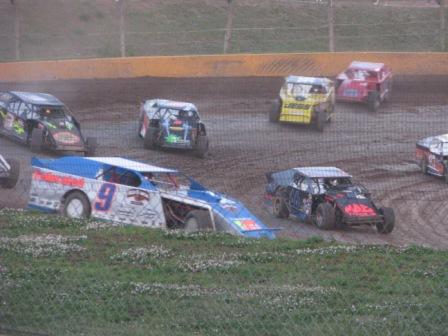
    Ceder Lake 3M NASCAR at dirt track - Photo (C) 2008 Karen Schulz all rights reserved

    Ceder Lake dirt track 3M NASCAR night (Photo (C) 2008 Karen Schulz)

    NASCAR is also involved with vehicles that dont or at least should not fly, however they do go round and round on a track, often paved however sometimes mud or dirt tracks plus high tech exists with computers and various data models, not to mention the NASCAR air force.

    In addition to being involved with round objects and activities, all three are also involved in computing, generating, processing, storing and retrieving for analysis of data, not to mention high performance requirements.

    NAS based storage can also be relied upon for serving the needs of NASA and NASCAR data and informational needs.

    And FWIW, just for fun, look at what you get when you spell NAS, NASA or NASCAR backwards:

    RACSAN
    ASAN
    SAN

    Where To Learn More

    View additional NAS, NVMe, SSD, NVM, SCM, Data Infrastructure and HDD related topics via the following links.

    Additional learning experiences along with common questions (and answers), as well as tips can be found in Software Defined Data Infrastructure Essentials book.

    Software Defined Data Infrastructure Essentials Book SDDC

    What This All Means

    Not much actually other than to stimulate some thought, discussion as well as perhaps have some fun with technology during the holiday season.

    Im sure if I put some more thought to it, more similarities would or will come to mind.

    However, for now, thats it for a quick thought, what similarities do you see or know about with NAS, NASA and NASCAR?

    Ok, nuf fun for now, time to work on some other posts, content and projects.

    Ok, nuff said, for now.

    Gs

    Greg Schulz – Microsoft MVP Cloud and Data Center Management, VMware vExpert 2010-2017 (vSAN and vCloud). Author of Software Defined Data Infrastructure Essentials (CRC Press), as well as Cloud and Virtual Data Storage Networking (CRC Press), The Green and Virtual Data Center (CRC Press), Resilient Storage Networks (Elsevier) and twitter @storageio. Courteous comments are welcome for consideration. First published on https://storageioblog.com any reproduction in whole, in part, with changes to content, without source attribution under title or without permission is forbidden.

    All Comments, (C) and (TM) belong to their owners/posters, Other content (C) Copyright 2006-2026 Server StorageIO and UnlimitedIO. All Rights Reserved. StorageIO is a registered Trade Mark (TM) of Server StorageIO.

    EMC Storage and Management Software Getting FAST

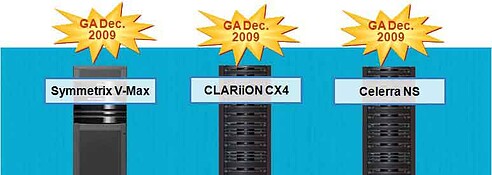
    EMC has announced the availability of the first phase of FAST (Fully Automated Storage Tiering) functionality for their Symmetrix VMAX, CLARiiON and Celerra storage systems.

    FAST was first previewed earlier this year (see here and here).

    Key themes of FAST are to leverage policies for enabling automation to support large scale environments, doing more with what you have along with enabling virtual data centers for traditional, private and public clouds as well as enhancing IT economics.

    This means enabling performance and capacity planning analysis along with facilitating load balancing or other infrastructure optimization activities to boost productivity, efficiency and resource usage effectiveness not to mention enabling Green IT.

    Is FAST revolutionary? That will depend on who you talk or listen to.

    Some vendors will jump up and down similar to donkey in shrek wanting to be picked or noticed claiming to have been the first to implement LUN or file movement inside of storage systems, or, as operating system or file system or volume manager built in. Others will claim to have done it via third party information lifecycle management (ILM) software including hierarchal storage management (HSM) tools among others. Ok, fair enough, than let their games begin (or continue) and I will leave it up to the variou vendors and their followings to debate whos got what or not.

    BTW, anyone remember system manage storage on IBM mainframes or array based movement in HP AutoRAID among others?

    Vendors have also in the past provided built in or third party add on tools for providing insight and awareness ranging from capacity or space usage and allocation storage resource management (SRM) tools, performance advisory activity monitors or charge back among others. For example, hot files analysis and reporting tool have been popular in the past, often operating system specific for identifying candidate files for placement on SSD or other fast storage. Granted the tools provided insight and awareness, there was still the time and error prone task of decision making and subsequently data movement, not to mention associated down time.

    What is new here with FAST is the integrated approach, tools that are operating system independent, functionality in the array, available for different product family and price bands as well as that are optimized for improving user and IT productivity in medium to high-end enterprise scale environments.

    One of the knocks on previous technology is either the performance impact to an application when data was moved, or, impact to other applications when data is being moved in the background. Another issue has been avoiding excessive thrashing due to data being moved at the expense of taking performance cycles from production applications. This would also be similar to having too many snapshots or raid rebuild that are not optimized running in the background on a storage system lacking sufficient performance capability. Another knock has been that historically, either 3rd party host or appliance based software was needed, or, solutions were designed and targeted for workgroup, departmental or small environments.

    What is FAST and how is it implemented
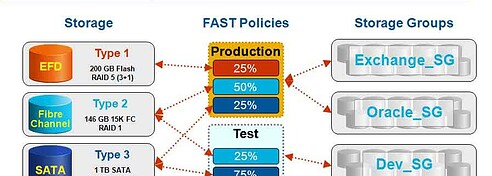
    FAST is technology for moving data within storage systems (and external for Celerra) for load balancing, capacity and performance optimization to meet quality of service (QoS) performance, availability, capacity along with energy and economic initiatives (figure1) across different tiers or types of storage devices. For example, moving data from slower SATA disks where a performance bottleneck exists to faster Fibre Channel or SSD devices. Similarly, cold or infrequently data on faster more expensive storage devices can be marked as candidates for migration to lower cost SATA devices based on customer policies.

    EMC FAST
    Figure 1 FAST big picture Source EMC

    The premise is that policies are defined based on activity along with capacity to determine when data becomes a candidate for movement. All movement is performed in the background concurrently while applications are accessing data without disruptions. This means that there are no stub files or application pause or timeouts that occur or erratic I/O activity while data is being migrated. Another aspect of FAST data movement which is performed in the actual storage systems by their respective controllers is the ability for EMC management tools to identify hot or active LUNs or volumes (files in the case of Celerra) as candidates for moving (figure 2).

    EMC FAST
    Figure 2 FAST what it does Source EMC

    However, users specify if they want data moved on its own or under supervision enabling a deterministic environment where the storage system and associated management tools makes recommendations and suggestions for administrators to approve before migration occurs. This capacity can be a safeguard as well as a learn mode enabling organizations to become comfortable with the technology along with its recommendations while applying knowledge of current business dynamics (figure 3).

    EMC FAST
    Figure 3 The Value proposition of FAST Source EMC

    FAST is implemented as technology resident or embedded in the EMC VMAX (aka Symmetrix), CLARiiON and Cellera along with external management software tools. In the case of the block (figure 4) storage systems including DMX/VMAX and CLARiiON family of products that support FAST, data movement is on a LUN or volume basis and within a single storage system. For NAS or file based Cellera storage systems, FAST is implanted using FMA technology enabling either in the box or externally to other storage systems on a file basis.

    EMC FAST
    Figure 4 Example of FAST activity Source EMC

    What this means is that data at the LUN or volume level can be moved across different tiers of storage or disk drives within a CLARiiON instance, or, within a VMAX instance (e.g. amongst the nodes). For example, Virtual LUNs are a building block that is leveraged for data movement and migration combined with external management tools including Navisphere for the CLARiiON and Symmetrix management console along with Ionix all of which has been enhanced.

    Note however that initially data is not moved externally between different CLARiiONs or VMAX systems. For external data movement, other existing EMC tools would be deployed. In the case of Celerra, files can be moved within a specific CLARiiON as well as externally across other storage systems. External storage systems that files can be moved across using EMC FMA technology includes other Celleras, Centera and ATMOS solutions based upon defined policies.

    What do I like most and why?

    Integration of management tools providing insight with ability for user to setup polices as well as approve or intercede with data movement and placement as their specific philosophies dictate. This is key, for those who want to, let the system manage it self with your supervision of course. For those who prefer to take their time, then take simple steps by using the solution for initially providing insight into hot or cold spots and then helping to make decisions on what changes to make. Use the solution and adapt it to your specific environment and philosophy approach, what a concept, a tool that works for you, vs you working for it.

    What dont I like and why?

    There is and will remain some confusion about intra and inter box or system data movement and migration, operations that can be done by other EMC technology today for those who need it. For example I have had questions asking if FAST is nothing more than EMC Invista or some other data mover appliance sitting in front of Symmetrix or CLARiiONs and the answer is NO. Thus EMC will need to articulate that FAST is both an umbrella term as well as a product feature set combining the storage system along with associated management tools unique to each of the different storage systems. In addition, there will be confusion at least with GA of lack of support for Symmetrix DMX vs supported VMAX. Of course with EMC pricing is always a question so lets see how this plays out in the market with customer acceptance.

    What about the others?

    Certainly some will jump up and down claiming ratification of their visions welcoming EMC to the game while forgetting that there were others before them. However, it can also be said that EMC like others who have had LUN and volume movement or cloning capabilities for large scale solutions are taking the next step. Thus I would expect other vendors to continue movement in the same direction with their own unique spin and approach. For others who have in the past made automated tiering their marketing differentiation, I would suggest they come up with some new spins and stories as those functions are about to become table stakes or common feature functionality on a go forward basis.

    When and where to use?

    In theory, anyone with a Symmetrix/VMAX, CLARiiON or Celerra that supports the new functionality should be a candidate for the capabilities, that is, at least the insight, analysis, monitoring and situation awareness capabilities Note that does not mean actually enabling the automated movement initially.

    While the concept is to enable automated system managed storage (Hmmm, Mainframe DejaVu anyone), for those who want to walk before they run, enabling the insight and awareness capabilities can provide valuable information about how resources are being used. The next step would then to look at the recommendations of the tools, and if you concur with the recommendations, then take remedial action by telling the system when the movement can occur at your desired time.

    For those ready to run, then let it rip and take off as FAST as you want. In either situation, look at FAST for providing insight and situational awareness of hot and cold storage, where opportunities exist for optimizing and gaining efficiency in how resources are used, all important aspects for enabling a Green and Virtual Data Center not to mention as well as supporting public and private clouds.

    FYI, FTC Disclosure and FWIW

    I have done content related projects for EMC in the past (see here), they are not currently a client nor have they sponsored, underwritten, influenced, renumerated, utilize third party off shore swiss, cayman or south american unnumbered bank accounts, or provided any other reimbursement for this post, however I did personally sign and hand to Joe Tucci a copy of my book The Green and Virtual Data Center (CRC) ;).

    Bottom line

    Do I like what EMC is doing with FAST and this approach? Yes.

    Do I think there is room for improvement and additional enhancements? Absolutely!

    Whats my recommendation? Have a look, do your homework, due diligence and see if its applicable to your environment while asking others vendors what they will be doing (under NDA if needed).

    Ok, nuff said.

    Cheers gs

    Greg Schulz – Author Cloud and Virtual Data Storage Networking (CRC Press), The Green and Virtual Data Center (CRC Press) and Resilient Storage Networks (Elsevier)
    twitter @storageio

    All Comments, (C) and (TM) belong to their owners/posters, Other content (C) Copyright 2006-2026 Server StorageIO and UnlimitedIO LLC All Rights Reserved

    SSD and Storage System Performance

    Jacob Gsoedl has a new article over at SearchStorage titled How to add solidstate storage to your enterprise data storage systems.

    In his article which includes some commentary by me, Jacob lays out various options on where and how to deploy solid state devices (SSD) in and with enterprise storage systems.

    While many vendors have jumped on the latest SSD bandwagon adding flash based devices to storage systems, where and how they implement the technologies varies.

    Some vendors take a simplistic approach of qualify flash SSD devices for attachment to their storage controllers similar to how any other Fibre Channel, SAS or SATA hard disk drive (HDD) would be.

    Yet others take a more in depth approach including optimizing controller software, firmware or micro code to leverage flash SSD devices along with addressing wear leveling, read and write performance among other capabilities.

    Performance is another area where on paper a flash SSD device might appear to be fast and enable a storage system to be faster.

    However, systems that are not optimized for higher throughput and or increased IOPs needing lower latency may end up placing restrictions on the number of flash SSD devices or other configuration constraints. Even worse is when expected performance improvements are not realized as after all, fast controllers need fast devices, and fast devices need fast controllers.

    RAM and flash based SSD are great enabling technologies for boosting performance, productivity and enabling a green efficient environment however do your homework.

    Look at how various vendors implement and support SSD particularly flash based products with enhancements to storage controllers for optimal performance.

    Likewise check out the activity of  the SNIA Solid State Storage Initiative (SSSI) among other industry trade group or vendor initiatives around enhancing along with best practices for SSD.

    Ok, nuff said.

    Cheers gs

    Greg Schulz – Author Cloud and Virtual Data Storage Networking (CRC Press), The Green and Virtual Data Center (CRC Press) and Resilient Storage Networks (Elsevier)
    twitter @storageio

    All Comments, (C) and (TM) belong to their owners/posters, Other content (C) Copyright 2006-2026 Server StorageIO and UnlimitedIO LLC All Rights Reserved

    StorageIO debuts at 79 in Technobabble top 400 analyst list

    Following on the heals of being named one of three EcoTech warriors earlier in the year, and then number 5 in the top ten independent bloggers at StorageMonkeys earlier this year (plus appearing on InfoSmack), the momentum continues more recently being named as the 23rd out of the top 30 influential virtualization bloggers.

    If that were not enough, I was also surprised to learn recently that I have also made a debut appearance at number 79 in the Technobabble top 400 analyst and independent blogger lists as well.

    To say that Im honored and flattered would be an understatement and I thank all of the growing number of readers and commenters to the various blogs, twitter tweets along with other content at the different venues and events Im involved with.

    Thanks to all of you and have a safe happy holiday season along with a prosperous new years, look forward to future conversations and discussions.

    Cheers gs

    Greg Schulz – Author Cloud and Virtual Data Storage Networking (CRC Press, 2011), The Green and Virtual Data Center (CRC Press, 2009), and Resilient Storage Networks (Elsevier, 2004)

    twitter @storageio

    All Comments, (C) and (TM) belong to their owners/posters, Other content (C) Copyright 2006-2012 StorageIO and UnlimitedIO All Rights Reserved
    How to win approval for upgrades: Link them to business benefits

    Drew Rob has another good article over at Processor.com about various tips and strategies on how to gain approval for hardware (or software) purchases with some comments by yours truly.

    My tips and advice that are quoted in the story include to link technology resources to business needs impact which may be common sense, however still a time tested effective technique.

    Instead of speaking tech talk such as Performance, capacity, availability, IOPS, bandwidth, GHz, frames or packets per second, VMs to PM or dedupe ratio, map them to business speak, that is things that finance, accountants, MBAs or other management personal understand.

    For example, how many transactions at a given response time can be supported by a given type of server, storage or networking device.

    Or, put a different way, with a given device, how much work can be done and what is the associated monetary or business benefit.

    Likewise, if you do not have a capacity plan for servers, storage, I/O and networking along with software and facilities covering performance, availability, capacity and energy demands now is the time to put one in place.

    More on capacity and performance planning later, however for now, if you want to learn more, check Chapter 10 (Performance and Capacity Planning) in my book Resilient Storage Networks: Designing Flexible and Scalable Data Infrastructure: Elsevier).

    Ok, nuff said.

    Cheers gs

    Greg Schulz – Author Cloud and Virtual Data Storage Networking (CRC Press), The Green and Virtual Data Center (CRC Press) and Resilient Storage Networks (Elsevier)
    twitter @storageio

    All Comments, (C) and (TM) belong to their owners/posters, Other content (C) Copyright 2006-2026 Server StorageIO and UnlimitedIO LLC All Rights Reserved

    Justifying Green IT and Home Hardware Upgrades with EnergyStar

    Energy Star

    Have you seen the TV commercials or print advertisements where an energy star washer is mentioned as so efficient that the savings from reduced power consumption are enough to pay for the dryer? If not, check out the EPA Energy Star website for information about various programs, savings and efficiency options to learn more

    What does this have to do with servers, storage, networking, data centers or other IT equipment?

    Simple, if you are not aware, Energy Star for Servers now exits and is being enhanced while good progress is being made on the Energy Star for storage program.

    The Energy Star for household appliances has been around a bit longer and more refined, something that I anticipated the server and storage programs to follow-suit with over time.

    What really caught my eye with the commercial is the focus on closing the green gap, that is instead of the green environmental impact savings of an appliance that uses less power and subsequent carbon footprint benefits, the message is to the economic hot button. That is, switch to more energy efficient technology that allows more work to done at a lower overall cost and the savings can help self fund the enhancements.

    For example, a more energy efficient server that can do more work or GHz per watt of energy when needed, or, to go into lower power modes (intelligent power management: IPM). Low power modes do not necessarily mean turning completely off, rather, drawing less energy and subsequently lower cooling demands during slow periods such as with new Intel Nehalem and other processors.

    From a disk storage perspective, energy efficiency is often thought to be avoidance or turning disk drives off boosting capacity and squeezing data footprints.

    However energy efficiency and savings can also be achieved by slowing a disk drive down or turning of some of the electronics to reduce energy consumption and heat generation.

    Other forms of energy savings include thin provisioning and deduplication however another form of energy efficiency for storage is boosting performance. That is, doing more work per watt of energy for active or time sensitive applications or usage scenarios.

    Thus there is another Green IT, one that provides both economic and environmental benefits!

    Here are some related links:

    Saving Money with Green IT: Time To Invest In Information Factories

    EPA Energy Star for Data Center Storage Update

    Green Storage is Alive and Well: ENERGY STAR Enterprise Storage Stakeholder Meeting Details

    Shifting from energy avoidance to energy efficiency

    U.S. EPA Energy Star for Server Update

    U.S. EPA Looking for Industry Input on Energy Star for Storage

    Update: EnergyStar for Server Workshop

    US EPA EnergyStar for Servers Wants To Hear From YOU!

    Optimize Data Storage for Performance and Capacity Efficiency

    Ok, nuff said.

    Cheers gs

    Greg Schulz – Author Cloud and Virtual Data Storage Networking (CRC Press), The Green and Virtual Data Center (CRC Press) and Resilient Storage Networks (Elsevier)
    twitter @storageio

    All Comments, (C) and (TM) belong to their owners/posters, Other content (C) Copyright 2006-2026 Server StorageIO and UnlimitedIO LLC All Rights Reserved

    Did HP respond to EMC and Cisco VCE with Microsoft HyperV bundle?

    Last week EMC and Cisco along with Intel and VMware created the VCE collation along with a consumption model based service joint venture called Acadia.

    In other activity last week, HP made several announcements including:

    • Improvements in sensing technologies
    • StorageWorks enhancements (SVSP, IBRIX, EVA and HyperV, X9000 and others)

    EMC and Cisco were relatively quiet this week on announcement front, however HP unleashed another round of announcements that among others included:

    • Quarterly financial results
    • SMB server, storage, network and virtualization enhancements (here, here, here and here)
    • Acquisitions of 3COM (see related blog post here)

    The reason I bring up all of this HP activity is not to simply re-cap all of the news and announcements which you can find on many other blogs or news sites, rather I see as a trend.

    That trend appears to be one of a company on the move, not ready to sit back on its laurels, rather a company that continues to innovate in-house and via acquisitions.

    Some of those acquisitions including IBRIX were relatively small, some like EDS last year and the one this week of 3COM to some would be large while to others perhaps as being seen as medium sized. Either way, HP has been busy expanding its portfolio of technology solution and services offerings along with its comprehensive IT stack.

    Cisco, EMC and HP are examples of companies looking to expand their IT stacks and footprint in terms of diversifying current product focus and reach, along with extending into new or further into existing customer and market sector areas. Last weeks EMC and Cisco signaled two large players combing their resources to make virtualization and private clouds easy to acquire and deploy for mid to large size environments with a theme around VMware.

    This week buried in all of the HP announcements was one that caught my eye which is a virtualization solution bundle designed for small business (that is something smaller than a vblock0), something that was missing in the Cisco and EMC news of last week however one that Im sure will be addressed sooner versus later.

    In the case of HP, the other thing with their virtualization bundle was the focus on the mid to small business that fall into the broad and diverse SMB category, not to mention including Microsoft.

    Yes, that is right, while a VMware based solution from HP would be a no-brainer given all of the activity the two companies are involved  in as joint partners, Microsoft HyperV was front and center.

    Is this a reaction to last weeks Cisco and EMC salvo?

    Perhaps and some will jump to that conclusion. However I will also offer this alternative scenario, 85-90 percent of servers consolidated into virtual machines (VMs) on VMware or other hypervisors including Microsoft HyperV are Windows based.

    Likewise as one of the largest if not largest server vendors (pick your favorite server category or price band) who also happens to be one of the largest Microsoft Windows partners, I would have been more surprised if HP had not done a HyperV bundle.

    While Cisco and EMC may stay the course or at least talk the talk with a VMware affinity in the Acadia and VCE coalition for the time being, I would expect HP to flex its wings a bit and show diversity of support for multiple Hypervisors, Operating Systems across its various server, network, storage and services platforms.

    I would not be surprised to see some VMware based bundles appear over time building on previous announced HP blade systems matrix solution bundles.

    Welcome back my friends to the show that never ends, that is the on-going server, storage, networking, virtualization, hardware, software and services solutions game for enabling the adaptive, dynamic, flexible, scalable, resilient, service oriented, public or private cloud, infrastructure as a service green and virtual data center.

    Stay tuned, there is much more to come!

    Ok, nuff said.

    Cheers gs

    Greg Schulz – Author Cloud and Virtual Data Storage Networking (CRC Press, 2011), The Green and Virtual Data Center (CRC Press, 2009), and Resilient Storage Networks (Elsevier, 2004)

    twitter @storageio

    All Comments, (C) and (TM) belong to their owners/posters, Other content (C) Copyright 2006-2012 StorageIO and UnlimitedIO All Rights Reserved

    Acadia VCE: VMware + Cisco + EMC = Virtual Computing Environment

    Was today the day the music died? (click here or here if you are not familar with the expression)

    Add another three letter acronym (TLA) to your IT vocabulary if you are involved with server, storage, networking, virtualization, security and related infrastructure resource management (IRM) topics.

    That new TLA is Virtual Computing Environment (VCE), a coalition formed by EMC and Cisco along with partner Intel called Acadia that was announced today. Of course, EMC who also happens to own VMware for virtualization and RSA for security software tools bring those to the coalition (read press release here).

    For some quick fun, twittervile and the blogosphere have come up with other meanings such as:

    VCE = Virtualization Communications Endpoint
    VCE = VMware Cisco EMC
    VCE = Very Cash Efficient
    VCE = VMware Controls Everything
    VCE = Virtualization Causes Enthusiasm
    VCE = VMware Cisco Exclusive

    Ok, so much for some fun, at least for now.

    With Cisco, EMC and VMware announcing their new VCE coalition, has this signaled the end of servers, storage, networking, hardware and software for physical, virtual and clouding computing as we know it?

    Does this mean all other vendors not in this announcement should pack it up, game over and go home?

    The answer in my perspective is NO!

    No, the music did not end today!

    NO, servers, storage and networking for virtual or cloud environments has not ended.

    Also, NO, other vendors do not have to go home today, the game is not over!

    However a new game is on, one that some have seen before, for others it is something new, exciting perhaps revolutionary or an industry first.

    What was announced?
    Figure 1 shows a general vision or positioning from the three major players involved along with four tenants or topic areas of focus. Here is a link to a press release where you can read more.

    CiscoVirtualizationCoalition.png
    Figure 1: Source: Cisco, EMC, VMware

    General points include:

    • A new coalition (e.g. VCE) focused on virtual compute for cloud and non cloud environments
    • A new company Acadia owned by EMC and Cisco (1/3 each) along with Intel and VMware
    • A new go to market pre-sales, service and support cross technology domain skill set team
    • Solution bundles or vblocks with technology from Cisco, EMC, Intel and VMware

    What are the vblocks and components?
    Pre-configured (see this link for a 3D model), tested, and supported with a single throat to choke model for streamlined end to end management and acquisition. There are three vblocks or virtual building blocks that include server, storage, I/O networking, and virtualization hypervisor software along with associated IRM software tools.

    Cisco is bringing to the game their Unified Compute Solution (UCS) server along with Nexus 1000v and Multilayer Director (MDS) switches, EMC is bringing storage (Symmetrix VMax, CLARiiON and unified storage) along with their RSA security and Ionix IRM tools. VMware is providing their vSphere hypervisors running on Intel based services (via Cisco).

    The components include:

    • EMC Ionix management tools and framework – The IRM tools
    • EMC RSA security framework software – The security tools
    • EMC VMware vSphere hypervisor virtualization software – The virtualization layer
    • EMC VMax, CLARiiON and unified storage systems – The storage
    • Cisco Nexus 1000v and MDS switches – The Network and connectivity
    • Cisco Unified Compute Solution (UCS) – The physical servers
    • Services and support – Cross technology domain presales, delivery and professional services

    CiscoEMCVMwarevblock.jpg
    Figure 2: Source: Cisco vblock (Server, Storage, Networking and Virtualization Software) via Cisco

    The three vblock models are:
    Vblock0: entry level system due out in 2010 supporting 300 to 800 VMs for initial customer consolidation, private clouds or other diverse applications in small or medium sized business. You can think of this as a SAN in a CAN or Data Center in a box with Cisco UCS and Nexus 1000v, EMC unified storage secured by RSA and VMware vSphere.

    Vblock1: mid sized building block supporting 800 to 3000 VMs for consolidation and other optimization initiatives using Cisco UCS, Nexus and MDS switches along with EMC CLARiiON storage secured with RSA software hosting VMware hypervisors.

    Vblock2 high end supporting up 3000 to 6000 VMs for large scale data center transformation or new virtualization efforts combing Cisco Unified Computing System (UCS), Nexus 1000v and MDS switches and EMC VMax Symmetix storage with RSA security software hosting VMware vSpshere hypervisor.

    What does this all mean?
    With this move, for some it will add fuel to the campfire that Cisco is moving closer to EMC and or VMware with a pre-nuptial via Acadia. For others, this will be seen as fragmentation for virtualization particularly if other vendors such as Dell, Fujitsu, HP, IBM and Microsoft among others are kept out of the game, not to mention their channels of vars or IT customers barriers.

    Acadia is a new company or more precisely, a joint venture being created by major backers EMC and Cisco with minority backers being VMware and Intel.

    Like any other joint ventures, for examples those commonly seen in the airline industry (e.g. transportation utility) where carriers pool resources such as SkyTeam whose members include Delta who had a JV with Airframe owner of KLM who had a antitrust immunity JV with northwest (now being digested by Delta).

    These joint ventures can range from simple marketing alliances like you see with EMC programs such as their Select program to more formal OEM to ownership as is the case with VMware and RSA to this new model for Acadia.

    An airline analogy may not be the most appropriate, yet there are some interesting similarities, least of which that air carriers rely on information systems and technologies provided by members of this collation among others. There is also a correlation in that joint ventures are about streamlining and creating a seamless end to end customer experience. That is, give them enough choice and options, keep them happy, take out the complexities and hopefully some cost, and with customer control come revenue and margin or profits.

    Certainly there are opportunities to streamline and not just simply cut corners, perhaps that’s another area or analogy with the airlines where there is a current focus on cutting, nickel and dimming for services. Hopefully the Acadia and VCE are not just another example of vendors getting together around the campfire to sing Kumbaya in the name of increasing customer adoption, cost cutting or putting a marketing spin on how to sell more to customers for account control.

    Now with all due respect to the individual companies and personal, at least in this iteration, it is not as much about the technology or packaging. Likewise, while important, it is also not just about bundling, integration and testing (they are important) as we have seen similar solutions before.

    Rather, I think this has the potential for changing the way server, storage and networking hardware along with IRM and virtualization software are sold into organizations, for the better or worse.

    What Im watching is how Acadia and their principal backers can navigate the channel maze and ultimately the customer maze to sell a cross technology domain solution. For example, will a sales call require six to fourteen legs (e.g. one person is a two legged call for those not up on sales or vendor lingo) with a storage, server, networking, VMware, RSA, Ionix and services representative?

    Or, can a model to drive down the number of people or product specialist involved in a given sales call be achieved leveraging people with cross technology domain skills (e.g. someone who can speak server and storage hardware and software along with networking)?

    Assuming Acadia and VCE vblocks address product integration issues, I see the bigger issue as being streamlining the sales process (including compensation plans) along with how partners are dealt with not to mention customers.

    How will the sales pitch be to the Cisco network people at VARs or customer sites, or too the storage or server or VMware teams, or, all of the above?

    What about the others?
    Cisco has relationships with Dell, HP, IBM, Microsoft and Oracle/Sun among others that they will be stepping even more on the partner toes than when they launched the UCS earlier this year. EMC for its part if fairly diversified and is not as subservient to IBM however has a history of partnering with Dell, Oracle and Microsoft among others.

    VMware has a smaller investment and thus more in the wings as is Intel given that both have large partnership with Dell, HP, IBM and Microsoft. Microsoft is of interest here because on one front the bulk of all servers virtualized into VMware VMs are Windows based.

    On the other hand, Microsoft has their own virtualization hypervisor HyperV that depending upon how you look at it, could be a competitor of VMware or simply a nuisance. Im of the mindset that its still to early and don’t judge this game on the first round which VMware has won. Keep in mind the history such as desktop and browser wars that Microsoft lost in the first round only to come back strong later. This move could very well invigorate Microsoft, or perhaps Oracle, Citrix among others.

    Now this is far from the first time that we have seen alliances, coalitions, marketing or sales promotion cross technology vendor clubs in the industry let alone from the specific vendors involved in this announcement.

    One that comes to mind was 3COMs failed attempt in the late 90s to become the first traditional networking vendor to get into SANs, that was many years before Cisco could spell SAN let alone their Andiamo startup incubated. The 3COM initiative which was cancelled due to financial issues literally on the eve of rollout was to include the likes of STK (pre-sun), Qlogic, Anchor (People were still learning how to spell Brocade), Crossroads (FC to SCSI routers for tape), Legato (pre-EMC), DG CLARiiON (Pre-EMC), MTI (sold their patents to EMC, became a reseller, now defunct) along with some others slated to jump on the bandwagon.

    Lets also not forget that while among the traditional networking market vendors Cisco is the $32B giant and all of the others including 3Com, Brocade, Broadcom, Ciena, Emulex, Juniper and Qlogic are the seven plus dwarfs. However, keep the $23B USD Huawei networking vendor that is growing at a 45% annual rate in mind.

    I would keep an eye on AMD, Brocade, Citrix, Dell, Fujitsu, HP, Huawei, Juniper, Microsoft, NetApp, Oracle/Sun, Rackable and Symantec among many others for similar joint venture or marketing alliances.

    Some of these have already surfaced with Brocade and Oracle sharing hugs and chugs (another sales term referring to alliance meetings over beers or shots).

    Also keep in mind that VMware has a large software (customer business) footprint deployed on HP with Intel (and AMD) servers.

    Oh, and those VMware based VMs running on HP servers also just happen to be hosting in their neighbor of 80% or more Windows based guests operating systems, I would say its game on time.

    When I say its game on time, I dont think VMware is brash enough to cut HP (or others) off forcing them to move to Microsoft for virtualization. However the game is about control, control of technology stacks and partnerships, control of vars, integrators and the channel, as well as control of customers.

    If you cannot tell, I find this topic fun and interesting.

    For those who only know me from servers they often ask when did I learn about networking to which I say check out one of my books (Resilient Storage Networks-Elsevier). Meanwhile for others who know me from storage I get asked when did I learn about or get into servers to which I respond about 28 years ago when I worked in IT as the customer.

    Bottom line on Acadia, vblocks and VCE for now, I like the idea of a unified and bundled solution as long as they are open and flexible.

    On the other hand, I have many questions and even skeptical in some areas including of how this plays out for Cisco and EMC in terms of if it can be a unifier or polarized causing market fragmentation.

    For some this is or will be dejavu, back to the future, while for others it is a new, exciting and revolutionary approach while for others it will be new fodder for smack talk!

    More to follow soon.

    Cheers gs

    Greg Schulz – Author Cloud and Virtual Data Storage Networking (CRC Press, 2011), The Green and Virtual Data Center (CRC Press, 2009), and Resilient Storage Networks (Elsevier, 2004)

    twitter @storageio

    All Comments, (C) and (TM) belong to their owners/posters, Other content (C) Copyright 2006-2012 StorageIO and UnlimitedIO All Rights Reserved

    Saving Money with Green IT: Time To Invest In Information Factories

    There is a good and timely article titled Green IT Can Save Money, Too over at Business Week that has a familiar topic and theme for those who read this blog or other content, articles, reports, books, white papers, videos, podcasts or in-person speaking and keynote sessions that I have done..

    I posted a short version of this over there, here is the full version that would not fit in their comment section.

    Short of calling it Green IT 2.0 or the perfect storm, there is a resurgence and more importantly IMHO a growing awareness of the many facets of Green IT along with Green in general having an economic business sustainability aspect.

    While the Green Gap and confusion still exists, that is, the difference between what people think or perceive and actual opportunities or issues; with growing awareness, it will close or at least narrow. For example, when I regularly talk with IT professionals from various sized, different focused industries across the globe in diverse geographies and ask them about having to go green, the response is in the 7-15% range (these are changing) with most believing that Green is only about carbon footprint.

    On the other hand, when I ask them if they have power, cooling, floor space or other footprint constraints including frozen or reduced budgets, recycling along with ewaste disposition or RoHS requirements, not to mention sustaining business growth without negatively impacting quality of service or customer experience, the response jumps up to 65-75% (these are changing) if not higher.

    That is the essence of the green gap or disconnect!

    Granted carbon dioxide or CO2 reduction is important along with NO2, water vapors and other related issues, however there is also the need to do more with what is available, stretch resources and footprints do be more productive in a shrinking footprint. Keep in mind that there is no such thing as an information, data or processing recession with all indicators pointing towards the need to move, manage and store larger amounts of data on a go forward basis. Thus, the need to do more in a given footprint or constraint, maximizing resources, energy, productivity and available budgets.

    Innovation is the ability to do more with less at a lower cost without compromise on quality of service or negatively impacting customer experience. Regardless of if you are a manufacturer, or a service provider including in IT, by innovating with a diverse Green IT focus to become more efficient and optimized, the result is that your customers become more enabled and competitive.

    By shifting from an avoidance model where cost cutting or containment are the near-term tactical focus to an efficiency and productivity model via optimization, net unit costs should be lowered while overall service experience increase in a positive manner. This means treating IT as an information factory, one that needs investment in the people, processes and technologies (hardware, software, services) along with management metric indicator tools.

    The net result is that environmental or perceived Green issues are addressed and self-funded via the investment in Green IT technology that boosts productivity (e.g. closing or narrowing the Green Gap). Thus, the environmental concerns that organizations have or need to address for different reasons yet that lack funding get addressed via funding to boost business productivity which have tangible ROI characteristics similar to other lean manufacturing approaches.

    Here are some additional links to learn more about these and other related themes:

    Have a read over at Business Week about how Green IT Can Save Money, Too while thinking about how investing in IT infrastructure productivity (Information Factories) by becoming more efficient and optimized helps the business top and bottom line, not to mention the environment as well.

    Ok, nuff said.

    Cheers gs

    Greg Schulz – Author Cloud and Virtual Data Storage Networking (CRC Press), The Green and Virtual Data Center (CRC Press) and Resilient Storage Networks (Elsevier)
    twitter @storageio

    All Comments, (C) and (TM) belong to their owners/posters, Other content (C) Copyright 2006-2026 Server StorageIO and UnlimitedIO LLC All Rights Reserved