Acadia VCE: VMware + Cisco + EMC = Virtual Computing Environment

Was today the day the music died? (click here or here if you are not familar with the expression)

Add another three letter acronym (TLA) to your IT vocabulary if you are involved with server, storage, networking, virtualization, security and related infrastructure resource management (IRM) topics.

That new TLA is Virtual Computing Environment (VCE), a coalition formed by EMC and Cisco along with partner Intel called Acadia that was announced today. Of course, EMC who also happens to own VMware for virtualization and RSA for security software tools bring those to the coalition (read press release here).

For some quick fun, twittervile and the blogosphere have come up with other meanings such as:

VCE = Virtualization Communications Endpoint
VCE = VMware Cisco EMC
VCE = Very Cash Efficient
VCE = VMware Controls Everything
VCE = Virtualization Causes Enthusiasm
VCE = VMware Cisco Exclusive

Ok, so much for some fun, at least for now.

With Cisco, EMC and VMware announcing their new VCE coalition, has this signaled the end of servers, storage, networking, hardware and software for physical, virtual and clouding computing as we know it?

Does this mean all other vendors not in this announcement should pack it up, game over and go home?

The answer in my perspective is NO!

No, the music did not end today!

NO, servers, storage and networking for virtual or cloud environments has not ended.

Also, NO, other vendors do not have to go home today, the game is not over!

However a new game is on, one that some have seen before, for others it is something new, exciting perhaps revolutionary or an industry first.

What was announced?
Figure 1 shows a general vision or positioning from the three major players involved along with four tenants or topic areas of focus. Here is a link to a press release where you can read more.

CiscoVirtualizationCoalition.png
Figure 1: Source: Cisco, EMC, VMware

General points include:

  • A new coalition (e.g. VCE) focused on virtual compute for cloud and non cloud environments
  • A new company Acadia owned by EMC and Cisco (1/3 each) along with Intel and VMware
  • A new go to market pre-sales, service and support cross technology domain skill set team
  • Solution bundles or vblocks with technology from Cisco, EMC, Intel and VMware

What are the vblocks and components?
Pre-configured (see this link for a 3D model), tested, and supported with a single throat to choke model for streamlined end to end management and acquisition. There are three vblocks or virtual building blocks that include server, storage, I/O networking, and virtualization hypervisor software along with associated IRM software tools.

Cisco is bringing to the game their Unified Compute Solution (UCS) server along with Nexus 1000v and Multilayer Director (MDS) switches, EMC is bringing storage (Symmetrix VMax, CLARiiON and unified storage) along with their RSA security and Ionix IRM tools. VMware is providing their vSphere hypervisors running on Intel based services (via Cisco).

The components include:

  • EMC Ionix management tools and framework – The IRM tools
  • EMC RSA security framework software – The security tools
  • EMC VMware vSphere hypervisor virtualization software – The virtualization layer
  • EMC VMax, CLARiiON and unified storage systems – The storage
  • Cisco Nexus 1000v and MDS switches – The Network and connectivity
  • Cisco Unified Compute Solution (UCS) – The physical servers
  • Services and support – Cross technology domain presales, delivery and professional services

CiscoEMCVMwarevblock.jpg
Figure 2: Source: Cisco vblock (Server, Storage, Networking and Virtualization Software) via Cisco

The three vblock models are:
Vblock0: entry level system due out in 2010 supporting 300 to 800 VMs for initial customer consolidation, private clouds or other diverse applications in small or medium sized business. You can think of this as a SAN in a CAN or Data Center in a box with Cisco UCS and Nexus 1000v, EMC unified storage secured by RSA and VMware vSphere.

Vblock1: mid sized building block supporting 800 to 3000 VMs for consolidation and other optimization initiatives using Cisco UCS, Nexus and MDS switches along with EMC CLARiiON storage secured with RSA software hosting VMware hypervisors.

Vblock2 high end supporting up 3000 to 6000 VMs for large scale data center transformation or new virtualization efforts combing Cisco Unified Computing System (UCS), Nexus 1000v and MDS switches and EMC VMax Symmetix storage with RSA security software hosting VMware vSpshere hypervisor.

What does this all mean?
With this move, for some it will add fuel to the campfire that Cisco is moving closer to EMC and or VMware with a pre-nuptial via Acadia. For others, this will be seen as fragmentation for virtualization particularly if other vendors such as Dell, Fujitsu, HP, IBM and Microsoft among others are kept out of the game, not to mention their channels of vars or IT customers barriers.

Acadia is a new company or more precisely, a joint venture being created by major backers EMC and Cisco with minority backers being VMware and Intel.

Like any other joint ventures, for examples those commonly seen in the airline industry (e.g. transportation utility) where carriers pool resources such as SkyTeam whose members include Delta who had a JV with Airframe owner of KLM who had a antitrust immunity JV with northwest (now being digested by Delta).

These joint ventures can range from simple marketing alliances like you see with EMC programs such as their Select program to more formal OEM to ownership as is the case with VMware and RSA to this new model for Acadia.

An airline analogy may not be the most appropriate, yet there are some interesting similarities, least of which that air carriers rely on information systems and technologies provided by members of this collation among others. There is also a correlation in that joint ventures are about streamlining and creating a seamless end to end customer experience. That is, give them enough choice and options, keep them happy, take out the complexities and hopefully some cost, and with customer control come revenue and margin or profits.

Certainly there are opportunities to streamline and not just simply cut corners, perhaps that’s another area or analogy with the airlines where there is a current focus on cutting, nickel and dimming for services. Hopefully the Acadia and VCE are not just another example of vendors getting together around the campfire to sing Kumbaya in the name of increasing customer adoption, cost cutting or putting a marketing spin on how to sell more to customers for account control.

Now with all due respect to the individual companies and personal, at least in this iteration, it is not as much about the technology or packaging. Likewise, while important, it is also not just about bundling, integration and testing (they are important) as we have seen similar solutions before.

Rather, I think this has the potential for changing the way server, storage and networking hardware along with IRM and virtualization software are sold into organizations, for the better or worse.

What Im watching is how Acadia and their principal backers can navigate the channel maze and ultimately the customer maze to sell a cross technology domain solution. For example, will a sales call require six to fourteen legs (e.g. one person is a two legged call for those not up on sales or vendor lingo) with a storage, server, networking, VMware, RSA, Ionix and services representative?

Or, can a model to drive down the number of people or product specialist involved in a given sales call be achieved leveraging people with cross technology domain skills (e.g. someone who can speak server and storage hardware and software along with networking)?

Assuming Acadia and VCE vblocks address product integration issues, I see the bigger issue as being streamlining the sales process (including compensation plans) along with how partners are dealt with not to mention customers.

How will the sales pitch be to the Cisco network people at VARs or customer sites, or too the storage or server or VMware teams, or, all of the above?

What about the others?
Cisco has relationships with Dell, HP, IBM, Microsoft and Oracle/Sun among others that they will be stepping even more on the partner toes than when they launched the UCS earlier this year. EMC for its part if fairly diversified and is not as subservient to IBM however has a history of partnering with Dell, Oracle and Microsoft among others.

VMware has a smaller investment and thus more in the wings as is Intel given that both have large partnership with Dell, HP, IBM and Microsoft. Microsoft is of interest here because on one front the bulk of all servers virtualized into VMware VMs are Windows based.

On the other hand, Microsoft has their own virtualization hypervisor HyperV that depending upon how you look at it, could be a competitor of VMware or simply a nuisance. Im of the mindset that its still to early and don’t judge this game on the first round which VMware has won. Keep in mind the history such as desktop and browser wars that Microsoft lost in the first round only to come back strong later. This move could very well invigorate Microsoft, or perhaps Oracle, Citrix among others.

Now this is far from the first time that we have seen alliances, coalitions, marketing or sales promotion cross technology vendor clubs in the industry let alone from the specific vendors involved in this announcement.

One that comes to mind was 3COMs failed attempt in the late 90s to become the first traditional networking vendor to get into SANs, that was many years before Cisco could spell SAN let alone their Andiamo startup incubated. The 3COM initiative which was cancelled due to financial issues literally on the eve of rollout was to include the likes of STK (pre-sun), Qlogic, Anchor (People were still learning how to spell Brocade), Crossroads (FC to SCSI routers for tape), Legato (pre-EMC), DG CLARiiON (Pre-EMC), MTI (sold their patents to EMC, became a reseller, now defunct) along with some others slated to jump on the bandwagon.

Lets also not forget that while among the traditional networking market vendors Cisco is the $32B giant and all of the others including 3Com, Brocade, Broadcom, Ciena, Emulex, Juniper and Qlogic are the seven plus dwarfs. However, keep the $23B USD Huawei networking vendor that is growing at a 45% annual rate in mind.

I would keep an eye on AMD, Brocade, Citrix, Dell, Fujitsu, HP, Huawei, Juniper, Microsoft, NetApp, Oracle/Sun, Rackable and Symantec among many others for similar joint venture or marketing alliances.

Some of these have already surfaced with Brocade and Oracle sharing hugs and chugs (another sales term referring to alliance meetings over beers or shots).

Also keep in mind that VMware has a large software (customer business) footprint deployed on HP with Intel (and AMD) servers.

Oh, and those VMware based VMs running on HP servers also just happen to be hosting in their neighbor of 80% or more Windows based guests operating systems, I would say its game on time.

When I say its game on time, I dont think VMware is brash enough to cut HP (or others) off forcing them to move to Microsoft for virtualization. However the game is about control, control of technology stacks and partnerships, control of vars, integrators and the channel, as well as control of customers.

If you cannot tell, I find this topic fun and interesting.

For those who only know me from servers they often ask when did I learn about networking to which I say check out one of my books (Resilient Storage Networks-Elsevier). Meanwhile for others who know me from storage I get asked when did I learn about or get into servers to which I respond about 28 years ago when I worked in IT as the customer.

Bottom line on Acadia, vblocks and VCE for now, I like the idea of a unified and bundled solution as long as they are open and flexible.

On the other hand, I have many questions and even skeptical in some areas including of how this plays out for Cisco and EMC in terms of if it can be a unifier or polarized causing market fragmentation.

For some this is or will be dejavu, back to the future, while for others it is a new, exciting and revolutionary approach while for others it will be new fodder for smack talk!

More to follow soon.

Cheers gs

Greg Schulz – Author Cloud and Virtual Data Storage Networking (CRC Press, 2011), The Green and Virtual Data Center (CRC Press, 2009), and Resilient Storage Networks (Elsevier, 2004)

twitter @storageio

All Comments, (C) and (TM) belong to their owners/posters, Other content (C) Copyright 2006-2012 StorageIO and UnlimitedIO All Rights Reserved

Saving Money with Green IT: Time To Invest In Information Factories

There is a good and timely article titled Green IT Can Save Money, Too over at Business Week that has a familiar topic and theme for those who read this blog or other content, articles, reports, books, white papers, videos, podcasts or in-person speaking and keynote sessions that I have done..

I posted a short version of this over there, here is the full version that would not fit in their comment section.

Short of calling it Green IT 2.0 or the perfect storm, there is a resurgence and more importantly IMHO a growing awareness of the many facets of Green IT along with Green in general having an economic business sustainability aspect.

While the Green Gap and confusion still exists, that is, the difference between what people think or perceive and actual opportunities or issues; with growing awareness, it will close or at least narrow. For example, when I regularly talk with IT professionals from various sized, different focused industries across the globe in diverse geographies and ask them about having to go green, the response is in the 7-15% range (these are changing) with most believing that Green is only about carbon footprint.

On the other hand, when I ask them if they have power, cooling, floor space or other footprint constraints including frozen or reduced budgets, recycling along with ewaste disposition or RoHS requirements, not to mention sustaining business growth without negatively impacting quality of service or customer experience, the response jumps up to 65-75% (these are changing) if not higher.

That is the essence of the green gap or disconnect!

Granted carbon dioxide or CO2 reduction is important along with NO2, water vapors and other related issues, however there is also the need to do more with what is available, stretch resources and footprints do be more productive in a shrinking footprint. Keep in mind that there is no such thing as an information, data or processing recession with all indicators pointing towards the need to move, manage and store larger amounts of data on a go forward basis. Thus, the need to do more in a given footprint or constraint, maximizing resources, energy, productivity and available budgets.

Innovation is the ability to do more with less at a lower cost without compromise on quality of service or negatively impacting customer experience. Regardless of if you are a manufacturer, or a service provider including in IT, by innovating with a diverse Green IT focus to become more efficient and optimized, the result is that your customers become more enabled and competitive.

By shifting from an avoidance model where cost cutting or containment are the near-term tactical focus to an efficiency and productivity model via optimization, net unit costs should be lowered while overall service experience increase in a positive manner. This means treating IT as an information factory, one that needs investment in the people, processes and technologies (hardware, software, services) along with management metric indicator tools.

The net result is that environmental or perceived Green issues are addressed and self-funded via the investment in Green IT technology that boosts productivity (e.g. closing or narrowing the Green Gap). Thus, the environmental concerns that organizations have or need to address for different reasons yet that lack funding get addressed via funding to boost business productivity which have tangible ROI characteristics similar to other lean manufacturing approaches.

Here are some additional links to learn more about these and other related themes:

Have a read over at Business Week about how Green IT Can Save Money, Too while thinking about how investing in IT infrastructure productivity (Information Factories) by becoming more efficient and optimized helps the business top and bottom line, not to mention the environment as well.

Ok, nuff said.

Cheers gs

Greg Schulz – Author Cloud and Virtual Data Storage Networking (CRC Press), The Green and Virtual Data Center (CRC Press) and Resilient Storage Networks (Elsevier)
twitter @storageio

All Comments, (C) and (TM) belong to their owners/posters, Other content (C) Copyright 2006-2026 Server StorageIO and UnlimitedIO LLC All Rights Reserved

Poll: Whats Your Take on Windows 7


Microsoft finally officially released Windows 7 recently, whats your take?

Have you already taken the jump to be the first on the block or neighbored to be on Windows 7, getting ready to make the leap, have it on the back burner for next year, no plans, or perhaps already dumped Windows for Mac or Linux or getting ready to pull the plug?

Cheers – gs

Greg Schulz – StorageIO, Author “The Green and Virtual Data Center” (CRC)

Optimize Data Storage for Performance and Capacity Efficiency

This post builds on a recent article I did that can be read here.

Even with tough economic times, there is no such thing as a data recession! Thus the importance of optimizing data storage efficiency addressing both performance and capacity without impacting availability in a cost effective way to do more with what you have.

What this means is that even though budgets are tight or have been cut resulting in reduced spending, overall net storage capacity is up year over year by double digits if not higher in some environments.

Consequently, there is continued focus on stretching available IT and storage related resources or footprints further while eliminating barriers or constraints. IT footprint constraints can be physical in a cabinet or rack as well as floorspace, power or cooling thresholds and budget among others.

Constraints can be due to lack of performance (bandwidth, IOPS or transactions), poor response time or lack of availability for some environments. Yet for other environments, constraints can be lack of capacity, limited primary or standby power or cooling constraints. Other constraints include budget, staffing or lack of infrastructure resource management (IRM) tools and time for routine tasks.

Look before you leap
Before jumping into an optimization effort, gain insight if you do not already have it as to where the bottlenecks exist, along with the cause and effect of moving or reconfiguring storage resources. For example, boosting capacity use to more fully use storage resources can result in a performance issue or data center bottlenecks for other environments.

An alternative scenario is that in the quest to boost performance, storage is seen as being under-utilized, yet when capacity use is increased, low and behold, response time deteriorates. The result can be a vicious cycle hence the need to address the issue as opposed to moving problems by using tools to gain insight on resource usage, both space and activity or performance.

Gaining insight means looking at capacity use along with performance and availability activity and how they use power, cooling and floor-space. Consequently an important tool is to gain insight and knowledge of how your resources are being used to deliver various levels of service.

Tools include storage or system resource management (SRM) tools that report on storage space capacity usage, performance and availability with some tools now adding energy usage metrics along with storage or system resource analysis (SRA) tools.

Cooling Off
Power and cooling are commonly talked about as constraints, either from a cost standpoint, or availability of primary or secondary (e.g. standby) energy and cooling capacity to support growth. Electricity is essential for powering IT equipment including storage enabling devices to do their specific tasks of storing data, moving data, processing data or a combination of these attributes.

Thus, power gets consumed, some work or effort to move and store data takes place and the by product is heat that needs to be removed. In a typical IT data center, cooling on average can account for about 50% of energy used with some sites using less.

With cooling being a large consumer of electricity, a small percentage change to how cooling consumes energy can yield large results. Addressing cooling energy consumption can be to discuss budget or cost issues, or to enable cooling capacity to be freed up to support installation of extra storage or other IT equipment.

Keep in mind that effective cooling relies on removing heat from as close to the source as possible to avoid over cooling which requires more energy. If you have not done so, have a facilities review or assessment performed that can range from a quick walk around, to a more in-depth review and thermal airflow analysis. A means of removing heat close to the sort are techniques such as intelligent, precision or smart cooling also known by other marketing names.

Powering Up, or, Powering Down
Speaking of energy or power, in addition to addressing cooling, there are a couple of ways of addressing power consumption by storage equipment (Figure 1). The most popular discussed approach towards efficiency is energy avoidance involving powering down storage when not used such as first generation MAID at the cost of performance.

For off-line storage, tape and other removable media give low-cost capacity per watt with low to no energy needed when not in use. Second generation (e.g. MAID 2.0) solutions with intelligent power management (IPM) capabilities have become more prevalent enabling performance or energy savings on a more granular or selective basis often as a standard feature in common storage systems.

GreenOptionsBalance
Figure 1:  How various RAID levels and configuration impact or benefit footprint constraints

Another approach to energy efficiency is seen in figure 1 which is doing more work for active applications per watt of energy to boost productivity. This can be done by using same amount of energy however doing more work, or, same amount of work with less energy.

For example instead of using larger capacity disks to improve capacity per watt metrics, active or performance sensitive storage should be looked at on an activity basis such as IOP, transactions, videos, emails or throughput per watt. Hence, a fast disk drive doing work can be more energy-efficient in terms of productivity than a higher capacity slower disk drive for active workloads, where for idle or inactive, the inverse should hold true.

On a go forward basis the trend already being seen with some servers and storage systems is to do both more work, while using less energy. Thus a larger gap between useful work (for active or non idle storage) and amount of energy consumed yields a better efficiency rating, or, take the inverse if that is your preference for smaller numbers.

Reducing Data Footprint Impact
Data footprint impact reduction tools or techniques for both on-line as well as off-line storage include archiving, data management, compression, deduplication, space-saving snapshots, thin provisioning along with different RAID levels among other approaches. From a storage access standpoint, you can also include bandwidth optimization, data replication optimization, protocol optimizers along with other network technologies including WAFS/WAAS/WADM to help improve efficiency of data movement or access.

Thin provisioning for capacity centric environments can be used to achieving a higher effective storage use level by essentially over booking storage similar to how airlines oversell seats on a flight. If you have good historical information and insight into how storage capacity is used and over allocated, thin provisioning enables improved effective storage use to occur for some applications.

However, with thin provisioning, avoid introducing performance bottlenecks by leveraging solutions that work closely with tools that providing historical trending information (capacity and performance).

For a technology that some have tried to declare as being dead to prop other new or emerging solutions, RAID remains relevant given its widespread deployment and transparent reliance in organizations of all size. RAID also plays a role in storage performance, availability, capacity and energy constraints as well as a relief tool.

The trick is to align the applicable RAID configuration to the task at hand meeting specific performance, availability, capacity or energy along with economic requirements. For some environments a one size fits all approach may be used while others may configure storage using different RAID levels along with number of drives in RAID sets to meet specific requirements.


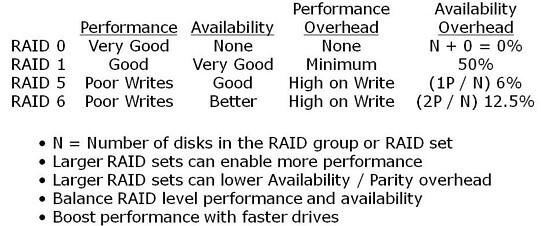
Figure 2:  How various RAID levels and configuration impact or benefit footprint constraints

Figure 2 shows a summary and tradeoffs of various RAID levels. In addition to the RAID levels, how many disks can also have an impact on performance or capacity, such as, by creating a larger RAID 5 or RAID 6 group, the parity overhead can be spread out, however there is a tradeoff. Tradeoffs can be performance bottlenecks on writes or during drive rebuilds along with potential exposure to drive failures.

All of this comes back to a balancing act to align to your specific needs as some will go with a RAID 10 stripe and mirror to avoid risks, even going so far as to do triple mirroring along with replication. On the other hand, some will go with RAID 5 or RAID 6 to meet cost or availability requirements, or, some I have talked with even run RAID 0 for data and applications that need the raw speed, yet can be restored rapidly from some other medium.

Lets bring it all together with an example
Figure 3 shows a generic example of a before and after optimization for a mixed workload environment, granted you can increase or decrease the applicable capacity and performance to meet your specific needs. In figure 3, the storage configuration consists of one storage system setup for high performance (left) and another for high-capacity secondary (right), disk to disk backup and other near-line needs, again, you can scale the approach up or down to your specific need.

For the performance side (left), 192 x 146GB 15K RPM (28TB raw) disks provide good performance, however with low capacity use. This translates into a low capacity per watt value however with reasonable IOPs per watt and some performance hot spots.

On the capacity centric side (right), there are 192 x 1TB disks (192TB raw) with good space utilization, however some performance hot spots or bottlenecks, constrained growth not to mention low IOPS per watt with reasonable capacity per watt. In the before scenario, the joint energy use (both arrays) is about 15 kWh or 15,000 watts which translates to about $16,000 annual energy costs (cooling excluded) assuming energy cost of 12 cents per kWh.

Note, your specific performance, availability, capacity and energy mileage will vary based on particular vendor solution, configuration along with your application characteristics.


Figure 3: Baseline before and after storage optimization (raw hardware) example

Building on the example in figure 3, a combination of techniques along with technologies yields a net performance, capacity and perhaps feature functionality (depends on specific solution) increase. In addition, floor-space, power, cooling and associated footprints are also reduced. For example, the resulting solution shown (middle) comprises 4 x 250GB flash SSD devices, along with 32 x 450GB 15.5K RPM and 124 x 2TB 7200RPM enabling an 53TB (raw) capacity increase along with performance boost.

The previous example are based on raw or baseline capacity metrics meaning that further optimization techniques should yield improved benefits. These examples should also help to discuss the question or myth that it costs more to power storage than to buy it which the answer should be it depends.

If you can buy the above solution for say under $50,000 (cost to power), or, let alone, $100,000 (power and cool) for three years which would also be a good acquisition, then the myth of buying is more expensive than powering holds true. However, if a solution as described above costs more, than the story changes along with other variables include energy costs for your particular location re-enforcing the notion that your mileage will vary.

Another tip is that more is not always better.

That is, more disks, ports, processors, controllers or cache do not always equate into better performance. Performance is the sum of how those and other pieces working together in a demonstrable way, ideally your specific application workload compared to what is on a product data sheet.

Additional general tips include:

  • Align the applicable tool, technique or technology to task at hand
  • Look to optimize for both performance and capacity, active and idle storage
  • Consolidated applications and servers need fast servers
  • Fast servers need fast I/O and storage devices to avoid bottlenecks
  • For active storage use an activity per watt metric such as IOP or transaction per watt
  • For in-active or idle storage, a capacity per watt per footprint metric would apply
  • Gain insight and control of how storage resources are used to meet service requirements

It should go without saying, however sometimes what is understood needs to be restated.

In the quest to become more efficient and optimized, avoid introducing performance, quality of service or availability issues by moving problems.

Likewise, look beyond storage space capacity also considering performance as applicable to become efficient.

Finally, it is all relative in that what might be applicable to one environment or application need may not apply to another.

Ok, nuff said.

Cheers gs

Greg Schulz – Author Cloud and Virtual Data Storage Networking (CRC Press), The Green and Virtual Data Center (CRC Press) and Resilient Storage Networks (Elsevier)
twitter @storageio

All Comments, (C) and (TM) belong to their owners/posters, Other content (C) Copyright 2006-2026 Server StorageIO and UnlimitedIO LLC All Rights Reserved

EPA Energy Star for Data Center Storage Update

EPA Energy Star

Following up on a recent post about Green IT, energy efficiency and optimization for servers, storage and more, here are some additional  thoughts, perspectives along with industry activity around the U.S. Environmental Protection Agency (EPA) Energy Star for Server, Data Center Storage and Data Centers.

First a quick update, Energy Star for Servers is in place with work now underway on expanding and extending beyond the first specification. Second is that Energy Star for Data Center storage definition is well underway including a recent workshop to refine the initial specification along with discussion for follow-on drafts.

Energy Star for Data Centers is also currently undergoing definition which is focused more on macro or facility energy (notice I did not say electricity) efficiency as opposed to productivity or effectiveness, items that the Server and Storage specifications are working towards.

Among all of the different industry trade or special interests groups, at least on the storage front the Storage Networking Industry Association (SNIA) Green Storage Initiative (GSI) and their Technical Work Groups (TWG) have been busily working for the past couple of years on taxonomies, metrics and other items in support of EPA Energy Star for Data Center Storage.

A challenge for SNIA along with others working on related material pertaining to storage and efficiency is the multi-role functionality of storage. That is, some storage simply stores data with little to no performance requirements while other storage is actively used for reading and writing. In addition, there are various categories, architectures not to mention hardware and software feature functionality or vendors with different product focus and interests.

Unlike servers that are either on and doing work, or, off or in low power mode, storage is either doing active work (e.g. moving data), storing in-active or idle data, or a combination of both. Hence for some, energy efficiency is about how much data can be stored in a given footprint with the least amount of power known as in-active or idle measurement.

On the other hand, storage efficiency is also about using the least amount of energy to produce the most amount of work or activity, for example IOPS or bandwidth per watt per footprint.

Thus the challenge and need for at least a two dimensional  model looking at, and reflecting different types or categories of storage aligned for active or in-active (e.g. storing) data enabling apples to apples, vs. apples to oranges comparison.

This is not all that different from how EPA looks at motor vehicle categories of economy cars, sport utility, work or heavy utility among others when doing different types of work, or, in idle.

What does this have to do with servers and storage?

Simple, when a server powers down where does its data go? That’s right, to a storage system using disk, ssd (RAM or flash), tape or optical for persistency. Likewise, when there is work to be done, where does the data get read into computer memory from, or written to? That’s right, a storage system. Hence the need to look at storage in a multi-tenant manner.

The storage industry is diverse with some vendors or products focused on performance or activity, while others on long term, low cost persistent storage for archive, backup, not to mention some doing a bit of both. Hence the nomenclature of herding cats towards a common goal when different parties have various interests that may conflict yet support needs of various customer storage usage requirements.

Figure 1 shows a simplified, streamlined storage taxonomy that has been put together by SNIA representing various types, categories and functions of data center storage. The green shaded areas are a good step in the right direction to simplify yet move towards realistic and achievable befits for storage consumers.


Figure 1 Source: EPA Energy Star for Data Center Storage web site document

The importance of the streamlined SNIA taxonomy is to help differentiate or characterize various types and tiers of storage (Figure 2) products facilitating apples to apples comparison instead of apples or oranges. For example, on-line primary storage needs to be looked at in terms of how much work or activity per energy footprint determines efficiency.


Figure 2: Tiered Storage Example

On other hand, storage for retaining large amounts of data that is in-active or idle for long periods of time should be looked at on a capacity per energy footprint basis. While final metrics are still being flushed out, some examples could be active storage gauged by IOPS or work or bandwidth per watt of energy per footprint while other storage for idle or inactive data could be looked at on a capacity per energy footprint basis.

What benchmarks or workloads to be used for simulating or measuring work or activity are still being discussed with proposals coming from various sources. For example SNIA GSI TWG are developing measurements and discussing metrics, as have the storage performance council (SPC) and SPEC among others including use of simulation tools such as IOmeter, VMware VMmark, TPC, Bonnie, or perhaps even Microsoft ESRP.

Tenants of Energy Star for Data Center Storage overtime hopefully will include:

  • Reflective of different types, categories, price-bands and storage usage scenarios
  • Measure storage efficiency for active work along with in-active or idle usage
  • Provide insight for both storage performance efficiency and effective capacity
  • Baseline or raw storage capacity along with effective enhanced optimized capacity
  • Easy to use metrics with more in-depth back ground or disclosure information

Ultimately the specification should help IT storage buyers and decision makers to compare and contrast different storage systems that are best suited and applicable to their usage scenarios.

This means measuring work or activity per energy footprint at a given capacity and data protection level to meet service requirements along with during in-active or idle periods. This also means showing storage that is capacity focused in terms of how much data can be stored in a given energy footprint.

One thing that will be tricky however will be differentiating GBytes per watt in terms of capacity, or, in terms of performance and bandwidth.

Here are some links to learn more:

Stay tuned for more on Energy Star for Data Centers, Servers and Data Center Storage.

Ok, nuff said.

Cheers gs

Greg Schulz – Author Cloud and Virtual Data Storage Networking (CRC Press), The Green and Virtual Data Center (CRC Press) and Resilient Storage Networks (Elsevier)
twitter @storageio

All Comments, (C) and (TM) belong to their owners/posters, Other content (C) Copyright 2006-2026 Server StorageIO and UnlimitedIO LLC All Rights Reserved

Clouds are like Electricity: Dont be Scared

Clouds

IT clouds (compute, applications, storage, and services) are like electricity in that they can be scary or confusing to some while being enabling or a necessity s to others not to mention being a polarizing force depending on where you sit or view them.

As a polarizing force, if you are a cloud crowd cheerleader or evangelist, you might view someone who does not subscribe or share your excitement, views or interpretations as a cynic.

On the other hand, if you are a skeptic, or perhaps scared or even a cynic, you might view anyone who talks about cloud in general or not specific terms as a cheerleader.

I have seen and experienced this electrifying polarization first hand having being told by crowd cloud cheerleaders or evangelists that I dont like clouds, that Im a cynic who does not know anything about clouds.

As a funny aside (at least I thought it was funny), I recently asked someone who gave me an ear full while they were trying to convert me to be a cloud believer if they had read any of the chapters in my new book The Green and Virtual Data Center (CRC). The response was NO and I said to the effect to bad, as in the book, I talk about how clouds can be complimentary to existing IT resources as being another tier of servers, storage, applications, facilities and IT services.

On the other hand, and this might be funny for some of the crowd cloud, when I bring up tiered IT resources including servers, storage, applications and facilities as well as where or how clouds can fit to compliment IT, I have been told by cynics or naysayers that Im a cloud cheerleader.

Wow, talk about polarized sides!

Now, what about all those that are somewhere in the middle, those that are skeptics who might see value for IT clouds for different scenarios and may in fact already be using clouds (depending upon someones definition).

For those in the middle, whether they are vendors, vars, media, press, analysts, consultants, IT professionals, investors or others, they can easily be misunderstood, misrepresented, and a missed opportunity, perhaps even lamented by those on either of the two extremes (e.g. cloud crowd cheerleaders or true skeptic nay sayers).

Time for some education, don’t be scared, however be careful!

When I worked for an electric power generating and transmission utility an important lesson was not to be scared of electricity, however, be educated, what to do, what not to do in different situations including what to do or not do in the actual power plant or substation. I was taught that when in the actual plant, or at a substation of which I visited in support of the applications and systems I was developing or maintaining, to do certain things. For example, number one, dont touch certain things, number two, if you fall, don’t grab anything, the fall may or may not hurt you, let alone the sudden stop where ever you land, however, if you grab something, that might kill you and you may not be able to let go further injuring yourself. This was a challenging thought as we are taught to grab onto something when falling.

What does this have to do with clouds?

Don’t grab and hang-on if you don’t know what you are grabbing on to if you don’t have to.

The cloud crowd can be polarizing and in some ways acting as a lightning rod drawing the scorns, cynicism ,skeptics, lambasting or being poked fun of given some of the over the top hype around clouds today. Now granted, not all cloud evangelists, vendors or cheerleaders deserve to be the brunt of some of this backlash within the industry; however, it comes with the territory.

Im in the middle as I pointed out above when I talk with vendors, vars, media, investors and IT customers.  Some I talk with are using clouds (perhaps not compliant with some of the definitions). Some are looking at clouds to move problems or mask issues, others are curious yet skeptical to see where or how they could use clouds to compliment their environments. Yet others are scared however maybe in the future will be more open minded as they become educated and see technologies evolve or shift beyond a fashionable trend.

So its time for disclosure, I seeIT clouds as being complimentary that can co-exist with other IT resources (servers, storage, software). In essence, my view is that clouds are just another tier of IT resources to be used when and where applicable as opposed to being a complete replacement, or, simply ignored.

My point is that cloud computing is another tier of traditional computing or servers providing a different performance, availability, capacity, economic and management attributes compared to other traditional technology delivery vehicles. Same thing with storage, same thing with data centers or hosting sites in general. This also applies to application services, in that a cloud web, email, expense, sales, crm, erp, office or other applications is a tier of those same implementations that may exist in a traditional environment. After all, legacy, physical, virtual, grid and cloud IT datacenters all have something in common, they rely on physical servers, storage, networks, software, metrics and management involving people, processes and best practices.

Now back to disclosure, I like clouds, however Im not a cloud cheerleader, Im a skeptic at times of some over the top hype, yet I also personally use some cloud services and technologies as well as advise others to leverage cloud services when, or where applicable to compliment, co-exist and help enable a green and virtual data center and information factory.

To the cloud crowd cheerleaders, too bad if I don’t line up with all of your belief systems or if you perceive me as raining on your parade by being a skeptic , or what you might think of as a cynic and non believer, even though I use clouds myself.

Likewise, to the true cynics (not skeptics) or naysayers, ease up, Im not drinking the cool-aid of the cheerleaders and evangelists, or at least not in large excessive binge doses. I agree that clouds are not the solution to every IT issue, regardless of what your definition of a cloud happens to be.

To everyone else, regardless of if you are the minatory or majority out there that do not fall into one of the two above groups I have this to say.

Dont be afraid, dont be scared of clouds, learn to navigate your way around and through the various technologies, techniques, products and services and indemnity where they might compliment and enable a flexible and scalable resilient IT infrastructure.

Take some time to listen and learn, become educated on what the different types of clouds (public, private, services, products, architectures, or marketecture), their attributes (compute, storage, applications, services, cost, availability, performance, protocols, functionality) and value proposition.

Look into how cloud technologies and techniques might compliment your existing environment to meet specific business objectives. You might find there are fits, you might there are not, however have a look and do some research so that you can at least hold your ground if storm clouds roll in.

After all, clouds are just another tier of IT resources to add to your tool box enabling more efficient and effective IT services delivery. Clouds do not have to be the all or nothing value proposition that often end up in discussions due to polarized extreme views and definitions or past experiences.

Look at it this way, IT relies on electricity, however electricity needs to be understood and respected not to mention used in effective ways. You can be scared of electricity, you can be caviler around it, or, it can be part of your environment and enabler as long as you know when, where and how to use it, not to mention not using it as applicable.

So next time you see a cloud crowd cheerleader, give them a hug, give them a pat on the back, an atta boy or atta girl as they are just doing their jobs, perhaps even following their beliefs and in the line of duty taking a lot of heat from the industry in the pursuit of their work.

On the other hand, as to the cynics and naysayers, they may in fact be using clouds already, perhaps not under the strict definition of some of the chieftains of the cloud crowd.

To everyone else, dont worry, don’t by scared about the clouds, instead, focus on your business, you IT issues and look at various tiers of technologies that can serve as an enabler in a cost effective manner.

Ok, nuff said.

Cheers gs

Greg Schulz – Author Cloud and Virtual Data Storage Networking (CRC Press), The Green and Virtual Data Center (CRC Press) and Resilient Storage Networks (Elsevier)
twitter @storageio

All Comments, (C) and (TM) belong to their owners/posters, Other content (C) Copyright 2006-2026 Server StorageIO and UnlimitedIO LLC All Rights Reserved

Performance = Availability StorageIOblog featured ITKE guest blog

ITKE - IT Knowledge Exchange

Recently IT Knowledge Exchange named me and StorageIOblog as their weekly featured IT blog too which Im flattered and honored. Consequently, I did a guest blog for them titled Performance = Availability, Availability = Performance that you can read about here.

For those not familiar with ITKE, take a few minutes and go over and check it out, there is a wealth of information there on a diversity of topics that you can read about, or, you can also get involved and participate in the questions and answers discussions.

Speaking of ITKE, interested in “The Green and Virtual Data Center” (CRC), check out this link where you can download a free chapter of my book, along with information on how to order your own copy along with a special discount code from CRC press.

Thank you very much to Sean Brooks of ITKE and his social media team of Michael Morisy and Jenny Mackintosh for being named featured IT blogger, as well as for being able to do a guest post for them. It has been fantastic working them and particularly Jenny who helped with all of the logistics in putting together the various pieces including getting the post up on the web as well as in their news letter.

Ok, nuff said.

Cheers gs

Greg Schulz – Author Cloud and Virtual Data Storage Networking (CRC Press), The Green and Virtual Data Center (CRC Press) and Resilient Storage Networks (Elsevier)
twitter @storageio

All Comments, (C) and (TM) belong to their owners/posters, Other content (C) Copyright 2006-2026 Server StorageIO and UnlimitedIO LLC All Rights Reserved

I/O, I/O, Its off to Virtual Work and VMworld I Go (or went)

Ok, so I should have used that intro last week before heading off to VMworld in San Francisco instead of after the fact.

Think of it as a high latency title or intro, kind of like attaching a fast SSD to a slow, high latency storage controller, or a fast server attached to a slow network, or fast network with slow storage and servers, it is what it is.

I/O virtualization (IOV), Virtual I/O (VIO) along with I/O and networking convergence have been getting more and more attention lately, particularly on the convergence front. In fact one might conclude that it is trendy to all of a sudden to be on the IOV, VIO and convergence bandwagon given how clouds, soa and SaaS hype are being challenged, perhaps even turning to storm clouds?

Lets get back on track, or in the case of the past week, get back in the car, get back in the plane, get back into the virtual office and what it all has to do with Virtual I/O and VMworld.

The convergence game has at its center Brocade emanating from the data center and storage centric I/O corner challenging Cisco hailing from the MAN, WAN, LAN general networking corner.

Granted both vendors have dabbled with success in each others corners or areas of focus in the past. For example, Brocade as via acquisitions (McData+Nishan+CNT+INRANGE among others) a diverse and capable stable of local and long distance SAN connectivity and channel extension for mainframe and open systems supporting data replication, remote tape and wide area clustering. Not to mention deep bench experience with the technologies, protocols and partners solutions for LAN, MAN (xWDM), WAN (iFCP, FCIP, etc) and even FAN (file area networking aka NAS) along with iSCSI in addition to Fibre Channel and FICON solutions.

Disclosure: Here’s another plug ;) Learn more about SANs, LANs, MANs, WANs, POTs, PANs and related technologies and techniques in my book “Resilient Storage NetworksDesigning Flexible Scalable Data Infrastructures" (Elsevier).

Cisco not to be outdone has a background in the LAN, MAN, WAN space directly, or similar to Brocade via partnerships with product and experience and depth. In fact while many of my former INRANGE and CNT associates ended up at Brocade via McData or in-directly, some ended up at Cisco. While Cisco is known for general networking, the past several years they have gone from zero to being successful in the Fibre Channel and yes, even the FICON mainframe space while like Brocade (HBAs) dabbling in other areas like servers and storage not to mention consumer products.

What does this have to do with IOV and VIO, let alone VMworld and my virtual office, hang on, hold that thought for a moment, lets get the convergence aspect out of the way first.

On the I/O and networking convergence (e.g. Fibre Channel over Ethernet – FCoE) scene both Brocade (Converged Enhanced Ethernet-CEE) and Cisco (Data Center Ethernet – DCE) along with their partners are rallying around each others camps. This is similar to how a pair of prize fighters maneuvers in advance of a match including plenty of trash talk, hype and all that goes with it. Brocade and Cisco throwing mud balls (or spam) at each other, or having someone else do it is nothing new, however in the past each has had their core areas of focus coming from different tenets in some cases selling to different people in an IT environment or those in VAR and partner organizations. Brocade and Cisco are not alone nor is the I/O networking convergence game the only one in play as it is being complimented by the IOV and VIO technologies addressing different value propositions in IT data centers.

Now on to the IOV and VIO aspect along with VMworld.

For those of you that attended VMworld and managed to get outside of session rooms, or media/analyst briefing or reeducation rooms, or out of partner and advisory board meetings walking the expo hall show floor, there was the usual sea of vendors and technology. There were the servers (physical and virtual), storage (physical and virtual), terminals, displays and other hardware, I/O and networking, data protection, security, cloud and managed services, development and visualization tools, infrastructure resource management (IRM) software tools, manufactures and VARs, consulting firms and even some analysts with booths selling their wares among others.

Likewise, in the onsite physical data center to support the virtual environment, there were servers, storage, networking, cabling and associated hardware along with applicable software and tucked away in all of that, there were also some converged I/O and networking, and, IOV technologies.

Yes, IOV, VIO and I/O networking convergence were at VMworld in force, just ask Jon Torr of Xsigo who was beaming like a proud papa wanting to tell anyone who would listen that his wares were part of the VMworld data center (Disclosure: Thanks for the T-Shirt).

Virtensys had their wares on display with Bob Nappa more than happy to show the technology beyond an UhiGui demo including how their solution includes disk drives and an LSI MegaRAID adapter to support VM boot while leveraging off-the shelf or existing PCIe adapters (SAS, FC, FCoE, Ethernet, SATA, etc.) while allowing adapter sharing across servers, not to mention, they won best new technology at VMworld award.

NextIO who is involved in the IOV / VIO game was there along with convergence vendors Brocade, Cisco, Qlogic and Emulex among others. Rest assured, there are many other vendors and VARs in the VIO and IOV game either still in stealth, semi-stealth or having recently launched.

IOV and VIO are complimentary to I/O and networking convergence in that solutions like those from Aprius, Virtensys, Xsigo, NextIO and others. While they sound similar, and in fact there is confusion as to if Fibre Channel N_Port Virtual ID (FC_NPVID) and VMware virtual adapters are IOV and VIO vs. solutions that are focused on PCIe device/resource extension and sharing.

Another point of confusion around I/O virtualization and virtual I/O are blade system or blade center connectivity solutions such as HP Virtual Connect or IBM Fabric Manger not to mention those form Engenera add confusion to the equation. Some of the buzzwords that you will be hearing and reading more about include PCIe Single Root IOV (SR-IOV) and Multi-Root IOV (MR-IOV). Think of it this way, within VMware you have virtual adapters, and Fibre Channel Virtualization N_Port IDs for LUN mapping/masking, zone management and other tasks.

IOV enables localized sharing of physical adapters across different physical servers (blades or chassis) with distances measured in a few meters; after all, it’s the PCIe bus that is being extended. Thus, it is not a replacement for longer distance in the data center solutions such as FCoE or even SAS for that matter, thus they are complimentary, or at least should be considered complimentary.

The following are some links to previous articles and related material including an excerpt (yes, another plug ;)) from chapter 9 “Networking with you servers and storage” of new book “The Green and Virtual Data Center” (CRC). Speaking of virtual and physical, “The Green and Virtual Data Center” (CRC) was on sale at the physical VMworld book store this week, as well as at the virtual book stores including Amazon.com

The Green and Virtual Data Center

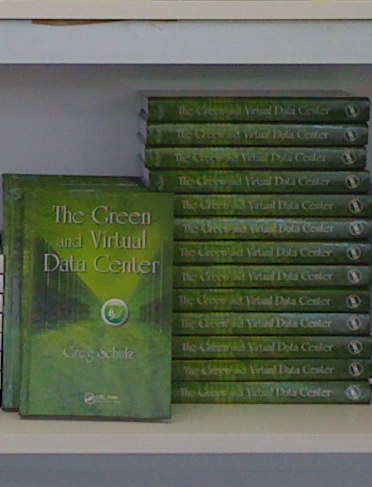
The Green and Virtual Data Center (CRC) on book shelves at VMworld Book Store

Links to some IOV, VIO and I/O networking convergence pieces among others, as well as news coverage, comments and interviews can be found here and here with StorageIOblog posts that may be of interest found here and here.

SearchSystemChannel: Comparing I/O virtualization and virtual I/O benefits – August 2009

Enterprise Storage Forum: I/O, I/O, It’s Off to Virtual Work We Go – December 2007

Byte and Switch: I/O, I/O, It’s Off to Virtual Work We Go (Book Chapter Excerpt) – April 2009

Thus I went to VMworld in San Francisco this past week as much of the work I do is involved with convergence similar to my background, that is, servers, storage, I/O networking, hardware, software, virtualization, data protection, performance and capacity planning.

As to the virtual work, well, I spent some time on airplanes this week which as is often the case, my virtual office, granted it was real work that had to be done, however I also had a chance to meet up with some fellow tweeters at a tweet up Tuesday evening before getting back in a plane in my virtual office.

Now, I/O, I/O, its back to real work I go at Server and StorageIO , kind of rhymes doesnt it!

I/O, I/O, Its off to Virtual Work and VMworld I Go (or went)

Summer Book Update and Back to School Reading

August and thus Summer 2009 in the northern hemisphere are swiftly passing by and start of a new school year is just around the corner which means it is also time for final vacations, time at the beach, pool, golf course, amusement park or favorite fishing hole among other past times. In order to help get you ready for fall (or late summer) book shopping for those with IT interests, here are some Amazon lists (here, here and here) for ideas, after all, the 2009 holiday season is not that far away!

Here’s a link to my Amazon.com Authors page that includes coverage of both my books, "The Green and Virtual Data Center" (CRC) and "Resilient Storage Networks – Designing Scalable Flexible Data Infrastructures" (Elsevier).

Resilient Storage Networks - Designing Flexible Scalable Data Infrastructures (Elsevier)

Click here to look inside "The Green and Virtual Data Center" (CRC) and or inside "Resilient Storage Networks" (Elsevier).

Its been six months since the launch announcement of my new book "The Green and Virtual Data Center" (CRC) and general availability at Amazon.com and other global venues here and here. In celebration of the six month anniversary of the book launch (thank you very much to all who have bought a copy!), here is some coverage including what is being said, related articles, interviews, book reviews and more.

Article: New Green Data Center: shifting from avoidance to becoming more efficient IT-World August 2009

wsradio.com interview discussing themes and topics covered in the book including closing the green gap and shifting towards an IT efficiency and productivity for business sustainability.

Closing the green gap: Discussion about expanding data centers with environmental benefits at SearchDataCenter.com

From Greg Brunton – EDS/An HP Company: “Greg Schulz has presented a concise and visionary perspective on the Green issues, He has cut through the hype and highlighted where to start and what the options are. A great place to start your green journey and a useful handbook to have as the journey continues.”

From Rick Bauer – Storage Networking Industry Association (SNIA) – Education and Technology Director”
“Greg is one of the smartest “good guys” in the storage industry.
He has been a voice of calm amid all the “green IT hype” over the past few years. So when he speaks of the possible improvements that Green Tech can bring, it’s a much more realistic approach…”

From CMG (Computer Measurement Group) MeasureIT
I must admit that I have been slightly skeptical at times, when it comes to what the true value is behind all of the discussions on “green” technologies in the data center. As someone who has seen both the end user and vendor side of things, I think my skepticism gets heightened more than it normally would be. This book really helped dispel my skepticism.

The book is extremely well organized and easy to follow. Each chapter has a very good introduction and comprehensive summary. This book could easily serve as a blueprint for organizations to follow when they look for ideas on how to design new data centers. It’s a great addition to an IT Bookshelf. – Reviewed by Stephen R. Guendert, PhD (Brocade and CMG MeasureIT). Click here to read the full review in CMG MeasureIT.

From Tom Becchetti – IT Architect: “This book is packed full of information. From ecological and energy efficiencies, to virtualization strategies and what the future may hold for many of the key enabling technologies. Greg’s writing style benefits both technologists and management levels.”

From MSP Business Journal: Greg Schulz named an Eco-Tech Warrior – April 2009

From David Marshall at VMblog.com: If you follow me on Linked in, you might have seen that I had been reading a new book that came out at the beginning of the year titled, “The Green and Virtual Data Center” by Greg Schulz. Rather than writing about a specific virtualization platform and how to get it up and running, Schulz takes an interesting approach at stepping back and looking at the big picture. After reading the book, I reached out to the author to ask him a few more questions and to share his thoughts with readers of VMBlog.com. I know I’m not Oprah’s Book Club, but I think everyone here will enjoy this book. Click here to read more what David Marshal has to say.

From Zen Kishimoto of Altaterra Research: Book Review May 2009

From Kurt Marko of Processor.com Green and Virtual Book Review – April 2009

From Serial Storage Wire (STA): Green and SASy = Energy and Economic, Effective Storage – March 2009

From Computer Technology Review: Recent Comments on The Green and Virtual Data Center – March 2009

From Alan Radding in Big Fat Finance Blog: Green IT for Finance Operations – April 2009

From VMblog: Comments on The Green and Virtual Data CenterMarch 2009

From StorageIO Blog: Recent Comments and Tips – March 2009

From VMblog: Comments on The Green and Virtual Data CenterMarch 2009

From Data Center Links John Rath comments on “The Green and Virtual Data Center

From InfoStor Dave Simpson comments on “The Green and Virtual Data Center

From Sys-Con Georgiana Comsa comments on “The Green and Virtual Data Center

From Ziff Davis Heather Clancy comments on “The Green and Virtual Data Center”

From Byte & Switch Green IT and the Green Gap February 2009

From GreenerComputing: Enabling a Green and Virtual Data Center February 2009

From Sys-con: Comments on The Green and Virtual Data Center – March 2009

From ServerWatch: Green IT: Myths vs. Realities – February 2009

From Byte & Switch: Going Green and the Economic Downturn – February 2009

From Business Wire: Comments on The Green and Virtual Data Center Book – January 2009

Additional content and news can be found here and here with upcoming events listed here.

Interested in Kindle? Here’s a link to get a Kindle copy of "Resilient Storage Networks" (Elsevier) or to send a message via Amazon to publisher CRC that you would like to see a Kindle version of "The Green and Virtual Data Center". While you are at it, I also invite you to become a fan of my books at Facebook.

Thanks again to everyone who has obtained their copy of either of my books, also thanks to all of those who have done reviews, interviews and helped in many other ways!

Enjoy the rest of your summer!

Cheers – gs

Greg Schulz – twitter @storageio

StorageIO in the news

StorageIO is regularly quoted and interviewed in various industry and vertical market venues and publications both on-line and in print on a global basis. The following is coverage, perspectives and commentary by StorageIO on IT industry trends including servers, storage, I/O networking, hardware, software, services, virtualization, cloud, cluster, grid, SSD, data protection, Green IT and more.

Realizing that some prefer blogs to webs to twitters to other venues, here are some recent links among others to media coverage and comments by me on a different topics that are among others found at www.storageio.com/news.html:

  • Virtualization Review: Comments on Clouds, Virtualizaiton and Cisco move into servers – July 2009
  • SearchStorage: Comments on Storage Resource Managemet (SRM) and related tools – July 2009
  • SearchStorage: Comments on flash SSD – July 2009
  • SearchDataBackup: Comments on Data backup reporting tools’ trends – July 2009
  • SearchServerVirtualization: Comments on Hyper-V R2 matches VMware with 64-processor support – July 2009
  • SearchStorage: Comments on HP buying IBRIX for clustered and Cloud NAS – July 2009
  • Enterprise Storage Forum: Comments on HP buying IBRIX for clustered and Cloud NAS – July 2009
  • eWeek: Comments on NetApps next moves after DDUP and EMC – July 2009
  • Enterprise Storage Forum: Comments on NetApps next moves after DDUP and EMC – July 2009
  • SearchStorage: Comments on EMC buying DataDomain, NetApps next moves – July 2009
  • SearchVirtualization: Comments on Microsft HyperV features and VMware – July 2009
  • SearchITchannel: Comments on social media for business – June 2009
  • SearchSMBstorage: Comments on Storage Resource Management (SRM) for SMBs – June 2009
  • Enterprise Storage Forum: Comments on IT Merger & Acquisition activity – June 2009
  • Evolving Solutions: Comments on Storage Consolidation, Networking & Green IT – June 2009
  • Enterprise Storage Forum: Comments on EMC letter to DDUP – June 2009
  • SearchStorage: Comments on best practices for effective thin provisioning – June 2009
  • Processor: Comments on Cloud computing, SaaS and SOAs – June 2009
  • Serverwatch: Comments in How EMC’s World Pulls the Data Center Together – June 2009
  • Processor: Comments on Virtual Security Is No Walk In The Park – May 2009
  • SearchStorage: Comments on EPA launching Green Storage specification – May 2009
  • SearchStorage: Comments on Storage Provisioning Tools – May 2009
  • Enterprise Systems Journal: Comments on Tape: The Zombie Technology – May 2009
  • Enterprise Storage Forum: Comments on Oracle Keeping Sun Storage Business – May 2009
  • IT Health Blogging: Discussion about iSCSI vs. Fibre Channel for Virtual Environments – May 2009
  • IT Business Edge: Discussion about IT Data Center Futures – May 2009
  • IT Business Edge: Comments on Tape being a Green Technology – April 2009
  • Big Fat Finance Blog: Quoted in story about Green IT for Finance Operaitons – April 2009
  • SearchStorage: Comments on FLASH and SSD Storage – April 2009
  • SearchStorage AU: Comments on Data Classificaiton – April 2009
  • IT Knowledge Exchange: Comments on FCoE and Converged Networking Coming Together – April 2009
  • SearchSMBStorage: Comments on Data Deduplicaiton for SMBs – April 2009
  • SearchSMBStorage: Comments on Blade Storage for SMBs – April 2009
  • SearchStorage: Comments on MAID technology remaining underutilized – April 2009
  • SearchDataCenter: Closing the green gap: Expanding data centers with environmental benefits – April 2009
  • ServerWatch: Comments on What’s Selling In the Data Storage Market? – April 2009
  • ServerWatch: Comments on Oracle Buys Sun: The Consequences – April 2009
  • SearchStorage: Comments on Tiered Storage – April 2009
  • SearchStorage: Comments on Data Classification for Storage Managers – April 2009
  • wsradio.com Interview closing the Green Gap


  • IT Knowledge Exchange: Comments on FCoE eco-system maturing – April 2009
  • Internet Revolution: Comments on the Pre-mature death of the disk drive – April 2009
  • Enterprise Storage Forum: Comments on EMC V-MAX announcement – April 2009
  • MSP Business Journal: Greg Schulz named an Eco-Tech Warrior – April 2009
  • Storage Magazine: Comments on Power-smart disk systems – April 2009
  • Storage Magazine: Comments on Replication Alternatives – April 2009
  • StorageIO Blog: Comments and Tape as a Green Storage Medium – April 2009
  • Inside HPC: Recent Comments on Tape and Green IT – April 2009
  • Processor.com: Recent Comments on Green and Virtual – April 2009
  • SearchDataCenter: Interview: Closing the green gap: Expanding data centers with environmental benefits – April 2009
  • Enterprise Systems Journal: Recent Comments and Tips – March 2009
  • Computer Technology Review: Recent Comments on The Green and Virtual Data Center – March 2009
  • VMblog: Comments on The Green and Virtual Data Center – March 2009
  • Sys-con: Comments on The Green and Virtual Data Center – March 2009
  • Server Watch: Comments on IBM possibly buying Sun – March 2009
  • Bnet: Comments on IBM possibly buying Sun – March 2009
  • SearchStorage: Comments on Tiered Storage 101 – March 2009
  • SearchStorage: Comments – Cisco pushes into Servers March 2009
  • Enterprise Storage Forum: Comments – Cisco Entering Server Market March 2009
  • Enterprise Storage Forum: Comments – State of Storage Job Market – March 2009
  • SearchSMBStorage: Comments on SMB Storage Options – March 2009
  • Enterprise Storage Forum: Comments on Sun Proposes New Solid State Storage Spec – March 2009
  • Enterprise Storage Forum: Comments on Despite Economy, Storage Bargains Hard to Find – March 2009
  • TechWorld: Comments on Where to Stash Your Data – February 2009
  • ServerWatch: Green IT: Myths vs. Realities – February 2009
  • Byte & Switch: Going Green and the Economic Downturn – February 2009
  • CTR: Comments on Tape Hardly Being On Way Out – February 2009
  • Processor: Comments on SSD (FLASH and RAM) – February 2009
  • Internet News: Comments on Steve Wozniak joining SSD startup – February 2009
  • SearchServerVirtualization: Comments on I/O and Virtualization – February 2009
  • Technology Inc.: Comments on Data De-dupe for DR – February 2009
  • SearchStorage: Comments on NetApp SMB NAS – February 2009
  • Check out the Tips, Tools and White Papers, and News pages for additional commentary, coverage and related content or events.

    Ok, nuff said.

    Cheers gs

    Greg Schulz – Author Cloud and Virtual Data Storage Networking (CRC Press, 2011), The Green and Virtual Data Center (CRC Press, 2009), and Resilient Storage Networks (Elsevier, 2004)

    twitter @storageio

    All Comments, (C) and (TM) belong to their owners/posters, Other content (C) Copyright 2006-2012 StorageIO and UnlimitedIO All Rights Reserved

    Recent tips, videos, articles and more

    Its been a busy year so far and there is still plenty more to do. Taking advantage of a short summer break, I’m getting caught up on some items including putting up a link to some of the recent articles, tips, reports, webcasts, videos and more that I have eluded to in recent posts. Realizing that some prefer blogs to webs to tweets to other venues, here are some links to recent articles, tips, videos, podcasts, webcasts, white papers and more that can be found on the StorageIO Tips, tools and White Papers pages.

    Recent articles, columns, tips, white papers and reports:

  • ITworld: The new green data center: From energy avoidance to energy efficiency August 2009
  • SearchSystemsChannel: Comparing I/O virtualization and virtual I/O benefits July 2009
  • SearchDisasterRecovery: Top server virtualization myths in DR and BC July 2009
  • Enterprise Storage Forum: Saving Money with Green Data Storage Technology July 2009
  • SearchSMB ATE Tips: SMB Tips and ATE by Greg Schulz
  • SearchSMB ATE Tip: Tape library storage July 2009
  • SearchSMB ATE Tip: Server-based operating systems vs. PC-based operating systems June 2009
  • SearchSMB ATE Tip: Pros/cons of block/variable block dedupe June 2009
  • FedTechAt the Ready: High-availability storage hinges on being ready for a system failure May 2009
  • Byte & Switch Part XI – Key Elements For A Green and Virtual Data Center May 2009
  • Byte & Switch Part X – Basic Steps For Building a Green and Virtual Data Center May 2009
  • InfoStor Technology Options for Green Storage: April 2009
  • Byte & Switch Part IX – I/O, I/O, Its off to Virtual Work We Go: Networks role in Virtual Data Centers April 2009
  • Byte & Switch Part VIII – Data Storage Can Become Green: There are many steps you can take April 2009
  • Byte & Switch Part VII – Server Virtualization Can Save Costs April 2009
  • Byte & Switch Part VI – Building a Habitat for Technology April 2009
  • Byte & Switch Part V – Data Center Measurement, Metrics & Capacity Planning April 2009
  • zJournal Storage & Data Management: Tips for Enabling Green and Virtual Efficient Data Management March 2009
  • Serial Storage Wire (STA): Green and SASy = Energy and Economic, Effective Storage March 2009
  • SearchSystemsChannel: FAQs: Green IT strategies for solutions providers March 2009
  • Computer Technology Review: Recent Comments on The Green and Virtual Data Center March 2009
  • Byte & Switch Part IV – Virtual Data Centers Can Promote Business Growth March 2009
  • Byte & Switch Part III – The Challenge of IT Infrastructure Resource Management March 2009
  • Byte & Switch Part II – Building an Efficient & Ecologically Friendly Data Center March 2009
  • Byte & Switch Part I – The Green Gap – Addressing Environmental & Economic Sustainability March 2009
  • Byte & Switch Green IT and the Green Gap February 2009
  • GreenerComputing: Enabling a Green and Virtual Data Center February 2009
  • Some recent videos and podcasts include:

  • bmighty.com The dark side of SMB virtualization July 2009
  • bmighty.com SMBs Are Now Virtualization’s “Sweet Spot” July 2009
  • eWeek.com Green IT is not dead, its new focus is about efficiency July 2009
  • SearchSystemsChannel FAQ: Using cloud computing services opportunities to get more business July 2009
  • SearchStorage FAQ guide – How Fibre Channel over Ethernet can combine networks July 2009
  • SearchDataCenter Business Benefits of Boosting Web hosting Efficiency June 2009
  • SearchStorageChannel Disaster recovery services for solution providers June 2009
  • The Serverside The Changing Dynamic of the Data Center April 2009
  • TechTarget Virtualization and Consolidation for Agility: Intels Xeon Processor 5500 series May 2009
  • TechTarget Virtualization and Consolidation for Agility: Intels Xeon Processor 5500 series May 2009
  • Intel Reduce Energy Usage while Increasing Business Productivity in the Data Center May 2009
  • WSRadio Closing the green gap and shifting towards an IT efficiency and productivity April 2009
  • bmighty.com July 2009
  • Check out the Tips, Tools and White Papers, and News pages for more commentary, coverage and related content or events.

    Ok, nuff said.

    Cheers gs

    Greg Schulz – Author Cloud and Virtual Data Storage Networking (CRC Press, 2011), The Green and Virtual Data Center (CRC Press, 2009), and Resilient Storage Networks (Elsevier, 2004)

    twitter @storageio

    All Comments, (C) and (TM) belong to their owners/posters, Other content (C) Copyright 2006-2012 StorageIO and UnlimitedIO All Rights Reserved

    Green IT Confusion Continues, Opportunities Missed!

    I continue to see those looking for fast silver bullets in the quest to be green, efficient, optimized or sustainable while addressing issues ranging from power/energy, cooling, floor-space/footprint, EH&S (environmental health & safety) not to mention recycling. Yet, I’m also continued to be  amazed by the focus and emphasis around reduce as in reduce your capacity and your performance or processing capabilities in the form of consolidation or aggregation along with energy avoidance which for some is applicable.

    However, there is also the other side of the tale which is shifting from avoidance to becoming more efficient, that is doing more with what you have or with less while boosting productivity. For example, having a server or processor that can do more work in the same or smaller physical footprint drawing the same or less energy and requiring less cooling is a form of reducing overall impact yet boosting productivity. The same can be done with data and I/O networks, storage and even software.

    Similar to automobiles after the 1970s oil and energy crisis, the focus was on reduction, conservation and avoidance as the form of being efficient. Over time, this approach gave way to levering more efficient engines and vehicles that boosted the MPG city and highway, change in driving or usage habits, awareness of issues including applicable metrics and energy costs, as well as the continuing quest for alternative fuels.

    This is no different than what is happening with the IT organizations or compute focused entities in that there has been an initial focus of avoidance to meet short term tactical requirements, not to mention all of the green hype of a few years ago. Today there is a shift taking place towards efficiency and awareness that optimization and efficiency is more than consolidation, that it also includes boosting productivity as part of achieving reduced energy and cooling demands.

    How this can be done is to leverage multiple different techniques including new servers with processors that have intelligent power management (IPM) also known as adaptive voltage scaling (AVS) or other marketing terms enabling variable performance and energy consumption. For example, vary clock cycles and turn on cores when needed, then to turn off cores, slow clock speed down when there is less work to be done. Likewise there are improvements with cooling closer to the heat source ranging from leveraging inert liquid cooling inside the cabinet of computers to surface attached cooling to emerging micro cooling located inside silicon. There is a fascination with using virtualization to consolidate and reduce servers that are underutilized, which again is applicable for some environments and applications.

    However not all servers including many that are underutilized lend themselves to being consolidated for various reasons including quality of service (QoS) or performance, security, vendor support or software compatibility, politics or finance among others. This however does not mean that they cannot be virtualized, it more than likely mean that they cannot be consolidated. There is a common myth that virtualization equals consolidation and vice versa, however virtualization can also be used for abstraction, transparency, emulation and enabling agility including support for load-balancing, scale-up and scale-out performance oriented clustering among other uses. Thus there is another side of virtualization and that is to achieve   efficiency, life beyond consolidation.

    Needless to say there are many more technologies and techniques to address various issues now along with those that are emerging. The good news in all of this is the growing awareness that there are many different faces or facets of being green. That green wash and green hype may be on the endangered species list, that green means more than reducing carbon footprints or recycling or energy avoidance. That green is really about shifting and becoming more efficient, more optimized to support more processing, more work in a cost effective manner to sustain growth on a go forward basis. For high performance compute (HPC) or other large scale IT organizations, there is a notion that small improvements on a large broad scale have significant impact.

    Some organizations are in pursuit of technologies of solutions that promise significant saving ratios over small sets or instances, solutions that provide  smaller reduction or savings over a larger basis can prove to be more effective. For example, if power is a concern, powering down servers or storage that promises 85-100% savings might only be applicable to less than 5% of the devices. However, if 85-100% of the devices can be upgraded to newer models that boost productivity by 5-15% (or more) in the same or smaller footprint, using 5-15% (or more) less power, the results add up quickly. Think of it this way, a 1% saving for an environment using 1,000 kilo watt hour (kWh) or 1mWh of energy is a savings of 10kWh. The point being that for large environments, don’t forget to look at small savings that apply to a large installed base that then add up to big benefits.

    The net result is that one can pursue being green or being perceived as being green which can have a high cost, or, can pursue various efficiency that help the overall organization by boosting productivity, helping the top and bottom line, doing more in a smaller footprint and guess what, the result is not only economic, it’s also environmental positive. Thus, the byproduct of shifting towards efficiency (and not just avoidance) is to become green!

    Ok, nuff said.

    Cheers gs

    Greg Schulz – Author Cloud and Virtual Data Storage Networking (CRC Press), The Green and Virtual Data Center (CRC Press) and Resilient Storage Networks (Elsevier)
    twitter @storageio

    All Comments, (C) and (TM) belong to their owners/posters, Other content (C) Copyright 2006-2026 Server StorageIO and UnlimitedIO LLC All Rights Reserved

    Clarifying Clustered Storage Confusion

    Clustered storage can be iSCSI, Fibre Channel block based or NAS (NFS or CIFS or proprietary file system) file system based. Clustered storage can also be found in virtual tape library (VTL) including dedupe solutions along with other storage solutions such as those for archiving, cloud, medical or other specialized grids among others.

    Recently in the IT and data storage specific industry, there has been a flurry of merger and acquisition (M&A) (Here and here), new product enhancement or announcement activity around clustered storage. For example, HP buying clustered file system vendor IBRIX complimenting their previous acquisition of another clustered file system vendor (PolyServe) a few years ago, or, of iSCSI block clustered storage software vendor LeftHand earlier this year. Another recent acquisition is that of LSI buying clustered NAS vendor ONstor, not to mention Dell buying iSCSI block clustered storage vendor EqualLogic about a year and half ago, not to mention other vendor acquisitions or announcements involving storage and clustering.

    Where the confusion enters into play is the term cluster which means many things to different people, and even more so when clustered storage is combined with NAS or file based storage. For example, clustered NAS may infer a clustered file system when in reality a solution may only be multiple NAS filers, NAS heads, controllers or storage processors configured for availability or failover.

    What this means is that a NFS or CIFS file system may only be active on one node at a time, however in the event of a failover, the file system shifts from one NAS hardware device (e.g. NAS head or filer) to another. On the other hand, a clustered file system enables a NFS or CIFS or other file system to be active on multiple nodes (e.g. NAS heads, controllers, etc.) concurrently. The concurrent access may be for small random reads and writes for example supporting a popular website or file serving application, or, it may be for parallel reads or writes to a large sequential file.

    Clustered storage is no longer exclusive to the confines of high-performance sequential and parallel scientific computing or ultra large environments. Small files and I/O (read or write), including meta-data information, are also being supported by a new generation of multipurpose, flexible, clustered storage solutions that can be tailored to support different applications workloads.

    There are many different types of clustered and bulk storage systems. Clustered storage solutions may be block (iSCSI or Fibre Channel), NAS or file serving, virtual tape library (VTL), or archiving and object-or content-addressable storage. Clustered storage in general is similar to using clustered servers, providing scale beyond the limits of a single traditional system—scale for performance, scale for availability, and scale for capacity and to enable growth in a modular fashion, adding performance and intelligence capabilities along with capacity.

    For smaller environments, clustered storage enables modular pay-as-you-grow capabilities to address specific performance or capacity needs. For larger environments, clustered storage enables growth beyond the limits of a single storage system to meet performance, capacity, or availability needs.

    Applications that lend themselves to clustered and bulk storage solutions include:

    • Unstructured data files, including spreadsheets, PDFs, slide decks, and other documents
    • Email systems, including Microsoft Exchange Personal (.PST) files stored on file servers
    • Users’ home directories and online file storage for documents and multimedia
    • Web-based managed service providers for online data storage, backup, and restore
    • Rich media data delivery, hosting, and social networking Internet sites
    • Media and entertainment creation, including animation rendering and post processing
    • High-performance databases such as Oracle with NFS direct I/O
    • Financial services and telecommunications, transportation, logistics, and manufacturing
    • Project-oriented development, simulation, and energy exploration
    • Low-cost, high-performance caching for transient and look-up or reference data
    • Real-time performance including fraud detection and electronic surveillance
    • Life sciences, chemical research, and computer-aided design

    Clustered storage solutions go beyond meeting the basic requirements of supporting large sequential parallel or concurrent file access. Clustered storage systems can also support random access of small files for highly concurrent online and other applications. Scalable and flexible clustered file servers that leverage commonly deployed servers, networking, and storage technologies are well suited for new and emerging applications, including bulk storage of online unstructured data, cloud services, and multimedia, where extreme scaling of performance (IOPS or bandwidth), low latency, storage capacity, and flexibility at a low cost are needed.

    The bandwidth-intensive and parallel-access performance characteristics associated with clustered storage are generally known; what is not so commonly known is the breakthrough to support small and random IOPS associated with database, email, general-purpose file serving, home directories, and meta-data look-up (Figure 1). Note that a clustered storage system, and in particular, a clustered NAS may or may not include a clustered file system.

    Clustered Storage Model: Source The Green and Virtual Data Center (CRC)
    Figure 1 – Generic clustered storage model (Courtesy “The Green and Virtual Data Center  (CRC)”

    More nodes, ports, memory, and disks do not guarantee more performance for applications. Performance depends on how those resources are deployed and how the storage management software enables those resources to avoid bottlenecks. For some clustered NAS and storage systems, more nodes are required to compensate for overhead or performance congestion when processing diverse application workloads. Other things to consider include support for industry-standard interfaces, protocols, and technologies.

    Scalable and flexible clustered file server and storage systems provide the potential to leverage the inherent processing capabilities of constantly improving underlying hardware platforms. For example, software-based clustered storage systems that do not rely on proprietary hardware can be deployed on industry-standard high-density servers and blade centers and utilizes third-party internal or external storage.

    Clustered storage is no longer exclusive to niche applications or scientific and high-performance computing environments. Organizations of all sizes can benefit from ultra scalable, flexible, clustered NAS storage that supports application performance needs from small random I/O to meta-data lookup and large-stream sequential I/O that scales with stability to grow with business and application needs.

    Additional considerations for clustered NAS storage solutions include the following.

    • Can memory, processors, and I/O devices be varied to meet application needs?
    • Is there support for large file systems supporting many small files as well as large files?
    • What is the performance for small random IOPS and bandwidth for large sequential I/O?
    • How is performance enabled across different application in the same cluster instance?
    • Are I/O requests, including meta-data look-up, funneled through a single node?
    • How does a solution scale as the number of nodes and storage devices is increased?
    • How disruptive and time-consuming is adding new or replacing existing storage?
    • Is proprietary hardware needed, or can industry-standard servers and storage be used?
    • What data management features, including load balancing and data protection, exists?
    • What storage interface can be used: SAS, SATA, iSCSI, or Fibre Channel?
    • What types of storage devices are supported: SSD, SAS, Fibre Channel, or SATA disks?

    As with most storage systems, it is not the total number of hard disk drives (HDDs), the quantity and speed of tiered-access I/O connectivity, the types and speeds of the processors, or even the amount of cache memory that determines performance. The performance differentiator is how a manufacturer combines the various components to create a solution that delivers a given level of performance with lower power consumption.

    To avoid performance surprises, be leery of performance claims based solely on speed and quantity of HDDs or the speed and number of ports, processors and memory. How the resources are deployed and how the storage management software enables those resources to avoid bottlenecks are more important. For some clustered NAS and storage systems, more nodes are required to compensate for overhead or performance congestion.

    Learn more about clustered storage (block, file, VTL/dedupe, archive), clustered NAS, clustered file system, grids and cloud storage among other topics in the following links:

    "The Many faces of NAS – Which is appropriate for you?"

    Article: Clarifying Storage Cluster Confusion
    Presentation: Clustered Storage: “From SMB, to Scientific, to File Serving, to Commercial, Social Networking and Web 2.0”
    Video Interview: How to Scale Data Storage Systems with Clustering
    Guidelines for controlling clustering
    The benefits of clustered storage

    Along with other material on the StorageIO Tips and Tools or portfolio archive or events pages.

    Ok, nuff said.

    Cheers gs

    Greg Schulz – Author Cloud and Virtual Data Storage Networking (CRC Press), The Green and Virtual Data Center (CRC Press) and Resilient Storage Networks (Elsevier)
    twitter @storageio

    All Comments, (C) and (TM) belong to their owners/posters, Other content (C) Copyright 2006-2026 Server StorageIO and UnlimitedIO LLC All Rights Reserved

    Worried about IT M&A, here come the new startups!

    Storage I/O trends

    Late last year , I did a post (see here) countering the notion that there is a lack of innovation in IT and specifically around data storage. Recently I did a post about a Funeral for Friend, not to mention yesterdays post about Summer marriages.

    For those who are concerned about lack of innovation, or, that consolidation will result in just a few big vendors, here’s some food for thought. Those big vendors in addition to growing via internal organic growth, also grow by buying or merging with other vendors. Those other vendors emerge as startups, some grow, blossom and are bought, some make a decent business on their own, some are looking to be bought, some need to be bought, some will see fire sales, liquidation or simply closing their doors and perhaps re-launching as a new company.

    With all the M&A activity currently that has taken place, and I’m sure (speculation only ;) ) that there will be plenty more, here’s a short and far from comprehensive list of some startups or companies you may not have heard of yet. There are additional ones who are still in deep stealth, some on the list are still in stealth, yet talking and letting information trickle out, thus only non-NDA information is being shown here. In other words, you can find out about these via publicly available information and sources.

    Something that I have noticed and talked with others in the industry about is that this generation of startups, at least for now are taking a far more low-key approach to their launches than in the past. Gone at least for now are the Dot COM era over the top announcements in some cases before there was even a product or shipping for actual customer production deployment scenario. This crop or corps of startups are taking their time leveraging the current economic situation to further incubate their technologies and go to market strategies, not to mention minimizing the amount of over the top VC funding we have seen in the past. Some of these may not appear to be storage related and that would be correct. This list includes those associated with data infrastructure technolgies from servers, to storage to networking, hardware, software and services among othes as a common theme.

    Disclosure Notice: None of these companies mentioned are nor have ever been clients of StorageIO. Why do I mention this, why not!

    Balesio – File compression solutions
    Box.net – Internet/web/cloud storage service with high availability and backup
    Cirrustore – Backup data protection tools
    Dataslide – Hard rectangular disk (HRD)
    Enclarity – Healthcare CRM and analysis tools
    Enstratus – Amazon cloud computing management tools
    Exludas – Multi core optimize
    Firescope – CMDB data solutions
    Greenbytes – ZFS based storage management solutions
    Likewise – Open backup software for macs/linux/windows
    Liquidcomputing – High density servers
    Maxiscale – Web infrastructure (Stealth)
    Metalogix – Archiving solutions
    Neptuny – Capacity Planning
    Netronome – Network and I/O optimization technology
    Newboundary – IT policy management and IRM tools
    Nexenta ZFS – based storage management solutions
    Pergamumsystems – Archive solutions (Stealth)
    Pranah – SMB Storage vendor formerly known as Marner
    Procedo – Archiving and migration solutions
    Rebit – Backup and data protection solutions
    Rightscale – Amazon cloud computing management tools
    Rmsource – Cloud backup solutions
    RNAnetworks – Virtual memory management solutions
    Scale Computing – Clustered storage management software
    ScaleMP – Multi-core virtualization for scale out
    SiberSystems – Goodsync data protection solutions
    Sparebackup – Backup data protection solutions
    StorageFusion – Storage resource analysis
    Storspeed – NAS/NFS optimization solutions (Stealth)
    Sugarsync – Backup and data protection solutions
    Surgient – Cloud computing solutions
    Synology – SMB storage solutions
    TwinStrata – BC/DR analysis and assessment tools
    Vadium – Security and encryption tools
    Vembu – Backup data protection tools
    Versant – Object database management solutions
    Vipre – Security, data loss, data leak prevention
    VirtenSys – Virtual I/O and I/O virtualization (IOV)
    Vizrt – Video management software tools
    WhipTail – Flash SSD solutions
    Xenos – Archive and data footprint reduction solutions

    Links to the above along with many other companies including manufactures and vars can be found on the Interesting Links page at StorageIO.

    Food for thought for your summer technology picnic fun.

    Nuf said for now.

    Ok, nuff said.

    Cheers gs

    Greg Schulz – Author Cloud and Virtual Data Storage Networking (CRC Press, 2011), The Green and Virtual Data Center (CRC Press, 2009), and Resilient Storage Networks (Elsevier, 2004)

    twitter @storageio

    All Comments, (C) and (TM) belong to their owners/posters, Other content (C) Copyright 2006-2012 StorageIO and UnlimitedIO All Rights Reserved