Part III Dell Technology World 2018 Storage Announcement Details

Part III Dell Technology World 2018 Storage Announcement Details

Part III Dell Technology World 2018 Storage Announcement Details

This is Part III Dell Technology World 2018 Storage Announcement Details that is part of a five-post series (view part I here, part II here, part IV (PowerEdge MX Composable) here and part V here). Last week (April 30-May 3) I traveled to Las Vegas Nevada (LAS) to attend Dell Technology World 2018 (e.g., DTW 2018) as a guest of Dell (that is a disclosure btw).

Dell Technology World 2018 Storage Announcements Include:

  • PowerMax – Enterprise class tier 0 and tier 1 all-flash array (AFA)
  • XtremIO X2 – Native replication and new entry-level pricing
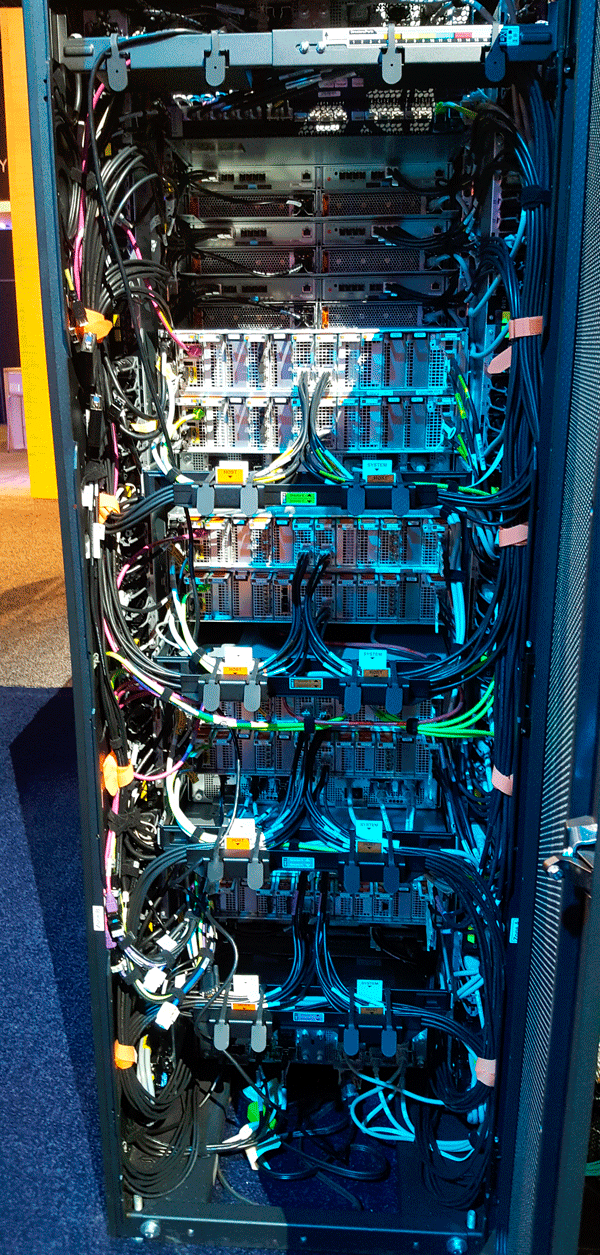
Dell Technology World 2018 PowerMax back view
Back view of Dell PowerMax

Dell PowerMax Something Old, Something New, Something Fast Near You Soon

PowerMax is the new companion to VMAX. Positioned for traditional tier 0 and tier 1 enterprise-class applications and workloads, PowerMax is optimized for dense server virtualization and SDDC, SAP, Oracle, SQL Server along with other low-latency, high-performance database activity. Different target workloads include Mainframe as well as Open Systems, AI, ML, DL, Big Data, as well as consolidation.

The Dell PowerMax is an all-flash array (AFA) architecture with an end to end NVMe along with built-in AI and ML technology. Building on the architecture of Dell EMC VMAX (some models still available) with new faster processors, full end to end NVMe ready (e.g., front-end server attachment, back-end devices).

The AI and ML features of PowerMax PowerMaxOS include an engine (software) that learns and makes autonomous storage management decisions, as well as implementations including tiering. Other AI and ML enabled operations include performance optimizations based on I/O pattern recognition.

Other features of PowerMax besides increased speeds, feeds, performance includes data footprint reduction (DFR) inline deduplication along with enhanced compression. The DFR benefits include up to 5:1 data reduction for space efficiency, without performance impact to boost performance effectiveness. The DFR along with improved 2x rack density, along with up to 40% power savings (your results may vary) based on Dell claims to enable an impressive amount of performance, availability, capacity, economics (e.g., PACE) in a given number of cubic feet (or meters).

There are two PowerMax models including 2000 (scales from 1 to 2 redundant controllers) and 8000 (scales from 1 to 8 redundant controller nodes). Note that controller nodes are Intel Xeon multi-socket, multi-core processors enabling scale-up and scale-out performance, availability, and capacity. Competitors of the PowerMax include AFA solutions from HPE 3PAR, NetApp, and Pure Storage among others.
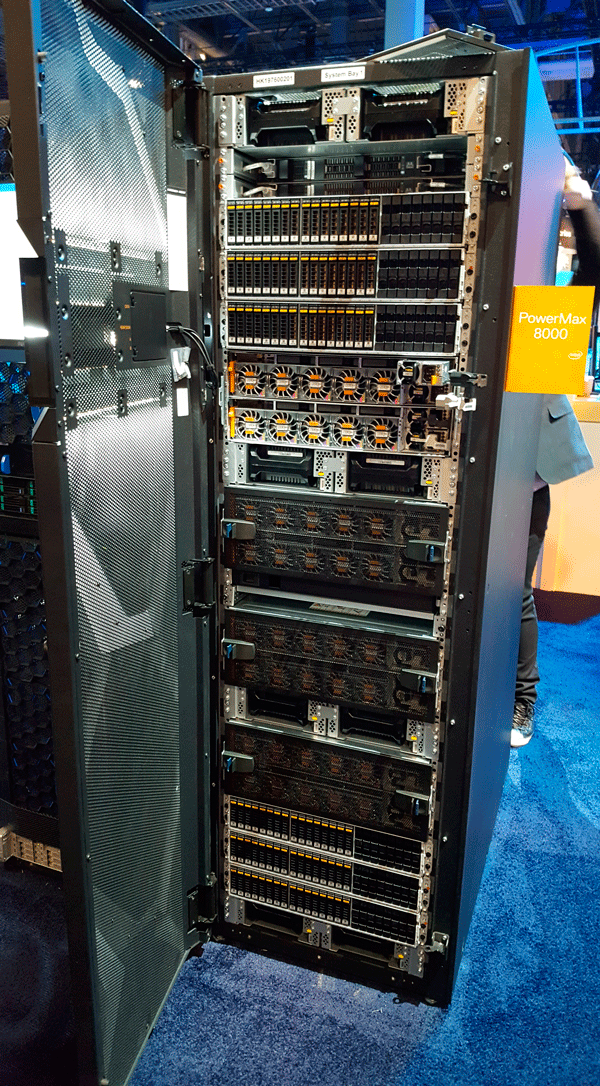
Dell Technology World 2018 PowerMax Front View
Front view of Dell PowerMax

Besides resiliency, data services along with data protection, Dell is claiming PowerMax is 2x faster than their nearest high-end storage system competitors with up to 150GB/sec (e.g., 1,200Gbps) of bandwidth, as well as up to 10 million IOPS with 50% lower latency compared to previous VMAX.

PowerMax is also a full end to end NVMe ready (both back-end and front-end). Back-end includes NVMe drives, devices, shelves, and enclosures) as well as front-end (future NVMe over Fabrics, e.g., NVMeoF). Being NVMeoF ready enables PowerMax to support future front-end server network connectivity options to traditional SAN Fibre Channel (FC), iSCSI among others.

PowerMax is also ready for new, emerging high speed, low-latency storage class memory (SCM).  SCM is the next generation of persistent memories (PMEM) having performance closer to traditional DRAM while persistence of flash SSD. Examples of SCM technologies entering the market include Intel Optane based on 3D XPoint, along with others such as those from Everspin among others.
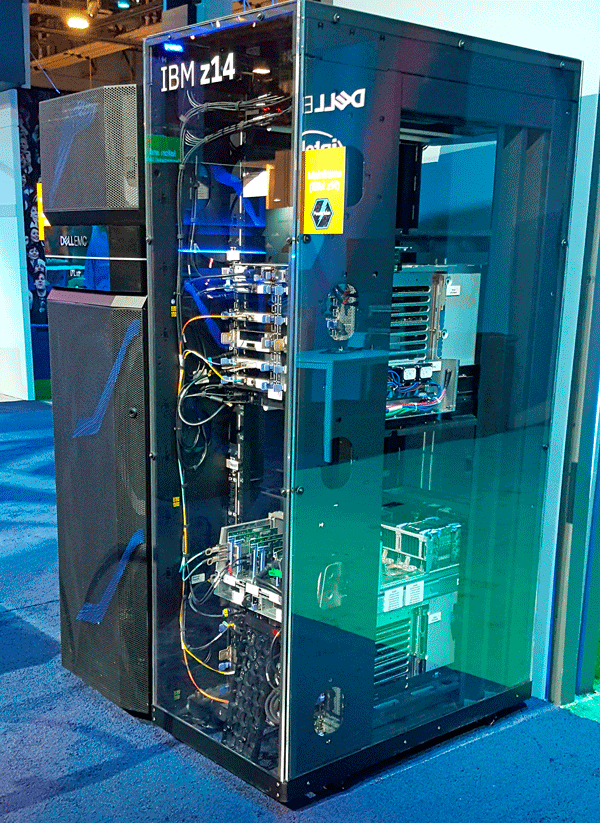
IBM Z Zed Mainframe at Dell Technology World 2018
An IBM “Zed” Mainframe (in case you have never seen one)

Based on the performance claims, the Dell PowerMax has an interesting if not potentially industry leading power, performance, availability, capacity, economic footprint per cubic foot (or meter). It will be interesting to see some third-party validation or audits of Dell claims. Likewise, I look forward to seeing some real-world applied workloads of Dell PowerMax vs. other storage systems. Here are some additional perspectives Via SearchStorage: Dell EMC all-flash PowerMax replaces VMAX, injects NVMe


Dell PowerMax Visual Studio (Image via Dell.com)

To help with customer decision making, Dell has created an interactive VMAX and PowerMax configuration studio that you can use to try out as well as learn about different options here. View more Dell PowerMax speeds, feeds, slots, watts, features and functions here (PDF).
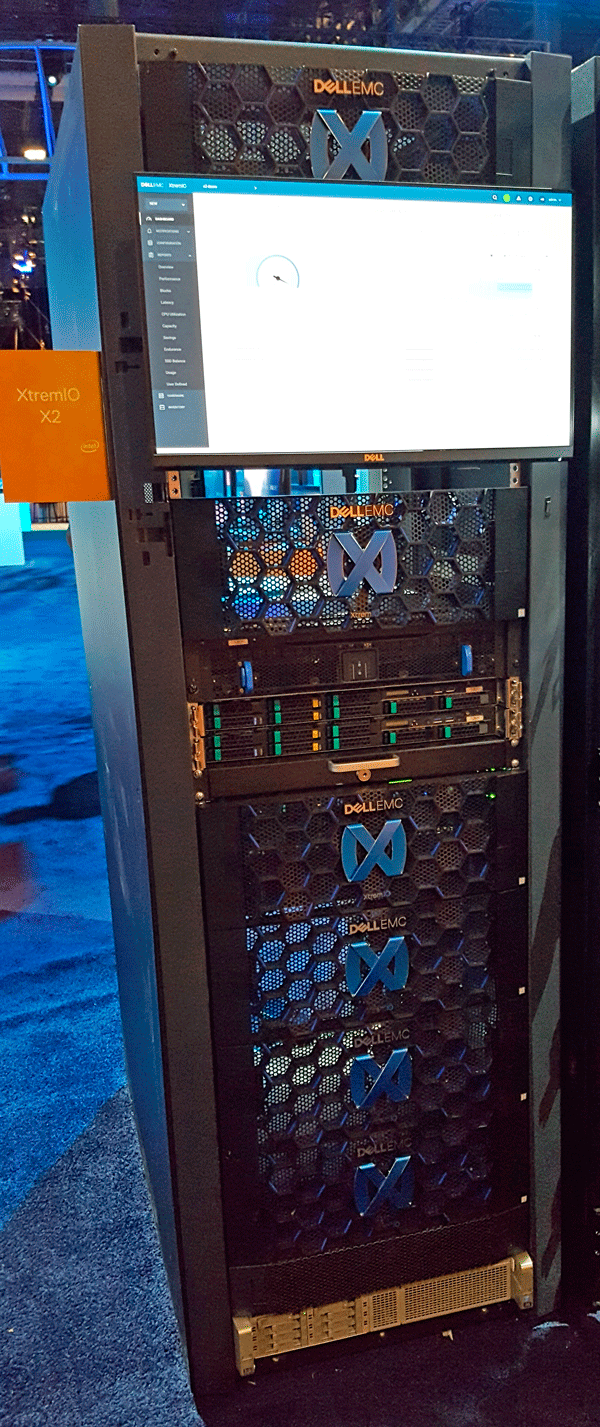
Dell Technology World 2018 XtremIO X2

XtremIO X2

Dell XtremIO X2 and XIOS 6.1 operating system (software-defined storage) enhanced with native replication across wide area networks (WAN). The new WAN replication is metadata-aware native to the XtremIO X2 that implements data footprint reduction (DFR) technology reducing the amount of data sent over network connections. The benefit is more data moved in a given amount of time along with better data protection requiring less time (and network) by only moving unique changed data.
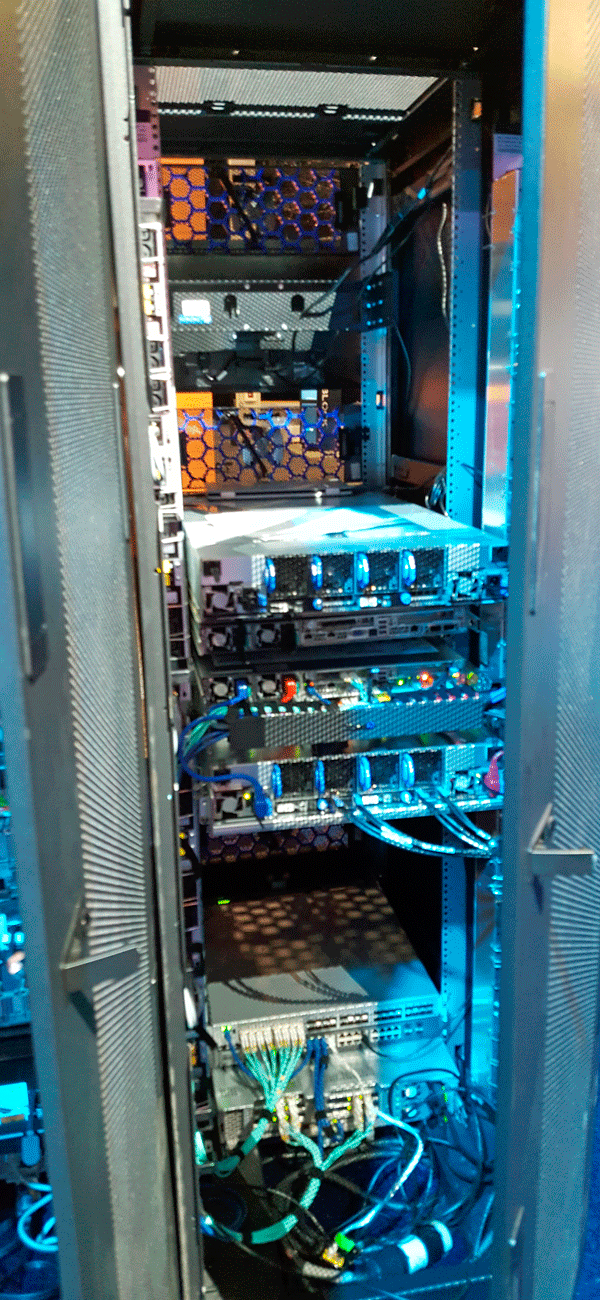
Dell Technology World 2018 XtremIO X2 back view
Back View of XtremIO X2

Dell EMC claims to reduce WAN network bandwidth by up to 75% utilizing the new native XtremIO X2 native asynchronous replication. Also, Dell says XtremIO X2 requires up to 38% less storage space at disaster recovery and business resiliency locations while maintaining predictable recovery point objectives (RPO) of 30 seconds. Another XtremIO X2 announcement is a new entry model for customers at up to 55% lower cost than previous product generations. View more information about Dell XtremIO X2 here, along with speeds feeds here, here, as well as here.

What about Dell Midrange Storage Unity and SC?

Here are some perspectives Via SearchStorage: Dell EMC midrange storage keeps its overlapping arrays.

Dell Bulk and Elastic Cloud Storage (ECS)

One of the questions I had going into Dell Technology World 2018 was what is the status of ECS (and its predecessors Atmos as well as Centera) bulk object storage is given lack of messaging and news around it. Specifically, my concern was that if ECS is the platform for storing and managing data to be preserved for the future, what is the current status, state as well as future of ECS.

In conversations with the Dell ECS folks, ECS which has encompassed Centera functionality and it (ECS) is very much alive, stay tuned for more updates. Also, note that Centera has been EOL. However, its feature functionality has been absorbed by ECS meaning that data preserved can now be managed by ECS. While I can not divulge the details of some meeting discussions, I can say that I am comfortable (for now) with the future directions of ECS along with the data it manages, stay tuned for updates.

Dell Data Protection

What about Data Protection? Security was mentioned in several different contexts during Dell Technology World 2018, as was a strong physical security presence seen at the Palazzo and Sands venues. Likewise, there was a data protection presence at Dell Technologies World 2018 in the expo hall, as well as with various sessions.

What was heard was mainly around data protection management tools, hybrid, as well as data protection appliances and data domain-based solutions. Perhaps we will hear more from Dell Technologies World in the future about data protection related topics.

Where to learn more

Learn more about Dell Technology World 2018 and related topics via the following links:

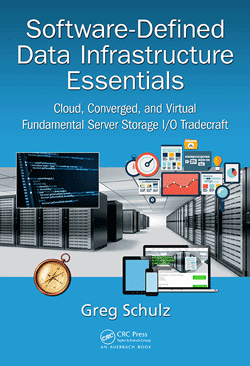
Additional learning experiences along with common questions (and answers), as well as tips can be found in Software Defined Data Infrastructure Essentials book.

Software Defined Data Infrastructure Essentials Book SDDC

What this all means

If there was any doubt about would Dell keep EMC storage progressing forward, the above announcements help to show some examples of what they are doing. On the other hand, lets stay tuned to see what news and updates appear in the future pertaining to mid-range storage (e.g. Unity and SC) as well as Isilon, ScaleIO, Data Protection platforms as well as software among other technologies.

Continue reading part IV (PowerEdge MX Composable and Gen-Z) here in this series, as well as part I here, part II here, part IV (PowerEdge MX Composable) here, and, part V here.

Ok, nuff said, for now.

Cheers Gs

Greg Schulz – Microsoft MVP Cloud and Data Center Management, VMware vExpert 2010-2017 (vSAN and vCloud). Author of Software Defined Data Infrastructure Essentials (CRC Press), as well as Cloud and Virtual Data Storage Networking (CRC Press), The Green and Virtual Data Center (CRC Press), Resilient Storage Networks (Elsevier) and twitter @storageio. Courteous comments are welcome for consideration. First published on https://storageioblog.com any reproduction in whole, in part, with changes to content, without source attribution under title or without permission is forbidden.

All Comments, (C) and (TM) belong to their owners/posters, Other content (C) Copyright 2006-2026 Server StorageIO and UnlimitedIO. All Rights Reserved. StorageIO is a registered Trade Mark (TM) of Server StorageIO.

Part IV Dell Technology World 2018 PowerEdge MX Gen-Z Composable Infrastructure

Part IV Dell Technology World 2018 PowerEdge MX Gen-Z Composable Infrastructure

Part IV Dell Technology World 2018 PowerEdge MX Gen-Z Composable Infrastructure
This is Part IV Dell Technology World 2018 PowerEdge MX Gen-Z Composable Infrastructure that is part of a five-post series (view part I here, part II here, part III here and part V here). Last week (April 30-May 3) I traveled to Las Vegas Nevada (LAS) to attend Dell Technology World 2018 (e.g., DTW 2018) as a guest of Dell (that is a disclosure btw).

Introducing PowerEdge MX Composable Infrastructure (the other CI)

Dell announced at Dell Technology World 2018 a preview of the new PowerEdge MX (kinetic) family of data infrastructure resource servers. PowerEdge MX is being developed to meet the needs of resource-centric data infrastructures that require scalability, as well as performance availability, capacity, economic (PACE) flexibility for diverse workloads. Read more about Dell PowerEdge MX, Gen-Z and composable infrastructures (the other CI) here.

Some of the workloads being targeted by PowerEdge MX include large-scale dense SDDC virtualization (and containers), private (or public clouds by service providers). Other workloads include AI, ML, DL, data analytics, HPC, SC, big data, in-memory database, software-defined storage (SDS), software-defined networking (SDN), network function virtualization (NFV) among others.

The new PowerEdge MX previewed will be announced later in 2018 featuring a flexible, decomposable, as well as composable architecture that enables resources to be disaggregated and reassigned or aggregated to meet particular needs (e.g., defined or composed). Instead of traditional software defined virtualization carving up servers in smaller virtual machines or containers to meet workload needs, PowerEdge MX is part of a next-generation approach to enable server resources to be leveraged at a finer granularity.

For example, today an entire server including all of its sockets, cores, memory, PCIe devices among other resources get allocated and defined for use. A server gets defined for use by an operating system when bare metal (or Metal as a Service) or a hypervisor. PowerEdge MX (and other platforms expected to enter the market) have a finer granularity where with a proper upper layer (or higher altitude) software resources can be allocated and defined to meet different needs.

What this means is the potential to allocate resources to a given server with more granularity and flexibility, as well as combine multiple server’s resources to create what appears to be a more massive server. There are vendors in the market who have been working on and enabling this type of approach for several years ranging from ScaleMP to startup Liqid and Tidal among others. However, at the heart of the Dell PowerEdge MX is the new emerging Gen-Z technology.

If you are not familiar with Gen-Z, add it to your buzzword bingo lineup and learn about it as it is coming your way. A brief overview of Gen-Z consortium and Gen-Z material and primer information here. A common question is if Gen-Z is a replacement for PCIe which for now is that they will coexist and complement each other. Another common question is if Gen-Z will replace Ethernet and InfiniBand and the answer is for now they complement each other. Another question is if Gen-Z will replace Intel Quick Path and another CPU device and memory interconnects and the answer is potentially, and in my opinion, watch to see how long Intel drags its feet.

Note that composability is another way of saying defined without saying defined, something to pay attention too as well as have some vendor fun with. Also, note that Dell is referent to PowerEdge MX and Kinetic architecture which is not the same as the Seagate Kinetic Ethernet-based object key value accessed drive initiative from a few years ago (learn more about Seagate Kinetic here). Learn more about Gen-Z and what Dell is doing here.

Where to learn more

Learn more about Dell Technology World 2018 and related topics via the following links:

Additional learning experiences along with common questions (and answers), as well as tips can be found in Software Defined Data Infrastructure Essentials book.

Software Defined Data Infrastructure Essentials Book SDDC

What this all means

Dell has provided a glimpse of what they are working on pertaining composable infrastructure, the other CI, as well as Gen-Z and related next generation of servers with PowerEdge MX as well as Kinetic. Stay tuned for more about Gen-Z and composable infrastructures. Continue reading Part V (servers converged) in this series here, as well as part I here, part II here and part III here.

Ok, nuff said, for now.

Cheers Gs

Greg Schulz – Microsoft MVP Cloud and Data Center Management, VMware vExpert 2010-2017 (vSAN and vCloud). Author of Software Defined Data Infrastructure Essentials (CRC Press), as well as Cloud and Virtual Data Storage Networking (CRC Press), The Green and Virtual Data Center (CRC Press), Resilient Storage Networks (Elsevier) and twitter @storageio. Courteous comments are welcome for consideration. First published on https://storageioblog.com any reproduction in whole, in part, with changes to content, without source attribution under title or without permission is forbidden.

All Comments, (C) and (TM) belong to their owners/posters, Other content (C) Copyright 2006-2026 Server StorageIO and UnlimitedIO. All Rights Reserved. StorageIO is a registered Trade Mark (TM) of Server StorageIO.

HPE Announces AMD Powered Gen 10 ProLiant DL385 For Software Defined Workloads

HPE Announces AMD Powered Gen 10 ProLiant DL385 For Software Defined Workloads

server storage I/O data infrastructure trends

By Greg Schulzwww.storageioblog.com November 20, 2017

HPE Announced today a new AMD EPYC 7000 Powered Gen 10 ProLiant DL385 for Software Defined Workloads including server virtualization, software-defined data center (SDDC), software-defined data infrastructure (SDDI), software-defined storage among others. These new servers are part of a broader Gen10 HPE portfolio of ProLiant DL systems.

HPE AMD EPYC Gen10 DL385
24 Small Form Factor Drive front view DL385 Gen 10 Via HPE

The value proposition being promoted by HPE of these new AMD powered Gen 10 DL385 servers besides supporting software-defined, SDDI, SDDC, and related workloads are security, density and lower price than others. HPE is claiming with the new AMD EPYC system on a chip (SoC) processor powered Gen 10 DL385 that it is offering up to 50 percent lower cost per virtual machine (VM) than traditional server solutions.

About HPE AMD Powered Gen 10 DL385

HPE AMD EPYC 7000 Gen 10 DL385 features:

  • 2U (height) form factor
  • HPE OneView and iLO management
  • Flexible HPE finance options
  • Data Infrastructure Security
  • AMD EPYC 7000 System on Chip (SoC) processors
  • NVMe storage (Embedded M.2 and U.2/8639 Small Form Factor (SFF) e.g. drive form factor)
  • Address server I/O and memory bottlenecks

These new HPE servers are positioned for:

  • Software Defined, Server Virtualization
  • Virtual Desktop Infrastructure (VDI) workspaces
  • HPC, Cloud and other general high-density workloads
  • General Data Infrastructure workloads that benefit from memory-centric or GPUs

Different AMD Powered DL385 ProLiant Gen 10 Packaging Options

Common across AMD EPYC 7000 powered Gen 10 DL385 servers are 2U high form factor, iLO management software and interfaces, flexible LAN on Motherboard (LOM) options, MicroSD (optional dual MicroSD), NVMe (embedded M.2 and SFF U.2) server storage I/O interface and drives, health and status LEDs, GPU support, single or dual socket processors.

HPE AMD EPYC Gen10 DL385 Look Inside
HPE DL385 Gen10 Inside View Via HPE

HPE AMD EPYC Gen10 DL385 Rear View
HPE DL385 Gen10 Rear View Via HPE

Other up to three storage drive bays, support for Large Form Factor (LFF) and Small Form Factor (SFF) devices (HDD and SSD) including SFF NVMe (e.g., U.2) SSD. Up to 4 x Gbe NICs, PCIe riser for GPU (optional second riser requires the second processor). Other features and options include HPE SmartArray (RAID), up to 6 cooling fans, internal and external USB 3. Optional universal media bay that can also add a front display, optional Optical Disc Drive (ODD), optional 2 x U.2 NVMe SFF SSD. Note media bay occupies one of three storage drive bays.

HPE AMD EPYC Gen10 DL385 Form Factor
HPE DL385 Form Factor Via HPE

Up to 3 x Drive Bays
Up to 12 LFF drives (2 per bay)
Up to 24 SFF drives ( 3 x 8 drive bays, 6 SFF + 2 NVMe U.2 or 8 x NVMe)

AMD EPYC 7000 Series

The AMD EPYC 7000 series is available in the single and dual socket. View additional AMD EPYC speeds and feeds in this data sheet (PDF), along with AMD server benchmarks here.

HPE AMD EPYC Specifications
HPE DL385 Gen 10 AMD EPYC Specifications Via HPE

AMD EPYC 7000 General Features

  • Single and dual socket
  • Up to 32 cores, 64 threads per socket
  • Up to 16 DDR4 DIMMS over eight channels per socket (e.g., up to 2TB RAM)
  • Up to 128 PCIe Gen 3 lanes (e.g. combination of x4, x8, x16 etc)
  • Future 128GB DIMM support

AMD EPYC 7000 Security Features

  • Secure processor and secure boot for malware rootkit protection
  • System memory encryption (SME)
  • Secure Encrypted Virtualization (SEV) hypervisors and guest virtual machine memory protection
  • Secure move (e.g., encrypted) between enabled servers

Where To Learn More

Learn more about Data Infrastructure and related server technology, trends, tools, techniques, tradecraft and tips with the following links.

  • AMD EPYC 7000 System on Chip (SoC) processors
  • Gen10 HPE portfolio and ProLiant DL systems.
  • Various Data Infrastructure related news commentary, events, tips and articles
  • Data Center and Data Infrastructure industry links
  • Data Infrastructure server storage I/O network Recommended Reading List Book Shelf
  • Software Defined Data Infrastructure Essentials (CRC 2017) Book
  • What This All Means

    With the flexible options including HDD, SSD as well as NVMe accessible SSDs, large memory capacity along with computing cores, these new solutions provide good data infrastructure server density (e.g., CPU, memory, I/O, storage) per cubic foot or meter per cost.

    I look forward to trying one of these systems out for software-defined scenarios including virtualization, software-defined storage (SDS) among others workload scenarios. Overall the HPE announcement of the new AMD EPYC 7000 Powered Gen 10 ProLiant DL385 looks to be a good option for many environments.

    Ok, nuff said, for now.

    Gs

    Greg Schulz – Microsoft MVP Cloud and Data Center Management, VMware vExpert 2010-2017 (vSAN and vCloud). Author of Software Defined Data Infrastructure Essentials (CRC Press), as well as Cloud and Virtual Data Storage Networking (CRC Press), The Green and Virtual Data Center (CRC Press), Resilient Storage Networks (Elsevier) and twitter @storageio. Courteous comments are welcome for consideration. First published on https://storageioblog.com any reproduction in whole, in part, with changes to content, without source attribution under title or without permission is forbidden.

    All Comments, (C) and (TM) belong to their owners/posters, Other content (C) Copyright 2006-2026 Server StorageIO and UnlimitedIO. All Rights Reserved. StorageIO is a registered Trade Mark (TM) of Server StorageIO.

    Cloud Conversations AWS Azure Service Maps via Microsoft

    Cloud Conversations AWS Azure Service Maps via Microsoft

    server storage I/O data infrastructure trends

    Updated 1/21/2018

    Microsoft has created an Amazon Web Service AWS Azure Service Map. The AWS Azure Service Map is a list created by Microsoft looks at corresponding services of both cloud providers.

    Azure AWS service map via Microsoft.com
    Image via Azure.Microsoft.com

    Note that this is an evolving work in progress from Microsoft and use it as a tool to help position the different services from Azure and AWS.

    Also note that not all features or services may not be available in different regions, visit Azure and AWS sites to see current availability.

    As with any comparison they are often dated the day they are posted hence this is a work in progress. If you are looking for another Microsoft created why Azure vs. AWS then check out this here. If you are looking for an AWS vs. Azure, do a simple Google (or Bing) search and watch all the various items appear, some sponsored, some not so sponsored among others.

    Whats In the Service Map

    The following AWS and Azure services are mapped:

    • Marketplace (e.g. where you select service offerings)
    • Compute (Virtual Machines instances, Containers, Virtual Private Servers, Serverless Microservices and Management)
    • Storage (Primary, Secondary, Archive, Premium SSD and HDD, Block, File, Object/Blobs, Tables, Queues, Import/Export, Bulk transfer, Backup, Data Protection, Disaster Recovery, Gateways)
    • Network & Content Delivery (Virtual networking, virtual private networks and virtual private cloud, domain name services (DNS), content delivery network (CDN), load balancing, direct connect, edge, alerts)
    • Database (Relational, SQL and NoSQL document and key value, caching, database migration)
    • Analytics and Big Data (data warehouse, data lake, data processing, real-time and batch, data orchestration, data platforms, analytics)
    • Intelligence and IoT (IoT hub and gateways, speech recognition, visualization, search, machine learning, AI)
    • Management and Monitoring (management, monitoring, advisor, DevOps)
    • Mobile Services (management, monitoring, administration)
    • Security, Identity and Access (Security, directory services, compliance, authorization, authentication, encryption, firewall
    • Developer Tools (workflow, messaging, email, API management, media trans coding, development tools, testing, DevOps)
    • Enterprise Integration (application integration, content management)

    Down load a PDF version of the service map from Microsoft here.

    Where To Learn More

    Learn more about related technology, trends, tools, techniques, and tips with the following links.

    Additional learning experiences along with common questions (and answers), as well as tips can be found in Software Defined Data Infrastructure Essentials book.

    Software Defined Data Infrastructure Essentials Book SDDC

    What This All Means

    On one hand this can and will likely be used as a comparison however use caution as both Azure and AWS services are rapidly evolving, adding new features, extending others. Likewise the service regions and site of data centers also continue to evolve thus use the above as a general guide or tool to help map what service offerings are similar between AWS and Azure.

    By the way, if you have not heard, its Blogtober, check out some of the other blogs and posts occurring during October here.

    Ok, nuff said, for now.

    Gs

    Greg Schulz – Microsoft MVP Cloud and Data Center Management, VMware vExpert 2010-2017 (vSAN and vCloud). Author of Software Defined Data Infrastructure Essentials (CRC Press), as well as Cloud and Virtual Data Storage Networking (CRC Press), The Green and Virtual Data Center (CRC Press), Resilient Storage Networks (Elsevier) and twitter @storageio. Courteous comments are welcome for consideration. First published on https://storageioblog.com any reproduction in whole, in part, with changes to content, without source attribution under title or without permission is forbidden.

    All Comments, (C) and (TM) belong to their owners/posters, Other content (C) Copyright 2006-2026 Server StorageIO and UnlimitedIO. All Rights Reserved. StorageIO is a registered Trade Mark (TM) of Server StorageIO.

    Hot Popular New Trending Data Infrastructure Vendors To Watch

    Hot Popular New Trending Data Infrastructure Vendors To Watch

    server storage I/O data infrastructure trends

    Updated 1/21/2018

    A common question I get asked is who are the hot popular new trending data infrastructure vendors to watch. This post looks at some data infrastructure vendors to watch and keep an eye on.

    Keep in mind that there is a difference between industry adoption and customer deployment, the former being what the industry (e.g. Vendors, resellers, integrators, investors, consultants, analyst, press, media, analysts, bloggers or other influences) like, want and need to talk about. Then there is customer adoption and deployment which is what is being bought, installed and used.

    Some Popular Trending Vendors To Watch

    The following is far from an exhaustive list however here are some that come to mind that I’m watching.

    Apcera – Enterprise class containers and management tools
    AWS – Rolls our new services like a startup with size momentum of a legacy player
    Blue Medora – Data Infrastructure insight, software defined management
    Broadcom – Avago/LSI, legacy Broadcom, Emulex, Brocade acquisition interesting portfolio
    Chelsio – Server, storage and data Infrastructure I/O technologies
    Commvault – Data protection and backup solutions
    Compuverde – Software defined storage
    Data Direct Networks (DDN) – Scale out and high performance storage
    Datadog – Software defined management, data infrastructure insight, analytics, reporting
    Datrium – Converged software defined data infrastructure solutions
    Dell EMC Code – Rexray container persistent storage management
    Docker – Container and management tools
    E8 Storage – NVMe based storage solutions
    Elastifile – Scale out software defined storage and file system
    Enmotus – MicroTiering that works with Windows, Linux and various cloud platforms
    Everspin – storage class memories and NVDIMM
    Excelero – NVMe based storage
    Hedvig – Scale out software defined storage
    Huawei – While not common in the US, in Europe and elsewhere they are gaining momentum
    Intel – Watch what they do with Optane and storage class memories
    Kubernetes – Container software defined management
    Liqid – Stealth Colorado startup focusing on PCIe fabrics and composable infrastructure
    Maxta – Hyper converged infrastructure (HCI) and software defined data infrastructure vendor
    Mellanox – While not a startup, keep an eye on what they are doing with their adapters
    Micron – Watch what they do with 3D XPoint storage class memory and SSD
    Microsoft – Not a startup, however keep an eye on Azure, Azure Stack, Window Server with S2D, ReFS, tiering, CI/HCI as well as Linux services on Windows.
    Minio – Software defined storage solutions
    NetApp – While FAS/Ontap and Solidfire get the headlines, E series generates revenue, keep an eye on StorageGrid and AltaVault
    Neuvector – Container management and security
    Noobaa – Software defined storage and more
    NVIDA – No longer just another graphics process unit based company
    Pivot3 – An original HCI software defined players, granted, some of their competitors might not think so
    Pluribus Networks – Software Defined Networks for Software Defined Data Infrastructures
    Portwork – Container management and persistent storage
    Rozo Systems – Scale out software defined storage and file system
    Rubrik – Data Protection software, reminds me of a startup called Commvault 20 years ago.
    ScaleMP – Composable scale out software defined servers
    Storpool – Scale out software defined storage
    Stratoscale – Software defined data infrastructure and hybrid solutions
    SUSE – Linux distribution looking to expand their offerings, gain more insight
    Tidalscale – Composable software defined data infrastructures
    Turbonomic – Software Defined Management, insight, analytics and automation
    Ubuntu – Known for their Linux distribution, check out their Metal as a Service (MaaS) technology
    Veeam – Data protection and backup solutions
    technology
    Virtuozzo – Software defined storage and data infrastructure technologies
    VMware – AWS, vSAN, NSX, Integrated Containers and much more
    WekaIO – Scale out software defined storage and file system

    Some Popular Trending Technology Trends

    • ARM, ASIC, FPGA, GPU servers among others
    • Converged Infrastructure (CI), Hyper Converged Infrastructure (HCI), Composable Infrastructure
    • Analytics, reporting, insight, machine learning (ML), artificial intelligence (AI), automation
    • Software Defined including Cloud, Virtual, Containers, Docker, kubernetes, mesos, serverless, micro services
    • Data protection, backup/restore, archive, security, business resiliency (BR), business continuance (BC), disaster recovery (DR)
    • Non-volatile memory (NMV), NVM Express (NVMe), storage class memories (SCM), persistent memory, nand flash, SSD

    Where To Learn More

    Learn more about related technology, trends, tools, techniques, and tips with the following links.

    Data Infrastructures Protect Preserve Secure and Serve Information
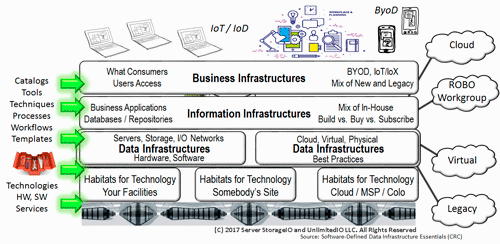
    Various IT and Cloud Infrastructure Layers including Data Infrastructures

    Additional learning experiences along with common questions (and answers), as well as tips can be found in Software Defined Data Infrastructure Essentials book.

    Additional learning experiences along with common questions (and answers), as well as tips can be found in Software Defined Data Infrastructure Essentials book.

    Software Defined Data Infrastructure Essentials Book SDDC

    What This All Means

    There are always more hot popular new or trending data infrastructure vendors to watch, which ones are you keeping an eye on?

    Ok, nuff said, for now.

    Gs

    Greg Schulz – Microsoft MVP Cloud and Data Center Management, VMware vExpert 2010-2017 (vSAN and vCloud). Author of Software Defined Data Infrastructure Essentials (CRC Press), as well as Cloud and Virtual Data Storage Networking (CRC Press), The Green and Virtual Data Center (CRC Press), Resilient Storage Networks (Elsevier) and twitter @storageio. Courteous comments are welcome for consideration. First published on https://storageioblog.com any reproduction in whole, in part, with changes to content, without source attribution under title or without permission is forbidden.

    All Comments, (C) and (TM) belong to their owners/posters, Other content (C) Copyright 2006-2026 Server StorageIO and UnlimitedIO. All Rights Reserved. StorageIO is a registered Trade Mark (TM) of Server StorageIO.

    Dell EMC World 2017 Day One news announcement summary

    server storage I/O trends

    Dell EMC World 2017 Day One news announcement summary

    This is the first day of the first combined Dell EMC World 2017 being held in Las Vegas Nevada. Last year’s event in Las Vegas was the end of the EMC World, while this being the first of the combined Dell EMC World events that succeeded its predecessors.

    What this means is an expanded focus because of the new Dell EMC that has added servers among other items to the event focus. Granted, EMC had been doing servers via its VCE and converged divisions, however with the Dell EMC integration completed as of last fall, the Dell Server group is now part of the Dell EMC organization.

    The central theme of this Dell EMC world is REALIZE with a focus on four pillars:

    • Digital Transformation (Pivotal focus) of applications
    • IT Transformation (Dell EMC, Virtustream, VMware) data center modernization
    • Workforce transformation (Dell Client Solutions) devices from mobile to IoT
    • Information Security (RSA and Secureworks)

    software defined data infrastructures SDDI and SDDC

    What Did Dell EMC Announce Today

    Note that while there are focus areas of the different Dell Technologies business units aligned to the pillars, there is also leveraging across those areas and groups. For example, VMware NSX spans into security, and  PowerEdge servers span into other pillars as a core data infrastructure building block.

    What Dell EMC and Dell Technologies announced today.

    • Wave of Innovations to help customers realize digital transformation
    • New 14th generation PowerEdge Servers that are core building blocks for data infrastructures
    • Flexible consumption models (financing and more) from desktop to data center
    • Hyper-Converged Infrastructure (HCI), Converged (CI) and Cloud like systems
    • New All-Flash (ADA) SSD Storage Systems (VMAX, XtremIO X2, Unity, SC, Isilon)
    • Integrated Data Protection Appliance (IDPA) and Cloud Protection solutions
    • Using Gen14 servers several Software Defined Storage (SDS) enhancements
    • Open Networking and software-defined networks (SDN) with 25G
    • Last week Dell EMC announced Microsoft Azure Stack hybrid cloud solutions

    New 14th generation PowerEdge Servers that are core building blocks for data infrastructures

    Dell EMC has announced the 14th generation of Intel-powered Dell EMC PowerEdge server portfolio systems. These includes servers that get defined with software for software-defined data centers (SDDC), software-defined data infrastructures (SDDI) for the cloud, virtual, the container as well as storage among other applications. Target application workloads and environments range from high-performance compute (HPC), and high-productivity (or profitability) compute (the other HPC), super compute (SC), little data and big data analytics, legacy and emerging business applications as well as cloud and beyond. Enhancements besides new Intel processor technology includes enhanced iDRAC, OpenManage, REST interface, QuickSync, Secure Boot among other management, automation, security, performance, and capacity updates.

    Other Dell EMC enhancements with Gen14 include support for various NVDIMM to enable persistent memory also known as storage class memories such as 3D Xpoint among others. Note at this time, Dell EMC is not saying much about speeds, feeds and other details, stay tuned for more information on these in the weeks and months to come.

    Dell EMC has also been leaders with deploying NVMe from PCIe flash cards to 8639 U.2 devices such as 2.5” drives. Thus it makes sense to see continued adoption and deployment of those devices along with SAS, SATA support. Note that Broadcom (formerly known as Avago) recently announced the release of their PCIe SAS, SATA and NVMe based adapters.

    The reason this is worth mentioning is that in the past Dell has OEM sourced Avago (formerly known as LSI) based adapters. Given Dell EMC use of NVMe drives, it only makes sense to put two and two together.

    Let’s wait a few months to see what the speeds, feeds, and specifications are to put the rest of the puzzle together. Speaking of NVMe, also look for Dell EMC to also supporting PCIe AIC and U.2 (8639) NVMe devices, also leverage M.2 Next Generation Form Factor (NGFF) aka Gum sticks as boot devices.

    While these are all Intel focused, I would expect Dell EMC not to sit back, instead, watch for what they do with other processors and servers including ARMs among others.

    Increased support for more GPUs to support VDI and other graphic intensive workloads such as video rendering, imaging among others. Part of enhanced GPU support is improvements (multi-vector cooling) to power and cooling including sensing the type of PCIe card, and then adjusting cooling fans and subsequent power draw accordingly. The benefit should be more proper cooling to reduce power to support more work and productivity.

    Flexible consumption models (financing and more) from desktop to data center

    Dell Technologies has announced several financing, procurement, and consumption models with cloud-like flexible options for different IT and data center, along with mobile device technologies. These range from licensing to deployment as a service, consumption and other options via Dell Financial Services (DFS).

    Highlights include:

    • DFS Flex on Demand is available now in select countries globally.
    • DFS Cloud Flex for HCI is available now for Dell EMC VxRail and Dell EMC XC Series and has planned availability for Q3 2017 in Dell EMC VxRack Systems.
    • PC as a Service is available now in select countries globally.
    • Dell EMC VDI Complete Solutions are available now in select countries globally.
    • DFS Flex on Demand is available now in select countries globally.
    • DFS Cloud Flex for HCI is available now for Dell EMC VxRail and Dell EMC XC Series and has planned VxRack systems in Q3 2017.
    • PC as a Service solution is available now in select countries globally.
    • Dell EMC VDI Complete Solutions are available now in select countries.
    • Dell Technologies transformation license agreement (TLA) is available now in select countries

    Hyper-Converged Infrastructure (HCI), Converged (CI) and Cloud like systems

    Enhancements to VxRail system, VxRACK Systems, and XC Series leveraging Del EMC Gen14 PowerEdge servers along with other improvements. Note that this also includes continued support for VMware, Microsoft as well as Nutanix software-defined solutions.

    New All-Flash (ADA) SSD Storage Systems (VMAX, XtremIO X2, Unity, SC, Isilon)

    Storage system enhancements include from high-end (VMAX and XtremIO) to mid-range (Unity and SC) along with scale-out NAS (Isilon)

    Highlights of the announcements include:

    • New VMAX 950F all flash array (AFA)
    • New XtremIO X2 with enhanced software, more powerful hardware
    • New Unity AFA systems
    • New SC5020 midrange hybrid storage
    • New generation of Isilon storage with improved performance, capacity, density

    Integrated Data Protection Appliance (IDPA) and Cloud Protection solutions

    Data protection enhancement highlights include:

    • New Turnkey Integrated Data Protection Appliance (IDPA) with four models (DP5300, DP5800, DP8300, and DP8800) starting at 34 TB usable scaling up to 1PB usable. Data services including encryption, data footprint reduction such as dedupe, remote monitoring, Maintenance service dispatch, along with application integration. Application integration includes MongoDB, Hadoop, MySQL.

    • Enhanced cloud capabilities powered by Data Domain virtual edition (DD VE 3.1) along with data protection suite enable data to be protected too, and restored from Amazon Web Services (AWS) Simple Storage Service (S3) as well as Microsoft Azure.

    Open Networking and software-defined networks (SDN) with 25G

    Dell EMC Open Networking highlights include:

    • Dell EMCs first 25GbE open networking top of rack (TOR) switch including S5100-ON series (With OS10 enterprise edition software) complimenting new PowerEdge Gen14 servers with native 25GbE support. Switches support 100GbE uplinks fabric connectivity for east-west (management) network traffic. Also announced is the S4100-ON series and N1100-ON series that are in addition to recently announce N3100-ON and N2100-ON switches.

    • Dell EMCs first optimized Open Networking platform for unified storage network switching including support for 16Gb/32GB Fibre Channel

    • New Network Function Virtualization (NFV) and IoT advisory consulting services

    Note that Dell EMC is announcing the availability of these networking solutions in Dell Technologies 2018 fiscal year which occurs before the traditional calendar year.

    Using Gen14 servers, several Software Defined Storage (SDS) enhancements

    Dell EMC announced enhancements to their Software Defined Storage (SDS) portfolio that leveraging the PowerEdge 14th generation server portfolio. These improvements include ScaleIO, Elastic Cloud Storage (ECS), IsilonSD Edge and Preview of Project Nautilus.

    Where to learn more

    What this all means

    This is a summary of what has been announced so far on the first morning of the first day of the first new Dell EMC world. Needless to say, there is more detail to look at for the above announcements from speeds, feeds, functionality and related topics that will get addressed in subsequent posts. Overall this is a good set of announcements expanding capabilities of the combined Dell EMC while enhancing existing systems as well as well as solutions.

    Ok, nuff said (for now…)

    Cheers
    Gs

    Greg Schulz – Microsoft MVP Cloud and Data Center Management, VMware vExpert (and vSAN). Author Cloud and Virtual Data Storage Networking (CRC Press), The Green and Virtual Data Center (CRC Press), Resilient Storage Networks (Elsevier) and twitter @storageio. Watch for the spring 2017 release of his new book "Software-Defined Data Infrastructure Essentials" (CRC Press).

    Courteous comments are welcome for consideration. First published on https://storageioblog.com any reproduction in whole, in part, with changes to content, without source attribution under title or without permission is forbidden.

    All Comments, (C) and (TM) belong to their owners/posters, Other content (C) Copyright 2006-2023 Server StorageIO(R) and UnlimitedIO. All Rights Reserved.

    What is DFR or Data Footprint Reduction?

    What is DFR or Data Footprint Reduction?

    What is DFR or Data Footprint Reduction?

    Updated 10/9/2018

    What is DFR or Data Footprint Reduction?

    Data Footprint Reduction (DFR) is a collection of techniques, technologies, tools and best practices that are used to address data growth management challenges. Dedupe is currently the industry darling for DFR particularly in the scope or context of backup or other repetitive data.

    However DFR expands the scope of expanding data footprints and their impact to cover primary, secondary along with offline data that ranges from high performance to inactive high capacity.

    Consequently the focus of DFR is not just on reduction ratios, its also about meeting time or performance rates and data protection windows.

    This means DFR is about using the right tool for the task at hand to effectively meet business needs, and cost objectives while meeting service requirements across all applications.

    Examples of DFR technologies include Archiving, Compression, Dedupe, Data Management and Thin Provisioning among others.

    Read more about DFR in Part I and Part II of a two part series found here and here.

    Where to learn more

    Learn more about data footprint reducton (DFR), data footprint overhead and related topics via the following links:

    Additional learning experiences along with common questions (and answers), as well as tips can be found in Software Defined Data Infrastructure Essentials book.

    Software Defined Data Infrastructure Essentials Book SDDC

    What this all means

    That is all for now, hope you find these ongoing series of current or emerging Industry Trends and Perspectives posts of interest.

    Ok, nuff said, for now.

    Cheers Gs

    Greg Schulz – Microsoft MVP Cloud and Data Center Management, VMware vExpert 2010-2018. Author of Software Defined Data Infrastructure Essentials (CRC Press), as well as Cloud and Virtual Data Storage Networking (CRC Press), The Green and Virtual Data Center (CRC Press), Resilient Storage Networks (Elsevier) and twitter @storageio. Courteous comments are welcome for consideration. First published on https://storageioblog.com any reproduction in whole, in part, with changes to content, without source attribution under title or without permission is forbidden.

    All Comments, (C) and (TM) belong to their owners/posters, Other content (C) Copyright 2006-2026 Server StorageIO and UnlimitedIO. All Rights Reserved. StorageIO is a registered Trade Mark (TM) of Server StorageIO.