The new Green IT: Efficient, Effective, Smart and Productive

Given the buzz about big data and conversations or confusion around clouds along with virtualizing virtually anything possible, Green IT has fallen off the Buzzword Bingo Bandwagon.

Green IT like so many other buzzwords and trends typically go through a hype cycle before getting tired, worn out, or disillusioned (see here and here). Often these buzzwords will go to Some Day Isle for some rest and recuperation before reappearing later as part of a second or third buzzword wave either making it to broad adoption which means the plateau of profitability (for vendors or vars) and productivity (for customers) or disappearing.

Some Day Isle for those not familiar with it is a visional or fictional place that some day you will go to, a wishful happy place so to speak that is perfect for hyperbole R and R. After some R and R, these trends, technologies or techniques often reappear well rested and ready for the next wave of buzz, FUD, hype and activity.

Keep in mind that industry adoption (e.g. everybody is talking about it) can differ from industry deployment (e.g. some people have actually paid for, deployed and using the technology) to broad customer adoption (e.g. many people are actually paying for, deploying and using the technology on a routine basis).

Confusion still reigns around Green IT not surprising given the heavy dose of Green Washing that has occurred.

Consequently Green IT themes or pitches often fall on deaf ears as people have either become numb or ignore the Green washing hype or FUD. For example many people will skip reading this post because the word Green is in the title assuming that it is another CO2 or related themed piece missing out on the other themes or messages here. Unfortunately as I have discussed in the past, there remains a Green Gap that results in missed opportunities for vendors, vars, service providers, IT organizations along with those who would like to see environmental benefits or change.

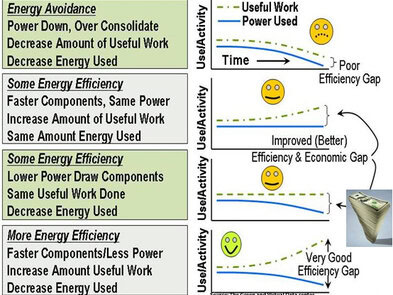
Another example of a Green gap is messaging around energy avoidance as being efficient vs. using energy in a more productive or effective manner (doing more work with the same or fewer resources) shown in the figure below.
Tiered Storage
Expanding focus from energy avoidance to energy usage effectiveness

In routine conversations with IT professionals it is clear that the Green Gap and thus missed opportunities will continue for some time until the business and economic values of efficient, effective, smart and productive IT are understood to have environmental benefits as a by product and thus being Green. Watch for more missed messaging around CO2 and related themes popular with so called Greenies (or if you prefer environmentalists) that miss the mark with most business and IT organizations.

Business and thus IT are driven by economics and as such will invest where they can reduce complexity and costs, become more efficient and effective while increasing productivity and reducing waste by working smarter. In other words, by changing how information services are delivered in a smarter more effective efficient manner maximizes what resources are used enabling more to be done in a denser footprint (budget, people staffing, management, power, cooling, floor space) that have positive environmental benefits. Put another way, a benefit for IT organizations to remove complexity results in lower costs, by becoming more efficient and effective reducing waste results in better productivity and fewer missed opportunities meaning enhanced profits. The net result is that environmental concerns get a free ride or being funded as a result of IT organizations improving their productivity which of course should have a business benefit.

Efficient and Optimized IT Wheel of Oppourtunity
Wheel of Opportunity: Various techniques and technologies for infrastructure optimization

Efficient and effective IT (aka the other Green IT) that links to common technology and business issues with the benefit of helping the environment can be accomplished using a combination approaches. The approaches for enabling an efficient, effective, smarter and productive IT environment includes from a generic perspective various technologies, techniques and best practices shown in the wheel of opportunity figure.

For example:

Here are some related links for additional reading:

Also check out my book for enabling efficient, effective and smart IT The Green and Virtual Data Center (CRC) including a free sample chapter download here.

Ok, nuff said for now, go hug a tree, your computer, hybrid car, droid, ipad or whatever suits your needs.

Cheers gs

Greg Schulz – Author Cloud and Virtual Data Storage Networking (CRC), The Green and Virtual Data Center (CRC), Resilient Storage Networks (Elsevier)
twitter @storageio

All Comments, (C) and (TM) belong to their owners/posters, Other content (C) Copyright 2006-2011 StorageIO and UnlimitedIO All Rights Reserved

The data storage prayer

On a lighter note.

For those who follow or are involved with data storage religiously with a passion, then this is for you. As for others who do not get or understand what this is about, just ask those who are devout data storage followers.

Now I lay my data to sleep
I pray the lord my backups to keep
If a disk should die before I wake
I hope like heck RAID works and my resume is up to date

Nuff said, now get back to work or what ever it was you were doing before reading this and best wishes!

Cheers gs

Greg Schulz – Author The Green and Virtual Data Center (CRC), Resilient Storage Networks (Elsevier) and coming summer 2011 Cloud and Virtual Data Storage Networking (CRC)
twitter @storageio

All Comments, (C) and (TM) belong to their owners/posters, Other content (C) Copyright 2006-2011 StorageIO and UnlimitedIO All Rights Reserved

Is FCoE Struggling to Gain Traction, or on a normal adoption course?

Here is an article by Drew Robb over at Enterprise Storage Forum about Fibre Channel over Ethernet (FCoE) and its state of adoption. Drews article includes comments and perspectives from myself around where FCoE is going and why it is on a long road and not a sprint for a short temporal technology play (e.g. not a quick passing fad or bandwagon trend).

If you measure FCoE adoption in months, sure, its been slow to gain adoption and deployment similar to how Ethernet, Fibre Channel (FC) and even iSCSI took time to evolve. Part of the time involved is for developing the standards, implementing the technology as well as expanding the capabilities of the new tools. Another part of the time required for technologies that are targeted to be around for a decade or more include ecosystem maturity, education not to mention customers being comfortable with along with having budget to buy the new items.

I have previously said that FCoE was in the trough of disillusionment and depending on your view, that could be either entering, exiting or there to stay. Not surprisingly some cheerleaders thought that saying FCoE was in the trough of disillusionment was being cynical, while some cynics were cheerleading.

My point around FCoE is that any technology or paradigm that goes through a hype cycle that will actually have long term legs or be around for years if not decades goes through a post initial hype disillusionment phase before reappearing. Technologies or trends that go through the trough of disillusionment that will eventually reappear sometimes go to Some Day Isle for rest and relaxation (R and R). Some Day Isle for those not familiar with it is a visional or fictional place that some day you will go to, a wishful happy place so to speak that is perfect for hyperbole R and R. After some R and R, these trends, technologies or techniques often reappear well rested and ready for the next wave of buzz, fud, hype and activity.

Certainly there have been and will continue to be more battles or matches tied to early deployments along with plenty of hype or FUD. After all, if FCoE were to simply pack up and go away like some cynics or naysayers suggest, what will they have to talk, blog, write or speak about? Similarly if FCoE magically goes mainstream tomorrow, the cheerleaders will have to find a new bandwagon or Shiny New Toy (SNT) to rally around.

Also as I have said in the past, its not if, rather when FCoE will be deployed in yours or your customers environment along with how and using what tools or technologies. Another question to pose around FCoE as a converged technology is will you use it in a true converged manner meaning adapting how server, storage and networking resources are managed including best practices? Or, will you use FCoE in a hybrid SAN or LAN mode using traditional SAN and LAN management practice and separate teams perhaps even battling over who owns the tools or technology.

Fwiw, in case you did not pick up on it from my previous posts, tips, articles and coverage in books, I think that FCoE has a very bright future as does NAS and iSCSI along with shared SAS as complimentary technologies when used for the applicable scenario.

What is your take, Is FCoE struggling to gain traction?

Is FCoE on a normal technology evolution path and timeline?

Is it too early to tell what the future holds for FCoE?

Is FCoE too little to late and if so why?

Ok, nuff said for now.

Cheers gs

Greg Schulz – Author The Green and Virtual Data Center (CRC), Resilient Storage Networks (Elsevier) and coming summer 2011 Cloud and Virtual Data Storage Networking (CRC)
twitter @storageio

All Comments, (C) and (TM) belong to their owners/posters, Other content (C) Copyright 2006-2011 StorageIO and UnlimitedIO All Rights Reserved

What do you need when its time to buy a new server?

You have been told by someone or determined on your own that it is time for a new server, however what to get?

A blade server, rack mount, floor model, physical or virtual perhaps cloud?

How about one that is fully configured and accessorized to meet your specific environments needs?

There are several considerations involving what type of server or computer is needed to meet your specific needs or application requirements. Options include price, packaging, vendor preferences, blade center, freestanding, 1U rack mount, virtual and cloud support, with or without storage and networking, performance as well as power and cooling among other considerations.

Here is a link (PDF version here, may require registration) to an article that I put together to help determine your needs as well as consider various options for your next server.

Hope you find the information useful!

Nuff said for now

Cheers gs

Greg Schulz – Author The Green and Virtual Data Center (CRC), Resilient Storage Networks (Elsevier) and coming summer 2011 Cloud and Virtual Data Storage Networking (CRC) at https://storageio.com/books
twitter @storageio

Winter 2011 Server and StorageIO News Letter

StorageIO News Letter Image
Winter 2011 Newsletter

Welcome to the Winter 2011 edition of the Server and StorageIO Group (StorageIO) newsletter. This follows the Fall 2011 edition.

You can access this news letter via various social media venues (some are shown below) in addition to StorageIO web sites and subscriptions. Click on the following links to view the Winter 2011 edition as an HTML or PDF or, to go to the newsletter page to view previous editions.

Follow via Goggle Feedburner here or via email subscription here.

You can also subscribe to the news letter by simply sending an email to newsletter@storageio.com

Enjoy this edition of the StorageIO newsletter, let me know your comments and feedback.

Cheers gs

Nuff said for now

Cheers gs

Greg Schulz – Author The Green and Virtual Data Center (CRC), Resilient Storage Networks (Elsevier) and coming summer 2011 Cloud and Virtual Data Storage Networking (CRC)
twitter @storageio

Securing data at rest: Self Encrypting Disks (SEDs)

Here is a link to a recent guest post that I was invited to do over at The Virtualization Practice (TVP) pertaining to Self Encrypting Disk (SEDs).

Based on the trusted computing group (TCG) DriveTrust and OPAL disk drive security models, SEDs offload encryption to the disk drive while complimenting other encryption security solutions to protect against theft or lost storage devices. There is another benefit however for SEDs which is simplifying the process of decommissioning a storage device safely and quickly.

If you are not familiar with them, SEDs perform encryption within the hard disk drive (HDD) itself using the onboard processor and resident firmware. Since SEDs only protect data at rest, other forms of encryption should be combined to protect data in flight or on the move.

There is also another benefit of SEDs in that for those of you concerned about how to digital destroy, shred or erase large capacity disks in the future, you may have a new option. While intended for protecting data, a byproduct is that when a SED is removed from the system or server or controller that it has established an affinity with, its contents are effectively useless until reattached. If the encryption key for a SED is changed, then the data is instantly rendered useless, or at least for most environments.

Learn more about SEDs here and via the following links:

  • Self-Encrypting Drives for IBM System x
  • Trusted Computing Group OPAL Summary
  • Storage Performance Council (SPC) SED and Non SED benchmarks
  • Seagate SED information
  • Trusted Computing Group SED information

Ok, nuff said.

Cheers gs

Greg Schulz – Author Cloud and Virtual Data Storage Networking (CRC Press), The Green and Virtual Data Center (CRC Press) and Resilient Storage Networks (Elsevier)
twitter @storageio

All Comments, (C) and (TM) belong to their owners/posters, Other content (C) Copyright 2006-2026 Server StorageIO and UnlimitedIO LLC All Rights Reserved

What have I been doing this winter?

Its been almost a month since my last post and want to say hello and let you know what I have been doing.

What I have been doing is:

  • Accumulating a long list of ideas for upcoming blog post, article, tips, webinars and other content.
  • Recording some podcasts, web casts doing interviews and commentary along with a few articles here and there.
  • Working with some new venues where if all comes together you should be seeing material or commentary appearing soon.
  • Filling some dates for the 2011 out and about events and activities page.
  • Doing research in several different areas as well as working with clients on various project activities, many of which that are NDA.
  • Getting some recently finished content ready to appear on the main web site as well as in the blog and other venues.
  • Attending vendor events and briefing sessions on solutions some of which are yet to be announced.
  • Enjoying the cold and snowy winter as best as can be (see some videos here) while trying to avoid cold and flue season.

In addition to the above, I have been trying to stay very focused on is getting my new book which is titled Cloud and Virtual Data Storage Networking (CRC) wrapped up for a summer 2011 release. This is my third solo book project that is in addition to co writing or contributing to several other book projects.

Cloud and Virtual Data Storage Networking

Im doing the project the old fashioned way which means writing it myself as opposed to using ghost writers along with a traditional publishing house (CRC, same as my last book) all of which takes a bit more time. For anyone who has done a project like this you know what is involved. For those who have not it includes research, writing, editing, working with editors and copyeditors, subject matter experts doing initial reviews, illustrations and page layouts, markups, more edits and proofs. Then there are the general project management activities along with marketing and rollout plans, companion presentation material working with the publisher and others.

Anyway, hope you are all doing well, look forward to sharing more with you soon, now it is time to get back to work…

Nuff said for now

Cheers gs

Greg Schulz – Author The Green and Virtual Data Center (CRC), Resilient Storage Networks (Elsevier) and coming summer 2011 Cloud and Virtual Data Storage Networking (CRC)
twitter @storageio

Are you on the StorageIO IT Data Infrastructure industry links page?

Hey IT data infrastructure vendors, VARs or service providers, are you on the Server and StorageIO IT industry interesting links page?

Dont worry, its free and no obligation!

There are no hidden charges or fees, you will not be obligated to pay a fee or subscribe to a service, or be called or contacted via a sales or account manager person to buy something. Nor will you be required to sign up for a annual or short term retainer, make a donation, honorarium, endowment, contribution, subsidy, renumerate or sponsor in any other manner directly or via indirect means including second, third, fourth or by way of other virtual means or physical means. This also means via other organizations, venues, institutes, associations, communities, events or causes. (Btw, that is some industry humor some will get however to others that feel it is poking fun of their lively hoods, too bad!)

Your contact information will not be sold, bartered, traded, borrowed or abused being kept confidential nor will you be called or bothered (contact me if somebody does reach out to you). However you may get an occasional Server and StorageIO newsletter sent to you via email (privacy and disclosure statement can be found here).

There is however one small caveat and that is no spamming and direct submissions on yours or your companies behalf. If you are a public relations firm feel free to submit on behalf of your own organization, however have your clients submit on their own (or use their identity when doing so on their own behalf).

Why do I make this links page and list available for free to those who read it, as well as to those who are on it?

Simple, I use it myself to keep a list of companies, firms or organizations that are involved with data infrastructures (servers, storage, I/O and networking, hardware, software, services) that I have come across and worth keeping track of that I also feel worth sharing with others.

Of course, if you feel compelled, you can always contact Server and StorageIO to discuss other services or simply buy one of my books including Resilient Storage Networks: Designing Flexible Scalable Data Infrastructures (Elsevier), The Green and Virtual Data Center (CRC) and coming summer 2011 Cloud and Virtual Data Storage Networking (CRC) at Amazon or one of the other many fine global venues.


Still interested, all you need to do is the following:

No SPAM submission please

Please do not submit via web or blog page unless you want your contact information known to others.

Send an email to links at storageio dot com that includes the following:

1. Your company name
2. Your company URL
3. Your company contact person (you or someone else) including:
Name
Title or position
Phone or Skype
Email
Optional twitter

4. Brief 40 character or less description of what you do, or solution categories (tip, avoid superlatives, see links page for ideas)

5. Optionally indicate to DND (Do Not Disturb) you with email newsletters, coverage or mentions.

Again, please, No Spam!

Its that simple.

Now its up to you to decide if you want to be included or not.

Ok, nuff said.

Cheers gs

Greg Schulz – Author Cloud and Virtual Data Storage Networking (CRC Press), The Green and Virtual Data Center (CRC Press) and Resilient Storage Networks (Elsevier)
twitter @storageio

All Comments, (C) and (TM) belong to their owners/posters, Other content (C) Copyright 2006-2026 Server StorageIO and UnlimitedIO LLC All Rights Reserved

NetApp and Akorri: An E2E cross technology domain SRA play

The other day NetApp announced that it was planning on doing another acquisition following on their recent purchase of Bycast (policy based storage and management software).

This time, NetApp is doing yet another software acquisition of Infrastructure Resource Management (IRM) as well as End to End (E2E) cross technology domain management and Storage or Systems Resource Analysis (SRA) startup Akorri which also builds on its past acquisition of SRA solution Onaro.

Is this a good move by NetApp?

Assuming they got a good price, yes, this has very potential for NetApp assuming they can assimilate the solution as well as articulate where it fits complimenting its other management tools including SANscreen (aka Onaro).

Is Akorii a good product?

Yes, most of the customers and var partners of Akorri that I talk to have great things to say and having looked into the technology, it has lots of good potential for NetApp. However, there is a common theme around Akorri that has been its high price, something that was also heard from Onaro customers before NetApp did that acquisition. If NetApp can leverage its direct as well as partner touch to reduce the cost of sale for Akorri as well as rationalize the pricing or at least better articulate the value proposition to make it a must have vs nice to have, they can do well.

The importance of E2E awareness of IT resources across different technology domains (or focus areas) is that you can not effectively manage what you do not have timely access or visibility into. Hence the theme of session being You cannot effectively manage what you do not know about in a timely manner. I recently did a couple of Industry Trends and Perspectives webcast events around the topic and themes of End to End (E2E) awareness and cross domain (or technology) management insight for cloud, virtual and other abstracted as well as physical IT environments.

Ok, nuff said.

Cheers gs

Greg Schulz – Author Cloud and Virtual Data Storage Networking (CRC Press), The Green and Virtual Data Center (CRC Press) and Resilient Storage Networks (Elsevier)
twitter @storageio

All Comments, (C) and (TM) belong to their owners/posters, Other content (C) Copyright 2006-2026 Server StorageIO and UnlimitedIO LLC All Rights Reserved

E2E Awareness and insight for IT environments

I recently did a couple of Industry Trends and Perspectives webcast events around the topic and themes of End to End (E2E) awareness and cross domain (or technology) management insight for cloud, virtual and other abstracted as well as physical IT environments.

The importance of E2E awareness of IT resources across different technology domains (or focus areas) is that you can not effectively manage what you do not have timely access or visibility into. Hence the theme of session being You cannot effectively manage what you do not know about in a timely manner.

Here is the abstract for the webcast:

Virtualization, clouds and other forms of abstraction help IT organizations enable flexible and scalable services delivery. While abstraction of underlying resources simplifies services delivery from an IT customers perspective, additional layers of technology along with interdependencies still need to be tracked as well as managed.  A key enabler for IT organizations is having end to end (E2E) situational awareness of available resources and how they are being used. By having timely situational awareness across various technology domains, IT organizations gain insight into how resources can be more effectively deployed in an efficient manner.

Join independent IT industry analyst, author and blogger Greg Schulz as he looks at common challenges as well as opportunities for leveraging E2E situational awareness to remove blind spots from efficient effective IT services delivery. Greg will look several scenarios including among others cost reduction, maximize resource usage, shrink migration and data consolidation times for cloud, virtual and traditional IT environments while maintaining or enhancing IT services delivery.

If you are interested in IT Infrastructure Resource Management (IRM) of servers, storage, IO networking, virtualization, cloud, backup or restore, optimization as well as cloud or legacy environments and metrics, I invite you to view the following web cast.

E2E cross domain awareness webcast

Click on the above image to access the BrightTalk web cast from their recent Virtualization Summit series (may require registration)

If you are interested, here is a link to a previous post I did on E2E management, SRA (systems or storage resource analysis) and management insight along with a recent related white paper sponsored by SANpulse that you can access here.

Ok, nuff said.

Cheers gs

Greg Schulz – Author Cloud and Virtual Data Storage Networking (CRC Press), The Green and Virtual Data Center (CRC Press) and Resilient Storage Networks (Elsevier)
twitter @storageio

All Comments, (C) and (TM) belong to their owners/posters, Other content (C) Copyright 2006-2026 Server StorageIO and UnlimitedIO LLC All Rights Reserved

Green IT goes mainstream: What about data storage environments?

I recently did an interview with the folks over at Infortrend (a RAID storage company) discussing various industry trends and perspectives including RAID, data footprint reduction (DFR) as well as Green IT including how the Green Gap.

The Green Gap is the disconnect between common messaging around carbon and environment vs. IT and business productivity sustainment challenges that continues to result in confusion along with missed opportunities.

  • There is no such thing as a data or information recession
  • Organizations of all size will continue to have to support growth in a denser fashion
  • Doing more in a denser manner also means acquiring as well as managing more usable IT resources per dollar spent
  • Optimization and data footprint reduction (DFR) expands focus from reduction efficiency to productivity effectiveness
  • Energy efficiency shifts from avoidance to energy effectiveness where more work is done to support business productivity and sustainment
  • RAID is alive however it continues to evolve as well as leveraged in conjunction with other techniques

Here is the link to the first of a two part series where you can read my comments on how many organizations are missing out on economic as well as business sustainability benefits due to confusion and the Green Gap among other topics.

Ok, nuff said.

Cheers gs

Greg Schulz – Author Cloud and Virtual Data Storage Networking (CRC Press), The Green and Virtual Data Center (CRC Press) and Resilient Storage Networks (Elsevier)
twitter @storageio

All Comments, (C) and (TM) belong to their owners/posters, Other content (C) Copyright 2006-2026 Server StorageIO and UnlimitedIO LLC All Rights Reserved

Dude, is Dell doing a disk deal again with Compellent?

Over in Eden Prairie (Minneapolis Minnesota suburb) where data storage vendor Compellent (CML) is based, they must be singing in the hallways today that it is beginning to feel a lot like Christmas.

Sure we had another dusting of snow this morning here in the Minneapolis area and the temp is actually up in the balmy 20F temperature range (was around 0F yesterday) and holiday shopping is in full swing.

The other reason I think that the Compellent folks are thinking that it feels a lot like Christmas are the reports that Dell is in exclusive talks to buy them at about $29 per share or about $876 million USD.

Dell is no stranger to holiday or shopping sprees, check these posts out as examples:

Dell Will Buy Someone, However Not Brocade (At least for now)

Back to school shopping: Dude, Dell Digests 3PAR Disk storage (we now know Dell was out bid)

Data footprint reduction (Part 2): Dell, IBM, Ocarina and Storwize

Data footprint reduction (Part 1): Life beyond dedupe and changing data lifecycles

Post Holiday IT Shopping Bargains, Dell Buying Exanet?

Did someone forget to tell Dell that Tape is dead?

Now some Compellent fans are not going to be happy with only about $29 a share or about $876 million USD price given the recent stock run up into the $30 plus range. Likewise, some of the Compellent fans may be hoping for or expecting a bidding war to drive the stock back up into the $30 range however keep in mind that it was earlier this year when the stock adjusted itself down into the mid teens.

In the case of 3PAR and the HP Dell budding war, that was a different product and company focused in a different space than where Compellent has a good fit.

Sure both 3PAR and Compellent do Fibre Channel (FC) where Dells EqualLogic only does iSCSI, however a valuation based just on FC would be like saying Dell has all the storage capabilities they need with their MD3000 series that can do SAS, iSCSI and FC.

In other words, there are different storage products for different markets or price bands and customer application needs. Kind of like winter here in Minnesota, sure one type of shovel will work for moving snow or you can leverage different technologies and techniques (tiering) to get the job done effectively the same holds for storage solutions.

Compellent has a good Cadillac product that is a good fit for some SMB environments. However the SMB space is also where Dell has several storage products some of which they own (e.g. EqualLogic), some they OEM (MD3000 series and NX) as well as resell (e.g. EMC CLARiiON).

Can the Compellent product replace the lowered CLARiiON business that Dell has itself been shifting more to their flagship EqualLogic product?

Sure however at the risk of revenue cannibalization or worse, introduction of revenue prevention teams.

Can the Compellent product then be positioned lower down under the EqualLogic product?

Sure, however why hold it back not to mention force a higher priced product down into that market segment.

Can the Compellent product be taken up market to compete above the EqualLogic head to head with the larger CLARiiON systems from EMC or comparable solutions from other vendors?

Sure, however I can hear choruses of its sounding a lot like Christmas from New England, the bay area and Tucson among others.

Does this mean that Dell is being overly generous and that this is not a good deal?

No, not at all.

Sure it is the holiday season and Dell has several billion dollars of cash laying around however that in itself does not guarantee a large handout or government sized bailout (excuse me, infusion). At $30 or more, that would be overly generous simply based on where the technology fits as well as aligns to the market realities. Consequently, at $29, this is a great deal for Compellent and also for Dell.

Why is it a good deal for Dell?

I think that it is as much about Dell getting a good deal (ok, paying a premium) to acquire a competitor that they can use to fill some product gaps where they have common VARs. However I also think that this is very much about the channel and the VAR as much if not more than it is just about a storage product. Servers are part of the game here which in turn supports storage, networking, management tools, backup/recovery, archiving and services.

Sure Dell can maybe take some cost out of the Compellent solution by replacing the Supermicro PCs that are the hardware platform for their storage controllers with Dell servers. However the bigger play is around further developing its channel and VAR ecosystems, some of whom were with EqualLogic before Dell bought them. This can also be seen as a means of Dell getting that partner ecosystem to sell overall, more dell products and solutions instead of those from Apple, EMC, Futjisu, HP, IBM, Oracle and many others.

Likewise, I doubt that Mr. Dell is paying a premium simply to make the Compellent shareholders and fans happy to create monetary velocity to stimulate holiday shopping and economic stimulus. However, for the fans, sure, while drowning your sorrows in egg nogg of holiday cheer that you are not getting $30 or higher, instead buy a round for your mates and toast Dell for your holiday gift.

The real reason I think this is a good reason for Dell is that from a business and financial perspective, assuming they stick to the $29 range, it is a good bargain for both parties. Dell gets a company who has been competing with their EqualLogic product in some cases with the same VARs or resellers. Sure it gets a Fibre Channel based product however Dell already has that with the MD3000 series which I realize is less function laden then Compellent or EqualLogic; however it is also more affordable for a different market.

If Dell can close on the deal sticking to its offer which they have the upper hand on, execute including rolling out a strategy as well as product positioning plan. Then educate their own teams as well as VARs and customers of what products fit where and when in such a manner that does not cause revenue prevention (e.g. one product or team blocking the other) or cannibalization instead expanding markets, they can do well.

While Compellent gets a huge price multiple based on their revenue (about $125M USD), if Dell can get the product revenue up from the $125 to $150 million plateau to around $250 to $300 million without cannibalizing other Dell products, the deal pays for itself in many ways.

Keep in mind that a large pile of cash sitting in the bank these days is not exactly yielding the best returns on investment.

For the Compellent fans and shareholders, congratulations!

You have gotten or perhaps are about to get a good holiday gift so knock of the complaining that you should be getting more. The option is that instead of $28 per share, you could be getting 28 lumps of coal in your Christmas stocking.

For the Dell folks, assuming the deal is done on their terms and that they can quickly rationalize the product overlap, convey and then execute on a strategy while keeping the revenue prevention teams on the sidelines you too have a holiday gift to work with (some assembly will be required however). This also is good for Dell outside of storage which may turn out to be one of the gems of the deal in keeping or expanding VARs selling Dell based servers and associated technologies.

For EMC who was slapped in the face earlier this year when Dell took a run at 3PAR, sure there will be more erosion on the lower end CLARiiOn as has been occurring with the EqualLogic. However Dell still needs a solution to effectively compete with EMC and others at the higher end of the SMB or lower end of the enterprise market.

Sure the EqualLogic or Compellent products could be deployed into such scenarios; however those solutions are then playing on a different field and out of their market sweet spots.

Lets see what happens shall we.

In the meantime, what say you?

Is this a good deal for Dell, who is the deal good for assuming it goes through and at the terms mentioned, what is your take?

Who benefits from this proposed deal?

Note that in the holiday gift giving spirit, Chicago style voting or polling will be enabled.

Ok, nuff said.

Cheers gs

Greg Schulz – Author Cloud and Virtual Data Storage Networking (CRC Press), The Green and Virtual Data Center (CRC Press) and Resilient Storage Networks (Elsevier)
twitter @storageio

All Comments, (C) and (TM) belong to their owners/posters, Other content (C) Copyright 2006-2026 Server StorageIO and UnlimitedIO LLC All Rights Reserved

Fall 2010 StorageIO News Letter

StorageIO News Letter Image
Fall 2010 Newsletter

Welcome to the Fall 2010 edition of the Server and StorageIO Group (StorageIO) newsletter. This follows the August 2010 edition building on the great feedback received from recipients.

You can access this news letter via various social media venues (some are shown below) in addition to StorageIO web sites and subscriptions. Click on the following links to view the Fall 2010 edition as an HTML or PDF or, to go to the newsletter page to view previous editions.

Follow via Goggle Feedburner here or via email subscription here.

You can also subscribe to the news letter by simply sending an email to newsletter@storageio.com

Enjoy this edition of the StorageIO newsletter, let me know your comments and feedback.

Cheers gs

Nuff said for now

Cheers gs

Greg Schulz – Author The Green and Virtual Data Center (CRC) and Resilient Storage Networks (Elsevier)
twitter @storageio

IBMs Storwize or wise Storage, the V7000 and DFR

A few months ago IBM bought a Data Footprint Reduction (DFR) technology company called Storwize (read more about DFR and Storwize Real time Compression here, here, here, here and here).

A couple of weeks ago IBM renamed the Storwize real time compression technology to surprise surprise, IBM real time compression (wow, wonder how lively that market focus research group study discussion was).

Subsequently IBM recycled the Storwize name in time to be used for the V7000 launch.

Now to be clear right up front, currently the V7000 does not include real time compression capabilities, however I would look for that and other forms of DFR techniques to appear on an increasing basis in IBM products in the future.

IBM has a diverse storage portfolio with good products some with longer legs than others to compete in the market. By long legs, that means both technology and marketability for enabling their direct as well as partners including distributors or vars to effectively compete with other vendors offerings.

The enablement capability of the V7000 will be to give IBM and their business partners a product that they will want go tell and sell to customers competing with Cisco, Dell, EMC, Fujitsu, HDS, HP, NEC, NetApp and Oracle among others.

What about XIV?

For those interested in XIV regardless of if you are a fan, nay sayer or simply an observer, here, here and here are some related posts to view if you like (as well as comment on).

Back to the V7000

A couple of common themes about the IBM V7000 are:

  • It appears to be a good product based on the SVC platform with many enhancements
  • Expanding the industry scope and focus awareness around Data Footprint Reduction (DFR)
  • Branding the storwize acquisition as real-time compression as part of their DFR portfolio
  • Confusion about using the Storwize name for a storage virtualization solution
  • Lack of Data Footprint Reduction (DFR) particularly real-time compression (aka Storwize)
  • Yet another IBM storage product adding to confusion around product positioning

Common questions that Im being asked about the IBM V7000 include among others:

  • Is the V7000 based on LSI, NetApp or other third party OEM technology?

    No, it is based on the IBM SVC code base along with an XIV like GUI and features from other IBM products.

  • Is the V7000 based on XIV?

    No, as mentioned above, the V7000 is based on the IBM SVC code base along with an XIV like GUI and features from other IBM products.

  • Does the V7000 have DFR such as dedupe or compression?

    No, not at this time other than what was previously available with the SVC.

  • Does this mean there will be a change or defocusing on or of other IBM storage products?

    IMHO I do not think so other than perhaps around XIV. If anything, I would expect IBM to start pushing the V7000 as well as the entire storage product portfolio more aggressively. Now there could be some defocusing on XIV or put a different way, putting all products on the same equal footing and let the customer determine what they want based on effective solution selling from IBM and their business partners.

  • What does this mean for XIV is that product no longer the featured or marquee product?

    IMHO XIV remains relevant for the time being. However, I also expect to be put on equal footprint with other IBM products or, if you prefer, other IBM products particularly the V7000 to be unleashed to compete with other external vendors solutions such as those from Cisco, Dell, EMC, Fujitsu, HDS, HP, NEC, NetApp and Oracle among others. Read more here, here and here about XIV remaining relevant.

  • Why would I not just buy an SVC and add storage to it?

    That is an option and strength of SVC to sit in front of different IBM storage products as well as those of third party competitors. However with the V7000 customers now have a turnkey storage solution to sell instead of a virtualization appliance.

  • Is this a reaction to EMC VPLEX, HDS VSP, HP SVSP or 3PAR, Oracle/Sun 7000?

    Perhaps it is, perhaps it is a reaction to XIV, and perhaps it is a realization that IBM has a lot of IP that could be combined into a solution to respond to a market need among many other scenarios. However, IBM has had a virtualization platform with a decent installed base in the form of SVC which happens to be at the heart of the V7000.

  • Does this mean IBM is jumping on the using off the shelf server instead of purpose built hardware for storage systems bandwagon like Oracle, HP and others are doing?

    If you are new to storage or IBM, it might appear that way, however, IBM has been shipping storage systems that are based on general purpose servers for a couple for a couple of decades now. Granted, some of those products are based on IBM Power PC (e.g. power platform) also used in their pSeries formerly known as the RS6000s. For example, the DS8000 series similar to its predecessors the ESS (aka Shark) and VSS before that have been based on the Power platform. Likewise, SVC has been based on general purpose processors since its inception.

    Likewise, while only generally deployed in two node pairs, the DS8000 is architected to scale into many more nodes that what has been shipped meaning that IBM has had clustered storage for some time, granted, some of their competitors will dispute that.

  • How does the V7000 stack up from a performance standpoint?

    Interestingly, IBM has traditionally been very good if not out front running public benchmarks and workload simulations ranging from SPC to TPC to SPEC to Microsoft ESRP among others for all of their storage systems except one (e.g. XIV). However true to traditional IBM systems and storage practices, just a couple of weeks after the V7000 launch, IBM has released the first wave of performance comparisons including SPC for the V7000 which can be seen here to compare with others.

  • What do I think of the V7000?

    Like other products both in the IBM storage portfolio or from other vendors, the V7000 has its place and in that place which needs to be further articulated by IBM, it has a bright future. I think that the V7000 for many environments particularly those that were looking at XIV will be a good IBM based solution as well as competitor to other solutions from Dell, EMC, HDS, HP, NetApp, Oracle as well as some smaller startups providers.

Comments, thoughts and perspectives:

IBM is part of a growing industry trend realizing that data footprint reduction (DFR) focus should expand the scope beyond backup and dedupe to span an entire organization using many different tools, techniques and best practices. These include archiving of databases, email, file systems for both compliance and non compliance purposes, backup/restore modernization or redesign, compression (real-time for online and post processing). In addition, DFR includes consolidation of storage capacity and performance (e.g. fast 15K SAS, caching or SSD), data management (including some data deletion where practical), data dedupe, space saving snapshots such as copy on write or redirect on write, thin provisioning as well as virtualization for both consolidation and enabling agility.

IBM has some great products, however too often with such a diverse product portfolio better navigation and messaging of what to use when, where and why is needed not to mention the confusion over the current product dejur.

As has been the case for the past couple of years, lets see how this all plays out in a year or so from now. Meanwhile cast your vote or see the results of others as to if XIV remains relevant. Likewise, join in on the new poll below as to if the V7000 is now relevant or not.

Note: As with the ongoing is XIV relevant polling (above), for the new is the V7000 relevant polling (below) you are free to vote early, vote often, vote for those who cannot or that care not to vote.

Here are some links to read more about this and related topics:

Ok, nuff said.

Cheers gs

Greg Schulz – Author Cloud and Virtual Data Storage Networking (CRC Press), The Green and Virtual Data Center (CRC Press) and Resilient Storage Networks (Elsevier)
twitter @storageio

All Comments, (C) and (TM) belong to their owners/posters, Other content (C) Copyright 2006-2026 Server StorageIO and UnlimitedIO LLC All Rights Reserved