April 2013 Server and StorageIO Update Newsletter

StorageIO News Letter Image
April 2013 News letter

Welcome to the April 2013 edition of the StorageIO Update. This edition includes more on nand flash SSD, after all its not if, rather when, where, why, with what along with how much SSD is in your future. Also more on object storage, clouds, big data and little data, HDDs, SNW, backup/restore, HA, BC, DR and data protection along with data center topics and trends.

You can get access to this news letter via various social media venues (some are shown below) in addition to StorageIO web sites and subscriptions.

Click on the following links to view the April 2013 edition as (HTML sent via Email) version, or PDF versions.

Visit the news letter page to view previous editions of the StorageIO Update.

You can subscribe to the news letter by clicking here.

Enjoy this edition of the StorageIO Update news letter, let me know your comments and feedback.

Ok Nuff said, for now

Cheers
Gs

Greg Schulz – Author Cloud and Virtual Data Storage Networking (CRC Press), The Green and Virtual Data Center (CRC Press) and Resilient Storage Networks (Elsevier)
twitter @storageio

All Comments, (C) and (TM) belong to their owners/posters, Other content (C) Copyright 2006-2026 Server StorageIO and UnlimitedIO LLC All Rights Reserved

March 2013 Server and StorageIO Update Newsletter

StorageIO News Letter Image
March 2013 News letter

Welcome to the March 2013 edition of the StorageIO Update news letter including a new format and added content.

You can get access to this news letter via various social media venues (some are shown below) in addition to StorageIO web sites and subscriptions.

Click on the following links to view the March 2013 edition as (HTML sent via Email) version, or PDF versions.

Visit the news letter page to view previous editions of the StorageIO Update.

You can subscribe to the news letter by clicking here.

Enjoy this edition of the StorageIO Update news letter, let me know your comments and feedback.

Nuff said for now

Cheers
Gs

Greg Schulz – Author Cloud and Virtual Data Storage Networking (CRC Press), The Green and Virtual Data Center (CRC Press) and Resilient Storage Networks (Elsevier)
twitter @storageio

All Comments, (C) and (TM) belong to their owners/posters, Other content (C) Copyright 2006-2026 Server StorageIO and UnlimitedIO LLC All Rights Reserved

Open Data Center Alliance (ODCA) BMW Private Cloud Strategy

Storage I/O cloud virtual and big data perspectives

If your organization like StorageIO is a member of the Open Data Center Alliance (ODCA) you may be aware of the resources they make available about cloud, virtualization, security and more. Unlike so many other industry associates or trade groups dominated by vendors, the ODCA has an IT or customer focus including member developed best practices, strategies and templates.

A good example is the recently released ODCA member BMW group private cloud strategy document.

This 24 page document covers BMW groups private cloud strategy that sets stage for phased future hybrid. By being a phased approach, it seems that BMW is leveraging and transitioning for the future while maintaining support for their current environment (including Windows-based) as part of a paradigm shift. This is refreshing and good to see how organizations are looking to use cloud as part of a paradigm or IT service deliver model and not just as a new technology or platform focus.

Topics covered include IaaS along with PaaS for DB, Web, SAP and CSaaS or Corporate Software as a Service based on the NIST cloud model. Also included are roles and integration of CMDB, ITSM, ITIL, orchestration in a business vs. technology driven model. Being business driven, that means there is a mission statement for the BMW cloud strategy, with objectives aligned to support organization enablement vs. using different tools, technologies or trends along with design criteria.

What I like about the BMW strategy is that it is aligned to support the business as opposed to finding ways to use technology to support the business, or justify why a cloud is needed. In other words, something different from those needing for a technology, tool, product, standard or service to be adopted.

Thus while having been a vendor, the ODCA customer focused angle appeals to me from when I was on that side of the table working in IT organizations. Otoh, for some of you reading through the BMW document might result in DejaVu from experiences of web-based, client-server, information utilities and other IT service delivery models or paradigms.

Learn more at the ODCA newsroom

If you have not done, check out and join the ODCA.

Ok nuff said

Cheers gs

Greg Schulz – Author Cloud and Virtual Data Storage Networking (CRC Press), The Green and Virtual Data Center (CRC Press) and Resilient Storage Networks (Elsevier)
twitter @storageio

All Comments, (C) and (TM) belong to their owners/posters, Other content (C) Copyright 2006-2026 Server StorageIO and UnlimitedIO LLC All Rights Reserved

VCE revisited, now & zen

StorageIO Industry trends and perspectives image

Yesterday VCE and their proud parents announced revenues had reached an annual run rate of a billion dollars. Today VCE announced some new products along with enhancements to others.

Before going forward though, lets take go back for a moment to help set the stage to see where things might be going in the future. A little over a three years ago, back in November 2009 VCE was born and initially named ACADIA by its proud parents (Cisco, EMC, Intel and VMware). Here is a post that I did back then.

Btw the reference to Zen might cause some to think that I don’t how to properly refer to the Xen hypervisor. It is really a play from Robert Plants album Now & Zen and its song Tall Cool One. For those not familiar, click on the link and listen (some will have DejaVu, others might think its new and cool) as it takes a look back as well as present, similar to VCE.
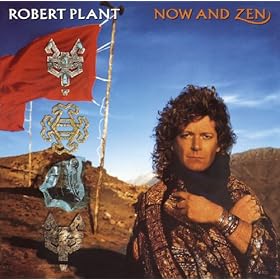
Robert plant now & zen vs. Xen hypervisor

On the other hand, this might prompt the question of when will Xen be available on a Vblock? For that I defer you to VCE CTO Trey Layton (@treylayton).

VCE stands for Virtual Computing Environment and was launched as a joint initiative including products and a company (since renamed from Acadia to VCE) to bring all the pieces together. As a company, VCE is based in Plano (Richardson) Texas just north of downtown Dallas and down the road from EDS or what is now left of it after the HP acquisition  The primary product of VCE has been the Vblock. The Vblock is a converged solution comprising components from their parents such as VMware virtualization and management software tools, Cisco servers, EMC storage and software tools and Intel processors.

Not surprisingly there are many ex-EDS personal at VCE along with some Cisco, EMC, VMware and many other people from other organizations in Plano as well as other cites. Also interesting to note that unlike other youngsters that grow up and stay in touch with their parents via technology or social media tools, VCE is also more than a few miles (try hundreds to thousands) from the proud parent headquarters on the San Jose California and Boston areas.

As part of a momentum update, VCE and their parents (Cisco, EMC, VMware and Intel) announced annual revenue run rate of a billion dollars in just three years. In addition the proud parents and VCE announced that they have over 1,000 revenue shipped and installed Vblock systems (also here) based on Cisco compute servers, and EMC storage solutions.

The VCE announcement consists of:

  • SAP HANA database application optimized Vblocks (two modes, 4 node and 8 node)
  • VCE Vision management tools and middleware or what I have refered to as Valueware
  • Entry level Vblock (100 and 200) with Cisco C servers and EMC (VNXe and VNX) storage
  • Performance and functionality enhancements to existing Vblock models 300 and 700
  • Statement of direction for more specialized Vblocks besides SAP HANA


Images courtesy with permission of VCE.com

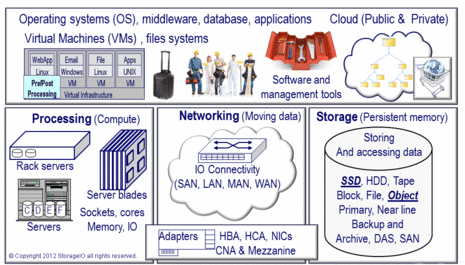
While VCE is known for their Vblock converged, stack, integrated, data center in a box, private cloud or among other descriptors, there is more to the story. VCE is addressing convergence of common IT building blocks for cloud, virtual, and traditional physical environments. Common core building blocks include servers (compute or processors), networking (IO and connectivity), storage, hardware, software, management tools along with people, processes, metrics, policies and protocols.
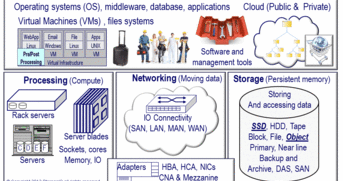
Storage I/O image of cloud and virtual IT building blocks

I like the visual image that VCE is using (see below) as it aligns with and has themes common to what I have discussing in the past.


Images courtesy with permission of VCE.com

VCE Vision is software with APIs that collects information about Vblock hardware and software components to give insight to other tools and management frameworks. For example VMware vCenter plug-in and vCenter Operations Manager Adapter which should not be a surprise. Customers will also be able to write to the Vision API to meet their custom needs. Let us watch and see what VCE does to add support for other software and management tools, along with gain support from others.
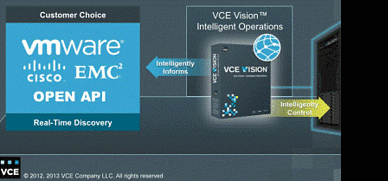

Images courtesy with permission of VCE.com

Vision is more than just an information source feed for VMware vCenter or VASA or tools and frameworks from others. Vision is software developed by VCE that will enable insight and awareness into the Vblock and applications, however also confirm and give status of physical and logical component configuration. This means the basis for setting up automated or programmatic remediation such as determining what software or firmware to update based on different guidelines.


Images courtesy with permission of VCE.com

Initially VCE Vision provides (information) inventory and perspective of how those components are in compliance with firmware or software releases, so stay tuned. VCE is indicating that Vision will continue to evolve after all this is the V1.0 release with future enhancements targeted towards taking action, controlling or active management.

StorageIO Industry trends and perspectives image

Some trends, thoughts and perspectives

The industry adoption buzz is around software defined X where X can be data center (SDDC), or storage (SDS) or networking (SDN), or marketing (SDM) or other things. The hype and noise around software defined which in the case of some technologies is good. On the marketing hype side, this has led to some Software Defined BS (SDBS).

Thus, it was refreshing at least in the briefing session I was involved in to hear a minimum focus around software defined and more around customer and IT business enablement with technology that is shipping today.

VCE Vision is a good example of adding value hence what I refer to as Valueware around converged components. For those vendors who have similar solutions, I urge them to streamline, simplify and more clearly articulate their value proposition if they have valueware.

Vendors including VCE continue to evolve their platform based converged solutions by adding more valueware, management tools, interfaces, APIs, interoperability and support for more applications. The support for applications is also moving beyond simple line item ordering or part number skews to ease acquisition and purchasing. Some solutions include VCE Vblock, NetApp FlexPod that also uses Cisco compute servers, IBM PureSystems (PureFlex etc) and Dell vStart among others are extending their support and optimization for various software solutions. These software solutions range from SAP (including HANA), Microsoft (Exchange, SQLserver, Sharepoint), Citrix desktop (VDI), Oracle, OpenStack, Hadoop map reduce along with other little-data, big-data and big-bandwidth applications to name a few.

Additional and related reading:
Acadia VCE: VMware + Cisco + EMC = Virtual Computing Environment
Cloud conversations: Public, Private, Hybrid what about Community Clouds?
Cloud, virtualization, Storage I/O trends for 2013 and beyond
Convergence: People, Processes, Policies and Products
Hard product vs. soft product
Hardware, Software, what about Valueware?
Industry adoption vs. industry deployment, is there a difference?
Many faces of storage hypervisor, virtual storage or storage virtualization
The Human Face of Big Data, a Book Review
Why VASA is important to have in your VMware CASA

Congratulations to VCE, along with their proud parents, family, friends and partners, now how long will it take to reach your next billion dollars in annual run rate revenue. Hopefully it wont be three years until the next VCE revisited now and Zen ;).

Disclosure: EMC and Cisco have been StorageIO clients, I am a VMware vExpert that gets me a free beer after I pay for VMworld and Intel has named two of my books listed on their Recommended Reading List for Developers.

Ok, nuff said, time to head off to vBeers over in Minneapolis.

Cheers gs

Greg Schulz – Author Cloud and Virtual Data Storage Networking (CRC Press, 2011), The Green and Virtual Data Center (CRC Press, 2009), and Resilient Storage Networks (Elsevier, 2004)

twitter @storageio

All Comments, (C) and (TM) belong to their owners/posters, Other content (C) Copyright 2006-2026 Server StorageIO and UnlimitedIO LLC All Rights Reserved
Cloud, virtualization, Storage I/O trends for 2013 and beyond

StorageIO Industry trends and perspectives image

It is still early in 2013, so I can make some cloud, virtualization, storage and IO related predictions, or more aptly, talk about some trends, in addition to those that I made in late 2012, looking forward and back. Common over-riding themes will continue to include convergence (people and technology), valueware, clouds (public, private, hybrid and community) among others.

cloud virtualization storage I/O data center image

Certainly, solid state drives (SSDs) will remain popular, both in terms of industry adoption, and industry deployment. Big-data (and little data) management tools and purpose-build storage systems or solutions continue to be popular, as are those for supporting little data applications. On the cloud storage front, there are many options for various use cases available. Watch for more emphasis on service-level agreements (SLA), service-level objectives (SLO), security, pricing transparency, and tiers of service.

storage I/O rto rpo dcim image

Cloud and object storage will continue to gain in awareness, functionality, and options from various providers in terms of products, solutions, and services. There will be a mix of large-scale solutions and smaller ones, with a mix of open-source and proprietary pieces. Some of these will be for archiving, some for backup or data protection. Others will be for big-data, high-performance computing, or cloud on a local or wide area basis, while others for general file sharing.

Ceph object storage architecture example

Along with cloud and object storage, watch for more options about how those products or services can be accessed using traditional NAS (NFS, CIFS, HDFS and others) along with block, such as iSCSI object API’s, including Amazon S3, REST, HTTP, JSON, XML, iOS and CDMI along with programmatic bindings.

Data protection modernization, including backup/restore, high-availability, business continuity, disaster recovery, archiving, and related technologies for cloud, virtual, and traditional environments will remain popular themes.

cloud and virtual data center image

Expect more Fibre Channel over Ethernet for networking with your servers and storage, PCIe Gen 3 to move data in and out of servers, and Serial-attached SCSI (SAS) as a means of attaching storage to servers or as the back-end storage for larger storage systems and appliances. For those who like to look out over the horizon, keep an eye and ear open for more discussion around PCI gen 3 deployment and gen 4 definitions, not to mention DDR4 and nand flash moving close to the processors.

With VMware buying Virsto, that should keep software defined marketing (SDM) and Storage hypervisors, storage virtualization, virtual storage, virtual storage arrays (VSA’s) active topic themes. Lets also keep in mind for storage space capacity optimization Data footprint reduction (DFR) including archiving, backup and data protection modernization, compression, consolidation, dedupe and data management.

Ok, nuff said.

Cheers gs

Greg Schulz – Author Cloud and Virtual Data Storage Networking (CRC Press, 2011), The Green and Virtual Data Center (CRC Press, 2009), and Resilient Storage Networks (Elsevier, 2004)

twitter @storageio

All Comments, (C) and (TM) belong to their owners/posters, Other content (C) Copyright 2006-2026 Server StorageIO and UnlimitedIO LLC All Rights Reserved

Cloud conversations: Public, Private, Hybrid and Community Clouds? (Part II)

StorageIO Industry trends and perspectives image

This is the second of a two part series, read part I here.

Common community cloud conversation questions include among others:

Who defines the standards for community clouds?
The members or participants, or whoever they hire or get to volunteer to do it.

Who pays for the community cloud?
The members or participants do, think about a co-op or other resource sharing consortium with multi-tenant (shared) capabilities to isolate and keep members along with what they are doing separate.

cloud image

Who are community clouds for, when to use them?
If you cannot justify a private cloud for yourself, or, if you need more resiliency than what can be provided by your site and you know of a peer, partner, member or other with common needs, those could be a fit. Another variation is you are in an industry or agency or district where pooling of resources, yet operating separate has advantages or already being done. These range from medical and healthcare to education along with various small medium businesses (SMBs) that do not want to or cannot use a public facility for various reasons.

What technology is needed for building a community cloud?
Similar to deploying a public or private cloud, you will need various hard products including servers, storage, networking, management software tools for provisioning, orchestration, show back or charge back, multi-tenancy, security and authentication, data protection (backup, bc, dr, ha) along with various middleware and applications.

Storage I/O cloud building block image

What are community clouds used for?
Almost anything, granted there are limits and boundaries based tools, technologies, security and access controls among other constraints. Applications can range from big-data to little-data on all if not most points in between. On the other hand, if they are not safe or secure enough for your needs, then use a private cloud or whatever it is that you are currently using.

What about community cloud security, privacy and compliance regulations?
Those are topics and reasons why like-minded or affected groups might be able to leverage a community cloud. By being like-minded or affected groups, labs, schools, business, entities, agencies, districts, or other organizations that are under common mandates for security, compliance, privacy or other regulations can work together, yet keep their interests separate. What tools or techniques for achieving those goals and objectives would be dependent on those who offer services to those entities now?

data centers, information factories and clouds

Where can you get a community cloud?
Look around using Google or your favorite search tool; also watch the comments section to see how long it takes someone to jump in to say how he or she can help. Also talk with solution providers, business partners and VARs. Note that they may not know the term or phrases per say, so here is what to tell them. Tell them that you would like to deploy a private cloud at some place that will then be used in a multi-tenant way to safely and securely support different members of your consortium.

For those who have been around long enough, you can also just tell them that you want to do something like the co-op or consortium time-sharing type systems from past generations and they may know what you are looking for. If although they look at you with a blank deer in the head-light stare eyes glazed over, just tell them it’s a new lead-edge, software defined new and revolutionary (add some superlatives if you feel inclined) and then they might get excited.  If they still don’t know what to do or help you with, have them get in touch with me and I will explain it to them, or, I’ll put you in touch with those can help.

data centers, information factories and clouds

Where do you put a community cloud?
You could deploy them in your own facility, other member’s locations or both for resiliency. You could also use a safe secure co-lo facility already being used for other purposes.

Do community clouds have organizers?
Perhaps, however they are probably more along the lines of a coordinator, administrator, manager, controller as opposed to a community organizer per say. In other words, do not confuse a community cloud with a cloud community organized, aligned and activated for some particular cause. On the other hand, maybe there is value prop for some cloud activist to be  organized and take up the cause for community clouds in your area of interest ;).

data centers, information factories and clouds

Are community clouds more of a concept vs. a product?
If you have figured out that a community or peer cloud is nothing more than a different way of deploying, using and managing a combination of private, public and hybrid and putting a marketing name on them, congratulations, you are now thinking outside of the box, or outside of the usual cloud conversations.

What about public cloud services for selected audiences such as Amazons GovCloud? On one hand, I guess you could call or think of that as a semi-private public cloud, or a semi-public private cloud, or if you like superlatives an uber gallistic hybrid community cloud.

How you go about building, deploying and managing your community, coop, consortium, and agency, district or peer cloud will be how you leverage various hard and software products. The results of which will be your return on innovation (the new ROI) to address various needs and concerns or also known as valueware. Those results should be able to address or help close gaps and leverage clouds in general as a resource vs. simply as a tool, technology or technique.

Ok, nuff said…

Cheers gs

Greg Schulz – Author Cloud and Virtual Data Storage Networking (CRC Press, 2011), The Green and Virtual Data Center (CRC Press, 2009), and Resilient Storage Networks (Elsevier, 2004)

twitter @storageio

All Comments, (C) and (TM) belong to their owners/posters, Other content (C) Copyright 2006-2026 Server StorageIO and UnlimitedIO LLC All Rights Reserved

Cloud conversations: Public, Private, Hybrid what about Community Clouds?

StorageIO Industry trends and perspectives image

Have you heard of a community clouds?

Cloud computing including cloud storage and services as products, solutions and services offer different functionality and enable benefits for various types of organizations, entities or individuals.

various types of clouds image

Public clouds, private clouds and hybrids leveraging public and private continue to evolve in technology, reliability, security and functionality along with the awareness around them.

IT professionals tell me they are interested in clouds however they have concerns.

Cloud concerns range from security, compliance, industry or government regulations, privacy and budgets among others with private, public or hybrid clouds. Peer, cooperative (co-op), consortium or community clouds can be a solution for those that traditional public, private, hybrid, AaaS, SaaS, PaaS or IaaS do not meet their needs.

various types, layers and services of clouds image

From a technology standpoint, there should have to be much if any difference between a community cloud and a public, private or hybrid. Instead, they community clouds are more about thinking outside of the box, or outside of common cloud thinking per say. This means thinking beyond what others are talking about or doing and looking at how cloud products, services and practices can be used in different ways to meet your concerns or requirements.

cloud image

What’s your take on clouds, click here to cast your vote and see results

Read more about community clouds including common questions in part II here.

Ok, nuff said (for now)…

Cheers gs

Greg Schulz – Author Cloud and Virtual Data Storage Networking (CRC Press, 2011), The Green and Virtual Data Center (CRC Press, 2009), and Resilient Storage Networks (Elsevier, 2004)

twitter @storageio

All Comments, (C) and (TM) belong to their owners/posters, Other content (C) Copyright 2006-2026 Server StorageIO and UnlimitedIO LLC All Rights Reserved

In the data center or information factory, not everything is the same

StorageIO Industry trends and perspectives image

Sometimes what should be understood, or that is common sense or that you think everybody should know needs to be stated. After all, there could be somebody who does not know what some assume as common sense or what others know for various reasons. At times, there is simply the need to restate or have a reminder of what should be known.

Storage I/O data center image

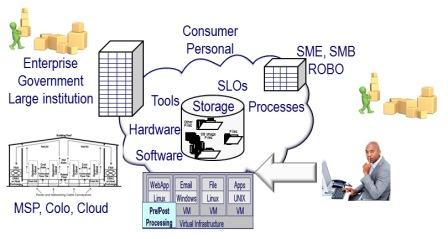
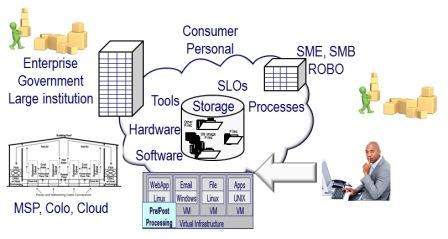
Consequently, in the data center or information factory, either traditional, virtual, converged, private, hybrid or public cloud, everything is not the same. When I say not everything is the same, is that different applications with various service level objectives (SLO’s) and service level agreements (SLA’s). These are based on different characteristics from performance, availability, reliability, responsiveness, cost, security, privacy among others. Likewise, there are different size and types of organizations with various requirements from enterprise to SMB, ROBO and SOHO, business or government, education or research.

Various levels of HA, BC and DR

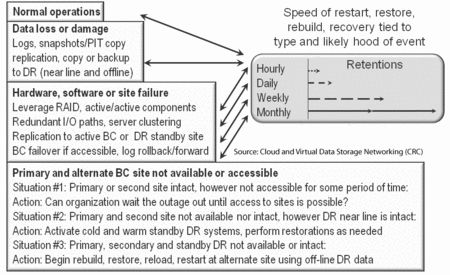
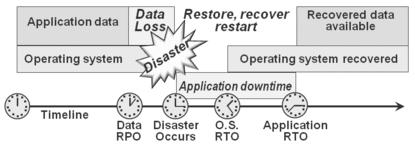
There are also different threat risks for various applications or information services within in an organization, or across different industry sectors. Thus various needs for meeting availability SLA’s, recovery time objectives (RTO’s) and recovery point objectives (RPO’s) for data protection ranging from backup/restore, to high-availability (HA), business continuance (BC), disaster recovery (DR) and archiving. Let us not forget about logical and physical security of information, assets and people, processes and intellectual property.

Storage IO RTO and RPO image

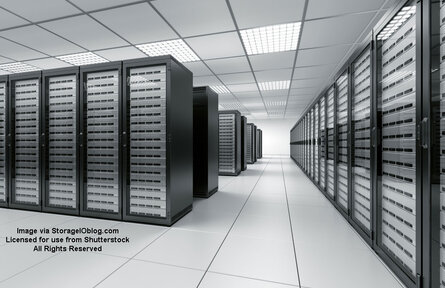
Some data centers or information factories are compute intensive while others are data centric, some are IO or activity intensive with a mix of compute and storage. On the other hand, some data centers such as a communications hub may be network centric with very little data sticking or being stored.

SLA and SLO image

Even within in a data center or information factory, various applications will have different profiles, protection requirements for big data and little data. There can also be a mix of old legacy applications and new systems developed in-house, purchased, open-source based or accessed as a service. The servers and storage may be software defined (a new buzzword that has already jumped the shark), virtualized or operated in a private, hybrid or community cloud if not using a public service.

Here are some related posts tied to everything is not the same:
Optimize Data Storage for Performance and Capacity
Is SSD only for performance?
Cloud conversations: Gaining cloud confidence from insights into AWS outages
Data Center Infrastructure Management (DCIM) and IRM
Saving Money with Green IT: Time To Invest In Information Factories
Everything Is Not Equal in the Datacenter, Part 1
Everything Is Not Equal in the Datacenter, Part 2
Everything Is Not Equal in the Datacenter, Part 3

Storage I/O data center image

Thus, not all things are the same in the data center, or information factories, both those under traditional management paradigms, as well as those supporting public, private, hybrid or community clouds.

Ok, nuff said.

Cheers gs

Greg Schulz – Author Cloud and Virtual Data Storage Networking (CRC Press, 2011), The Green and Virtual Data Center (CRC Press, 2009), and Resilient Storage Networks (Elsevier, 2004)

twitter @storageio

All Comments, (C) and (TM) belong to their owners/posters, Other content (C) Copyright 2006-2026 Server StorageIO and UnlimitedIO LLC All Rights Reserved

January 2013 Server and StorageIO Update Newsletter

StorageIO News Letter Image
January 2013 News letter

Welcome to the January 2013 edition of the StorageIO Update news letter including a new format and added content.

You can get access to this news letter via various social media venues (some are shown below) in addition to StorageIO web sites and subscriptions.

Click on the following links to view the January 2013 edition as (HTML sent via Email) version, or PDF versions.

Visit the news letter page to view previous editions of the StorageIO Update.

You can subscribe to the news letter by clicking here.

Enjoy this edition of the StorageIO Update news letter, let me know your comments and feedback.

Nuff said for now

Cheers
Gs

Greg Schulz – Author Cloud and Virtual Data Storage Networking (CRC Press), The Green and Virtual Data Center (CRC Press) and Resilient Storage Networks (Elsevier)
twitter @storageio

All Comments, (C) and (TM) belong to their owners/posters, Other content (C) Copyright 2006-2026 Server StorageIO and UnlimitedIO LLC All Rights Reserved

Thanks for viewing StorageIO content and top 2012 viewed posts

StorageIO industry trends cloud, virtualization and big data

2012 was a busy year (it was our 7th year in business) along with plenty of activity on StorageIOblog.com as well as on the various syndicate and other sites that pickup our content feed (https://storageioblog.com/RSSfull.xml).

Excluding traditional media venues, columns, articles, web casts and web site visits (StorageIO.com and StorageIO.TV), StorageIO generated content including posts and pod casts have reached over 50,000 views per month (and growing) across StorageIOblog.com and our partner or syndicated sites. Including both public and private, there were about four dozen in-person events and activities not counting attending conferences or vendor briefing sessions, along with plenty of industry commentary. On the twitter front, plenty of activity there as well closing in on 7,000 followers.

Thank you to everyone who have visited the sites where you will find StorageIO generated content, along with industry trends and perspective comments, articles, tips, webinars, live in person events and other activities.

In terms of what was popular on the StorageIOblog.com site, here are the top 20 viewed posts in alphabetical order.

Amazon cloud storage options enhanced with Glacier
Announcing SAS SANs for Dummies book, LSI edition
Are large storage arrays dead at the hands of SSD?
AWS (Amazon) storage gateway, first, second and third impressions
EMC VFCache respinning SSD and intelligent caching
Hard product vs. soft product
How much SSD do you need vs. want?
Oracle, Xsigo, VMware, Nicira, SDN and IOV: IO IO its off to work they go
Is SSD dead? No, however some vendors might be
IT and storage economics 101, supply and demand
More storage and IO metrics that matter
NAD recommends Oracle discontinue certain Exadata performance claims
New Seagate Momentus XT Hybrid drive (SSD and HDD)
PureSystems, something old, something new, something from big blue
Researchers and marketers dont agree on future of nand flash SSD
Should Everything Be Virtualized?
SSD, flash and DRAM, DejaVu or something new?
What is the best kind of IO? The one you do not have to do
Why FC and FCoE vendors get beat up over bandwidth?
Why SSD based arrays and storage appliances can be a good idea

Moving beyond the top twenty read posts on StorageIOblog.com site, the list quickly expands to include more popular posts around clouds, virtualization and data protection modernization (backup/restore, HA, BC, DR, archiving), general IT/ICT industry trends and related themes.

I would like to thank the current StorageIOblog.com site sponsors Solarwinds (management tools including response time monitoring for physical and virtual servers) and Veeam (VMware and Hyper-V virtual server backup and data protection management tools) for their support.

Thanks again to everyone for reading and following these and other posts as well as for your continued support, watch for more content on the above and other related and new topics or themes throughout 2013.

Btw, if you are into Facebook, you can give StorageIO a like at facebook.com/storageio (thanks in advance) along with viewing our newsletter here.

Ok, nuff said.

Cheers gs

Greg Schulz – Author Cloud and Virtual Data Storage Networking (CRC Press, 2011), The Green and Virtual Data Center (CRC Press, 2009), and Resilient Storage Networks (Elsevier, 2004)

twitter @storageio

All Comments, (C) and (TM) belong to their owners/posters, Other content (C) Copyright 2006-2026 Server StorageIO and UnlimitedIO LLC All Rights Reserved

Summary, EMC VMAX 10K, high-end storage systems stayin alive

StorageIO industry trends cloud, virtualization and big data

This is a follow-up companion post to the larger industry trends and perspectives series from earlier today (Part I, Part II and Part III) pertaining to today’s VMAX 10K enhancement and other announcements by EMC, and the industry myth of if large storage arrays or systems are dead.

The enhanced VMAX 10K scales from a couple of dozen up to 1,560 HDDs (or mix of HDD and SSDs). There can be a mix of 2.5 inch and 3.5 inch devices in different drive enclosures (DAE). There can be 25 SAS based 2.5 inch drives (HDD or SSD) in the 2U enclosure (see figure with cover panels removed), or 15 3.5 inch drives (HDD or SSD) in a 3U enclosure. As mentioned, there can be all 2.5 inch (including for vault drives) for up to 1,200 devices, all 3.5 inch drives for up to 960 devices, or a mix of 2.5 inch (2U DAE) and 3.5 inch (3U DAE) for a total of 1,560 drives.

Image of EMC 2U and 3U DAE for VMAX 10K via EMC
Image courtesy EMC

Note carefully in the figure (courtesy of EMC) that the 2U 2.5 inch DAE and 3U 3.5 inch DAE along with the VMAX 10K are actually mounted in a 3rd cabinet or rack that is part of today’s announcement.

Also note that the DAE’s are still EMC; however as part of today’s announcement, certain third-party cabinets or enclosures such as might be found in a collocation (colo) or other data center environment can be used instead of EMC cabinets.  The VMAX 10K can however like the VMAX 20K and 40K support external storage virtualized similar to what has been available from HDS (VSP/USP) and HP branded Hitachi equivalent storage, or using NetApp V-Series or IBM V7000 in a similar way.

As mentioned in one of the other posts, there are various software functionality bundles available. Note that SRDF is a separate license from the bundles to give customers options including RecoverPoint.

Check out the three post industry trends and perspectives posts here, here and here.

Ok, nuff said.

Cheers gs

Greg Schulz – Author Cloud and Virtual Data Storage Networking (CRC Press, 2011), The Green and Virtual Data Center (CRC Press, 2009), and Resilient Storage Networks (Elsevier, 2004)

twitter @storageio

All Comments, (C) and (TM) belong to their owners/posters, Other content (C) Copyright 2006-2026 Server StorageIO and UnlimitedIO LLC All Rights Reserved

EMC VMAX 10K, looks like high-end storage systems are still alive (part III)

StorageIO industry trends cloud, virtualization and big data

This is the third in a multi-part series of posts (read first post here and second post here) looking at what else EMC announced today in addition to an enhanced VMAX 10K and dispelling the myth that large storage arrays are dead (or at least for now).

In addition to the VMAX 10K specific updates, EMC also announced the release of a new version of their Enginuity storage software (firmware, storage operating system). Enginuity is supported across all VMAX platforms and features the following:

  • Replication enhancements include TimeFinder clone refresh, restore and four site SRDF for the VMAX 10K, along with think or thin support. This capability enables functionality across VMAX 10K, 40K or 20K using synchronous or asynchronous and extends earlier 3 site to 4 site and mix modes. Note that larger VMAX systems had the extended replication feature support with VMAX 10K now on par with those. Note that the VMAX can be enhanced with VPLEX in front of storage systems (local or wide area, in region HA and out of region DR) and RecoverPoint behind the systems supporting bi-synchronous (two-way), synchronous and asynchronous data protection (CDP, replication, snapshots).
  • Unisphere for VMAX 1.5 manages DMX along with VMware VAAI UNMAP and space reclamation, block zero and hardware clone enhancements, IPV6, Microsoft Server 2012 support and VFCache 1.5.
  • Support for mix of 2.5 inch and 3.5 inch DAEs (disk array enclosures) along with new SAS drive support (high-performance and high-capacity, and various flash-based SSD or EFD).
  • The addition of a fourth dynamic tier within FAST for supporting third-party virtualized storage, along with compression of in-active, cold or stale data (manual or automatic) with 2 to 1 data footprint reduction (DFR) ratio. Note that EMC was one of early vendors to put compression into its storage systems on a block LUN basis in the CLARiiON (now VNX) along with NetApp and IBM (via their Storwize acquisition). The new fourth tier also means that third-party storage does not have to be the lowest tier in terms of performance or functionality.
  • Federated Tiered Storage (FTS) is now available on all EMC block storage systems including those with third-party storage attached in virtualization mode (e.g. VMAX). In addition to supporting tiering across its own products, and those of other vendors that have been virtualized when attached to a VMAX, ANSI T10 Data Integrity Field (DIF) is also supported. Read more about T10 DIF here, and here.
  • Front-end performance enhancements with host I/O limits (Quality of Service or QoS) for multi tenant and cloud environments to balance or prioritize IO across ports and users. This feature can balance based on thresholds for IOPS, bandwidth or both from the VMAX. Note that this feature is independent of any operating system based tool, utility, pathing driver or feature such as VMware DRS and Storage I/O control. Storage groups are created and mapped to specific host ports on the VMAX with the QoS performance thresholds applied to meet specific service level requirements or objectives.

For discussion (or entertainment) purpose, how about the question of if Enginuity qualifies or can be considered as a storage hypervisors (or storage virtualization or virtual storage)? After all, the VMAX is now capable of having third-party storage from other vendors attached to it, something that HDS has done for many years now. For those who feel a storage hypervisor, virtual storage or storage virtualization requires software running on Intel or other commodity based processors, guess what the VMAX uses for CPU processors (granted, you can’t simply download Enginuity software and run on a Dell, HP, IBM, Oracle or SuperMicro server).

I am guessing some of EMC competitors and their surrogates or others who like to play the storage hypervisor card game will be quick to tell you it is not based on various reasons or product comparisons, however you be the judge.


Back to the question of if, traditional high-end storage arrays are dead or dying (from part one in this series).

IMHO as mentioned not yet.

Granted like other technologies that have been declared dead or dying yet still in use (technology zombies), they continue to be enhanced, finding new customers, or existing customers using them in new ways, their roles are evolving, this still alive.

For some environments as has been the case over the past decade or so, there will be a continued migration from large legacy enterprise class storage systems to midrange or modular storage arrays with a mix of SSD and HDD. Thus, watch out for having a death grip not letting go of the past, while being careful about flying blind into the future. Do not be scared, be ready, do your homework with clouds, virtualization and traditional physical resources.

Likewise, there will be the continued migration for some from traditional mid-range class storage arrays to all flash-based appliances. Yet others will continue to leverage all the above in different roles aligned to where their specific features best serve the applications and needs of an organization.

In the case of high-end storage systems such as EMC VMAX (aka formerly known as DMX and Symmetrix before that) based on its Enginuity software, the hardware platforms will continue to evolve as will the software functionality. This means that these systems will evolve to handling more workloads, as well as moving into new environments from service providers to mid-range organizations where the systems were before out of their reach.

Smaller environments have grown larger as have their needs for storage systems while higher end solutions have scaled down to meet needs in different markets. What this means is a convergence of where smaller environments have bigger data storage needs and can afford the capabilities of scaled down or Right-sized storage systems such as the VMAX 10K.

Thus while some of the high-end systems may fade away faster than others, for those that continue to evolve being able to move into different adjacent markets or usage scenarios, they will be around for some time, at least in some environments.

Avoid confusing what is new and cool falling under industry adoption vs. what is productive and practical for customer deployment. Systems like the VMAX 10K are not for all environments or applications; however, for those who are open to exploring alternative solutions and approaches, it could open new opportunities.

If there is a high-end storage system platform (e.g. Enginuity) that continues to evolve, re-invent itself in terms of moving into or finding new uses and markets the EMC VMAX would be at or near the top of such list. For the other vendors of high-end storage system that are also evolving, you can have an Atta boy or Atta girl as well to make you feel better, loved and not left out or off of such list. ;)

Ok, nuff said for now.

Disclosure: EMC is not a StorageIO client; however, they have been in the past directly and via acquisitions that they have done. I am however a customer of EMC via my Iomega IX4 NAS (I never did get the IX2 that I supposedly won at EMCworld ;) ) that I bought on Amazon.com and indirectly via VMware products that I have, oh, and they did sent me a copy of the new book Human Face of Big Data (read more here).

Ok, nuff said (for now).

Cheers gs

Greg Schulz – Author Cloud and Virtual Data Storage Networking (CRC Press, 2011), The Green and Virtual Data Center (CRC Press, 2009), and Resilient Storage Networks (Elsevier, 2004)

twitter @storageio

All Comments, (C) and (TM) belong to their owners/posters, Other content (C) Copyright 2006-2026 Server StorageIO and UnlimitedIO LLC All Rights Reserved

EMC VMAX 10K, looks like high-end storage systems are still alive (part II)

StorageIO industry trends cloud, virtualization and big data

This is the second in a multi-part series of posts (read first post here) looking at if large enterprise and legacy storage systems are dead, along with what todays EMC VMAX 10K updates mean.

Thus on January 14 2013 it is time for a new EMC Virtual Matrix (VMAX) model 10,000 (10K) storage system. EMC has been promoting their January 14 live virtual event for a while now. January significance is that is when (along with May or June) is when many new systems, solutions or upgrades are made on a staggered basis.

Historically speaking, January and February, along with May and June is when you have seen many of the larger announcements from EMC being made. Case in point, back in February of 2012 VFCache was released, then May (2012) in Las Vegas at EMCworld there were 42 announcements made and others later in the year.

Click here to see images of the car stuffing or click here to watch a video.

Let’s not forget back in February of 2012 VFCache was released, and go back to January 2011 there was the record-setting event in New York City complete with 26 people being compressed, deduped, singled instanced, optimized, stacked and tiered into a mini cooper (Coop) automobile (read and view more here).

Now back to the VMAX 10K enhancements

As an example of a company, product family and specific storage system model, still being alive is the VMAX 10K. Although this announcement by EMC is VMAX 10K centric, there is also a new version of the Enginuity software (firmware, storage operating system, valueware) that runs across all VMAX based systems including VMAX 20K and VMAX 40K. Read here, here and here and here to learn more about VMAX and Enginuity systems in general.

Some main themes of this announcement include Tier 1 reliability, availability and serviceability (RAS) storage systems functionality at tier 2 pricing for traditional, virtual and cloud data centers.

Some other themes of this announcement by EMC:

  • Flexible, scalable and resilient with performance to meet dynamic needs
  • Support private, public and hybrid cloud along with federated storage models
  • Simplified decision-making, acquisition, installation and ongoing management
  • Enable traditional, virtual and cloud workloads
  • Complement its siblings VMAX 40K, 20K and SP (Service Provider) models

Note that the VMAX SP is a model configured and optimized for easy self-service and private cloud, storage as a service (SaaS), IT as a Service (ITaaS) and public cloud service providers needing multi-tenant capabilities with service catalogs and associated tools.

So what is new with the VMAX 10K?

It is twice as fast (per EMC performance results) as earlier VMAX 10K by leveraging faster 2.8GHz Intel westmere vs. earlier 2.5GHz westmere processors. In addition to faster cores, there are more, from 4 to 6 on directors, from 8 to 12 on VMAX 10K engines. The PCIe (Gen 2) IO busses remain unchanged as does the RapidIO interconnect.  RapidIO  used for connecting nodes and engines,  while PCIe is used for adapter and device connectivity. Memory stays the same at up to 128GB of global DRAM cache, along with dual virtual matrix interfaces (how the nodes are connected). Note that there is no increase in the amount of DRAM based cache memory in this new VMAX 10K model.

This should prompt the question of for traditional cache centric or dependent for performance storage systems such as VMAX, how much are they now CPU and their associated L1 / L2 cache dependent or effective? Also how much has the Enginuity code under the covers been enhanced to leverage the multiple cores and threads thus shifting from being cache memory dependent processor hungry.

Also new with the updated VMAX 10K include:

  • Support for dense 2.5 inch drives, along with mixed 2.5 inch and 3.5 inch form factor devices with a maximum of 1,560 HDDs. This means support for 2.5 inch 1TB 7,200 RPM SAS HDDs, along with fast SAS HDDs, SLC/MLC and eMLC solid state devices (SSD) also known as electronic flash devices (EFD). Note that with higher density storage configurations, good disk enclosures become more important to counter or prevent the effects of drive vibration, something that leading vendors are paying attention to and so should customers.
  • EMC is also with the VMAX 10K adding support for certain 3rd party racks or cabinets to be used for mounting the product. This means being able to mount the VMAX main system and DAE components into selected cabinets or racks to meet specific customer, colo or other environment needs for increased flexibility.
  • For security, VMAX 10K also supports Data at Rest Encryption or (D@RE) which is implemented within the VMAX platform. All data encrypted on every drive, every drive type (drive independent) within the VMAX platform to avoid performance impacts. AES 256 fixed block encryption with FIPS 140-2 validation (#1610) using embedded or external key management including RSA Key Manager. Note that since the storage system based encryption is done within the VMAX platform or controller, not only is the encrypt / decrypt off-loaded from servers, it also means that any device from SSD to HDD to third-party storage arrays can be encrypted. This is in contrast to drive based approaches such as self encrypting devices (SED) or other full drive encryption approaches. With embedded key management, encryption keys kept and managed within the VMAX system while external mode leverages RSA key management as part of a broader security solution approach.
  • In terms of addressing ease of decision-making and acquisition, EMC has bundled core Enginuity software suite (virtual provisioning, FTS and FLM, DCP (dynamic cache partitioning), host I/O limits, Optimizer/virtual LUN and integrated RecoverPoint splitter). In addition are bundles for optimization (FAST VP, EMC Unisphere for VMAX with heat map and dashboards), availability (TimeFinder for VMAX 10K) and migration (Symmetrix migration suite, Open Replicator, Open Migrator, SRDF/DM, Federated Live Migration). Additional optional software include RecoverPoint CDP, CRR and CLR, Replication Manager, PowerPath, SRDF/S, SRDF/A and SRDF/DM, Storage Configuration Advisor, Open Replicator with Dynamic Mobility and ControlCenter/ProSphere package.

Who needs a VMAX 10K or where can it be used?

As the entry-level model of the VMAX family, certain organizations who are growing and looking for an alternative to traditional mid-range storage systems should be a primary opportunity. Assuming the VMAX 10K can sell at tier-2 prices with a focus of tier-1 reliability, feature functionality, and simplification while allowing their channel partners to make some money, then EMC can have success with this product. The challenge however will be helping their direct and channel partner sales organizations to avoid competing with their own products (e.g. high-end VNX) vs. those of others.

Consolidation of servers with virtualization, along with storage system consolidation to remove complexity in management and costs should be another opportunity with the ability to virtualize third-party storage. I would expect EMC and their channel partners to place the VMAX 10K with its storage virtualization of third-party storage as an alternative to HDS VSP (aka USP/USPV) and the HP XP P9000 (Hitachi based) products, or for block storage needs the NetApp V-Series among others. There could be some scenarios where the VMAX 10K could be positioned as an alternative to the IBM V7000 (SVC based) for virtualizing third-party storage, or for larger environments, some of the software based appliances where there is a scaling with stability (performance, availability, capacity, ease of management, feature functionality) concerns.

Another area where the VMAX 10K could see action which will fly in the face of some industry thinking is for deployment in new and growing managed service providers (MSP), public cloud, and community clouds (private consortiums) looking for an alternative to open source based, or traditional mid-range solutions. Otoh, I cant wait to hear somebody think outside of both the old and new boxes about how a VMAX 10K could be used beyond traditional applications or functionality. For example filling it up with a few SSDs, and then balance with 1TB 2.5 inch SAS HDD and 3.5 inch 3TB (or larger when available) HDDs as an active archive target leveraging the built-in data compression.

How about if EMC were to support cloud optimized HDDs such as the Seagate Constellation Cloud Storage (CS) HDDs that were announced late in 2012 as well as the newer enterprise class HDDs for opening up new markets? Also keep in mind that some of the new 2.5 inch SAS 10,000 (10K) HDDs have the same performance capabilities as traditional 3.5 inch 15,000 (15K) RPM drives in a smaller footprint to help drive and support increased density of performance and capacity with improved energy effectiveness.

How about attaching a VMAX 10K with the right type of cost-effective (aligned to a given scenario) SSD or HDDs or third-party storage to a cluster or grid of servers that are running OpenStack including Swift, CloudStack, Basho Riak CS, Celversafe, Scality, Caringo, Ceph or even EMCs own ATMOS (that supports external storage) for cloud storage or object based storage solutions? Granted that would be thinking outside of the current or new box thinking to move away from RAID based systems in favor or low-cost JBOD storage in servers, however what the heck, let’s think in pragmatic ways.

Will EMC be able to open new markets and opportunities by making the VMAX and its Enginuity software platform and functionality more accessible and affordable leveraging the VMAX 10K as well as the VMAX SP? Time will tell, after all, I recall back in the mid to late 90s, and then again several times during the 2000s similar questions or conversations not to mention the demise of the large traditional storage systems.

Continue reading about what else EMC announced on January 14 2013 in addition to VMAX 10K updates here in the next post in this series. Also check out Chucks EMC blog to see what he has to say.

Ok, nuff said (for now).

Cheers gs

Greg Schulz – Author Cloud and Virtual Data Storage Networking (CRC Press, 2011), The Green and Virtual Data Center (CRC Press, 2009), and Resilient Storage Networks (Elsevier, 2004)

twitter @storageio

All Comments, (C) and (TM) belong to their owners/posters, Other content (C) Copyright 2006-2026 Server StorageIO and UnlimitedIO LLC All Rights Reserved

Congratulations Imation and Nexsan, are there any independent storage vendors left?

StorageIO industry trends cloud, virtualization and big data

Last week Imation, the company that is known for making CDs, DVDs, magnetic tape and in the past floppy disk (diskettes) bought Nexsan, a company known for the SATA and SAS storage products.

Imation is also (or should be) owns the TDK and Memorex names (remember is it real or is it Memorex? If not Google it). They also have had for several years removable hard disk drive (RHDD) products including the Odyssey (I am in the process of retiring mine), as well as partnership with the former ProStor for RDX and having acquired some of the assets of ProStor namely their RDX based InifiVault storage appliance. Imation has also been involved in some other things including USB and other forms of flash-based solid state devices (SSD), as well as a couple of years (2007) they launched cloud backup with DataGuard before cloud backup had become a popular buzzword topic.

Imation has also divested parts of its business over past several years including some medical related (X-ray stuff) to Kodak who occupies part of the headquarter building in Oakdale MN, or at least last time I looked when driving by there on way from the airport. They also divested their SAN lab with some of the staff going to Glasshouse and other pieces going to Lion bridge (an independent test lab company). Beyond traditional of data protection, backup/restore and archiving media or mediums from consumer to large-scale enterprise, Imation has also been involved in other areas involving recording. Imation also has done some other recent acquisitions around dedupe (Nine Technologies).

For its part, Nexsan has extended their portfolio from SATA and SAS products, AutoMaid Intelligent Power Management (IPM) which gives benefits of variable power and performance without the penalties of first generation MAID type products. Read more about IPM and related themes here, here and here. Nexsan also supports NAS and iSCSI solutions in addition to their archive and content or object storage focused Assureon product they bought a few years ago.

This is a good acquisition for both companies as it gives Imation a new set of products to sell into their existing accounts and channels. It also can leverage Nexsan’s channel and solution selling skills giving them (Nexsan) a bigger brand and large parent for credibility (not that they did not have that in the past).

Here are is a link to a piece done by Dave Raffo that includes some comments and perspectives from me. To say that the synergy here is about archiving or selling SSD or storage would be too easy and miss a bigger potential. That potential is Imation has been in the business of selling consumable accessories for protecting and preserving data. Notice I said consumable accessories which in the past has meant manufacturing consumable media (e.g. Floppy disks or discs, CD, DVDs, magnetic tapes) as well as partnering around flash and HDDs.

In many environments from small to large to super-sized cloud and service providers, some types of storage systems including some of those that Nexsan sells can be considered a consumable media or medium taking over the role that tape, CDs or DVDs have been used in the pat. Instead of using tape or CDs or DVDs to protect the HDDs and SSDs based data, HDD based solutions are being used for disk-to-disk (D2D) protection (part of modernizing data protection). D2D is being done as appliances, or in conjunction with cloud and object storage system software stacks such as OpenStack swift, Basho Riak CS, CloudStack, Cleversafe, Ceph, Caringo and a list of others, in addition to appliances such as EMC ATMOS among others than can support 3rd party storage device as consumable mediums. Keep in mind that there is no such thing as a data or information recession, and people and data are living longer and getting larger, both for big data and little data.

The big if in this acquisition which IMHO is a fair price for both parties based on realistic valuations is if they can collective execute on it. This means that Imation and Nexsan need to leverage each other’s strengths, address any weakness, close gaps and expand into each other’s markets, channels and sell the entire portfolio as opposed to becoming singular focused on a particular area tool or technology. If Imation can execute on this and Nexsan leverages their new parent, the result should be moving from the roughly $85M USD sales to $100M+ then $125M then $150M and so forth over the next couple of years.

Even if Imation keeps maintains revenues or a slight increase, which would also be a good deal for them, granted the industry pundits may not agree, so let us see where this is in a few years. However if Imation can grow the Nexsan business, then it would become a very good deal. Thus, IMHO the price valuation for the deal has the risk built into, something like when NetApp bought the Engenio business unit from LSI back in 2011 for about $480M USD. At that time, Engenio was doing about $705M USD in revenue and seen by many industry pundits as being on the decline, thus a lower valuation. For its part, NetApp, has been executing maintaining the revenue of that business unit with some expansion, thus their execution so far is being rewarding for taking the risk.

Let us see if Imation can do the same thing.

Now, does that mean that Nexsan was the last of the independent storage vendors left?

Hardly, after all there is still Xiotech, excuse me, Xio as they changed their name as part of a repackaging, relaunch and downsizing. There is DotHill who supplies partners such HP, or Dothills former partner supplier InfoTrend. If you are an Apple fan then you might know about Promise, if not, you should. Lets not forget about Data Direct Networks (DDN) that is still independent and at around $200M (give or take several million) in revenue, are very much still around.

How about Xyratex, sure they make the enclosures and appliances that many others use in their solutions, however they also have a storage solutions business focused on scale out, clustered and grid NAS based on Lustre. There are some others that I am drawing a blank on now (if you read this and are one of them, chime in) in addition to all the new or current generation of startups (you can chime in as well to let people know who you are to be bought).

There is still consolidation taking place, both of smaller vendors by mid-sized vendors, mid-sized vendors by big vendors, big vendors by mega vendors, and startups by established.

Again congratulations to both Imation and Nexsan, let us see who or what is next on the 2013 mergers and acquisition list, as well as who will join the where are they now club.

Disclosure: Nexsan has been a StorageIO client in the past; however, Imation has not been a client, although they have bought me lunch before here in the Stillwater, MN area.

With Imation having their own brand name and identity, not to mention TDK and Memorex, now I have to wonder will Nexsan be real or Memorex or something else? ;)

Ok, nuff said.

Cheers gs

Greg Schulz – Author Cloud and Virtual Data Storage Networking (CRC Press, 2011), The Green and Virtual Data Center (CRC Press, 2009), and Resilient Storage Networks (Elsevier, 2004)

twitter @storageio

All Comments, (C) and (TM) belong to their owners/posters, Other content (C) Copyright 2006-2026 Server StorageIO and UnlimitedIO LLC All Rights Reserved