What does server storage I/O scaling mean to you?

What does server storage I/O scaling mean to you?

Scaling means different things to various people depending on the context or what it is referring to.

For example, scaling can me having or doing more of something, or less as well as referring to how more, or less of something is implemented.

Scaling occurs in a couple of different dimensions and ways:

  • Application workload attributes – Performance, Availability, Capacity, Economics (PACE)
  • Stability without compromise or increased complexity
  • Dimension and direction – Scaling-up (vertical), scaling-out (horizontal), scaling-down

Scaling PACE – Performance Availability Capacity Economics

Often I hear people talk about scaling only in the context of space capacity. However there are aspects including performance, availability as well as scaling-up or scaling-out. Scaling from application workloads perspectives include four main group themes which are performance, availability, capacity and economics (as well as energy).

  • Performance – Transactions, IOP’s, bandwidth, response time, errors, quality of service
  • Availability – Accessibility, durability, reliability, HA, BC, DR, Backup/Restore, BR, data protection, security
  • Capacity – Space to store information or place for workload to run on a server, connectivity ports for networks
  • Economics – Capital and operating expenses, buy, rent, lease, subscription

Scaling with Stability

The latter of the above items should be thought of more in terms of a by-product, result or goal for implementing scaling. Scaling should not result in a compromise of some other attribute such as increasing performance and loss of capacity or increased complexity. Scaling with stability also means that as you scale in some direction, or across some attribute (e.g. PACE), there should not be a corresponding increase in complexity of management, or loss of performance and availability. To use a popular buzz-term scaling with stability means performance, availability, capacity, economics should scale linear with their capabilities or perhaps cost less.

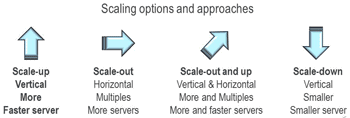
Scaling directions: Scaling-up, scaling-down, scaling-out

server and storage i/o scale options

Some examples of scaling in different directions include:

  • Scaling-up (vertical scaling with bigger or faster)
  • Scaling-down (vertical scaling with less)
  • Scaling-out (horizontal scaling with more of what being scaled)
  • Scaling-up and out (combines vertical and horizontal)

Of course you can combine the above in various combinations such as the example of scaling up and out, as well as apply different names and nomenclature to see your needs or preferences. The following are a closer look at the above with some simple examples.

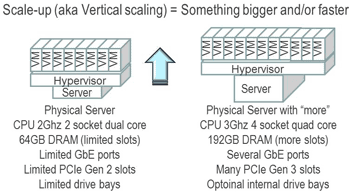
server and storage i/o scale up
Example of scaling up (vertically)

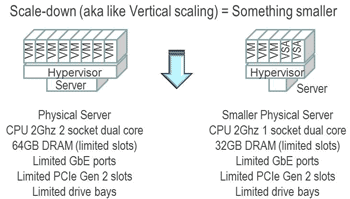
server and storage i/o scale down
Example of scaling-down (e.g. for smaller scenarios)

server and storage i/o scale out
Example of scaling-out (horizontally)

server and storage i/o scale out
Example of scaling-out and up(horizontally and vertical)

Summary and what this means

There are many aspects to scaling, as well as side-effects or impacts as a result of scaling.

Scaling can refer to different workload attributes as well as how to support those applications.

Regardless of what you view scaling as meaning, keep in mind the context of where and when it is used and that others might have another scale view of scale.

Ok, nuff said (for now)…

Cheers gs

Greg Schulz – Author Cloud and Virtual Data Storage Networking (CRC Press), The Green and Virtual Data Center (CRC Press) and Resilient Storage Networks (Elsevier)
twitter @storageio

All Comments, (C) and (TM) belong to their owners/posters, Other content (C) Copyright 2006-2026 Server StorageIO and UnlimitedIO LLC All Rights Reserved

Lenovo ThinkServer TD340 StorageIO lab Review

Storage I/O trends

Lenovo ThinkServer TD340 Server and StorageIO lab Review

Earlier this year I did a review of the Lenovo ThinkServer TS140 in the StorageIO Labs (see the review here), in fact I ended up buying a TS140 after the review, and a few months back picked up another one. This StorageIOlab review looks at the Lenovo ThinkServer TD340 Tower Server which besides having a larger model number than the TS140, it also has a lot more capabilities (server compute, memory, I/O slots and internal hot-swap storage bays. Pricing varies depending on specific configuration options, however at the time of this post Lenovo was advertising a starting price of $1,509 USD for a specific configuration here. You will need to select different options to decide your specific cost.

The TD340 is one of the servers that Lenovo has had prior to its acquisition of IBM x86 server business that you can read about here. Note that the Lenovo acquisition of the IBM xSeries business group has begun as of early October 2014 and is expected to be completed across different countries in early 2015. Read more about the IBM xSeries business unit here, here and here.

The Lenovo TD340 Experience

Lets start with the overall experience which was very easy other than deciding what make and model to try. This includes going from first answering some questions to get the process moving, agreeing to keep the equipment safe, secure, insured as well as not damaging anything. Part of the process also involved answering some configuration related questions and shortly there after a large box from Lenovo arrived.

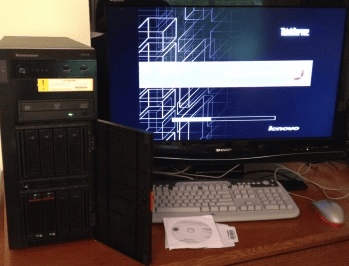
TD340 is ready for use
TD340 with Keyboard and Mouse (Monitor and keyboard not included)

One of the reasons I have a photo of the TD340 on a desk is that I initially put it in an office environment similar to what I did with the TS140 as Lenovo claimed it would be quiet enough to do so. I was not surprised and indeed the TD340 is quiet enough to be used where you would normally find a workstation or mini-tower. By being so quiet the TD340 is a good fit for environments that need a server that has to go into an office environment as opposed to a server or networking room.

Welcome to the TD340
Lenovo ThinkServer Setup

TD340 Setup
Lenovo TD340 as tested in BIOS setup, note the dual Intel Xeon E5-2420 v2 processors

TD340 as tested

TD340 Selfie of whats inside
TD340 "Selfie" with 4 x 8GB DDR3 DIMM (32GB) and PCIe slots (empty)

TD340 disk drive bays
TD340 internal drive hot-swap bays

Speeds and Feeds

The TD340 that I tested was a Machine type 7087 model 002RUX which included 4 x 16GB DIMMs and both processor sockets occupied.

You can view the Lenovo TD340 data sheet with more speeds and feeds here, however the following is a summary.

  • Operating systems support include various Windows Servers (2008-2012 R2), SUSE, RHEL, Citrix XenServer and VMware ESXi
  • Form factor is 5U tower with weight starting at 62 pounds depending on how configured
  • Processors include support for up to two (2) Intel E5-2400 v2 series
  • Memory includes 12 DDR3 DRAM DIMM slots (LV RDIMM and UDIMM) for up to 129GB.
  • Expansion slots vary depending on if a single or dual cpu socket. Single CPU socket installed has 1 x PCIe Gen3 FH/HL x8 mechanical, x4 electrical, 1 x PCIe Gen3
  • FH/HL x16 mechanical, x16 electrical and a single PCI 32bit/33 MHz FH/HL slot. With two CPU sockets installed extra PCIe slots are enabled. These include single x PCIe GEN3: FH/HL x8 mechanical, x4 electrical, single x PCIe GEN3: FH/HL x16 mechanical, x16 electrical, three x PCIe GEN3: FH/HL x8 mechanical, x8 electrical and a single PCI 5V 32-bit/33 MHz: FH/HL
  • Two 5.25” media bays for CD or DVDs or other devices
  • Integrated ThinkServer RAID (0/1/10/5) with optional RAID adapter models
  • Internal storage varies depending on model including up to eight (8) x 3.5” hot swap drives or 16 x 2.5” hot swap drives (HDD’s or SSDs).
  • Storage space capacity varies by the type and size of the drives being used.
  • Networking interfaces include two (2) x GbE
  • Power supply options include single 625 watt or 800 watt, or 1+1 redundant hot-swap 800 watt, five fixed fans.
  • Management tools include ThinkServer Management Module and diagnostics

What Did I do with the TD340

After initial check out in an office type environment, I moved the TD340 into the lab area where it joined other servers to be used for various things.

Some of those activities included using the Windows Server 2012 Essentials along with associated admin activities as well as installing VMware ESXi 5.5.

TD340 is ready for use
TD340 with Keyboard and Mouse (Monitor and keyboard not included)

What I liked

Unbelievably quiet which may not seem like a big deal, however if you are looking to deploy a server or system into a small office workspace, this becomes an important considerations. Otoh, if you are a power user and want a robust server that can be installed into a home media entertainment system, well, this might be a nice to have consideration ;). Speaking of IO slots, naturally I’m interested in Server Storage I/O so having multiple slots is a must have, along with the processor that is multi-core (pretty much standard these days) along with VT and EP for supporting VMware (these were disabled in the BIOS however that was an easy fix).

What I did not like

The only thing I did not like was that I ran into a compatibility issue trying to use a LSI 9300 series 12Gb SAS HBA which Lenovo is aware of, and perhaps has even addressed by now. What I ran into is that the adapters work however I was not able to get the full performance out of the adapters as compared to on other systems including my slower Lenovo TS140s.

Summary

Overall I give Lenovo and the TD340 an "B+" which would have been an "A" had I not gotten myself into a BIOS situation or been able to run the 12Gbps SAS PCIe Gen 3 cards at full speed. Likewise the Lenovo service and support also helped to improve on the experience. Otoh, if you are simply going to use the TD340 in a normal out of the box mode without customizing to add your own adapters or install your own operating system or Hypervisors (beyond those that are supplied as part of the install setup tool kit), you may have an "A" or "A+" experience with the TD340.

Would I recommend the TD340 to others? Yes for those who need this type and class of server for Windows, *nix, Hyper-V or VMware environments.

Would I buy a TD340 for myself? Maybe if that is the size and type of system I need, however I have my eye on something bigger. On the other hand for those who need a good value server for a SMB or ROBO environment with room to grow, the TD340 should be on your shopping list to compare with other solutions.

Disclosure: Thanks to the folks at Lenovo for sending and making the TD340 available for review and a hands on test experience including covering the cost of shipping both ways (the unit should now be back in your possession). Thus this is not a sponsored post as Lenovo is not paying for this (they did loan the server and covered two-way shipping), nor am I paying them, however I have bought some of their servers in the past for the StorageIOLab environment that are companions to some Dell and HP servers that I have also purchased.

Ok, nuff said

Cheers
Gs

Greg Schulz – Author Cloud and Virtual Data Storage Networking (CRC Press), The Green and Virtual Data Center (CRC Press) and Resilient Storage Networks (Elsevier)
twitter @storageio

All Comments, (C) and (TM) belong to their owners/posters, Other content (C) Copyright 2006-2026 Server StorageIO and UnlimitedIO LLC All Rights Reserved

September October 2014 Server and StorageIO Update Newsletter

September and October 2014

Hello and welcome to this joint September and October Server and StorageIO update newsletter. Since the August newsletter, things have been busy with a mix of behind the scenes projects, as well as other activities including several webinars, on-line along with in-person events in the US as well as Europe.

Enjoy this edition of the Server and StorageIO update newsletter and watch for new tips, articles, StorageIO lab report reviews, blog posts, videos and podcasts along with in the news commentary appearing soon.

Cheers gs

Industry Trends and Perspectives

Storage trends

In September I was invited to do a key-note opening presentation at the MSP area CMG event. Theme for the September CMG event was "Flash – A Real Life Experience" with a focus of what people are doing, how testing and evaluating including use of hybrid solutions as opposed to vendor marketing sessions. My session was titled "Flash back to reality – Myths and Realities, Flash and SSD Industry trends perspectives plus benchmarking tips and can be found here. Thanks to Tom Becchetti an the MSP CMG (@mspcmg) folks for a great event.

There are many facets to hybrid storage including different types of media (SSD and HDD’s) along with unified or multi-protocol access. Then there are hybrid storage that spans local and public clouds. Here is a link to an on-line Internet Radio show via Information Week along with on-line chat about Hybrid Storage for Government.

Some things I’m working with or keeping an eye on include Cloud, Converged solutions, Data Protection, Business Resiliency, DCIM, Docker, InfiniBand, Microsoft (Hyper-V, SOFS, SMB 3.0), Object Storage, SSD, SDS, VMware and VVOL among others items.

Commentary In The News

A lot has been going on in the IT industry since the last StorageIO Update newsletter. The following are some StorageIO industry trends perspectives comments that have appeared in various venues. Cloud conversations continue to be popular including concerns about privacy, security and availability. Here are some comments at SearchCloudComputing: about moving on from cloud deployment heartbreak.

Nand flash Solid State Devices (SSD) continue to increase in customer deployments, over at Processor, here are some here are some comments on Incorporating SSD’s Into Your Storage Plan. Also on SSD, here are some perspectives making the Argument For Flash-Based Storage. Some other comments over at Processer.com include looking At Disaster Recovery As A Service, tips to Avoid In Data Center Planning, making the most of Enterprise Virtualization, as well as New Tech, Advancements To Justify Servers. Part of controlling and managing storage costs is having timely insight, metrics that matter, here are some more perspectives and also here.

Over at SearchVirtualStorage I have some comments on how to configure and manage storage for a virtual desktop environment (VDI) while over at TechPageOne there are perspectives on top reasons to switch to Windows 8. 

Some other comments and perspectives are over at EnterpriseStorageForum including Top 10 Ways to Improve Data Center Energy Efficiency. At InfoStor there are comments and tips about Object Storage, while at SearchDataBackup I have some perspectives about Symantec being broken up.

View other industry trends comments at the here

Tips and Articles

Recent Server and StorageIO tips and articles appearing in various venues include over at SearchCloudStorage a series of discussion often asked question pieces:

Are you concerned with the security of the cloud?
Is the cost of cloud storage really cheaper?
What’s important to know about cloud privacy policy?
Are more than five nines of availability really possible?
What to look for enterprise file sync-and-share app?
How primary storage clouds and cloud backup differ?
What should I consider when using SSD cloud?
What is difference between a snapshot and a clone?

View other recent as well as past tips and articles here

StorageIOblog posts

Recent StorageIOblog posts include:

View other recent as well as past blog posts here

In This Issue

  • Industry Trends Perspectives
  • Commentary in the news
  • Tips and Articles
  • StorageIOblog posts
  • Events & Activities

    September 25, 2014
    MSP CMG – Flash and SSD performance

    October 8-10, 2014
    Nijkerk Netherlands Brouwer Seminar Series

    November 11-13, 2014
    AWS re:Invent Las Vegas

    View other recent and upcoming events here

    Webinars

    November 13 9AM PT
    BrightTalk – Software Defined Storage

    November 11 10AM PT
    Google+ Hangout Dell BackupU

    November 11 9AM PT
    BrightTak – Software Defined Data Centers

    October 16 9AM PT
    BrightTalk – Cloud Storage Decision Making

    October 15 1PM PT
    BrightTalk – Hybrid Cloud Trends

    October 7 11AM PT
    BackupU – Data Protection Management

    September 18 8AM CT
    Nexsan – Hybrid Storage

    September 18 9AM PT
    BrightTalk – Converged Storage

    September 17 1PM PT
    BrightTalk – DCIM

    September 16 1PM PT
    BrightTalk – Data Center Convergence

    September 16 Noon PT
    BrightTalk – BC, BR and DR

    September 16 1PM CT
    StarWind – SMB 3.0 & Microsoft SOFS

    September 16 9AM PT
    Google+ Hangout – BackupU – Replication

    September 2 11AM PT
    Dell BackupU – Replication

    Videos and Podcasts

    Docker for Smarties
    Video: Docker for Smarties

    StorageIO podcasts are also available via and at StorageIO.tv

    From StorageIO Labs

    Research, Reviews and Reports

    Enterprise 12Gbps SAS and SSD’s
    Better Together – Part of an Enterprise Tiered Storage Strategy

    In this StorageIO Industry Trends Perspective thought leadership white paper we look at how enterprise class SSD’s and 12Gbps SAS address current and next generation tiered storage for virtual, cloud, traditional Little and Big Data environments. This report includes proof points running various workloads including Database TPC-B, TPC-E, Microsoft Exchange in the StorageIO Labs along with cache software comparing SSD, SSHD and HDD’s. Read the  white paper  compliments of Seagate 1200 12Gbs SAS SSD’s.

    Seagate SSD White Paper

    Resources and Links

    Check out these useful links and pages:
    storageio.com/links
    objectstoragecenter.com
    storageioblog.com/data-protection-diaries-main/
    storageio.com/ssd
    storageio.com/ssd

    Ok, nuff said (for now)

    Cheers
    Gs

    Greg Schulz – Author Cloud and Virtual Data Storage Networking (CRC Press), The Green and Virtual Data Center (CRC Press) and Resilient Storage Networks (Elsevier)
    twitter @storageio

    All Comments, (C) and (TM) belong to their owners/posters, Other content (C) Copyright 2006-2026 Server StorageIO and UnlimitedIO LLC All Rights Reserved

    VMware Cisco EMC VCE Zen and now server storage I/O convergence

    Storage I/O trends

    VMware Cisco EMC VCE Zen and now server storage I/O convergence

    In case you have not heard, the joint initiative (JV) founded in the fall of 2009 between Intel VMware Cisco and EMC called VCE had a change of ownership today.

    Well, kind of…

    Who is VCE and what’s this Zen stuff?

    For those not familiar or who need a recap, VCE was created to create converged server, storage I/O networking hardware and software solutions combing technologies from its investors resulting in solutions called vBlocks.

    The major investors were Cisco who provides the converged servers and I/O networking along with associated management tools as well as EMC who provides the storage systems along with their associated management tools. Minority investors include VMware (who is majority owned by EMC) who provides the server virtualization aka software defined data center management tools and Intel whose’s processor chip technologies are used in the vBlocks. What has changed from Zen (e.g. yesterday or in the past) and now is that Cisco has sold the majority (they are retaining about 10%) of its investment ownership in VCE to EMC. Learn more about VCE, their solutions and valueware in this post here (VCE revisited, now and Zen).

    Activist activating activity?

    EMC pulling VCE in-house which should prop up its own internal sales figures by perhaps a few billion USDs within a year or so (if not sooner) is not as appealing to activists investors who want results now such as selling off parts of the company (e.g. EMC, VMware or other assets) or the entire company.

    However EMC has been under pressure from activist shareholder Elliot Management to divest or sell-off portions of this business such as VMware so that the investors (including the activist) can make more money. For example there have been the recent stories about EMC looking to sell or merge with the likes of HP (who is now buying back shares and splitting up its own business) among others which certainly must make the activist investors happy.

    However to the activist investors who want to see things sold to make money they are not happy with EMC off buying or investing it appears.

    Via Bloomberg

    “The last thing on investors’ minds is the future of VCE,” Daniel Ives, an analyst with FBR Capital Markets, wrote in a note today. “EMC has a fire in its house right now and the company appears focused on painting its bedroom (e.g. VCE), while the Street wants a resolution on the strategic ownership situation sooner rather than later.”

    Read more at Bloomberg

    Whats this EMC Federation stuff?

    Note that EMC has organized itself into a federation that consists of EMC Information Infrastructure (EMCII) or what you might know a traditional EMC based storage and related software solutions, VMware, Pivotal and RSA. Also note that each of those federated companies have their own CEO as well as have holdings or ownership of other companies. However all report to a common federated leadership aka EMC. Thus when you hear EMC that could mean depending on the context the federation mother ship which controls the individual companies, or it could also be used to refer to EMCII aka the traditional EMC. Click here to learn more about the EMC federation.

    Converging Markets and Opportunities

    Looking beyond near-term or quick gains, EMC could be simply doing something others do to take ownership and control over certain things while reducing complexities associated with joint initiatives. For example with EMC and Cisco in a close partnership with VCE, both parties have been free to explore and take part in other joint initiatives such as Cisco with EMC competitors NetApp, HDS among others. Otoh EMC partners with Arista for networking, not to mention via VMware acquired virtual network or software defined network Nicira now called NSX.

    server and storage I/O road map to convergence

    EMC is also in a partnership with Lenovo for developing servers to be used by EMC for various platforms to support storage, data and information services while shifting the lower-end SMB storage offerings such as Iomega to the Lenovo channel.

    Note that Lenovo is in the process of absorbing the IBM xSeries (e.g. x86 based) business unit that started closing earlier in October (will take several months to completely close in all countries around the world). For its part Cisco is also partnering with hyper-converged solution provider Simplivity while EMC has announced its statement of direction to bring to market its own hyper-converged platform by end of the year. For those not familiar, Hyper-converged solutions are simply the next evolution of converged or pre-bundled turnkey systems (some of you might have just had a Dejavu moment) that today tend to be targeted for SMBs and ROBOs however used for targeted applications such as VDI in larger environments.

    Storage I/O trends

    What does this have to do with VCE?

    IF EMC is about to release as it has made statement of direction statements of a hyper-converged solution by year-end to compete head-on with those from Nutanix, Simplivity and Tintri as well as perhaps to a lesser extent VMwares EVO:Rail, by having more control over VCE means reducing if not eliminating complexity around vBlocks which are Cisco based with EMC storage vs. what ever EMC brings to market for hyper-converged. In the past under the VCE initiatives storage was limited to EMC and servers along with networking from Cisco, hypervisors from VMware, however what happens in the future remains to be seen.

    Does this mean EMC is moving even more into servers than just virtual servers?

    Tough to say as EMC can not afford to have its sales force lose focus on its traditional core products while ramping up other business, however, the EMC direct and partner teams want and need to keep up account control which means gaining market share and footprint in those accounts. This also means EMC needs to find ways to take cost out of the sales and marketing process where possible to streamline which perhaps brining VCE will help do.

    Will this perhaps give the EMC direct and partner sales teams a new carrot or incentive to promote converged and hyper-converged at the cost of other competitors or incumbents? Perhaps, lets see what happens in the coming weeks.

    What does this all mean?

    In a nut shell, IMHO EMC is doing a couple of things here one of which is cleaning up some ownership in JVs to give it self more control, as well as options for doing other business transactions (mergers and acquisitions (M&A), sales or divestiture’s, new joint initiatives, etc). Then there is streamline its business from decision-making to quickly respond to new opportunities as well as routes to markets and other activities (e.g. removing complexity and cost vs. simply cutting cost).

    Does this signal the prelude to something else? Perhaps, we know that EMC has made a statement of direction about hyper-converged which with VCE now more under EMC control, perhaps we will see more options from under the VCE umbrella both for lower-end and entry SMB as well as SME and large enterprise organizations.

    What about the activist investors?

    They are going to make noise as long as they can continue to make more money or get what they want. Publicly I would be shocked if the activist investors were not making statements that EMC should be selling assets not buying or investing.

    On the other hand, any smart investor,  financial or other analyst should see though the fog of what this relatively simple transaction means in terms of EMC getting further control of its future.

    Of course the question will stay does EMC remain in control of its current federation of EMC, VMware, Pivotal, RSA along each of their respective holdings, does EMC doe a block buster merger, divestiture or acquisition?

    server and storage I/O road ahead

    Take a step back, look at the big picture!

    Some things to keep an eye on:

    • Will this move help streamline decision-making enabling new solutions to be brought to market and customers quicker?
    • While there is a VMware focus, don’t forget about the long-running decades old relationship with Microsoft and how that plays into the equation
    • Watch for what EMC releases with their hyper-converged solution as well as where it is focused, not to mention how sold
    • Also watch the EMC and Lenovo join initiative, both for the Iomega storage activity as well as what EMC and Lenovo do with and for servers
    • Speaking of Lenovo, unless I missed something as of the time of writing this, have you noticed that Lenovo is not yet part of the VMware EVO:Rail initiative?

    Ok, nuff said (for now)

    Cheers
    Gs

    Greg Schulz – Author Cloud and Virtual Data Storage Networking (CRC Press), The Green and Virtual Data Center (CRC Press) and Resilient Storage Networks (Elsevier)
    twitter @storageio

    All Comments, (C) and (TM) belong to their owners/posters, Other content (C) Copyright 2006-2026 Server StorageIO and UnlimitedIO LLC All Rights Reserved