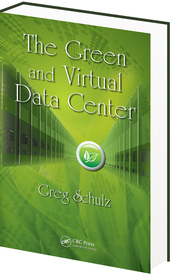
This past week I had the honor of delivering a keynote presentation in San Diego at the California Center for Sustainable Energy (CCSE) as part of their continuing education and community outreach and education, workshop and seminar series. The theme of the well attended event was Next Generation Data Center Solutions of which my talk centered around leveraging Green and Virtual Data Centers for enabling efficiencey and effectiveness. In addition to my keynote, included a panel discussion that I moderated with representatives of the events sponsor Compucom, along with their special guests APC, HP, Intel and VMware. The CCSE has a focus around Climate Change, Energy Efficienecey, Green Buildings, Renewable Energy, Transportation, Home and Business. Their services and focus includes awareness and outreach, education programs, library and tools, consultant and associated services. Speaking of their library, there is even a signed copy of my book The Green and Virtual Data Center (CRC) now at the CCSE library that can be checked out along with their other resources.
The CCSE staff and facilities were fantastic with hosts Mike Bigelow (an energy engineer) and Marlene King (program manager) orchestrating a great event.
If you are in the San Diego area, check out the CCSE located at 8690 Balboa Ave., Suite 100. They have a great library, cool demonstrations and tools that you can check out to assist with optimization IT data centers from an energy efficicinecy standpoint. Learn more about the CCSE here.
Following are some relevant links to the keynote along with panel discussion from the CCSE event:
Following on the heals of several guest appearances late in 2009 ( here, here, here and here) on the Storage Monkeys Infosmack weekly pod cast, I was recently asked to join them again for the inaugural 2010 show (Episode 34).
Along with VMguru Rich Brambley and hosts Greg Knieriemen and Marc Farley we discussed several recent industry topics in this first show of the year which can be accessed here or on iTunes.
Heres a link to the pod cast where you can listen to the discussion including VMware Go, VMware buying Zimbra, Vendor Alliances such as HP and Microsoft HyperV and EMC+Cisco+VMware, along with data protection for virtual servers issues options (or opportunities) among other topics.
I have included the following links that pertain to some of the items we discussed during the show.
2011 is not a typo, I figured that since Im getting caught up on some things, why not get a jump as well.
Since 2009 went by so fast, and that Im finally getting around to doing an obligatory 2010 predictions post, lets take a look at both 2010 and 2011.
Actually Im getting around to doing a post here having already done interviews and articles for others soon to be released.
Based on prior trends and looking at forecasts, a simple predictions is that some of the items for 2010 will apply for 2011 as well given some of this years items may have been predicted by some in 2008, 2007, 2006, 2005 or, well ok, you get the picture. :)
Predictions are fun and funny in that for some, they are taken very seriously, while for others, at best they are taken with a grain of salt depending on where you sit. This applies both for the reader as well as who is making the predictions along with various motives or incentives.
Some are serious, some not so much…
For some, predictions are a great way of touting or promoting favorite wares (hard, soft or services) or getting yet another plug (YAP is a TLA BTW) in to meet coverage or exposure quota.
Meanwhile for others, predictions are a chance to brush up on new terms for the upcoming season of buzzword bingo games (did you pick up on YAP).
In honor of the Vancouver winter games, Im expecting some cool Olympic sized buzzword bingo games with a new slippery fast one being federation. Some buzzwords will take a break in 2010 as well as 2011 having been worked pretty hard the past few years, while others that have been on break, will reappear well rested, rejuvenated, and ready for duty.
Lets also clarify something regarding predictions and this is that they can be from at least two different perspectives. One view is that from a trend of what will be talked about or discussed in the industry. The other is in terms of what will actually be bought, deployed and used.
What can be confusing is sometimes the two perspectives are intermixed or assumed to be one and the same and for 2010 I see that trend continuing. In other words, there is adoption in terms of customers asking and investigating technologies vs. deployment where they are buying, installing and using those technologies in primary situations.
It is safe to say that there is still no such thing as an information, data or processing recession. Ok, surprise surprise; my dogs could have probably made that prediction during a nap. However what this means is more data will need to be moved, processed and stored for longer periods of time and at a lower cost without degrading performance or availability.
This means, denser technologies that enable a lower per unit cost of service without negatively impacting performance, availability, capacity or energy efficiency will be needed. In other words, watch for an expanded virtualization discussion around life beyond consolidation for servers, storage, desktops and networks with a theme around productivity and virtualization for agility and management enablement.
Certainly there will be continued merger and acquisitions on both a small as well as large scale ranging from liquidation sales or bargain hunting, to large and a mega block buster or two. Im thinking in terms of outside of the box, the type that will have people wondering perhaps confused as to why such a deal would be done until the whole picture is reveled and thought out.
In other words, outside of perhaps IBM, HP, Oracle, Intel or Microsoft among a few others, no vendor is too large not to be acquired, merged with, or even involved in a reverse merger. Im also thinking in terms of vendors filling in niche areas as well as building out their larger portfolio and IT stacks for integrated solutions.
Ok, lets take a look at some easy ones, lay ups or slam dunks:
No such thing as an information, data or processing recession, granted budgets are strained
Server, Storage or Systems Resource Analysis (SRA) with event correlation
SRA tools that provide and enable automation along with situational awareness
The green gap of confusion will continue with carbon or environment centric stories and messages continue to second back stage while people realize the other dimension of green being productivity.
As previously mentioned, virtualization of servers and storage continues to be popular with an expanding focus from just consolidation to one around agility, flexibility and enabling production, high performance or for other systems that do not lend themselves to consolidation to be virtualized.
6GB SAS interfaces as well as more SAS disk drives continue to gain popularity. I have said in the past there was a long shot that 8GFC disk drives might appear. We might very well see those in higher end systems while SAS drives continue to pick up the high performance spinning disk role in mid range systems.
Granted some types of disk drives will give way over time to others, for example high performance 3.5” 15.5K Fibre Channel disks will give way to 2.5” 15.5K SAS boosting densities, energy efficiency while maintaining performance. SSD will help to offload hot spots as they have in the past enabling disks to be more effectively used in their applicable roles or tiers with a net result of enhanced optimization, productivity and economics all of which have environmental benefits (e.g. the other Green IT closing the Green Gap).
What I dont see occurring, or at least in 2010
An information or data recession requiring less server, storage, I/O networking or software resources
OSD (object based disk storage without a gateway) at least in the context of T10
Mainframes, magnetic tape, disk drives, PCs, or Windows going away (at least physically)
Cisco cracking top 3, no wait, top 5, no make that top 10 server vendor ranking
More respect for growing and diverse SOHO market space
iSCSI taking over for all I/O connectivity, however I do see iSCSI expand its footprint
FCoE and flash based SSD reaching tipping point in terms of actual customer deployments
Large increases in IT Budgets and subsequent wild spending rivaling the dot com era
Backup, security, data loss prevention (DLP), data availability or protection issues going away
Brett Favre and the Minnesota Vikings winning the super bowl
What will be predicted at end of 2010 for 2011 (some of these will be DejaVU)
Many items that were predicted this year, last year, the year before that and so on…
Dedupe moving into primary and online active storage, rekindling of dedupe debates
Demise of cloud in terms of hype and confusion being replaced by federation
Clustered, grid, bulk and other forms of scale out storage grow in adoption
Disk, Tape, RAID, Mainframe, Fibre Channel, PCs, Windows being declared dead (again)
2011 will be the year of Holographic storage and T10 OSD (an annual prediction by some)
FCoE kicks into broad and mainstream deployment adoption reaching tipping point
16Gb (16GFC) Fibre Channel gets more attention stirring FCoE vs. FC vs. iSCSI debates
100GbE gets more attention along with 4G adoption in order to move more data
Demise of iSCSI at the hands of SAS at low end, FCoE at high end and NAS from all angles
Gaining ground in 2010 however not yet in full stride (at least from customer deployment)
On the connectivity front, iSCSI, 6Gb SAS, 8Gb Fibre Channel, FCoE and 100GbE
SSD/flash based storage everywhere, however continued expansion
Dedupe everywhere including primary storage – its still far from its full potential
Public and private clouds along with pNFS as well as scale out or clustered storage
Policy based automated storage tiering and transparent data movement or migration
Microsoft HyperV and Oracle based server virtualization technologies
Open source based technologies along with heterogeneous encryption
Virtualization life beyond consolidation addressing agility, flexibility and ease of management
Desktop virtualization using Citrix, Microsoft and VMware along with Microsoft Windows 7
Buzzword bingo hot topics and themes (in no particular order) include:
2009 and previous year carry over items including cloud, iSCSI, HyperV, Dedupe, open source
Federation takes over some of the work of cloud, virtualization, clusters and grids
E2E, End to End management preferably across different technologies
SAS, Serial Attached SCSI for server to storage systems and as disk to storage interface
SRA, E23, Event correlation and other situational awareness related IRM tools
Virtualization, Life beyond consolidation enabling agility, flexibility for desktop, server and storage
Green IT, Transitions from carbon focus to economic with efficiency enabling productivity
FCoE, Continues to evolve and mature with more deployments however still not at tipping point
SSD, Flash based mediums continue to evolve however tipping point is still over the horizon
IOV, I/O Virtualization for both virtual and non virtual servers
Other new or recycled buzzword bingo candidates include PCoIP, 4G,
RAID will again be pronounced as being dead no longer relevant yet being found in more diverse deployments from consumer to the enterprise. In other words, RAID may be boring and thus no longer relevant to talk about, yet it is being used everywhere and enhanced in evolutionary ways, perhaps for some even revolutionary.
Tape remains being declared dead (e.g. on the Zombie technology list) yet being enhanced, purchased and utilized at higher rates with more data stored than in past history. Instead of being killed off by the disk drive, tape is being kept around for both traditional uses as well as taking on new roles where it is best suited such as long term or bulk off-line storage of data in ultra dense and energy efficient not to mention economical manners.
What I am seeing and hearing is that customers using tape are able to reduce the number of drives or transports, yet due to leveraging disk buffers or caches including from VTL and dedupe devices, they are able to operate their devices at higher utilization, thus requiring fewer devices with more data stored on media than in the past.
Likewise, even though I have been a fan of SSD for about 20 years and am bullish on its continued adoption, I do not see SSD killing off the spinning disk drive anytime soon. Disk drives are helping tape take on this new role by being a buffer or cache in the form of VTLs, disk based backup and bulk storage enhanced with compression, dedupe, thin provision and replication among other functionality.
There you have it, my predictions, observations and perspectives for 2010 and 2011. It is a broad and diverse list however I also get asked about and see a lot of different technologies, techniques and trends tied to IT resources (servers, storage, I/O and networks, hardware, software and services).
All Comments, (C) and (TM) belong to their owners/posters, Other content (C) Copyright 2006-2026 Server StorageIO and UnlimitedIO LLC All Rights Reserved
Here is the note (Italics added by me for clarity) from the folks at EPA with information about the event and how to participate.
Dear ENERGY STAR® Servers and Storage Stakeholders:
Representatives from the US EPA will be in attendance at The Green Grid Technical Forum in San Jose, CA in early February, and will be hosting information sessions to provide updates on recent ENERGY STAR servers and storage specification development activities. Given the timing of this event with respect to ongoing data collection and comment periods for both product categories, EPA intends for these meetings to be informal and informational in nature. EPA will share details of recent progress, identify key issues that require further stakeholder input, discuss timelines for the completion, and answer questions from the stakeholder community for each specification.
The sessions will take place on February 2, 2010, from 10:00 AM to 4:00 PM PT, at the San Jose Marriott. A conference line and Webinar will be available for participants who cannot attend the meeting in person. The preliminary agenda is as follows:
Servers (10:00 AM to 12:30 PM)
Draft 1 Version 2.0 specification development overview & progress report
Tier 1 Rollover Criteria
Power & Performance Data Sheet
SPEC efficiency rating tool development
Opportunities for energy performance data disclosure
Storage (1:30 PM to 4:00 PM)
Draft 1 Version 1.0 specification development overview & progress report
Preliminary stakeholder feedback & lessons learned from data collection
A more detailed agenda will be distributed in the coming weeks. Please RSVP to storage@energystar.gov or servers@energystar.gov no later than Friday, January 22. Indicate in your response whether you will be participating in person or via Webinar, and which of the two sessions you plan to attend.
Thank you for your continued support of ENERGY STAR.
End of EPA Transmission
For those attending the event, I look forward to seeing you there in person on Tuesday before flying down to San Diego where I will be presenting on Wednesday the 3rd at The Green Data Center Conference.
Following up from some previous posts on the topic, a continued discussion point in the data storage industry is the relevance (or lack there) of RAID (Redundant Array of Independent Disks).
These discussions tend to evolve around how RAID is dead due to its lack of real or perceived ability to continue scaling in terms of performance, availability, capacity, economies or energy capabilities needed or when compared to those of newer techniques, technologies or products.
While there are many new and evolving approaches to protecting data in addition to maintaining availability or accessibility to information, RAID despite the fan fare is far from being dead at least on the technology front.
Sure, there are issues or challenges that require continued investing in RAID as has been the case over the past 20 years; however those will also be addressed on a go forward basis via continued innovation and evolution along with riding technology improvement curves.
Now from a marketing standpoint, ok, I can see where the RAID story is dead, boring, and something new and shiny is needed, or, at least change the pitch to sound like something new.
Consequently, when being long in the tooth and with some of the fore mentioned items among others, older technologies that may be boring or lack sizzle or marketing dollars can and often are declared dead on the buzzword bingo circuit. After all, how long now has the industry trade group RAID Advisory Board (RAB) been missing in action, retired, spun down, archived or ILMed?
RAID remains relevant because like other dead or zombie technologies it has reached the plateau of productivity and profitability. That success is also something that emerging technologies envy as their future domain and thus a classic marketing move is to declare the incumbent dead.
The reality is that RAID in all of its various instances from hardware to software, standard to non-standard with extensions is very much alive from the largest enterprise to the SMB to the SOHO down into consumer products and all points in between.
Now candidly, like any technology that is about 20 years old if not older after all, the disk drive is over 50 years old and been declared dead for how long now?.RAID in some ways is long in the tooth and there are certainly issues to be addressed as have been taken care of in the past. Some of these include the overhead of rebuilding large capacity 1TB, 2TB and even larger disk drives in the not so distant future.
There are also issues pertaining to distributed data protection in support of cloud, virtualized or other solutions that need to be addressed. In fact, go way way back to when RAID appeared commercially on the scene in the late 80s and one of the value propositions among others was to address the reliability of emerging large capacity multi MByte sized SCSI disk drives. It seems almost laughable today that when a decade later, when the 1GB disk drives appeared in the market back in the 90s that there was renewed concern about RAID and disk drive rebuild times.
Rest assured, I think that there is a need and plenty of room for continued innovate evolution around RAID related technologies and their associated storage systems or packaging on a go forward basis.
What I find interesting is that some of the issues facing RAID today are similar to those of a decade ago for example having to deal with large capacity disk drive rebuild, distributed data protecting and availability, performance, ease of use and so the list goes.
However what happened was that vendors continued to innovate both in terms of basic performance accelerated rebuild rates with improvements to rebuild algorithms, leveraged faster processors, busses and other techniques. In addition, vendors continued to innovate in terms of new functionality including adopting RAID 6 which for the better part of a decade outside of a few niche vendors languished as one of those future technologies that probably nobody would ever adopt, however we know that to be different now and for the past several years. RAID 6 is one of those areas where vendors who do not have it are either adding it, enhancing it, or telling you why you do not need it or why it is no good for you.
An example of how RAID 6 is being enhanced is boosting performance on normal read and write operations along with acceleration of performance during disk rebuild. Also tied to RAID 6 and disk drive rebuild are improvements in controller design to detect and proactively make repairs on the fly to minimize or eliminate errors or diminished the need for drive rebuilds, similar to what was done in previous generations. Lets also not forget the improvements in disk drives boosting performance, availability, capacity and energy improvements over time.
Funny how these and other enhancements are similar to those made to RAID controllers hardware and software fine tuning them in the early to mid 2000s in support for high capacity SATA disk drives that had different RAS characteristics of higher performance lower capacity enterprise drives.
Here is my point.
RAID to some may be dead while others continue to rely on it. Meanwhile others are working on enhancing technologies for future generations of storage systems and application requirements. Thus in different shapes, forms, configurations, feature; functionality or packaging, the spirit of RAID is very much alive and well remaining relevant.
Regardless of if a solution using two or three disk mirroring for availability, or RAID 0 fast SSD or SAS or FC disks in a stripe configuration for performance with data protection via rapid restoration from some other low cost medium (perhaps RAID 6 or tape), or perhaps single, dual or triple parity protection, or if using small block or multiMByte or volume based chunklets, let alone if it is hardware or software based, local or disturbed, standard or non standard, chances are there is some theme of RAID involved.
Granted, you do not have to call it RAID if you prefer!
As a closing thought, if RAID were no longer relevant, than why do the post RAID, next generation, life beyond RAID or whatever you prefer to call them technologies need to tie themselves to the themes of RAID? Simple, RAID is still relevant in some shape or form to different audiences as well as it is a great way of stimulating discussion or debate in a constantly evolving industry.
BTW, Im still waiting for the revolutionary piece of hardware that does not require software, and the software that does not require hardware and that includes playing games with server less servers using hypervisors :) .
Provide your perspective on RAID and its relevance in the following poll.
Here are some additional related and relevant RAID links of interests:
All Comments, (C) and (TM) belong to their owners/posters, Other content (C) Copyright 2006-2026 Server StorageIO and UnlimitedIO LLC All Rights Reserved
I just received an email in my inbox from Voltaire along with a pile of other advertisements, advisories, alerts and announcements from other folks.
What caught my eye on the email was that it is announcing a new survey results that you can read here as well as below.
The question that this survey announcements prompts for me and hence why I am posting it here is how dominant will InfiniBand be on a go forward basis, the answer I think is it depends…
It depends on the target market or audience, what their applications and technology preferences are along with other service requirements.
I think that there is and will remain a place for Infiniband, the question is where and for what types of environments as well as why have both InfiniBand and Ethernet including Fibre Channel over Ethernet (FCoE) in support of unified or converged I/O and data networking.
So here is the note that I received from Voltaire:
Hello,
A new survey by Voltaire (NASDAQ: VOLT) reveals that IT executives plan to use InfiniBand and Ethernet technologies together as they refresh or build new data centers. They’re choosing a converged network strategy to improve fabric performance which in turn furthers their infrastructure consolidation and efficiency objectives.
The full press release is below. Please contact me if you would like to speak with a Voltaire executive for further commentary.
Regards, Christy
____________________________________________________________ Christy Lynch| 978.439.5407(o) |617.794.1362(m) Director, Corporate Communications Voltaire – The Leader in Scale-Out Data Center Fabrics christyl@voltaire.com |www.voltaire.com Follow us on Twitter: www.twitter.com/voltaireltd
FOR IMMEDIATE RELEASE:
IT Survey Finds Executives Planning Converged Network Strategy: Using Both InfiniBand and Ethernet
Fabric Performance Key to Making Data Centers Operate More Efficiently
CHELMSFORD, Mass. and ANANA, Israel January 12, 2010 – A new survey by Voltaire (NASDAQ: VOLT) reveals that IT executives plan to use InfiniBand and Ethernet technologies together as they refresh or build new data centers. They’re choosing a converged network strategy to improve fabric performance which in turn furthers their infrastructure consolidation and efficiency objectives.
Voltaire queried more than 120 members of the Global CIO & Executive IT Group, which includes CIOs, senior IT executives, and others in the field that attended the 2009 MIT Sloan CIO Symposium. The survey explored their data center networking needs, their choice of interconnect technologies (fabrics) for the enterprise, and criteria for making technology purchasing decisions.
“Increasingly, InfiniBand and Ethernet share the ability to address key networking requirements of virtualized, scale-out data centers, such as performance, efficiency, and scalability,” noted Asaf Somekh, vice president of marketing, Voltaire. “By adopting a converged network strategy, IT executives can build on their pre-existing investments, and leverage the best of both technologies.”
When asked about their fabric choices, 45 percent of the respondents said they planned to implement both InfiniBand with Ethernet as they made future data center enhancements. Another 54 percent intended to rely on Ethernet alone.
Among additional survey results:
When asked to rank the most important characteristics for their data center fabric, the largest number (31 percent) cited high bandwidth. Twenty-two percent cited low latency, and 17 percent said scalability.
When asked about their top data center networking priorities for the next two years, 34 percent again cited performance. Twenty-seven percent mentioned reducing costs, and 16 percent cited improving service levels.
A majority (nearly 60 percent) favored a fabric/network that is supported or backed by a global server manufacturer.
InfiniBand and Ethernet interconnect technologies are widely used in today’s data centers to speed up and make the most of computing applications, and to enable faster sharing of data among storage and server networks. Voltaire’s server and storage fabric switches leverage both technologies for optimum efficiency. The company provides InfiniBand products used in supercomputers, high-performance computing, and enterprise environments, as well as its Ethernet products to help a broad array of enterprise data centers meet their performance requirements and consolidation plans.
About Voltaire Voltaire (NASDAQ: VOLT) is a leading provider of scale-out computing fabrics for data centers, high performance computing and cloud environments. Voltaire’s family of server and storage fabric switches and advanced management software improve performance of mission-critical applications, increase efficiency and reduce costs through infrastructure consolidation and lower power consumption. Used by more than 30 percent of the Fortune 100 and other premier organizations across many industries, including many of the TOP500 supercomputers, Voltaire products are included in server and blade offerings from Bull, HP, IBM, NEC and Sun. Founded in 1997, Voltaire is headquartered in Ra’anana, Israel and Chelmsford, Massachusetts. More information is available at www.voltaire.com or by calling 1-800-865-8247.
Forward Looking Statements Information provided in this press release may contain statements relating to current expectations, estimates, forecasts and projections about future events that are "forward-looking statements" as defined in the Private Securities Litigation Reform Act of 1995. These forward-looking statements generally relate to Voltaire’s plans, objectives and expectations for future operations and are based upon management’s current estimates and projections of future results or trends. They also include third-party projections regarding expected industry growth rates. Actual future results may differ materially from those projected as a result of certain risks and uncertainties. These factors include, but are not limited to, those discussed under the heading "Risk Factors" in Voltaire’s annual report on Form 20-F for the year ended December 31, 2008. These forward-looking statements are made only as of the date hereof, and we undertake no obligation to update or revise the forward-looking statements, whether as a result of new information, future events or otherwise.
###
All product and company names mentioned herein may be the trademarks of their respective owners.
End of Voltaire transmission:
I/O, storage and networking interface wars come and go similar to other technology debates of what is the best or that will be supreme.
Some recent debates have been around Fibre Channel vs. iSCSI or iSCSI vs. Fibre Channel (depends on your perspective), SAN vs. NAS, NAS vs. SAS, SAS vs. iSCSI or Fibre Channel, Fibre Channel vs. Fibre Channel over Ethernet (FCoE) vs. iSCSI vs. InfiniBand, xWDM vs. SONET or MPLS, IP vs UDP or other IP based services, not to mention the whole LAN, SAN, MAN, WAN POTS and PAN speed games of 1G, 2G, 4G, 8G, 10G, 40G or 100G. Of course there are also the I/O virtualization (IOV) discussions including PCIe Single Root (SR) and Multi Root (MR) for attachment of SAS/SATA, Ethernet, Fibre Channel or other adapters vs. other approaches.
Thus when I routinely get asked about what is the best, my answer usually is a qualified it depends based on what you are doing, trying to accomplish, your environment, preferences among others. In other words, Im not hung up or tied to anyone particular networking transport, protocol, network or interface, rather, the ones that work and are most applicable to the task at hand
Now getting back to Voltaire and InfiniBand which I think has a future for some environments, however I dont see it being the be all end all it was once promoted to be. And outside of the InfiniBand faithful (there are also iSCSI, SAS, Fibre Channel, FCoE, CEE and DCE among other devotees), I suspect that the results would be mixed.
I suspect that the Voltaire survey reflects that as well as if I surveyed an Ethernet dominate environment I can take a pretty good guess at the results, likewise for a Fibre Channel, or FCoE influenced environment. Not to mention the composition of the environment, focus and business or applications being supported. One would also expect a slightly different survey results from the likes of Aprius, Broadcom, Brocade, Cisco, Emulex, Mellanox (they also are involved with InfiniBand), NextIO, Qlogic (they actually do some Infiniband activity as well), Virtensys or Xsigo (actually, they support convergence of Fibre Channel and Ethernet via Infiniband) among others.
Ok, so what is your take?
Whats your preffered network interface for convergence?
For additional reading, here are some related links:
Also check out what others including Scott Lowe have to say about IOV here or, Stuart Miniman about FCoE here, or of Greg Ferro here.
Oh, and for what its worth for those concerned about FTC disclosure, Voltaire is not nor have they been a client of StorageIO, however, I did used to work for a Fibre Channel, iSCSI, IP storage, LAN, SAN, MAN, WAN vendor and wrote a book on the topics :).
The end of year christmas and new years holiday season has come and gone which means of course that 2009 is a wrap along with the travel from being out and about.
In addition to getting some time to relax a bit (playing Wii resort, snow plowing, cooking etc.), I have also been catching up on developing some new content including articles, blogs (some yet to be post), tips as well as podcasts along with some custom research advisory projects.
2009 events and activities saw visits to cities including San Jose, Tucson, Cancun Mexico, Dallas, Tampa, Miami, Los Angles, San Jose, Las Vegas, Milwaukee, Atlanta, St. Louis, Birmingham, Cincinnati, Santa Ana, Minneapolis, Boston, Dallas, Boston, Chicago, Parsipanny, Raleigh, Providence, Kansas City, Denver, Chicago, Orlando, Chicago, Philadelphia, Toronto, Richmond, Columbus, Princeton, Seattle, Portland, Dallas, San Francisco, Minneapolis, Toronto, Chicago, New York, Milwaukee, Atlanta, Boston, Cleveland and Detroit among others.
This time of the year also means that the 2010 events and activities including in person keynote and presentations also known as out and about are getting underway. While the 2010 schedule of events is still being finalized, some initial events have are on the calendar, my bags are about to be packed and tickets in hand not to mention finalizing the presentation and discussion content.
In addition to some non public events including keynote presenting at some vendors annual sales (kick off) meetings, the following are some of what are currently on the calendar that you can click on the links below to learn more about the venues.
February 3, 2010 Green Data Center Conference, San Diego, CA January 21, 2010 Dinner Event keynote Speaker Dynamic IT Infrastructure, Beverly Hills, CA January 21, 2010 Morning keynote Speaker The Green and Virtual Data Center, San Diego, CA January 19, 2010 Dinner Event keynote Speaker Dynamic IT Infrastructure, Miami, FL
Watch for updates to the events calendar and I look forward to seeing you all while Im out and about during 2010.
StorageIO is regularly quoted and interviewed in various industry and vertical market venues and publications both on-line and in print on a global basis.
The following are some coverage, perspectives and commentary by StorageIO on IT industry trends including servers, storage, I/O networking, hardware, software, services, virtualization, cloud, cluster, grid, SSD, data protection, Green IT and more since the last update.
Realizing that some preferblogs to webs to twitter to other venues, here are some recent links among others to media coverage and comments by me on a different topics that are among others found at www.storageio.com/news.html:
SearchSMBStorage: Comments on EMC Iomega v.Clone for PC data syncronization – Jan 2010
Computerworld: Comments on leveraging cloud or online backup – Jan 2010
ChannelProSMB: Comments on NAS vs SAN Storage for SMBs – Dec 2009
ChannelProSMB: Comments on Affordable SMB Storage Solutions – Dec 2009
SearchStorage: Comments on What to buy a geek for the holidays, 2009 edition – Dec 2009
SearchStorage: Comments on EMC VMAX storage and 8GFC enhancements – Dec 2009
SearchStorage: Comments on Data Footprint Reduction – Dec 2009
SearchStorage: Comments on Building a private storage cloud – Dec 2009
SearchStorage: Comments on SSD in storage systems – Dec 2009
SearchStorage: Comments on slow adoption of file virtualization – Dec 2009
IT World: Comments on maximizing data security investments – Nov 2009
SearchCIO: Comments on storage virtualization for your organisation – Nov 2009
Processor: Comments on how to win approval for hardware upgrades – Nov 2009
Processor: Comments on the Future of Servers – Nov 2009
SearchITChannel: Comments on Energy-efficient technology sales depend on pitch – Nov 2009
SearchStorage: Comments on how to get from Fibre Channel to FCoE – Nov 2009
Minneapolis Star Tribune: Comments on Google Wave and Clouds – Nov 2009
SearchStorage: Comments on EMC and Cisco alliance – Nov 2009
SearchStorage: Comments on HP virtualizaiton enhancements – Nov 2009
SearchStorage: Comments on Apple canceling ZFS project – Oct 2009
Processor: Comments on EPA Energy Star for Server and Storage Ratings – Oct 2009
IT World Canada: Cloud computing, dot be scared, look before you leap – Oct 2009
IT World: Comments on stretching your data protection and security dollar – Oct 2009
Enterprise Storage Forum: Comments about Fragmentation and Performance? – Oct 2009
SearchStorage: Comments about data migration – Oct 2009
SearchStorage: Comments about What’s inside internal storage clouds? – Oct 2009
Enterprise Storage Forum: Comments about T-Mobile and Clouds? – Oct 2009
Storage Monkeys: Podcast comments about Sun and Oracle- Sep 2009
Enterprise Storage Forum: Comments on Maxiscale clustered, cloud NAS – Sep 2009
SearchStorage: Comments on Maxiscale clustered NAS for web hosting – Sep 2009
Enterprise Storage Forum: Comments on whos hot in data storage industry – Sep 2009
Realizing that some preferblogs to webs to twitter to other venues, here are some recent links to articles, tips, videos, webcasts and other content that have appeared in different venues since August 2009.
i365 Guest Interview: Experts Corner: Q&A with Greg Schulz December 2009
SearchCIO Midmarket: Remote-location disaster recovery risks and solutions December 2009
ESJ: What Comprises a Green, Efficient and Effective Virtual Data Center? November 2009
SearchSMBStorage: Determining what server to use for SMB November 2009
SearchStorage: Performance metrics: Evaluating your data storage efficiency October 2009
SearchStorage: Optimizing capacity and performance to reduce data footprint October 2009
SearchSMBStorage: How often should I conduct a disaster recovery (DR) test? October 2009
SearchStorage: Addressing storage performance bottlenecks in storage September 2009
SearchStorage AU: Is tape the right backup medium for smaller businesses? August 2009
ITworld: The new green data center: From energy avoidance to energy efficiency August 2009
Video and podcasts include: December 2009 Video: Green Storage: Metrics and measurement for management insight Discussion between Greg Schulz and Mark Lewis of TechTarget the importance of metrics and measurement to gauge productivity and efficiency for Green IT and enabling virtual information factories. Click here to watch the Video.
December 2009 Podcast: iSCSI SANs can be a good fit for SMB storage Discussion between Greg Schulz and Andrew Burton of TechTarget about iSCSI and other related technologies for SMB storage. Click here to listen to the podcast.
December 2009 Podcast: RAID Data Protection Discussion Discussion between Greg Schulz and Andrew Burton of TechTarget about RAID data proteciton, techniques and technologies. Click here to listen to the podcast.
December 2009 Podcast: Green IT, Effiency and Productivity Discussion Discussion between Greg Schulz and Jon Flower of Adaptec about data Green IT, energy effiency, inteligent power management (IPM) also known as MAID 2.0 and other forms of optimization techniques including SSD. Click here to listen to the podcast sponsored by Adaptec.
November 2009 Podcast: Reducing your data footprint impact Even though many enterprise data storage environments are coping with tightened budgets and reduced spending, overall net storage capacity is increasing. In this interview, Greg Schulz, founder and senior analyst at StorageIO Group, discusses how storage managers can reduce their data footprint. Schulz touches on the importance of managing your data footprint on both online and offline storage, as well as the various tools for doing so, including data archiving, thin provisioning and data deduplication. Click here to listen to the podcast.
October 2009 Podcast: Enterprise data storage technologies rise from the dead In this interview, Greg Schulz, founder and senior analyst of the Storage I/O group, classifies popular technologies such as solid-state drives (SSDs), RAID and Fibre Channel (FC) as “zombie” technologies. Why? These are already set to become part of standard storage infrastructures, says Schulz, and are too old to be considered fresh. But while some consider these technologies to be stale, users should expect to see them in their everyday lives. Click here to listen to the podcast.
Following up on previous posts pertaining to US EPA Energy Star for Servers, Data Center Storage and Data Centers, here is a note received today with some new information. For those interested in the evolving Energy Star for Data Center, Servers and Storage, have a look at the following as well as the associated links.
Here is the note from EPA:
From: ENERGY STAR Storage [storage@energystar.gov] Sent: Monday, December 28, 2009 8:00 AM Subject: ENERGY STAR Data Center Storage Initial Data Collection Procedure
Dear ENERGY STAR Data Center Storage Stakeholder or Other Interested Party:
The U.S. Environmental Production Agency (EPA) would like to invite interested parties to test the energy performance of storage products that are currently being considered for inclusion in the Version 1.0 ENERGY STAR® Data Center Storage specification. Please review the attached cover letter, data collection procedure, and test data collection sheet for further information.
Stakeholders are encouraged to submit test data via e-mail to storage@energystar.gov no later than Friday, February 12, 2009.
Thank you for your continued support of ENERGY STAR!
All Comments, (C) and (TM) belong to their owners/posters, Other content (C) Copyright 2006-2026 Server StorageIO and UnlimitedIO LLC All Rights Reserved
Following on the heals of being named one of three EcoTech warriors earlier in the year, and then number 5 in the top ten independent bloggers at StorageMonkeys earlier this year (plus appearing on InfoSmack), the momentum continues more recently being named as the 23rd out of the top 30 influential virtualization bloggers.
If that were not enough, I was also surprised to learn recently that I have also made a debut appearance at number 79 in the Technobabble top 400 analyst and independent blogger lists as well.
To say that Im honored and flattered would be an understatement and I thank all of the growing number of readers and commenters to the various blogs, twitter tweets along with other content at the different venues and events Im involved with.
Thanks to all of you and have a safe happy holiday season along with a prosperous new years, look forward to future conversations and discussions.
Drew Rob has another good article over at Processor.com about various tips and strategies on how to gain approval for hardware (or software) purchases with some comments by yours truly.
My tips and advice that are quoted in the story include to link technology resources to business needs impact which may be common sense, however still a time tested effective technique.
Instead of speaking tech talk such as Performance, capacity, availability, IOPS, bandwidth, GHz, frames or packets per second, VMs to PM or dedupe ratio, map them to business speak, that is things that finance, accountants, MBAs or other management personal understand.
For example, how many transactions at a given response time can be supported by a given type of server, storage or networking device.
Or, put a different way, with a given device, how much work can be done and what is the associated monetary or business benefit.
Likewise, if you do not have a capacity plan for servers, storage, I/O and networking along with software and facilities covering performance, availability, capacity and energy demands now is the time to put one in place.
All Comments, (C) and (TM) belong to their owners/posters, Other content (C) Copyright 2006-2026 Server StorageIO and UnlimitedIO LLC All Rights Reserved
Have you seen the TV commercials or print advertisements where an energy star washer is mentioned as so efficient that the savings from reduced power consumption are enough to pay for the dryer? If not, check out the EPA Energy Star website for information about various programs, savings and efficiency options to learn more
What does this have to do with servers, storage, networking, data centers or other IT equipment?
Simple, if you are not aware, Energy Star for Servers now exits and is being enhanced while good progress is being made on the Energy Star for storage program.
The Energy Star for household appliances has been around a bit longer and more refined, something that I anticipated the server and storage programs to follow-suit with over time.
What really caught my eye with the commercial is the focus on closing the green gap, that is instead of the green environmental impact savings of an appliance that uses less power and subsequent carbon footprint benefits, the message is to the economic hot button. That is, switch to more energy efficient technology that allows more work to done at a lower overall cost and the savings can help self fund the enhancements.
For example, a more energy efficient server that can do more work or GHz per watt of energy when needed, or, to go into lower power modes (intelligent power management: IPM). Low power modes do not necessarily mean turning completely off, rather, drawing less energy and subsequently lower cooling demands during slow periods such as with new Intel Nehalem and other processors.
From a disk storage perspective, energy efficiency is often thought to be avoidance or turning disk drives off boosting capacity and squeezing data footprints.
However energy efficiency and savings can also be achieved by slowing a disk drive down or turning of some of the electronics to reduce energy consumption and heat generation.
Other forms of energy savings include thin provisioning and deduplication however another form of energy efficiency for storage is boosting performance. That is, doing more work per watt of energy for active or time sensitive applications or usage scenarios.
Thus there is another Green IT, one that provides both economic and environmental benefits!
All Comments, (C) and (TM) belong to their owners/posters, Other content (C) Copyright 2006-2026 Server StorageIO and UnlimitedIO LLC All Rights Reserved
Last week EMC and Cisco along with Intel and VMware created the VCE collation along with a consumption model based service joint venture called Acadia.
In other activity last week, HP made several announcements including:
Improvements in sensing technologies
StorageWorks enhancements (SVSP, IBRIX, EVA and HyperV, X9000 and others)
EMC and Cisco were relatively quiet this week on announcement front, however HP unleashed another round of announcements that among others included:
Quarterly financial results
SMB server, storage, network and virtualization enhancements (here, here, here and here)
The reason I bring up all of this HP activity is not to simply re-cap all of the news and announcements which you can find on many other blogs or news sites, rather I see as a trend.
That trend appears to be one of a company on the move, not ready to sit back on its laurels, rather a company that continues to innovate in-house and via acquisitions.
Some of those acquisitions including IBRIX were relatively small, some like EDS last year and the one this week of 3COM to some would be large while to others perhaps as being seen as medium sized. Either way, HP has been busy expanding its portfolio of technology solution and services offerings along with its comprehensive IT stack.
Cisco, EMC and HP are examples of companies looking to expand their IT stacks and footprint in terms of diversifying current product focus and reach, along with extending into new or further into existing customer and market sector areas. Last weeks EMC and Cisco signaled two large players combing their resources to make virtualization and private clouds easy to acquire and deploy for mid to large size environments with a theme around VMware.
This week buried in all of the HP announcements was one that caught my eye which is a virtualization solution bundle designed for small business (that is something smaller than a vblock0), something that was missing in the Cisco and EMC news of last week however one that Im sure will be addressed sooner versus later.
In the case of HP, the other thing with their virtualization bundle was the focus on the mid to small business that fall into the broad and diverse SMB category, not to mention including Microsoft.
Yes, that is right, while a VMware based solution from HP would be a no-brainer given all of the activity the two companies are involved in as joint partners, Microsoft HyperV was front and center.
Is this a reaction to last weeks Cisco and EMC salvo?
Perhaps and some will jump to that conclusion. However I will also offer this alternative scenario, 85-90 percent of servers consolidated into virtual machines (VMs) on VMware or other hypervisors including Microsoft HyperV are Windows based.
Likewise as one of the largest if not largest server vendors (pick your favorite server category or price band) who also happens to be one of the largest Microsoft Windows partners, I would have been more surprised if HP had not done a HyperV bundle.
While Cisco and EMC may stay the course or at least talk the talk with a VMware affinity in the Acadia and VCE coalition for the time being, I would expect HP to flex its wings a bit and show diversity of support for multiple Hypervisors, Operating Systems across its various server, network, storage and services platforms.
I would not be surprised to see some VMware based bundles appear over time building on previous announced HP blade systems matrix solution bundles.
Welcome back my friends to the show that never ends, that is the on-going server, storage, networking, virtualization, hardware, software and services solutions game for enabling the adaptive, dynamic, flexible, scalable, resilient, service oriented, public or private cloud, infrastructure as a service green and virtual data center.