Upcoming Out and About Events

Following up on previous Out and About updates ( here and here ) of where I have been, heres where I’m going to be over the next couple of weeks.

On September 15th and 16th 2009, I will be the keynote speaker along with doing a deep dive discussion around data deduplication in Minneapolis, MN and Toronto ON. Free Seminar, register and learn more here.

The Infrastructure Optimization and Planning Best Practices (V2.009) – Doing more with less without sacrificing storage, system or network capabilities Seminar series continues September 22, 2009 with a stop in Chicago. Free Seminar, register and learn more here.

On September 23, 2009 I will be in New York City at Storage Decisions conference participating in the Ask the Experts during the expo session as well as presenting The Other Green — Storage Efficiency and Optimization.

Throw out the "green“: buzzword, and you’re still left with the task of saving or maximizing use of space, power, and cooling while stretching available IT dollars to support growth and business sustainability. For some environments the solution may be consolation while others need to maintain quality of service response time, performance and availability necessitating faster, energy efficient technologies to achieve optimization objectives. To accomplish these and other related issues, you can turn to the cloud, virtualization, intelligent power management, data footprint reduction and data management not to mention various types of tiered storage and performance optimization techniques. The session will look at various techniques and strategies to optimize either on-line active or primary as well as near-line or secondary storage environment during tough economic times, as well as to position for future growth, after all, there is no such thing as a data recession!

Topics, technologies and techniques that will be discussed include among others:

  • Energy efficiency (strategic) vs. energy avoidance (tactical)
  • Optimization and the need for speed vs. the need for capacity
  • Metrics and measurements for management insight
  • Tiered storage and tiered access including SSD, FC, SAS and clouds
  • Data footprint reduction (archive, compress, dedupe) and thin provision
  • Best practices, financial incentives and what you can do today

Free event, learn more and register here.

Check out the events page for other upcoming events and hope to see you this fall while Im out and about.

Cheers – gs

Greg Schulz – StorageIOblog, twitter @storageio Author “The Green and Virtual Data Center” (CRC)

I/O, I/O, Its off to Virtual Work and VMworld I Go (or went)

Ok, so I should have used that intro last week before heading off to VMworld in San Francisco instead of after the fact.

Think of it as a high latency title or intro, kind of like attaching a fast SSD to a slow, high latency storage controller, or a fast server attached to a slow network, or fast network with slow storage and servers, it is what it is.

I/O virtualization (IOV), Virtual I/O (VIO) along with I/O and networking convergence have been getting more and more attention lately, particularly on the convergence front. In fact one might conclude that it is trendy to all of a sudden to be on the IOV, VIO and convergence bandwagon given how clouds, soa and SaaS hype are being challenged, perhaps even turning to storm clouds?

Lets get back on track, or in the case of the past week, get back in the car, get back in the plane, get back into the virtual office and what it all has to do with Virtual I/O and VMworld.

The convergence game has at its center Brocade emanating from the data center and storage centric I/O corner challenging Cisco hailing from the MAN, WAN, LAN general networking corner.

Granted both vendors have dabbled with success in each others corners or areas of focus in the past. For example, Brocade as via acquisitions (McData+Nishan+CNT+INRANGE among others) a diverse and capable stable of local and long distance SAN connectivity and channel extension for mainframe and open systems supporting data replication, remote tape and wide area clustering. Not to mention deep bench experience with the technologies, protocols and partners solutions for LAN, MAN (xWDM), WAN (iFCP, FCIP, etc) and even FAN (file area networking aka NAS) along with iSCSI in addition to Fibre Channel and FICON solutions.

Disclosure: Here’s another plug ;) Learn more about SANs, LANs, MANs, WANs, POTs, PANs and related technologies and techniques in my book “Resilient Storage NetworksDesigning Flexible Scalable Data Infrastructures" (Elsevier).

Cisco not to be outdone has a background in the LAN, MAN, WAN space directly, or similar to Brocade via partnerships with product and experience and depth. In fact while many of my former INRANGE and CNT associates ended up at Brocade via McData or in-directly, some ended up at Cisco. While Cisco is known for general networking, the past several years they have gone from zero to being successful in the Fibre Channel and yes, even the FICON mainframe space while like Brocade (HBAs) dabbling in other areas like servers and storage not to mention consumer products.

What does this have to do with IOV and VIO, let alone VMworld and my virtual office, hang on, hold that thought for a moment, lets get the convergence aspect out of the way first.

On the I/O and networking convergence (e.g. Fibre Channel over Ethernet – FCoE) scene both Brocade (Converged Enhanced Ethernet-CEE) and Cisco (Data Center Ethernet – DCE) along with their partners are rallying around each others camps. This is similar to how a pair of prize fighters maneuvers in advance of a match including plenty of trash talk, hype and all that goes with it. Brocade and Cisco throwing mud balls (or spam) at each other, or having someone else do it is nothing new, however in the past each has had their core areas of focus coming from different tenets in some cases selling to different people in an IT environment or those in VAR and partner organizations. Brocade and Cisco are not alone nor is the I/O networking convergence game the only one in play as it is being complimented by the IOV and VIO technologies addressing different value propositions in IT data centers.

Now on to the IOV and VIO aspect along with VMworld.

For those of you that attended VMworld and managed to get outside of session rooms, or media/analyst briefing or reeducation rooms, or out of partner and advisory board meetings walking the expo hall show floor, there was the usual sea of vendors and technology. There were the servers (physical and virtual), storage (physical and virtual), terminals, displays and other hardware, I/O and networking, data protection, security, cloud and managed services, development and visualization tools, infrastructure resource management (IRM) software tools, manufactures and VARs, consulting firms and even some analysts with booths selling their wares among others.

Likewise, in the onsite physical data center to support the virtual environment, there were servers, storage, networking, cabling and associated hardware along with applicable software and tucked away in all of that, there were also some converged I/O and networking, and, IOV technologies.

Yes, IOV, VIO and I/O networking convergence were at VMworld in force, just ask Jon Torr of Xsigo who was beaming like a proud papa wanting to tell anyone who would listen that his wares were part of the VMworld data center (Disclosure: Thanks for the T-Shirt).

Virtensys had their wares on display with Bob Nappa more than happy to show the technology beyond an UhiGui demo including how their solution includes disk drives and an LSI MegaRAID adapter to support VM boot while leveraging off-the shelf or existing PCIe adapters (SAS, FC, FCoE, Ethernet, SATA, etc.) while allowing adapter sharing across servers, not to mention, they won best new technology at VMworld award.

NextIO who is involved in the IOV / VIO game was there along with convergence vendors Brocade, Cisco, Qlogic and Emulex among others. Rest assured, there are many other vendors and VARs in the VIO and IOV game either still in stealth, semi-stealth or having recently launched.

IOV and VIO are complimentary to I/O and networking convergence in that solutions like those from Aprius, Virtensys, Xsigo, NextIO and others. While they sound similar, and in fact there is confusion as to if Fibre Channel N_Port Virtual ID (FC_NPVID) and VMware virtual adapters are IOV and VIO vs. solutions that are focused on PCIe device/resource extension and sharing.

Another point of confusion around I/O virtualization and virtual I/O are blade system or blade center connectivity solutions such as HP Virtual Connect or IBM Fabric Manger not to mention those form Engenera add confusion to the equation. Some of the buzzwords that you will be hearing and reading more about include PCIe Single Root IOV (SR-IOV) and Multi-Root IOV (MR-IOV). Think of it this way, within VMware you have virtual adapters, and Fibre Channel Virtualization N_Port IDs for LUN mapping/masking, zone management and other tasks.

IOV enables localized sharing of physical adapters across different physical servers (blades or chassis) with distances measured in a few meters; after all, it’s the PCIe bus that is being extended. Thus, it is not a replacement for longer distance in the data center solutions such as FCoE or even SAS for that matter, thus they are complimentary, or at least should be considered complimentary.

The following are some links to previous articles and related material including an excerpt (yes, another plug ;)) from chapter 9 “Networking with you servers and storage” of new book “The Green and Virtual Data Center” (CRC). Speaking of virtual and physical, “The Green and Virtual Data Center” (CRC) was on sale at the physical VMworld book store this week, as well as at the virtual book stores including Amazon.com
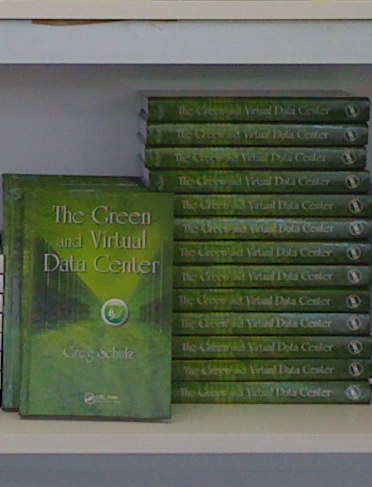
The Green and Virtual Data Center

The Green and Virtual Data Center (CRC) on book shelves at VMworld Book Store

Links to some IOV, VIO and I/O networking convergence pieces among others, as well as news coverage, comments and interviews can be found here and here with StorageIOblog posts that may be of interest found here and here.

SearchSystemChannel: Comparing I/O virtualization and virtual I/O benefits – August 2009

Enterprise Storage Forum: I/O, I/O, It’s Off to Virtual Work We Go – December 2007

Byte and Switch: I/O, I/O, It’s Off to Virtual Work We Go (Book Chapter Excerpt) – April 2009

Thus I went to VMworld in San Francisco this past week as much of the work I do is involved with convergence similar to my background, that is, servers, storage, I/O networking, hardware, software, virtualization, data protection, performance and capacity planning.

As to the virtual work, well, I spent some time on airplanes this week which as is often the case, my virtual office, granted it was real work that had to be done, however I also had a chance to meet up with some fellow tweeters at a tweet up Tuesday evening before getting back in a plane in my virtual office.

Now, I/O, I/O, its back to real work I go at Server and StorageIO , kind of rhymes doesnt it!

I/O, I/O, Its off to Virtual Work and VMworld I Go (or went)

Out and about update, Off to VMworld next week

For those that consider summer to be over after the labor day weekend in the northern hemisphere, well, then summer is almost over, for others, there is still plenty of nice weather to enjoy and get out and about. In addition to back to school time, its also the start of the fall conferences, symposium, lunch and learns, seminars, chugs & hugs (vendor/var/partner get together’s) schedule along with VMworld taking place next week in San Francisco (I will be there) in addition to many other events.

Having already this year been in (not counting changing planes in Atlanta, Detroit or Memphis), Atlanta, Birmingham, Boston, Cancun, Chicago, Cincinnati, Columbus, Dallas, Denver, Kansas City, Las Vegas, Los Angeles, Miami, Milwaukee, Minneapolis, Orlando, Parsippany, Philadelphia, Portland, Princeton, Providence, Raleigh, Richmond, San Jose, Santa Ana, Seattle, St. Louis, Tampa, Toronto and Tucson not to mention several other cities where I was for consulting and advisory engagements, upcoming cities I will be visiting this fall include among others Atlanta (again), Chicago (again), Cleveland, Detroit, New York City and San Francisco.

Check out events page to see what else is coming up when and where, see you sometime this fall while out and about.

Cheers – gs

Greg Schulz – StorageIOblog, twitter @storageio Author “The Green and Virtual Data Center” (CRC)

Technorati tags: StorageIOblog, vmworld

Buzzword Bingo 1.0 – Are you ready for fall product announcemnts?

Ever play IT buzzword bingo or perhaps you have and not realized it?

Anyone can play, its easy and you don’t even need to know or understand the words or terms.

Its actually quite common and very easy, it goes like this, someone perhaps a vendor, var, media, analysts, pundit, blogger, twitter, customer/user, financier or whomever starts rattling of terms, phrases and acronyms in a discussion until some says or yells, “Bingo”, that is what I want or want to talk about or that applies to what Im interested in.  Buzzword bingo can be multi-directional, it can be played by customers and vendors alike, it can be played via product announcements, articles, white papers, blog posts, videos, presentations or webcasts you name it.

So lets give it a try with a simple version to get started, oh, some of the acronyms have multiple meanings as well just to make the game more interesting, so remember, yell bingo when something resonates, ready? Ok, let’s go with 8 Gb Fibre Channel (8GFC), 10GbE, AVO, Agent-less, Authentication, Archiving, Backup, Backup Service Provider (BSP), BC/DR, Buffer, Bus, Benchmarking, Blade servers, Bulk Storage, CAS, Capacity Planning, Capacity per watt, CDP, Converged Enhanced Ethernet (CEE), CIFS, Cloud, cloud computing, cloud storage, cloud it, cloud confusion, clusters, Clustered Storage, CNA, Compliance, Compression, Converged Networks, Cores, Driver, Data Center Ethernet (DCE), DLP, Domain, D2D2D, Data management, Data migration, De-duplication, De-dupe debates, Dual Boot, DPM, eDiscovery, Energy Star, EPA, Environmental Health and Safety (EHS), Encryption, Event Correlation, eWaste, Fibre Channel over Ethernet (FCoE), FCBB, File management, FLASH or flash, Gateway, Green, Grid, Hash table, Index, HA, Hypervisor, hyperv, HAL, I/O Virtualization (IOV), Inband, Inline, ITIL, InfiniBand, Infrastructure Resource Management (IRM), IOPS per watt, IPM & MAID 2.0, iSCSI, LAN, Look aside buffer, MAN, Mhz, Multi-Protocol Storage, Managed Service Processors, Provider (MSP), MIBS, MLC, Meta, NAS, NFS, NPVID, OS, Over clocking, Optimization, Partitions, Para-virtualization, PCIe, Policy Management, POTS, POST, Post processing, PIROMA, Power Cooling Floor-space EHS (PCFE), PCI SIG IOV, Pin count, Pin out, Pun up, Performance, pNFS, Removable Hard Disk Drive (RHDD), RAID 6, RAM, Replication, RoHS, Replication, REST, SAN, SaaS, SRA, SRM, SAS, SATA, Security, SLC, Snapshots, SMIS, SNMP, SOAP, SRM, SSD, Stack, Tape, Threads, Thin Provision, Tier 0, Unstructured data, VCB, VM, Vmworld, Virtualization, virtual memory, Vmotion, VMware, vcpu, VTL, WAN, WAAS, WADS, WAFS, WADM, Web 2.0 or xaaS (replace x with whatever letter you like, kind of like xSP ;) ).

Any bingos yet? Ok, enough is enough, will leave it here for now, maybe a future post for Buzzword Bingo 2.0 will include more technical terms and acronyms or excerpts from industry trade group dictionaries such as SNIA or glossaries such as those from mine and other books .

With a plethora of upcoming announcements, rest assured, there will be plenty of opportunities to brush up on buzzword bingo so get ready, practice and enjoy your next game.

Check out the news and portfolio as well as interesting links page to learn more about related topics.

Ok, nuff said.

Cheers gs

Greg Schulz – Author Cloud and Virtual Data Storage Networking (CRC Press), The Green and Virtual Data Center (CRC Press) and Resilient Storage Networks (Elsevier)
twitter @storageio

All Comments, (C) and (TM) belong to their owners/posters, Other content (C) Copyright 2006-2026 Server StorageIO and UnlimitedIO LLC All Rights Reserved

Blog Roll Déjà Vu and Storage Monkeys

Ever have blog roll Déjà Vu? If not, go visit various blogs and look at the blog rolls.

While some blog owners do a good job of keeping their blog rolls up to date (for example the Storage Monkeys site) given their interests, preferences or blog objectives, there are also many who appear to simply cut and paste blog rolls from other sites (Not the Storage Monkeys).

Ok, fair enough keeping up with the Jones or whoever the neighbors or rivals are. However it’s also interesting to note how someone may not have taken the time to actually check out what is being cut and pasted from one list to another to see if still relevant or even active.

Hmm, Déjà Vu, kind of like how did a teacher know who was copying who’s homework in school? Let’s leave the copying content discussion for another blog post as that’s another topic altogether.

Spotting this pattern of blog roll cut and paste Déjà Vu late last year, I did a little research and analysis (you may recall, that’s something that analysts are supposed to do ;) ) pointing to a couple of trends.

One trend I saw was that many of those links were either stale, or, the sites they ended up at were stale or had changed to something else, hmm, linking to what others are doing yet not actually following, thus blog rolls keeping up with the Jones. For example vendor to vendor for smash / trash talk discussions or debates. Yet another trend found was that many of the blog rolls were dated as their sites were created for example early on in the blog era, then as the enthusiasm faded or something new appeared, the sites go stale.

I also found that some bloggers/web sites actively update and manage their blog rolls while others seem to take the approach that more is better (kind of like twitter thinking, more followers, more tweets are better?) e.g. qty vs. quality for example seeing some blog rolls that should have a vertical scroll bar or requiring some dedupe processing.

I used to have an extensive blog roll when I put up my blog about two years ago of which the first six months or so I let the blog site lay in stealth, low key mode as I watched, learned and figured out how, when and where I would leverage the blog and where/what I wanted to accomplished with it. Hmm, there’s that analytic stuff coming back again ;).

Now in fairness, want to see some links? Go to my links pages here and here or the portfolio page or checkout twitter (backtweets or other venues), read through some of my blog posts which are filled with links to other sites, venues and more.

As for my blog, I used to have a more extensive blog roll, however I’m currently under the mind set that fewer maybe better, that is unless you are a follower and simply want to show/post what others are doing to be part of the crowd.

What does all of this mean if anything and what’s my point?

Simple!

My hat off to Storage Monkeys, a site that if you are not yet a member, take a few minutes and go register, it’s not a vendor sponsored or endorsed site, nor is it an analyst or media sponsored site, rather, it’s a site put up and supported by folks who are involved in technology as a means for peers to collaborate.

Thus it’s not a vendor centric site, not a var centric site, not an engineering centric site, not a site loaded up with product ads or pitches, not a want to be media site, rather, simply what’s on the mind of the community that is made up of IT pros, vars, vendors, analyst’s media and others.

Congratulations to the Storage Monkeys who did two recent polls or votes to update their blog rolls. One blog roll for vendors was open to public polling/balloting and has lead to controversy given the results. The other poll for non-vendors was open to any registered Storage monkey and while it appears that the membership base grew during the polling with little to no controversy.

One of the things I noticed about the monkeys poll is that given its diverse membership base, some of the names you might expect to see on the poll list were absent, that is, those that might have a stronger vendor following than IT pros. Likewise, some of those on the list that might fare better in a vendor poll, fared different!

What might this mean? Vendors tend to like those who tell them or you what they want to hear or what they want told. IT pros for the most part I find tend to prefer to hear it as it is, sometimes bad news is good news and so forth.

I’m proud to have been named for the first time to the Storage Monkeys non-vendor blog roll having landed in the #5 spot particularly as I view this as a poll of peers (IT folks, vendors/vars, media or other analysts) who are registered as Storage Monkeys.

Congratulations to Curtis Preston (aka Mr. Backup and Dr. Dedupe) for moving up in the polls and landing in the #1 spot, likewise, let’s hear it for Chris M. Evans (aka Storage Architect) who moved up from the #10 to #2 spot in the polls. There also was some changing of the guard so to speak with three others joining me in the top ten who had not been there before.

Previous Blog RollNew Blog Roll
Robin HarrisCurtis Preston -https://backupcentral.com/content/blogsection/4/47/
Scott LoweThe Storage Architect -https://thestoragearchitect.com/
Beth PariseauNew  Devang Panchigar -https://storagenerve.com
Curtis PrestonStephen Foskett –
Stephen FoskettGreg Schulz – https://storageioblog.com
Jon ToigoRobin Harris –
Chris PreimesbergerStoragebod – http://www.storagebod.com/wordpress/
Thomas LasswellGestalt IT –
Howard MarksJon Toigo –
Chris M. EvansScott Lowe – https://blog.scottlowe.org

Again, congrats and hat off to all of the Storage Monkeys, maybe other venues will jump on this trend to update their blog rolls as well, I know I have.

Thanks to all of those who participated in the polling regardless of if you voted for me or not.

Cheers – gs

Greg Schulz – StorageIOblog, twitter @storageio Author “The Green and Virtual Data Center” (CRC)

Technorati tags: Storage Monkeys

Summer Book Update and Back to School Reading

August and thus Summer 2009 in the northern hemisphere are swiftly passing by and start of a new school year is just around the corner which means it is also time for final vacations, time at the beach, pool, golf course, amusement park or favorite fishing hole among other past times. In order to help get you ready for fall (or late summer) book shopping for those with IT interests, here are some Amazon lists (here, here and here) for ideas, after all, the 2009 holiday season is not that far away!

Here’s a link to my Amazon.com Authors page that includes coverage of both my books, "The Green and Virtual Data Center" (CRC) and "Resilient Storage Networks – Designing Scalable Flexible Data Infrastructures" (Elsevier).

Resilient Storage Networks - Designing Flexible Scalable Data Infrastructures (Elsevier)

Click here to look inside "The Green and Virtual Data Center" (CRC) and or inside "Resilient Storage Networks" (Elsevier).

Its been six months since the launch announcement of my new book "The Green and Virtual Data Center" (CRC) and general availability at Amazon.com and other global venues here and here. In celebration of the six month anniversary of the book launch (thank you very much to all who have bought a copy!), here is some coverage including what is being said, related articles, interviews, book reviews and more.

Article: New Green Data Center: shifting from avoidance to becoming more efficient IT-World August 2009

wsradio.com interview discussing themes and topics covered in the book including closing the green gap and shifting towards an IT efficiency and productivity for business sustainability.

Closing the green gap: Discussion about expanding data centers with environmental benefits at SearchDataCenter.com

From Greg Brunton – EDS/An HP Company: “Greg Schulz has presented a concise and visionary perspective on the Green issues, He has cut through the hype and highlighted where to start and what the options are. A great place to start your green journey and a useful handbook to have as the journey continues.”

From Rick Bauer – Storage Networking Industry Association (SNIA) – Education and Technology Director”
“Greg is one of the smartest “good guys” in the storage industry.
He has been a voice of calm amid all the “green IT hype” over the past few years. So when he speaks of the possible improvements that Green Tech can bring, it’s a much more realistic approach…”

From CMG (Computer Measurement Group) MeasureIT
I must admit that I have been slightly skeptical at times, when it comes to what the true value is behind all of the discussions on “green” technologies in the data center. As someone who has seen both the end user and vendor side of things, I think my skepticism gets heightened more than it normally would be. This book really helped dispel my skepticism.

The book is extremely well organized and easy to follow. Each chapter has a very good introduction and comprehensive summary. This book could easily serve as a blueprint for organizations to follow when they look for ideas on how to design new data centers. It’s a great addition to an IT Bookshelf. – Reviewed by Stephen R. Guendert, PhD (Brocade and CMG MeasureIT). Click here to read the full review in CMG MeasureIT.

From Tom Becchetti – IT Architect: “This book is packed full of information. From ecological and energy efficiencies, to virtualization strategies and what the future may hold for many of the key enabling technologies. Greg’s writing style benefits both technologists and management levels.”

From MSP Business Journal: Greg Schulz named an Eco-Tech Warrior – April 2009

From David Marshall at VMblog.com: If you follow me on Linked in, you might have seen that I had been reading a new book that came out at the beginning of the year titled, “The Green and Virtual Data Center” by Greg Schulz. Rather than writing about a specific virtualization platform and how to get it up and running, Schulz takes an interesting approach at stepping back and looking at the big picture. After reading the book, I reached out to the author to ask him a few more questions and to share his thoughts with readers of VMBlog.com. I know I’m not Oprah’s Book Club, but I think everyone here will enjoy this book. Click here to read more what David Marshal has to say.

From Zen Kishimoto of Altaterra Research: Book Review May 2009

From Kurt Marko of Processor.com Green and Virtual Book Review – April 2009

From Serial Storage Wire (STA): Green and SASy = Energy and Economic, Effective Storage – March 2009

From Computer Technology Review: Recent Comments on The Green and Virtual Data Center – March 2009

From Alan Radding in Big Fat Finance Blog: Green IT for Finance Operations – April 2009

From VMblog: Comments on The Green and Virtual Data CenterMarch 2009

From StorageIO Blog: Recent Comments and Tips – March 2009

From VMblog: Comments on The Green and Virtual Data CenterMarch 2009

From Data Center Links John Rath comments on “The Green and Virtual Data Center

From InfoStor Dave Simpson comments on “The Green and Virtual Data Center

From Sys-Con Georgiana Comsa comments on “The Green and Virtual Data Center

From Ziff Davis Heather Clancy comments on “The Green and Virtual Data Center”

From Byte & Switch Green IT and the Green Gap February 2009

From GreenerComputing: Enabling a Green and Virtual Data Center February 2009

From Sys-con: Comments on The Green and Virtual Data Center – March 2009

From ServerWatch: Green IT: Myths vs. Realities – February 2009

From Byte & Switch: Going Green and the Economic Downturn – February 2009

From Business Wire: Comments on The Green and Virtual Data Center Book – January 2009

Additional content and news can be found here and here with upcoming events listed here.

Interested in Kindle? Here’s a link to get a Kindle copy of "Resilient Storage Networks" (Elsevier) or to send a message via Amazon to publisher CRC that you would like to see a Kindle version of "The Green and Virtual Data Center". While you are at it, I also invite you to become a fan of my books at Facebook.

Thanks again to everyone who has obtained their copy of either of my books, also thanks to all of those who have done reviews, interviews and helped in many other ways!

Enjoy the rest of your summer!

Cheers – gs

Greg Schulz – twitter @storageio

StorageIO in the news

StorageIO is regularly quoted and interviewed in various industry and vertical market venues and publications both on-line and in print on a global basis. The following is coverage, perspectives and commentary by StorageIO on IT industry trends including servers, storage, I/O networking, hardware, software, services, virtualization, cloud, cluster, grid, SSD, data protection, Green IT and more.

Realizing that some prefer blogs to webs to twitters to other venues, here are some recent links among others to media coverage and comments by me on a different topics that are among others found at www.storageio.com/news.html:

  • Virtualization Review: Comments on Clouds, Virtualizaiton and Cisco move into servers – July 2009
  • SearchStorage: Comments on Storage Resource Managemet (SRM) and related tools – July 2009
  • SearchStorage: Comments on flash SSD – July 2009
  • SearchDataBackup: Comments on Data backup reporting tools’ trends – July 2009
  • SearchServerVirtualization: Comments on Hyper-V R2 matches VMware with 64-processor support – July 2009
  • SearchStorage: Comments on HP buying IBRIX for clustered and Cloud NAS – July 2009
  • Enterprise Storage Forum: Comments on HP buying IBRIX for clustered and Cloud NAS – July 2009
  • eWeek: Comments on NetApps next moves after DDUP and EMC – July 2009
  • Enterprise Storage Forum: Comments on NetApps next moves after DDUP and EMC – July 2009
  • SearchStorage: Comments on EMC buying DataDomain, NetApps next moves – July 2009
  • SearchVirtualization: Comments on Microsft HyperV features and VMware – July 2009
  • SearchITchannel: Comments on social media for business – June 2009
  • SearchSMBstorage: Comments on Storage Resource Management (SRM) for SMBs – June 2009
  • Enterprise Storage Forum: Comments on IT Merger & Acquisition activity – June 2009
  • Evolving Solutions: Comments on Storage Consolidation, Networking & Green IT – June 2009
  • Enterprise Storage Forum: Comments on EMC letter to DDUP – June 2009
  • SearchStorage: Comments on best practices for effective thin provisioning – June 2009
  • Processor: Comments on Cloud computing, SaaS and SOAs – June 2009
  • Serverwatch: Comments in How EMC’s World Pulls the Data Center Together – June 2009
  • Processor: Comments on Virtual Security Is No Walk In The Park – May 2009
  • SearchStorage: Comments on EPA launching Green Storage specification – May 2009
  • SearchStorage: Comments on Storage Provisioning Tools – May 2009
  • Enterprise Systems Journal: Comments on Tape: The Zombie Technology – May 2009
  • Enterprise Storage Forum: Comments on Oracle Keeping Sun Storage Business – May 2009
  • IT Health Blogging: Discussion about iSCSI vs. Fibre Channel for Virtual Environments – May 2009
  • IT Business Edge: Discussion about IT Data Center Futures – May 2009
  • IT Business Edge: Comments on Tape being a Green Technology – April 2009
  • Big Fat Finance Blog: Quoted in story about Green IT for Finance Operaitons – April 2009
  • SearchStorage: Comments on FLASH and SSD Storage – April 2009
  • SearchStorage AU: Comments on Data Classificaiton – April 2009
  • IT Knowledge Exchange: Comments on FCoE and Converged Networking Coming Together – April 2009
  • SearchSMBStorage: Comments on Data Deduplicaiton for SMBs – April 2009
  • SearchSMBStorage: Comments on Blade Storage for SMBs – April 2009
  • SearchStorage: Comments on MAID technology remaining underutilized – April 2009
  • SearchDataCenter: Closing the green gap: Expanding data centers with environmental benefits – April 2009
  • ServerWatch: Comments on What’s Selling In the Data Storage Market? – April 2009
  • ServerWatch: Comments on Oracle Buys Sun: The Consequences – April 2009
  • SearchStorage: Comments on Tiered Storage – April 2009
  • SearchStorage: Comments on Data Classification for Storage Managers – April 2009
  • wsradio.com Interview closing the Green Gap


  • IT Knowledge Exchange: Comments on FCoE eco-system maturing – April 2009
  • Internet Revolution: Comments on the Pre-mature death of the disk drive – April 2009
  • Enterprise Storage Forum: Comments on EMC V-MAX announcement – April 2009
  • MSP Business Journal: Greg Schulz named an Eco-Tech Warrior – April 2009
  • Storage Magazine: Comments on Power-smart disk systems – April 2009
  • Storage Magazine: Comments on Replication Alternatives – April 2009
  • StorageIO Blog: Comments and Tape as a Green Storage Medium – April 2009
  • Inside HPC: Recent Comments on Tape and Green IT – April 2009
  • Processor.com: Recent Comments on Green and Virtual – April 2009
  • SearchDataCenter: Interview: Closing the green gap: Expanding data centers with environmental benefits – April 2009
  • Enterprise Systems Journal: Recent Comments and Tips – March 2009
  • Computer Technology Review: Recent Comments on The Green and Virtual Data Center – March 2009
  • VMblog: Comments on The Green and Virtual Data Center – March 2009
  • Sys-con: Comments on The Green and Virtual Data Center – March 2009
  • Server Watch: Comments on IBM possibly buying Sun – March 2009
  • Bnet: Comments on IBM possibly buying Sun – March 2009
  • SearchStorage: Comments on Tiered Storage 101 – March 2009
  • SearchStorage: Comments – Cisco pushes into Servers March 2009
  • Enterprise Storage Forum: Comments – Cisco Entering Server Market March 2009
  • Enterprise Storage Forum: Comments – State of Storage Job Market – March 2009
  • SearchSMBStorage: Comments on SMB Storage Options – March 2009
  • Enterprise Storage Forum: Comments on Sun Proposes New Solid State Storage Spec – March 2009
  • Enterprise Storage Forum: Comments on Despite Economy, Storage Bargains Hard to Find – March 2009
  • TechWorld: Comments on Where to Stash Your Data – February 2009
  • ServerWatch: Green IT: Myths vs. Realities – February 2009
  • Byte & Switch: Going Green and the Economic Downturn – February 2009
  • CTR: Comments on Tape Hardly Being On Way Out – February 2009
  • Processor: Comments on SSD (FLASH and RAM) – February 2009
  • Internet News: Comments on Steve Wozniak joining SSD startup – February 2009
  • SearchServerVirtualization: Comments on I/O and Virtualization – February 2009
  • Technology Inc.: Comments on Data De-dupe for DR – February 2009
  • SearchStorage: Comments on NetApp SMB NAS – February 2009
  • Check out the Tips, Tools and White Papers, and News pages for additional commentary, coverage and related content or events.

    Ok, nuff said.

    Cheers gs

    Greg Schulz – Author Cloud and Virtual Data Storage Networking (CRC Press, 2011), The Green and Virtual Data Center (CRC Press, 2009), and Resilient Storage Networks (Elsevier, 2004)

    twitter @storageio

    All Comments, (C) and (TM) belong to their owners/posters, Other content (C) Copyright 2006-2012 StorageIO and UnlimitedIO All Rights Reserved

    Recent tips, videos, articles and more

    Its been a busy year so far and there is still plenty more to do. Taking advantage of a short summer break, I’m getting caught up on some items including putting up a link to some of the recent articles, tips, reports, webcasts, videos and more that I have eluded to in recent posts. Realizing that some prefer blogs to webs to tweets to other venues, here are some links to recent articles, tips, videos, podcasts, webcasts, white papers and more that can be found on the StorageIO Tips, tools and White Papers pages.

    Recent articles, columns, tips, white papers and reports:

  • ITworld: The new green data center: From energy avoidance to energy efficiency August 2009
  • SearchSystemsChannel: Comparing I/O virtualization and virtual I/O benefits July 2009
  • SearchDisasterRecovery: Top server virtualization myths in DR and BC July 2009
  • Enterprise Storage Forum: Saving Money with Green Data Storage Technology July 2009
  • SearchSMB ATE Tips: SMB Tips and ATE by Greg Schulz
  • SearchSMB ATE Tip: Tape library storage July 2009
  • SearchSMB ATE Tip: Server-based operating systems vs. PC-based operating systems June 2009
  • SearchSMB ATE Tip: Pros/cons of block/variable block dedupe June 2009
  • FedTechAt the Ready: High-availability storage hinges on being ready for a system failure May 2009
  • Byte & Switch Part XI – Key Elements For A Green and Virtual Data Center May 2009
  • Byte & Switch Part X – Basic Steps For Building a Green and Virtual Data Center May 2009
  • InfoStor Technology Options for Green Storage: April 2009
  • Byte & Switch Part IX – I/O, I/O, Its off to Virtual Work We Go: Networks role in Virtual Data Centers April 2009
  • Byte & Switch Part VIII – Data Storage Can Become Green: There are many steps you can take April 2009
  • Byte & Switch Part VII – Server Virtualization Can Save Costs April 2009
  • Byte & Switch Part VI – Building a Habitat for Technology April 2009
  • Byte & Switch Part V – Data Center Measurement, Metrics & Capacity Planning April 2009
  • zJournal Storage & Data Management: Tips for Enabling Green and Virtual Efficient Data Management March 2009
  • Serial Storage Wire (STA): Green and SASy = Energy and Economic, Effective Storage March 2009
  • SearchSystemsChannel: FAQs: Green IT strategies for solutions providers March 2009
  • Computer Technology Review: Recent Comments on The Green and Virtual Data Center March 2009
  • Byte & Switch Part IV – Virtual Data Centers Can Promote Business Growth March 2009
  • Byte & Switch Part III – The Challenge of IT Infrastructure Resource Management March 2009
  • Byte & Switch Part II – Building an Efficient & Ecologically Friendly Data Center March 2009
  • Byte & Switch Part I – The Green Gap – Addressing Environmental & Economic Sustainability March 2009
  • Byte & Switch Green IT and the Green Gap February 2009
  • GreenerComputing: Enabling a Green and Virtual Data Center February 2009
  • Some recent videos and podcasts include:

  • bmighty.com The dark side of SMB virtualization July 2009
  • bmighty.com SMBs Are Now Virtualization’s “Sweet Spot” July 2009
  • eWeek.com Green IT is not dead, its new focus is about efficiency July 2009
  • SearchSystemsChannel FAQ: Using cloud computing services opportunities to get more business July 2009
  • SearchStorage FAQ guide – How Fibre Channel over Ethernet can combine networks July 2009
  • SearchDataCenter Business Benefits of Boosting Web hosting Efficiency June 2009
  • SearchStorageChannel Disaster recovery services for solution providers June 2009
  • The Serverside The Changing Dynamic of the Data Center April 2009
  • TechTarget Virtualization and Consolidation for Agility: Intels Xeon Processor 5500 series May 2009
  • TechTarget Virtualization and Consolidation for Agility: Intels Xeon Processor 5500 series May 2009
  • Intel Reduce Energy Usage while Increasing Business Productivity in the Data Center May 2009
  • WSRadio Closing the green gap and shifting towards an IT efficiency and productivity April 2009
  • bmighty.com July 2009
  • Check out the Tips, Tools and White Papers, and News pages for more commentary, coverage and related content or events.

    Ok, nuff said.

    Cheers gs

    Greg Schulz – Author Cloud and Virtual Data Storage Networking (CRC Press, 2011), The Green and Virtual Data Center (CRC Press, 2009), and Resilient Storage Networks (Elsevier, 2004)

    twitter @storageio

    All Comments, (C) and (TM) belong to their owners/posters, Other content (C) Copyright 2006-2012 StorageIO and UnlimitedIO All Rights Reserved

    Green IT Confusion Continues, Opportunities Missed!

    I continue to see those looking for fast silver bullets in the quest to be green, efficient, optimized or sustainable while addressing issues ranging from power/energy, cooling, floor-space/footprint, EH&S (environmental health & safety) not to mention recycling. Yet, I’m also continued to be  amazed by the focus and emphasis around reduce as in reduce your capacity and your performance or processing capabilities in the form of consolidation or aggregation along with energy avoidance which for some is applicable.

    However, there is also the other side of the tale which is shifting from avoidance to becoming more efficient, that is doing more with what you have or with less while boosting productivity. For example, having a server or processor that can do more work in the same or smaller physical footprint drawing the same or less energy and requiring less cooling is a form of reducing overall impact yet boosting productivity. The same can be done with data and I/O networks, storage and even software.

    Similar to automobiles after the 1970s oil and energy crisis, the focus was on reduction, conservation and avoidance as the form of being efficient. Over time, this approach gave way to levering more efficient engines and vehicles that boosted the MPG city and highway, change in driving or usage habits, awareness of issues including applicable metrics and energy costs, as well as the continuing quest for alternative fuels.

    This is no different than what is happening with the IT organizations or compute focused entities in that there has been an initial focus of avoidance to meet short term tactical requirements, not to mention all of the green hype of a few years ago. Today there is a shift taking place towards efficiency and awareness that optimization and efficiency is more than consolidation, that it also includes boosting productivity as part of achieving reduced energy and cooling demands.

    How this can be done is to leverage multiple different techniques including new servers with processors that have intelligent power management (IPM) also known as adaptive voltage scaling (AVS) or other marketing terms enabling variable performance and energy consumption. For example, vary clock cycles and turn on cores when needed, then to turn off cores, slow clock speed down when there is less work to be done. Likewise there are improvements with cooling closer to the heat source ranging from leveraging inert liquid cooling inside the cabinet of computers to surface attached cooling to emerging micro cooling located inside silicon. There is a fascination with using virtualization to consolidate and reduce servers that are underutilized, which again is applicable for some environments and applications.

    However not all servers including many that are underutilized lend themselves to being consolidated for various reasons including quality of service (QoS) or performance, security, vendor support or software compatibility, politics or finance among others. This however does not mean that they cannot be virtualized, it more than likely mean that they cannot be consolidated. There is a common myth that virtualization equals consolidation and vice versa, however virtualization can also be used for abstraction, transparency, emulation and enabling agility including support for load-balancing, scale-up and scale-out performance oriented clustering among other uses. Thus there is another side of virtualization and that is to achieve   efficiency, life beyond consolidation.

    Needless to say there are many more technologies and techniques to address various issues now along with those that are emerging. The good news in all of this is the growing awareness that there are many different faces or facets of being green. That green wash and green hype may be on the endangered species list, that green means more than reducing carbon footprints or recycling or energy avoidance. That green is really about shifting and becoming more efficient, more optimized to support more processing, more work in a cost effective manner to sustain growth on a go forward basis. For high performance compute (HPC) or other large scale IT organizations, there is a notion that small improvements on a large broad scale have significant impact.

    Some organizations are in pursuit of technologies of solutions that promise significant saving ratios over small sets or instances, solutions that provide  smaller reduction or savings over a larger basis can prove to be more effective. For example, if power is a concern, powering down servers or storage that promises 85-100% savings might only be applicable to less than 5% of the devices. However, if 85-100% of the devices can be upgraded to newer models that boost productivity by 5-15% (or more) in the same or smaller footprint, using 5-15% (or more) less power, the results add up quickly. Think of it this way, a 1% saving for an environment using 1,000 kilo watt hour (kWh) or 1mWh of energy is a savings of 10kWh. The point being that for large environments, don’t forget to look at small savings that apply to a large installed base that then add up to big benefits.

    The net result is that one can pursue being green or being perceived as being green which can have a high cost, or, can pursue various efficiency that help the overall organization by boosting productivity, helping the top and bottom line, doing more in a smaller footprint and guess what, the result is not only economic, it’s also environmental positive. Thus, the byproduct of shifting towards efficiency (and not just avoidance) is to become green!

    Ok, nuff said.

    Cheers gs

    Greg Schulz – Author Cloud and Virtual Data Storage Networking (CRC Press), The Green and Virtual Data Center (CRC Press) and Resilient Storage Networks (Elsevier)
    twitter @storageio

    All Comments, (C) and (TM) belong to their owners/posters, Other content (C) Copyright 2006-2026 Server StorageIO and UnlimitedIO LLC All Rights Reserved

    Mirror mirror on the wall, who’s the greenest of them all?

    If you subscribe to the notion that Green IT is all about carbon footprints, you may be missing out on some real opportunities to go green. After all, carbon is part of the green movement, there are many other aspects including supply chain, efficiency, sustainability in addition to recycling, not to mention optimizing power, cooling footprints in order to do more work in a productive manner.

    So who is the greenest of them all? Could it be Brocade, CA, Cisco, EMC, Hitachi, IBM, Intel, LSI, Microsoft, NetApp, Oracle, Symantec, VMware or 3PAR? What about the cloud crowd or perhaps one of the industry trade groups such as Green grid, SNIA GSI, Climate Savers Computing or Carbon disclosure project perhaps among others?

    You might be surprised, now granted, this list is for consumer products. However, given their broad adoption, and looking at Green as more than carbon impact, and with the EPA implanting Energy Star for Servers and now Energy Star for storage in the works, not to mention factoring in the green supply chain, have a look here.

    Here’s an interesting read about how the Internet is causing global warming. How ironic, given Al Gore’s carbon crusade, and the folk-lore claim about  (or mistaken have claimed) to have invented the Internet, no wonder he has been able to cash-in and transform Green to Gold.

    For those interested in saving money with efficient and optimized storage (e.g. the new Green) to boost productivity, here’s an article to check out.

    Ok, that’s enough "Green" fun for now.

    Cheers gs

    All work and no play? Ok, how about an education half day?

    This past week in between keynote talks and moderating panel discussions pertaining to IT infrastructure optimization (server, storage, networks, hardware, software, services, virtualization, etc.) in Seattle and Portland, I was able to take a rare couple of hours break and go on a non work related tour.

    The tour was actually two tours in one, the 1st being the future of flight facility located adjacent (ok, across the runway) to the Boeing Everett large commercial aircraft facility, which is where the 2nd tour was.

    There was a saying heard on the tour, as well as something seen on several signs and bumper stickers which is, “if it does not say Boeing, I’m not going”. Disclosure time, I did fly to Seattle on a Boeing product, however I flew home from Portland on an Airbus product, and in-between those two great cities, I traveled via Amtrak.

    Having been in many other in interesting factories including those of GE Aircraft Engines, GE Appliances not to mention electrical power plants (another form of a factory) both Coal, Hydro and Nuclear as well as automotive/trucks, army tanks along with chemical manufacturing or processing sites among others, the Boeing tour is right up there if not at the top of the list.

    Boeing Everett Plant - photo from Gregs iPhone
    Here’s an iPhone photo of from the future of flight museum/facility of the Boeing Everett factory

    To say the building is huge would be an understatement! In the above photo, on the left the blue doors are each about the size of a football field in size. The building is touted as the largest building by volume in the world, and once up close you can see why the key phrase is “by volume”. The place is huge! Click here to see some more information from Boeing about the site.

    Boeing does not allow cameras, cell phones, MP3 players, purses, backpacks or fanny packs, essentially anything other than your wallet or what’s in your pocket during the tour, so sorry, no photos.  However, here are some links including a great website (flight blogger) where you can see what I saw as well as learn a lot more.

    Boeing is in the process of developing two new commercial aircraft, the 747-8 and the 787 “Dream liner” (learn more here at Boeings newairplane.com site).

    In the factory, on the 747 line, which is in the older part of the building (40+ years old), the first of what is the newest or essentially 3rd generation of the 40 year old 747 airplane was seen having had its fuselage sections joined hours before. In the photo found in the following link, the sections were hours away from being joined, and the vantage point of the tour can be seen in the background adjacent to where the large U.S. flag is seen.

    Click here and here to see photos from Flightblogger.com of the new “next generation” 747-8F taken the day before the tour. Click here to see some images of the 787 dream liner, including this one here that had just been removed from the paint hanger and was parked on the ramp. I also saw this plane on the ramp that had just emerged from being painted.

    Some perspectives that I found interesting from the tour included:

    On the 747 line, there were plenty of factory sounds, pneumatic air tools, riveters, drills, hammering and activity one would expect in a large factory where there was a mix of hand building with tools and automation. However clearly, rooted in a 40+ year old technology that has been brought up to current generation standards, systems and technologies.

    In the middle of the factory, where the newer 777 were being assembled, it looked like a newer program and processes including with moving assembly lines similar to what you would expect in a high volume factory. There were lots of people moving and installing things, you could see and hear work being done, however much more automated than on the larger 747 line, not surprising seeing the size of the new 747-8F.

    At the opposite end of the factory, in a section that is only about 15 years old, you could tell the difference in the structure as you walk through the below factory floor access tunnels which are large enough for large automobiles to comfortably pass each other in. The tunnels were larger; there were more bulk fiber optic cables in the overhead conveyance racks and a generally newer look and feel. However once up on the observation level above the factory floor is where you could really see the difference.

    At the end of the tour, we saw the brand new 787 dream liner being put together. This is a brand new plan that has yet to fly and that has been plagued by issues, some not so different to what we see with new IT technologies. The 787 is an all composite aircraft (ok, there are some small amounts of metal in some structures) that has its components built elsewhere and then flown to Everett for integration or final assembly.

    In fact, back on July 8th, 2007, (e.g. 787), Boeing did a virtual physical rollout, that is, they put the incomplete plane together, painted it, rolled it out for the world to see and of course, people believed that it was ready to fly in a month or so. Guess what, most everyone fell for the demo and thought it to be real (hmmm, sounds like some trade shows I have been to or demo rooms I have seen ;) ), only to still be on the ground dealing with development issues.

    Anyway, all that aside, what I saw on the 787 line were two aircraft, that were not surrounded by people with pneumatic tools, drills, riveters or making factory sounds or noises. Instead, what I saw looked more like what I see in many IT environments, which was a piece of hardware in the middle of the room, with people all around it with laptop, desktop or other workstation computers busily doing work.

    There were so many workstations, laptops and other computers on the floor in makeshift cubicles, conferences rooms that there were even network switches/directors positioned at the end of row of these cubes and clusters of workers. Thus the impact of having the engineers close to where the work was being done, the impact of all of the documentation and paper (virtual paper) work that goes with new development and reliance on information systems for communications, collaborations, design, simulation, parts tracking and so forth.

    The real takeaway for me was how from one end of the factory were signs of the past generation leveraging new technologies, the middle being a hybrid, and the other end being leading edge, yet so revolutionary that issues are still being worked out.

    I thought to myself of some similarities between what I saw at Boeing and many IT environments. That is, extremes, the past and the future, what works today, what will be key for tomorrow, as well as hybrid environments.

    Similar to IT, customers are buying, testing and deploying for early adoption new technologies such as SAS, FCoE, SSD, dedupe, thin provision, virtualization that will be key building blocks moving forward, yet at the same time leveraging the past including disk drives, tape, RAID, FC, iSCSI  and others buzzword bingo technology, techniques and three letter acronyms (TLAs). Thus I saw Boeing leveraging the past, building to the future, surviving and sustaining itself today, a balance of the old and the new, just like many IT environments.

    Souvenir hat - Photo via gregs iphone

    My souvenir hat

    If you are in the Seattle area and have a couple of hours to spare, I highly recommend the tour!

    Ok, nuff said.

    Cheers gs

    Greg Schulz – Author Cloud and Virtual Data Storage Networking (CRC Press), The Green and Virtual Data Center (CRC Press) and Resilient Storage Networks (Elsevier)
    twitter @storageio

    All Comments, (C) and (TM) belong to their owners/posters, Other content (C) Copyright 2006-2026 Server StorageIO and UnlimitedIO LLC All Rights Reserved

    Clarifying Clustered Storage Confusion

    Clustered storage can be iSCSI, Fibre Channel block based or NAS (NFS or CIFS or proprietary file system) file system based. Clustered storage can also be found in virtual tape library (VTL) including dedupe solutions along with other storage solutions such as those for archiving, cloud, medical or other specialized grids among others.

    Recently in the IT and data storage specific industry, there has been a flurry of merger and acquisition (M&A) (Here and here), new product enhancement or announcement activity around clustered storage. For example, HP buying clustered file system vendor IBRIX complimenting their previous acquisition of another clustered file system vendor (PolyServe) a few years ago, or, of iSCSI block clustered storage software vendor LeftHand earlier this year. Another recent acquisition is that of LSI buying clustered NAS vendor ONstor, not to mention Dell buying iSCSI block clustered storage vendor EqualLogic about a year and half ago, not to mention other vendor acquisitions or announcements involving storage and clustering.

    Where the confusion enters into play is the term cluster which means many things to different people, and even more so when clustered storage is combined with NAS or file based storage. For example, clustered NAS may infer a clustered file system when in reality a solution may only be multiple NAS filers, NAS heads, controllers or storage processors configured for availability or failover.

    What this means is that a NFS or CIFS file system may only be active on one node at a time, however in the event of a failover, the file system shifts from one NAS hardware device (e.g. NAS head or filer) to another. On the other hand, a clustered file system enables a NFS or CIFS or other file system to be active on multiple nodes (e.g. NAS heads, controllers, etc.) concurrently. The concurrent access may be for small random reads and writes for example supporting a popular website or file serving application, or, it may be for parallel reads or writes to a large sequential file.

    Clustered storage is no longer exclusive to the confines of high-performance sequential and parallel scientific computing or ultra large environments. Small files and I/O (read or write), including meta-data information, are also being supported by a new generation of multipurpose, flexible, clustered storage solutions that can be tailored to support different applications workloads.

    There are many different types of clustered and bulk storage systems. Clustered storage solutions may be block (iSCSI or Fibre Channel), NAS or file serving, virtual tape library (VTL), or archiving and object-or content-addressable storage. Clustered storage in general is similar to using clustered servers, providing scale beyond the limits of a single traditional system—scale for performance, scale for availability, and scale for capacity and to enable growth in a modular fashion, adding performance and intelligence capabilities along with capacity.

    For smaller environments, clustered storage enables modular pay-as-you-grow capabilities to address specific performance or capacity needs. For larger environments, clustered storage enables growth beyond the limits of a single storage system to meet performance, capacity, or availability needs.

    Applications that lend themselves to clustered and bulk storage solutions include:

    • Unstructured data files, including spreadsheets, PDFs, slide decks, and other documents
    • Email systems, including Microsoft Exchange Personal (.PST) files stored on file servers
    • Users’ home directories and online file storage for documents and multimedia
    • Web-based managed service providers for online data storage, backup, and restore
    • Rich media data delivery, hosting, and social networking Internet sites
    • Media and entertainment creation, including animation rendering and post processing
    • High-performance databases such as Oracle with NFS direct I/O
    • Financial services and telecommunications, transportation, logistics, and manufacturing
    • Project-oriented development, simulation, and energy exploration
    • Low-cost, high-performance caching for transient and look-up or reference data
    • Real-time performance including fraud detection and electronic surveillance
    • Life sciences, chemical research, and computer-aided design

    Clustered storage solutions go beyond meeting the basic requirements of supporting large sequential parallel or concurrent file access. Clustered storage systems can also support random access of small files for highly concurrent online and other applications. Scalable and flexible clustered file servers that leverage commonly deployed servers, networking, and storage technologies are well suited for new and emerging applications, including bulk storage of online unstructured data, cloud services, and multimedia, where extreme scaling of performance (IOPS or bandwidth), low latency, storage capacity, and flexibility at a low cost are needed.

    The bandwidth-intensive and parallel-access performance characteristics associated with clustered storage are generally known; what is not so commonly known is the breakthrough to support small and random IOPS associated with database, email, general-purpose file serving, home directories, and meta-data look-up (Figure 1). Note that a clustered storage system, and in particular, a clustered NAS may or may not include a clustered file system.

    Clustered Storage Model: Source The Green and Virtual Data Center (CRC)
    Figure 1 – Generic clustered storage model (Courtesy “The Green and Virtual Data Center  (CRC)”

    More nodes, ports, memory, and disks do not guarantee more performance for applications. Performance depends on how those resources are deployed and how the storage management software enables those resources to avoid bottlenecks. For some clustered NAS and storage systems, more nodes are required to compensate for overhead or performance congestion when processing diverse application workloads. Other things to consider include support for industry-standard interfaces, protocols, and technologies.

    Scalable and flexible clustered file server and storage systems provide the potential to leverage the inherent processing capabilities of constantly improving underlying hardware platforms. For example, software-based clustered storage systems that do not rely on proprietary hardware can be deployed on industry-standard high-density servers and blade centers and utilizes third-party internal or external storage.

    Clustered storage is no longer exclusive to niche applications or scientific and high-performance computing environments. Organizations of all sizes can benefit from ultra scalable, flexible, clustered NAS storage that supports application performance needs from small random I/O to meta-data lookup and large-stream sequential I/O that scales with stability to grow with business and application needs.

    Additional considerations for clustered NAS storage solutions include the following.

    • Can memory, processors, and I/O devices be varied to meet application needs?
    • Is there support for large file systems supporting many small files as well as large files?
    • What is the performance for small random IOPS and bandwidth for large sequential I/O?
    • How is performance enabled across different application in the same cluster instance?
    • Are I/O requests, including meta-data look-up, funneled through a single node?
    • How does a solution scale as the number of nodes and storage devices is increased?
    • How disruptive and time-consuming is adding new or replacing existing storage?
    • Is proprietary hardware needed, or can industry-standard servers and storage be used?
    • What data management features, including load balancing and data protection, exists?
    • What storage interface can be used: SAS, SATA, iSCSI, or Fibre Channel?
    • What types of storage devices are supported: SSD, SAS, Fibre Channel, or SATA disks?

    As with most storage systems, it is not the total number of hard disk drives (HDDs), the quantity and speed of tiered-access I/O connectivity, the types and speeds of the processors, or even the amount of cache memory that determines performance. The performance differentiator is how a manufacturer combines the various components to create a solution that delivers a given level of performance with lower power consumption.

    To avoid performance surprises, be leery of performance claims based solely on speed and quantity of HDDs or the speed and number of ports, processors and memory. How the resources are deployed and how the storage management software enables those resources to avoid bottlenecks are more important. For some clustered NAS and storage systems, more nodes are required to compensate for overhead or performance congestion.

    Learn more about clustered storage (block, file, VTL/dedupe, archive), clustered NAS, clustered file system, grids and cloud storage among other topics in the following links:

    "The Many faces of NAS – Which is appropriate for you?"

    Article: Clarifying Storage Cluster Confusion
    Presentation: Clustered Storage: “From SMB, to Scientific, to File Serving, to Commercial, Social Networking and Web 2.0”
    Video Interview: How to Scale Data Storage Systems with Clustering
    Guidelines for controlling clustering
    The benefits of clustered storage

    Along with other material on the StorageIO Tips and Tools or portfolio archive or events pages.

    Ok, nuff said.

    Cheers gs

    Greg Schulz – Author Cloud and Virtual Data Storage Networking (CRC Press), The Green and Virtual Data Center (CRC Press) and Resilient Storage Networks (Elsevier)
    twitter @storageio

    All Comments, (C) and (TM) belong to their owners/posters, Other content (C) Copyright 2006-2026 Server StorageIO and UnlimitedIO LLC All Rights Reserved

    Worried about IT M&A, here come the new startups!

    Storage I/O trends

    Late last year , I did a post (see here) countering the notion that there is a lack of innovation in IT and specifically around data storage. Recently I did a post about a Funeral for Friend, not to mention yesterdays post about Summer marriages.

    For those who are concerned about lack of innovation, or, that consolidation will result in just a few big vendors, here’s some food for thought. Those big vendors in addition to growing via internal organic growth, also grow by buying or merging with other vendors. Those other vendors emerge as startups, some grow, blossom and are bought, some make a decent business on their own, some are looking to be bought, some need to be bought, some will see fire sales, liquidation or simply closing their doors and perhaps re-launching as a new company.

    With all the M&A activity currently that has taken place, and I’m sure (speculation only ;) ) that there will be plenty more, here’s a short and far from comprehensive list of some startups or companies you may not have heard of yet. There are additional ones who are still in deep stealth, some on the list are still in stealth, yet talking and letting information trickle out, thus only non-NDA information is being shown here. In other words, you can find out about these via publicly available information and sources.

    Something that I have noticed and talked with others in the industry about is that this generation of startups, at least for now are taking a far more low-key approach to their launches than in the past. Gone at least for now are the Dot COM era over the top announcements in some cases before there was even a product or shipping for actual customer production deployment scenario. This crop or corps of startups are taking their time leveraging the current economic situation to further incubate their technologies and go to market strategies, not to mention minimizing the amount of over the top VC funding we have seen in the past. Some of these may not appear to be storage related and that would be correct. This list includes those associated with data infrastructure technolgies from servers, to storage to networking, hardware, software and services among othes as a common theme.

    Disclosure Notice: None of these companies mentioned are nor have ever been clients of StorageIO. Why do I mention this, why not!

    Balesio – File compression solutions
    Box.net – Internet/web/cloud storage service with high availability and backup
    Cirrustore – Backup data protection tools
    Dataslide – Hard rectangular disk (HRD)
    Enclarity – Healthcare CRM and analysis tools
    Enstratus – Amazon cloud computing management tools
    Exludas – Multi core optimize
    Firescope – CMDB data solutions
    Greenbytes – ZFS based storage management solutions
    Likewise – Open backup software for macs/linux/windows
    Liquidcomputing – High density servers
    Maxiscale – Web infrastructure (Stealth)
    Metalogix – Archiving solutions
    Neptuny – Capacity Planning
    Netronome – Network and I/O optimization technology
    Newboundary – IT policy management and IRM tools
    Nexenta ZFS – based storage management solutions
    Pergamumsystems – Archive solutions (Stealth)
    Pranah – SMB Storage vendor formerly known as Marner
    Procedo – Archiving and migration solutions
    Rebit – Backup and data protection solutions
    Rightscale – Amazon cloud computing management tools
    Rmsource – Cloud backup solutions
    RNAnetworks – Virtual memory management solutions
    Scale Computing – Clustered storage management software
    ScaleMP – Multi-core virtualization for scale out
    SiberSystems – Goodsync data protection solutions
    Sparebackup – Backup data protection solutions
    StorageFusion – Storage resource analysis
    Storspeed – NAS/NFS optimization solutions (Stealth)
    Sugarsync – Backup and data protection solutions
    Surgient – Cloud computing solutions
    Synology – SMB storage solutions
    TwinStrata – BC/DR analysis and assessment tools
    Vadium – Security and encryption tools
    Vembu – Backup data protection tools
    Versant – Object database management solutions
    Vipre – Security, data loss, data leak prevention
    VirtenSys – Virtual I/O and I/O virtualization (IOV)
    Vizrt – Video management software tools
    WhipTail – Flash SSD solutions
    Xenos – Archive and data footprint reduction solutions

    Links to the above along with many other companies including manufactures and vars can be found on the Interesting Links page at StorageIO.

    Food for thought for your summer technology picnic fun.

    Nuf said for now.

    Ok, nuff said.

    Cheers gs

    Greg Schulz – Author Cloud and Virtual Data Storage Networking (CRC Press, 2011), The Green and Virtual Data Center (CRC Press, 2009), and Resilient Storage Networks (Elsevier, 2004)

    twitter @storageio

    All Comments, (C) and (TM) belong to their owners/posters, Other content (C) Copyright 2006-2012 StorageIO and UnlimitedIO All Rights Reserved

    Summer Weddings: EMC+Datadomain and HP+IBRIX

    Storage I/O trends

    Are you friend or family of the bride or groom?

    Here’s comes the bride! (Audio)

    That’s a question me and Mrs. Schulz were asked recently when we attended a wedding.

    Summer months particularly June and August are known as wedding months (Hmmm, more merger & acquisition activity to come?). Summer is a nice time of the year for marriages at least in the U.S. and how ironic that we have already seen two well publicized IT data storage industry unions in the past couple of weeks, not to mention other smaller less publicized ones.

    In one case, the California based bride (Datadomain-DDUP) had two courtiers (Massachusetts based EMC and California based NetApp, plus rumors of others). Fortunately one of those had a prenuptial that earned them a cool $57 million for their efforts (NetApp-NTAP) when EMC won the bride. Read more including some of my comments and perspectives among others about EMC, NTAP and DDUP here and here.

    Yesterday, on a mid-July Friday, when things are normally quiet, in true wedding industry forum, news was released (here and here) that California based HP announced that it had bought Massachusetts based data and storage management software vendor IBRIX.

    That’s a lot of activity involving California and Massachusetts in the past couple of weeks, not to mention the tornado sightings in the vicinity of EMCs Hopington Massachusetts headquarters coincidently around the same time the marriage to DDUP was formerly announced! What’s’ next, Aerosmith is out on tour, perhaps the Del Fuegos or Boston will perform at one of these wedding parties?

    Within the data storage industry, publicly traded Datadomain (DDUP) is fairly well known to many for their role in helping to popularize the data footprint impact reduction technique refereed to as de-duplication (e.g. normalization, commonality factoring, intelligent compression, etc.). Adding to the awareness of DDUP was the recent highly public courtship with EMC eventually out-bidding NTAP with a dowry of about $2.1B USD. That type of press coverage and monetary amounts might normally be expected for the likes of a Madonna, Brittney Spears, Michael Jackson-RIP, Paris Hilton, Elizabeth Taylor or other celebrity unions covered by paparazzi with a similar number of attorneys involved.

    On the other hand, IBRIX while known to some, is a lessor known entity compared to DDUP having taken a lower profile than even some of their close competitors. However for those who have been following and covering the clustered storage market (see here, here, here, here, here, here, here, here and here ), IBRIX is a well known entity.

    IBRIX also has had ties to EMC having been involved in a pre-mari age affair with an reseller arrangement along with being "rumored" ;) to have been involved with ATMOS cloud or policy based storage solution formerly known as "Hulk". IBRIX has also quietly been involved with others like Dell as well as HP in similar to EMC reseller arrangements. Where IBRIX has been positioned is to address high performance, scale out parallel or concurrent clustered file system needs, both big and small I/O, sequential and random data storage and access. For example, in the media/entertainment and other industries along with enabling large Internet providers a bulk (low cost, high capacity) scale-out NAS (NFS & CIFS) option.

    One of the reasons that IBRIX has been involved with the likes of EMC, Dell and HP among others is that unlike other vendors such as BlueArc, the once high-flying Isilon, NetApp, Onstor or Panasas, not to mention EMC Cellera NAS , is that those solutions are all bundled with proprietary hardware while IBRIX is software based. Where IBRIX Fusion fits is to enable NAS storage solutions using industry standard hardware (servers and storage) that are capable of being configured for both high performance compute (HPC) along with for low-cost general purpose bulk storage to support Web 2.0, social networking, home directories or on-line archives.

    Consequently, and HP or Dell who just happen to sell servers, have had the ability of meeting large scale out and scale up NAS file serving applications by re-selling IBRIX installed on their servers or blade servers with either their own entry to mid-range lower cost, high performance and high capacity storage along with that of 3rd party vendors.

    Ironically one of IBRIX’s competitors in the software NAS solution market was and remains PolyServe, software that HP acquired a couple of years ago to create their own scale out NAS solution (e.g. EFS). Other software based solutions include among others Lustre (Sun), CXFS (SGI), EMC ATMOS (I’m sure some will argue this is not scale out or NAS, will leave it at that for now) ;) not to mention those from IBM, Microsoft, Quantum (also re-sold by HP) or Symantec.

    What does HP get with IBRIX?

    Simple, the ability to own the IP (intellectual proprietary) that one of their competitors had been "rumored" to have been working with at one point, IP that their competitors had been reselling like themselves.

    Thus HP gets more software IP that can and has been sold along with their hardware such as the Proliant servers and blade servers giving their customers choice, similar to what HP and other vendors do with their open servers. For example, HP had the ExDS9000 extreme storage system built on a blade server with high density, low cost, high capacity HP storage (e.g. HP Modular Disk System 600, HP MSA or even EVA).

    This makes for a nice solution for bulk on-line and near-line storage applications where the emphasis is not as much on performance, rather massive scalability for storing on-line documents, archives, videos, images and other unstructured content which is where there is a lot of growth activity. The challenge is that the ExDS9x00 has only been available with the HP PolyServe software which works good for some environments, yet, for others, the clustered file system scale out capabilities of IBRIX were deployed.

    With the addition of IBRIX, HP now should be able to provide their customers and prospects the choice of software to meet specific needs while maintaining an HP footprint, that is both hardware, software and services. HP has several different storage software stacks that they now own (e.g. Lefthand for clustered iSCSI, PolyServe for NFS/CIFS NAS, IBRIX for Clustered File system scale out NAS) not to mention those that it OEMS including among others Bycast (Medical Archive System) that is also OEM’d by IBM as their Medical Grid combined with IBM SOFS, Quantum StorNext and Microsoft Windows Storage Server and Sepaton (VTL and Dedupe) to name a few.

    Do I think this was a good move by HP?

    Yes as it gives them control over IP that they had been reselling as had some of their competitors who left IBRIX to HP to grab up. HP now has the IP which they can package with their hardware similar to how they have been doing, and giving customers choices to align the right hardware and software technology to the task at hand.

    Whether it be Bycast for medical archiving, PolyServe or IBRIX for scale out NAS, Lefthand for clustered iSCSI, Sepaton for VTL and dedupe, Microsoft, Quantum StorNext for shared block storage serving or any of the other software packages HP offers with their industry standard servers, the customer has options.

    For IBRIX customers and prospects, this move will give them a boost in a confidence that their decisions and investments are safe.

    Ironically, vendors like Symantec with their Scaleable File Serving (SFS) clustered NAS solution that is also software based and runs on anyone’s open servers including those from HP gets a potential shot in the arm with HP validating the model and approach for bulk-storage and clustered NAS (Oh Mr. Salem, Mr. Dell is holding on Line 1, Mr. Chambers is on line 2 and Mr. Ellison on line 3 ;) )

    Who’s going to be at the alter next? IMHO, I would keep an eye on (and this all just pure speculation) Bycast, Symantec, EMLX (Broadcom was a wake up call), Quantum, Sepaton, STEC, StorMagic, or ACS, maybe even 3PAR among other possibilities (think outside of the lines). I would not rule out a major game changer such as someone buying NetApp or the likes of an HP buying an EMC or Oracle buying a CSC, maybe even a CSCO buying someone like NTAP, how about Oracle buying NTAP and putting some attorneys out of work, not to mention, who will MSFT hook up with? Anything is possible as we have seen and traditional M&A wisdom is out the window.

    Have fun at the next wedding you attend, go easy on the cake and wedding punch, especially if you will be doing any dancing (please, no You tube videos of the chicken dance) and be careful throwing rice or other items.

    Ok, nuff said.

    Cheers gs

    Greg Schulz – Author Cloud and Virtual Data Storage Networking (CRC Press), The Green and Virtual Data Center (CRC Press) and Resilient Storage Networks (Elsevier)
    twitter @storageio

    All Comments, (C) and (TM) belong to their owners/posters, Other content (C) Copyright 2006-2026 Server StorageIO and UnlimitedIO LLC All Rights Reserved