Has SSD put Hard Disk Drives (HDDs) On Endangered Species List?

Storage I/O trends

Disclosure: I have been a user, vendor, author and analyst covering and a fan (and continue to be) of SSD for over 20 years

I have thought and wanting to post about this for a while, however recently several things popped up including moderating a panel where a vendor representative told the audience that the magnetic hard disk drive (HDD) would be dead in two, at most three years. While there were a few nods from those in the audience, the majority smiled politely, chuckled, looked at their watches or returned to doing email, twitters, texting or simply rolled their eyes in a way like, yeah right, we have heard this before ( ;) ).

Likewise, I have done many events including seminars, keynotes including at a recent CMG event (the performance and capacity planning group that I have been a part of for many years), webcasts and other interactions with IT pros, vendors, vars and media. These interactions have included among other topics, IT optimization, boosting server and storage efficiency, as well as the roll of tiering IT resources to boost efficiency, achieve better productivity while boosting performance in a cost-effective way during touch economic times, in other words, the other green IT!
Then the other day, I received an email from Mary Jander over at Internet Evolution. You may remember Mary from her days over at Byte & Switch. Mary was looking for a point, counter point, perspective and sound bit to a recent blog posting on her site and basically asked if I thought that the high performance HDD would be dead in a couple of years at the cost of FLASH SSD. Having given Mary some sound bits and perspectives which appear in her Article/Blog posting, there has since been a fun and lively discourse in Marys’ Internet Evolution blog comment section which could be seen by some as the pending funeral for high performance HDDs.

There has been a lot of work taking place including by industry trade groups such as the SNIA Solid State Storage Initiative (SSSI) among others, not to mention many claims, discussions, banter and even some trash talk about how the magnetic hard disk drives (HDD) that as a technology is over 50 years old now, is nearing the end of the road and is about to be replaced by FLASH SSD in the next two to three years depending on who you talk with or listen to.

That may very well be the case, however, I have a strong suspicion that while the high performance 3.5" Fibre Channel 15,500 Revolution per minute (15.5K RPM) HDD is nearing the end of the line, I don’t believe that the 2.5" small form factor (SFF) Serial Attached SCSI (SAS) 15.5K (maybe faster in the future?) high performance and larger capacity HDD will have met its demise in the two to three-year timeframe.

The reason I subscribe to this notion is that of a need for balancing performance, availability, capacity, energy to a given power, cooling, floor space and environmental need along with price to meet different tiers of application and data quality of service and service level needs. Simply put, there continues to be a need even with some the new or emerging enhanced intelligence capabilities of storage systems for tiered media. That is tier-0 ultra fast SSD (FLASH or RAM) in a 2.5" form factor with SATA shifting to SAS connectivity, tier-1 fast 2.5" SAS 15.5K large capacity HDDs, tier-2 2.5" SATA and SAS high-capacity, 5.4 to 10K HDDs, or, ultra large capacity SAS and SATA 3.5" HDDs to meet different performance, availability, capacity, energy and economic points.

Why not just use SSD FLASH for all high performance activity, after all it excels in reads correct? Yup, however, take a closer look at write performance which is getting better and better, even with less reliance on intelligent controllers, firmware and RAM as a buffer. However, there is still a need for a balance of Tier-0, Tier-1, Tier-2, Tier-3 etc mediums to balance different requirements and stretch strained IT budgets to do more efficiency.

Maybe I’m stuck in my ways and spend to much time talking with IT professionals including server or storage architects, as well as IT planners, purchasers and others in the trenches and not enough time drinking the cool-aid and believing the evangelists and truth squads ;). However there is certainly no denying that Solid State Devices (SSD) using either RAM or FLASH are back in the spotlight again as SSD has been in the past, this time for many reasons with adoption continuing to grow. I think that its safe to say that some HDDs will fade away like other earlier generations have, such as the 3.5" FC HDD, however other HDDs like the high performance 2.5" SAS HDDs have some time to enjoy before their funeral or wake.

What say you?

BTW, check out this popular (and its Free) StorageIO Industry Trends and Perspectives White Paper Report that looks at various data center performance bottlenecks and how to discuss them to transition towards becoming more efficient. However a warning, you might actually be inclined to jump on the SSD bandwagon.

Oh, and there’s nothing wrong with SSD, after all as I mentioned earlier, I’m a huge fan, however, I’m also a huge fan of spinning HDDs having skipped SSD in my latest computer purchases for fast 7.2K (or faster) HDDs with FLASH for portability (encrypted of course). After all, it’s also about balancing the different tiers of storage mediums to the task at hand, that is, unless you subscribe to the notion that one tool or technique should be used to solve all problems which is fine if that is your cup of tea.

Ok, nuff said.

Cheers gs

Greg Schulz – Author Cloud and Virtual Data Storage Networking (CRC Press), The Green and Virtual Data Center (CRC Press) and Resilient Storage Networks (Elsevier)
twitter @storageio

All Comments, (C) and (TM) belong to their owners/posters, Other content (C) Copyright 2006-2026 Server StorageIO and UnlimitedIO LLC All Rights Reserved

Storage Effiency and Optimizaiton – Balancing Time and Space

Storage I/O trends

Here’s a link to the presentation I recently delivered at the Spring 2009 Minneapolis/St. Paul area CMG (Computer Measurement Group – CMG) March 20th, 2009 hosted by Nexus Information Systems and organized by Tom Becchetti. The theme of the event was "Is your storage efficient? There are many ways to rate your storage, how does yours stack up?". Tom organized a great event as usual with a diverse set of speakers for the well attended event graciously hosted by Keith Norbie of Nexus at their Minnetonka facility. The title of my presentation was "Storage Efficiency: Mirror Mirror On The Wall, Who or What is The Most Efficient of Them All? Finding the Correct Balance" that looked at balancing the need to reduce (or maximize) space (utilization) with time (performance) to meet different requirements including maintaining quality of service, response time and availability.

Keeping in mind that there is no such thing as a data or I/O performance recession, there is a common myth that storage optimization or efficiency is all about driving up storage space capacity utilization which can be true for some environments, applications, data or storage types. However there is also the need to maintain or boost performance, reduce response time and latency, doing more work in a more productive and efficieny manner. Not all data or storage can be consolidated to boost utilization without concern for degrading or in any other way penalizing performance, response time or availability.

Thus it is about time and space, that is, balancing data movement and processing rates with storage space capacity utilization and that sometimes, more is not better for performance when it comes to ratios or the number of components in a solution.

Likewise there is the need to balance energy avoidance with energy efficient, balancing the need to store more data in a smaller footprint using less energy and the need to process more data in less time efficiently for productivity.

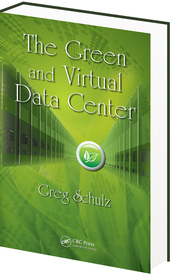
These and other related themes are expanded on in more detail in my book "The Green and Virtual Data Center" (CRC). These and other related themes will covered in one of my upcoming presentations (The Other Green — Storage Efficiency and Optimization) at StorageDecisions in Chicago the week of June 1st, 2009, as well as in various seminars and events that I will be involved in the coming weeks and months.

Thanks to all those who helped organize, support, sponsored, presented and attended the recent CMG event, look forward to seeing or hearing from you all again soon.

Ok, nuff said.

Ok, nuff said.

Cheers gs

Greg Schulz – Author Cloud and Virtual Data Storage Networking (CRC Press), The Green and Virtual Data Center (CRC Press) and Resilient Storage Networks (Elsevier)
twitter @storageio

All Comments, (C) and (TM) belong to their owners/posters, Other content (C) Copyright 2006-2026 Server StorageIO and UnlimitedIO LLC All Rights Reserved

On The Road Again: An Update

A while back, I posted about a busy upcoming spring schedule of activity and events, and then a few weeks ago, posted an update, so this can be considered the latest "On The Road Again" update. While the economy continues to be in rough condition and job reductions or layoffs continuing, or, reduction in hours or employees being asked to take time off without pay or to take sabbaticals, not to mention the race to get the economic stimulus bill passed, for many people, business and life goes on.

Airport parking lots have plenty of cars in them, airplanes while not always full, are not empty (granted there has been some fleet optimization aka aligning capacity to best suited tier of aircraft and other consolidation or capacity improvements). Many organizations cutting back on travel and entertainment (T&E) spending, either to watch the top and bottom line, avoid being perceived or seen on the news as having employees going on junkets when they may in fact being going to conferences, seminars, conventions or other educational and related events to boost skills and seek out ways to improve business productivity.

One of the reason that I have a busy travel schedule in addition to my normal analyst and consulting activities is that many events and seminars are being scheduled close to, or in the cities where IT professionals are located who might otherwise have T&E restrictions or other constraints from traveling to industry events, some of which are or will be impacted by recent economic and business conditions.

Last week I was invited to attend and speak at the FujiFilm Executive Seminar, no private jets were used or seen, travel was via scheduled air carriers (coach air-fare). FujiFilm has a nice program for those interested in or involved with tape whether for disk to tape backup, disk to disk to tape, long term archive, bulk storage and other scenarios involving the continued use and changing roles of tape as a green data storage medium for in-active or off-line data. Check out FujiFilm TapePower Center portal.

This past week I was in the big "D", that’s Dallas Texas to do another TechTarget Dinner event around the theme of BC/DR, Virtualization and IT optimization. The session was well attended by a diverse audience of IT professionals from around the DFW metroplex. Common themes included discussions about business and economic activity as well as the need to keep business and IT running even when budgets are being stretched further and further. Technology conversations included server and storage virtualization, tiered storage including SSD, fast FC and SAS disk drives, lower performance high capacity "fat" disk drives as well as tape not to mention tiered data protection, tiered servers and other related items.

The Green Gap continues to manifest itself in that when asked, most people do not have Green IT initiatives, however, when asked they do have power, cooling, floor-space, environmental (PCFE) or business economic sustainability concerns, aka, the rest of the Green story.

While some attendees have started to use some new technologies including dedupe technology, most I find are still using a combination of disk and tape with some considering dedupe for the future for certain applications. Other technologies and trends being watched, however also ones with concerns as to their stability and viability for enterprise use include FLASH based SSD, Cloud computing and thin provisioning among others. Common themes I hear from IT professionals are that these are technologies and tools to keep an eye on, or, use on a selective basis and are essentially tiered resources to have in a tool box of technologies to apply to different tasks to meet various service requirements. Hopefully the Cowboys can put a fraction of the amount of energy and interest into and improving their environment that the Dallas area IT folks are applying to their environments, especially given the strained IT budgets vs. the budget that the Cowboys have to work with for their player personal.

I always find it interesting when talking to groups of IT professionals which tend to be enterprise, SME and SMB hearing what they are doing and looking at or considering which often is in stark contrast to some of the survey results on technology adoption trends one commonly reads or hears about. Hummm, nuff said, what say you?

Hope to see you at one of the many upcoming events perhaps coming to a venue near you.

Cheers gs

Greg Schulz – Author Cloud and Virtual Data Storage Networking (CRC Press, 2011), The Green and Virtual Data Center (CRC Press, 2009), and Resilient Storage Networks (Elsevier, 2004)

twitter @storageio

All Comments, (C) and (TM) belong to their owners/posters, Other content (C) Copyright 2006-2012 StorageIO and UnlimitedIO All Rights Reserved

Green Power and Cooling Tools and Calculators

In the course of doing research and consulting work with various IT organizations, VARs, trade groups and vendors over the past couple of years, not to mention in preparing for my new book "The Green and Virtual Data Center" (Auerbach), I have come across (see a list here) several tools, calculators and modeling or sizing utilities pertaining to power, cooling, floor-space, EH&S (PCFE) also known as green topics.

Many vendors and organizations including APC, Dell, EMC, Emerson, IBM, HP and Sun among others have various types of green and related calculators in support of PCFE, performance and related sizing activities. These and other tools differ in what information they provide as well as the level of detail and configuration information, however, the tools are also evolving. As an example, EMC blogger Mark Twomey aka Storagezilla has a new post discussing an updated version of their updated calculator that is now web based tool for PCFE and green sizing.

Ok, nuff said.

Cheers gs

Greg Schulz – Author Cloud and Virtual Data Storage Networking (CRC Press), The Green and Virtual Data Center (CRC Press) and Resilient Storage Networks (Elsevier)
twitter @storageio

All Comments, (C) and (TM) belong to their owners/posters, Other content (C) Copyright 2006-2026 Server StorageIO and UnlimitedIO LLC All Rights Reserved